Warning! book length essay – 26,689 words
“The starting-point of critical elaboration is the consciousness of what one really is, and is ‘knowing thyself’ as a product of the historical process to date which has deposited in you an infinity of traces, without leaving an inventory. Therefore it is imperative at the outset to compile such an inventory.”
Antonio Gramsci, Prison Notebooks, Q11-12
I. “What is wrong with Sligo people?” “Why do they resist progress so much?”
The question was asked of me directly, more than once, by a person who had moved to Sligo from elsewhere (Galway i think) and had spent years working in the local authority. They had never come to terms with what they perceived as the town’s opposition to progress, its resistance to development schemes, its tendency to frustrate the well-intentioned efforts of those trying to improve it. They asked the question with genuine puzzlement, not malice. They could not understand the place. Why were these people, in this town, so determinedly difficult? Why were they against progress?
The question deserves an answer. The answer is not the one the questioner expected, and it is not flattering to the official narrative of the country in which the question is being asked. But it is the answer that the historical evidence forces upon anyone who actually examines it, and the purpose of this article is to lay out that evidence and follow it where it leads.
In 2013, the Fine Gael and Labour government abolished Sligo Borough Council. The council had accumulated a debt of approximately €94 million, much of it incurred through land purchases at top-of-market prices during the Celtic Tiger years. Phil Hogan, then Minister for the Environment, observed that “Sligo is certainly one of the reasons we are reforming local authorities.” It was a striking statement. It was also a misleading one: the debt had been accumulated by the County Council, not by the Borough. What the reform actually achieved was the abolition of a different democratic institution — one that had existed in various forms since 1613, that had survived four hundred years of political upheaval, and that had nothing to do with the financial mismanagement being cited as justification for its removal. The wrong body was abolished. Democratic representation was reduced rather than restored. The reformers proceeded anyway.
This was a small administrative event, easily overlooked, easily justified in the language of necessary modernisation. But it was also an indicator of something larger. It was the latest in a long series of decisions, stretching over decades, in which the Irish state had responded to Sligo’s difficulties by removing capacity rather than adding it. Services rationalised; routes closed; institutions consolidated elsewhere; investment directed to other regions; democratic structures abolished. The pattern was so consistent that it could not reasonably be attributed to unfortunate coincidence. It was, evidently, something else.
The European Union, in its periodic regional assessments, classifies the Northern and Western region of Ireland as a “lagging region.” This is technical language: it indicates an area whose economic performance falls significantly below both the national and EU averages, attributable to long-term underinvestment in regional infrastructure. The classification is not contested by the Irish state. The data behind it — GDP per capita, infrastructure density, transport connectivity, broadband penetration, healthcare access, third-level education attainment, demographic stability — are consistent across all measures. By every objective indicator, the region of which Sligo is a central town is one of the most chronically underdeveloped parts of Western Europe.
What is contested, or rather what is not addressed at all, is the explanation. Official descriptions, when they exist, are in the passive voice. There has been underinvestment. Services have been rationalised. Demographic factors have produced unfavourable outcomes. The phrasing treats the situation as the cumulative product of impersonal forces operating on a region that simply, somehow, mysteriously ended up disadvantaged. The active subjects who made the relevant decisions — the ministers, the civil servants, the agencies, the bodies that allocated the funding and routed the rail lines and located the hospitals and designated the universities — disappear from the account. So does the question of why they made the decisions they did.
This passive-voice account is not, in fact, satisfactory. The region in question is not an isolated, resource-poor periphery in the way that some European peripheries are. It contains more land area than the east coast, albeit a lot of it not great agricultural land admittedly. It has three international airports — Shannon, with the only US customs pre-clearance facility in Europe; Knock, one of the fastest-growing airports in Ireland; and Derry, providing exactly the kind of cross-border connectivity that EU policy actively prioritises. It contains the largest natural harbour in the British Isles, at Cork. It has a distributed regional university, Atlantic Technological University, with campuses stretching from Letterkenny to Galway. It has nineteenth-century intermodal port infrastructure at Sligo that aligns precisely with EU coastal shipping policy. It has substantial agricultural, fisheries, tourism, and renewable energy and water resources. By any objective measure, this is a region that could be thriving.
It is not thriving. It is, instead, the region that has been emptying out for over a century, generation after generation, as its young people leave to find in Dublin, in Britain, in North America, in Australia the opportunities that are not provided at home. The Greater Dublin Area now contains over forty per cent of the national population and continues to grow at a rate that has produced one of the most acute housing crises in Europe. The northwest continues to lose people. The infrastructure that might allow it to develop independently is not built. The Western Rail Corridor, the proposed restoration of the existing Atlantic seaboard rail line connecting Cork through Limerick, Galway, and Sligo to Derry, has been blocked for over fifteen years through a documented sequence of administrative obstructions, despite available EU funding and a strong economic case. The museum that Sligo town has been trying to establish since the 1950s remains unrealised, more than seventy years after the project was first proposed. The Borough Council, as we have seen, was abolished in 2013.
A pattern of this consistency, repeated across this many dimensions of state activity, over this length of time, requires an explanation. The pattern itself is the data; the explanation has not been provided. A substantial body of writing — investigative journalism, policy analysis, community advocacy — now documents the symptoms in considerable detail. What none of this writing does, with any rigour, is provide the underlying cause. The implicit theory has been that the symptoms are a series of independent failures, each individually explicable in technical terms, that have cumulatively produced an outcome no one explicitly intended. This article will argue that the implicit theory is wrong. The symptoms are not independent. They follow a pattern. The pattern has a structural source. The source can be identified, and once identified, it explains not only the specific case of Sligo but the broader phenomenon of which Sligo is the most acute and most visible instance.
The source is historical. It is not, however, the history that most readers will expect. The conventional history of post-independence regional inequality in Ireland is told in terms of geographical disadvantage, economic adjustment after the rupture of partition, the slow modernisation of an underdeveloped agrarian economy, and the comparatively recent shift toward concentrated urban service economies. This conventional account is not wrong about the symptoms it describes, but it is wrong about their causes. The actual causes lie much deeper, in cultural and institutional patterns that were established in medieval Ireland, consolidated through the centuries of English colonial rule, and — most consequentially — were not dissolved but were preserved and given new institutional form at independence in 1922. The post-independence Irish state is not, structurally, what its official narrative claims it to be. Once one sees what it actually is, the pattern of regional inequality becomes immediately and completely explicable.
Seeing what the state actually is requires, first, seeing what its constituent populations actually are. It requires accepting that there are not, and never have been, “the Irish” as a single cultural formation, but rather several Irelands with distinct historical trajectories whose relationships with each other have shaped the political development of the country since the thirteenth century. It requires recognising that the religious vocabulary in which Irish history is conventionally narrated — Catholic Ireland against Protestant Ireland, native against settler, Irish against English — obscures more than it reveals about the actual cultural fault lines, which are not religious in origin and are not adequately described in religious terms. It requires reading the period 1916–1923 not as the culmination of the Irish revolutionary tradition but as something quite different and considerably less straightforward.
And, finally, it requires looking at Sligo itself with new eyes. Sligo is not a peripheral town that has somehow failed to keep up with national development. Sligo is the most acute case of a structural pattern that operates wherever the post-independence state encounters a place or population that does not fit its cultural template. Once that pattern is understood, the apparent puzzle of Sligo’s chronic underdevelopment dissolves. The town’s condition is not anomalous. It is the predictable and necessary outcome of a framework that was constructed precisely to render places like Sligo — and the cultural traditions they represent — invisible to the state that nominally serves them.
To see this clearly, we must go back to the beginning. Not to 2013, or 1922, or even 1798. We must begin, where the relevant story actually begins, in 1245.
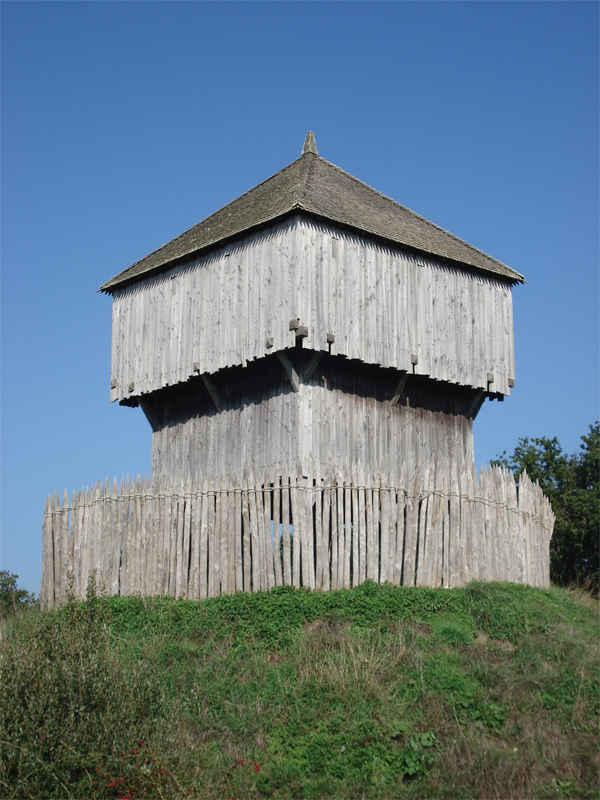
In that year, the Anglo-Norman magnate Maurice Fitzgerald — at the time one of the most powerful men in Ireland — and Feidlim Ó Conchobhair, King of Connacht, together founded a town on the south bank of the river Sligech, at the point where it spills out of Lough Gill toward the Atlantic. The location was deliberate. The river offered a natural defensive line. The lough behind it controlled the inland routes. The harbour ahead opened onto the western sea routes that linked Atlantic Ireland to Scotland, the Hebrides, and through them to Norway, and to the south towards Galway, France, and Spain. Whoever held this point held the gateway between the interior of Connacht and the wider Atlantic world.
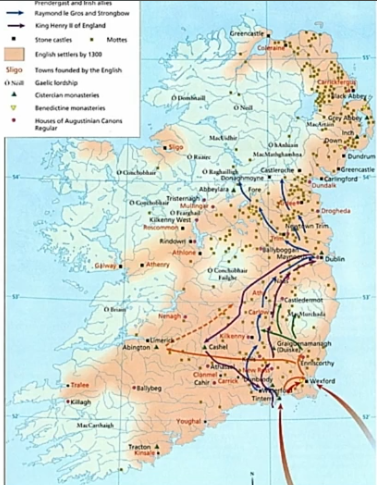
Sligo was the northern tip of a two point prong extending into Connacht from the bridgehead at Lough Ree. Here the Normans had finally organised the invasion of Connacht, 80 years after invading the east of the country. To make good these speculative grants of the English kings and especially the Pope, they had to enforce on the ground what was written in the documents.
At a promontory on the west side of Lough Ree the Normans set up the bridhead and supply depot, walling off the base of the peninsula to pretect it. From there one line adbanced southwest towards Galway, founding Athenry and Galway that were to remain in Engliush hands. The second line ran northwest, a chain of castles including Ballymote, hitting the coast at Sligo. From the two seaports at each end of Connacht the Normans could resupply by ship without trying to conquer the vast mountainous districts of western Connacht. All they had to do was hold them.
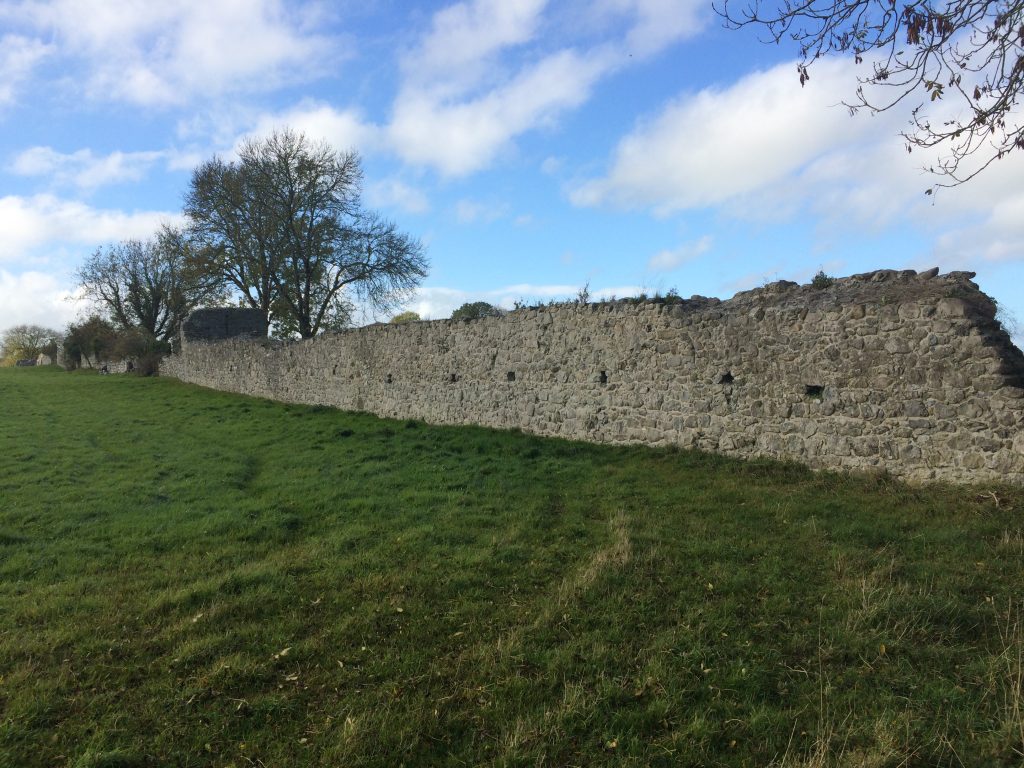
The town that rose on the river bank at Sligo followed the standard continental medieval template: a Dominican friary, a market cross, a castle, a hospital, and a port. This was urbanism in the European sense — the kind of integrated commercial-religious-military settlement that the Normans had built across England, France Wales, Sicily, the Levant, and the Atlantic seaboard wherever they went. By the standards of thirteenth-century Connacht, where the indigenous settlement pattern remained dispersed and clan-based, it was a remarkable imposition.
What is too often forgotten is that it was a joint imposition. Maurice Fitzgerald and Feidlim Ó Conchobhair did not found Sligo as conqueror and conquered. They founded it (ostensibly)as allies. The same king of Connacht had welcomed Norman builders into his territory because Norman engineering, Norman fortifications, and Norman commercial reach offered things the Gaelic political economy could not yet provide. Sligo, from the moment of its foundation, was a hybrid: a continental town built on a Gaelic invitation. This hybrid character would shape everything that followed. Although as the annals mention, Fitxgerald slyly gathered stone for the agreed upon hospital, only to arrive and switch the building materials to a castle at the last minute, catching the Irish king by surprise.
The Collapse of Norman Control
The Norman lordship over Sligo was brief. Within twelve years of the founding, in 1257, Maurice Fitzgerald was dead after the Battle of Credran-Cille, (near modern Rosses point) killed in a Gaelic counter-attack at the northern fringe of his own lordship. The Fitzgeralds held on for another generation under his nephew Maurice fitz Maurice — known to the annalists as Muiris Maol, “Maurice the Bald” — but by the death of Muiris Maol in 1286 the position was already untenable. Three powers were converging on north Connacht: the Fitzgeralds themselves, increasingly absentee; the de Burghs, the rising Anglo-Norman earls of Ulster and lords of Connacht; and the various branches of the Uí Chonchobhair, the royal family of Connacht, now fragmented into competing dynastic lines. The Normans had more luck along the coast in Tireragh and towards modern Mayo, ousting the O’Dowds for a time, but by the 1350s at the latest they had either intermarried and become absorbed or were driven out of the area and Gaelic chiefs re-estanlished control of the coastline.
The years between 1286 and 1310 were chaotic. As Katharine Simms has reconstructed from the annals, the lordship of Sligo became a contested borderland in a four-cornered conflict involving the Fitzgeralds, the de Burghs, the O’Donnells of Tír Conaill pressing down from the north, and the Clan Murtagh O’Conors pressing up from the south. Kings were made and unmade in months. Cathal Ruadh O’Conor took the kingship of Connacht in 1293 and was assassinated within three months. Aodh son of Eoghan O’Conor was deposed by his own Gaelic vassals in 1294 and reinstated by the English justiciar within months. The whole region, in the half-century after Maurice Fitzgerald’s foundation, was in a state of permanent succession crisis. The one effect the Normans did have in Connacht was to destabilise it – the Kings of Connacht never really reestablished proper authority, instead fracturing into rival dynasties.
This was the wider context for what happened in 1310, the date that fixes Sligo’s medieval fate. Richard de Burgh, the Red Earl of Ulster — by then the dominant Anglo-Norman magnate of the entire north and west of Ireland — undertook a serious effort to consolidate his control over Sligo. He rebuilt the castle, which had been allowed to decay, and attempted to bring the surrounding territory back under his lordship. It was the last serious Anglo-Norman attempt to hold the place.
It failed. Within a generation the de Burgh interest in Connacht itself was disintegrating, undone by the assassination of William, the Brown Earl, in 1333 and the civil war between the Mayo and Galway branches of the family that followed. Sligo passed into the hands of the Ó Conchobhair Sligigh — a Gaelic branch descended from the royal line of Connacht — and remained there.
The Wider Recession
What happened at Sligo between 1267 and 1333 was not an isolated regional setback. It was part of a much larger pattern. The Norman colonisation of Ireland had reached its high-water mark in the second half of the thirteenth century, and from about 1300 onwards it began to retreat. Town after town, lordship after lordship, was lost to Gaelic recovery. The Bruce invasion of 1315–1318 accelerated the process; the Black Death of 1348–49 finished it off in many places. By the early sixteenth century, English officials were complaining that the walled towns of the Pale could only communicate with each other by sea, because the Gaelic Irish had retaken almost all the land between them.
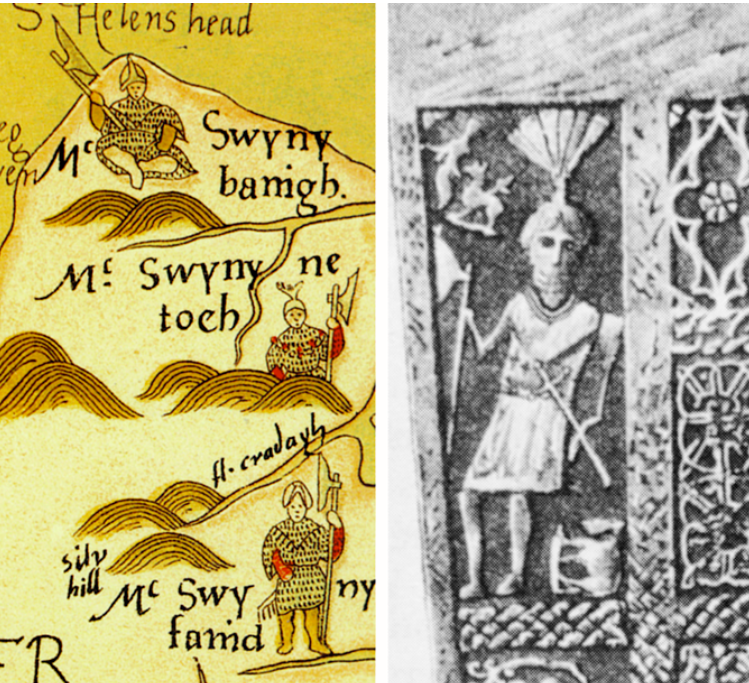
One reason for this retreat of the Normans was the arrival into the west of heavy infantry – the armoured Galloglas – Gaelic-Norse warriors with an origin of a fightlig style in Western Scotland, but who proved effective in countering the Norman heavy armoured horsemen who wrought such devastation on the battlefileds of Europe. Here, combined with the terrain, and the traditional Irish light infrantry known as Ceatharna or Kern, the Normans were stopped in their tracks and gradually retreated or were absorbed into the Gaelic world.
Sligo was part of this recession. But Sligo was unusual in two respects, and these two anomalies are the foundation of everything that follows.
The first anomaly is geographical. Most Norman towns lost in the recession either vanished or were absorbed into the surrounding Gaelic countryside, reverting to dispersed patterns of settlement. Rindoon is the textbook case — the walled town on a peninsula jutting into Lough Ree, founded as a bridgehead during the invasion of Connacht, by the fifteenth century a ruin. Athenry survived as a Norman town but only by remaining tightly Norman, walled, English-speaking, isolated. The general rule was that when Norman control collapsed, urbanism collapsed with it.
Sligo did not follow this rule. The town survived. The friary continued to function and continued to attract burial endowments from the surrounding Gaelic nobility — a sign of ongoing wealth and institutional continuity. The port continued to operate, exporting hides and fish, importing wine and salt. The castle was repaired and held, changing hands frequently but never abandoned. The market continued. The street pattern, identifiable on the earliest surviving maps, preserves the medieval layout to this day.
Why did Sligo survive where Rindoon did not? The most likely answer is geographical and political. Sligo sat at the southwestern edge of the Gaelic zone that included Tír Conaill (Donegal), Tír Eoghain (Tyrone), and the wider Ulster lordships. This zone was never effectively conquered by the Normans in the first place. After 1300 it became the great unconquered redoubt of Gaelic Ireland. Sligo’s proximity to this redoubt — its position as the southern gateway into and out of it — gave it a strategic value that could be defended. The Ó Conchobhair Sligigh, the O’Donnells, and the O’Neills all had reasons to keep the port functioning and the town viable. Rindoon, perhaps just wasnt situated on a traditional route, and stands now as one of the very strangest and most unique sites in Europe, a full town laid out for occupation but abandoned shortly after.
The abbey mattered too. The Dominican friary at Sligo was not just a religious institution; it was an administrative, economic, and educational hub. Friaries of this kind, in this period, functioned as something like medieval universities, hospitals, and archives all at once. They were international institutions, plugged into networks that ran from Spain to Poland. The Sligo Dominicans were patronised by Gaelic chiefs who endowed the friary, were buried in its grounds, and used it as a meeting place. The friary gave the town a continuity that did not depend on whoever was sitting in the castle in any given year.
The Anomaly Within the Anomaly
The second anomaly is what makes Sligo not just exceptional among Norman foundations but exceptional within the Gaelic world itself. After the Norman recession, most of what is now western and northern Ireland reverted to a non-urban, pastoral, political economy. Cattle were the medium of wealth. Movement was seasonal. The dominant settlement form was the ringfort or the unfortified clachan, not the town. Cities and large towns were, by the fifteenth century, a feature of Old English Ireland — Dublin, Drogheda, Kilkenny, Waterford, Cork, Limerick, Galway, Athenry — not of Gaelic Ireland.
Sligo violated this pattern. It remained a town under Gaelic governance. The Ó Conchobhair Sligigh ruled it as a Gaelic dynasty but operated it as a continental city. This combination was rare to the point of being almost unique. It is the central historical fact about medieval Sligo, and it explains everything that comes after.
The evidence for the town’s continued urban functioning is not abundant, because the Gaelic world did not produce the same density of administrative records that the English colonial system did. The annals — the great Gaelic chronicles compiled by hereditary historians attached to noble households — record what they considered worth recording: battles, dynastic successions, deaths of nobles, occasional natural disasters. They are not municipal records. But what they do record about Sligo, together with the surviving archaeological evidence, is enough to establish that Sligo was something other Gaelic regions did not have: a small, but working medieval city.
An idea of its culture can be gleaned from an incident recorded in the early 16th century of a Dublin merchant travelling to Sligo overland, presumably with pack-horses to sell his wares, who then before he left purchased the rights to poem from local poets – which turned out to have already been sold to someone else. We know of this because the merchant complained and was brought before Oconnor Sligo who restored the merchants 10 pounds he had paid and gave him ten more for his trouble. Presumably the sellers were tracked down by O’ Connor afterwards!. This shows us though what the place was known for – and interestingly that such poems could command prices and value even within the Pale.
However, perhaps the most telling evidence is the books.
The Manuscript Wealth
Making a manuscript in fifteenth-century Ireland was an enormous undertaking. Vellum had to be prepared from calf skins — perhaps two hundred animals for a substantial codex. Pigments had to be sourced, some of them imported from continental suppliers and worth their weight in silver. A trained scribe might take a year to copy a major text; an illuminator longer. The work required a secure space, sustained patronage, access to source texts that themselves had to be copied or borrowed from other patrons’ libraries, and the kind of long-term political stability that would allow such an investment to be safely completed.
Most of Gaelic Ireland after 1400 could not afford this. The pastoral economy generated enough wealth to support warrior aristocracies, hereditary professional families, and modest courts, but not enough surplus, and not enough security, to sustain large-scale manuscript production. Where the great manuscript collections were assembled, they were assembled in a handful of places where unusual concentrations of wealth and stability allowed it.
Sligo and its hinterland was one of these places. The Ó Conchobhair Sligigh, the MacDonnchadha, the O’hEadhra and O’Dubhda, drawing revenues from the port and from the agricultural surplus of north Connacht, were among the most consistent manuscript patrons of late medieval Gaelic Ireland. The clearest single piece of evidence for this is the history of the Lebor na hUidre, the “Book of the Dun Cow” — the oldest surviving manuscript in the Irish language, written at Clonmacnoise around 1100. In 1359, after a defeat in battle, Seaán O’Donnell of Tír Conaill was compelled to hand over the Lebor na hUidre to Cathal Óg O’Conor of Carbury as part of the ransom for two hostages. The fact that the book could function as ransom — and that the O’Conors of Carbury immediately commissioned the scribe Siograidh Ó Cuirnín in 1380 to restore its faded script — tells us something about the cultural priorities and the disposable wealth of Gaelic Sligo. A century later, in 1470, Aodh Ruadh O’Donnell took Sligo castle and recovered the manuscript, an event so important to him that it was inscribed into the manuscript itself. Books, in this region, in this period, were treated as objects of dynastic value comparable to land.
The wider regional pattern bears this out. The Book of Ballymote and the Book of Lecan, two of the great compendia of Gaelic learning, were both produced in the Sligo region in the late fourteenth and early fifteenth centuries, the work of the hereditary historian families — the MacFhirbhisigh, the Ó Cuirnín, the Ó Maolchonaire — who served the local Gaelic nobility. The scribal tradition was so deeply rooted in Sligo that it continued long after the medieval Gaelic order had been destroyed: as late as the eighteenth century, a scribe was still working in High Street in Sligo town, compiling the Leabhar na nGenealach. The town’s manuscript culture outlived the political order that had created it by more than a century.
This matters because it tells us something about what kind of place Gaelic Sligo actually was. It was not a backward outpost of pastoral subsistence. It was a regional capital with the wealth, the institutions, and the political stability to sustain one of the most demanding forms of intellectual production known to its world. Other Gaelic areas of comparable population could not do this. Sligo could.
The Three Hundred Years
The Gaelic city lasted, by any reasonable accounting, from the failure of de Burgh’s reconquest around 1310 until the Tudor conquest in the 1590s. Almost three centuries. Twelve generations.
That is a long time. It is a century longer than the United States has existed as a country. During those three centuries, Sligo was a working town, governed by Gaelic dynasties, operating in the Gaelic political and legal order, but maintaining continental urban forms — port, friary, market, castle — and supporting a culture of learning that produced some of the most important manuscripts in the Irish tradition. The Ó Conchobhair Sligigh were not provincial chiefs imitating something they did not understand. They were running a city. They had been running it for generations. By the time the Tudor armies arrived at the end of the sixteenth century, Sligo had been a Gaelic city for longer than it had been anything else. When Henry Sidney arrived in SLigo in 1567 he reported that
“the castle is fair and the greatest of any that we have seen in an Irishmans posession. It standeth upon a good haven and hath been full of merchants houses, all of which are now disinhabited and in ruins. Therein is a large monastery of Whitefriars and a bishops palace. “
The end came, as all such endings came in sixteenth-century Ireland, in violence. The Nine Years War, which began as a confederation of Gaelic lordships under Hugh O’Neill in 1594 and ended with the surrender at Mellifont in 1603, devastated the entire Gaelic north and west. English commanders under Lord Mountjoy pioneered what would now be called total war: burning crops, slaughtering cattle, deliberately starving civilian populations. The pastoral economy that had sustained Gaelic Ireland for a thousand years was systematically destroyed. By the end, contemporary accounts describe Irish populations reduced to eating grass and carrion. The Flight of the Earls in 1607 — when the great Ulster lords abandoned their territories for continental exile — completed the political defeat.
Sligo was caught in this destruction. The town was burned and rebuilt more than once during the war. The Ó Conchobhair Sligigh were broken as a ruling dynasty. By the time James I issued the borough charter to a reconstituted Sligo in 1613, the three-hundred-year-old Gaelic city had been effectively annihilated. The borough that replaced it was a colonial creation, a node in the new English administrative system, no longer connected to the dynastic and ecclesiastical networks that had sustained the older town. The continuity of place was preserved — the same river, the same harbour, the same friary site, even some of the same street lines — but the continuity of political and cultural life had been broken.
The three hundred years were over.
But their consequences were not. Three hundred years of Gaelic urban life had created something that did not exist anywhere else in Ireland: a population, a regional culture, a sense of what was possible, that had developed outside the framework of Old English colonial urbanism and outside the framework of pastoral Gaelic ruralism. When the colonial system arrived in seventeenth-century Sligo, it arrived in a place that already had three centuries of its own urban memory. That memory shaped everything that followed.
It is to those consequences that we now turn.
But in another sense, the destruction was only the beginning. What had happened to the Gaelic city in the 1590s would, over the following three hundred years, be done to Gaelic Ireland as a whole — first by the British colonial system, and then, in a different way, by the population that succeeded the British. And this second process — the slow, structural, often invisible reconfiguration of Irish cultural identity in the nineteenth and early twentieth centuries — is the one that explains how the cultural fault lines O’Sullivan Beare had described in 1618 came to be obscured rather than acknowledged in the modern Irish state. It is also what explains why a town like Sligo, with its unusual configuration of surviving and inherited identities, would end up structurally illegible to the state that emerged after 1922.
To see how this happened, we have to follow the long arc from the destruction of Gaelic Sligo through the famine, the Catholic emancipation, the romanticisation of the dying west, and the construction — in the second half of the nineteenth century — of a wholly new Irish identity that bore little real relationship to the actual cultural traditions it claimed to represent.
The Plantation Aftermath in Sligo
The Sligo that received the borough charter in 1613 was not a planted town in the Ulster sense. The Ulster Plantation, organised after the Flight of the Earls, involved the systematic settlement of Lowland Scots and English colonists onto confiscated lands across the northern six counties. Sligo received no comparable programme. The seventeenth-century arrivals — soldiers granted land after the Cromwellian campaigns of the 1650s, Williamite veterans after 1690, and the steady drift of merchant and professional settlers who came in their wake — were less systematic, less concentrated, and less ideologically driven than the Ulster planters. They came as opportunists into a region that had been broken open by conquest, and they settled where the opportunities were.
What they encountered in Sligo was a town that had lost its old elite but retained its physical and commercial infrastructure. The port still worked. The friary site still drew local devotion. The street pattern, the harbour, the agricultural hinterland — all remained productive. What was missing was the indigenous urban middle class that, in other Irish towns, would have absorbed the new settlers into existing social structures over generations. Sligo had had no Old English Catholic middle class to begin with, and the Tudor conquest had eliminated whatever indigenous mercantile elite the Gaelic city had supported. The new Protestant settlers, by default, became Sligo’s middle class. There was no other.
This was the structural inheritance that would shape everything that followed. Across most of the Old English towns — Dublin, Drogheda, Kilkenny, Cork, Limerick, Galway, and the rest — the seventeenth-century Protestant settlers arrived into towns where a Catholic mercantile elite already existed and where, despite the penal laws, that elite would survive as a parallel commercial class. The two communities would coexist and eventually merge in commercial life, with the Old English Catholic merchants gradually re-emerging as the dominant local force after Emancipation. In Ulster, the rural plantation produced a different pattern: a smallholding Protestant population alongside dispossessed Gaelic tenants, with no significant Catholic middle class until the late nineteenth century. Sligo combined features of both patterns and was identical to neither. It had an urban Protestant middle class — small relative to the urban populations of the planted Ulster towns, large relative to the tiny Protestant minorities of the Old English towns — and almost no Catholic middle class at all. A situation that will become very important later.
This unusual configuration would persist, with modifications, into the twentieth century. It is the foundation of everything that follows.
The Penal Era and the Cultural Inheritance That Survived
The eighteenth century in Ireland is usually described as the Penal Era — the period during which a series of laws systematically restricted Catholics from owning land above a certain value, holding public office, practising law, serving in the army, voting in parliamentary elections, or educating their children abroad. The penal laws were enforced with varying intensity in different periods and different places, and the modern historiography has generally moved away from the older nationalist account that treated them as a uniform programme of religious oppression. But what is undisputed is that throughout the eighteenth century, the Catholic Irish — both Old English Catholic and Gaelic Catholic — were excluded from formal political and economic power, while the Protestant Ascendancy consolidated its ownership of the land and its control of the institutions of state.
What this concealed, however, was the survival of distinct cultural formations within the Catholic population. The Old English Catholics, concentrated in the towns of the old Pale and the southern walled towns, maintained their distinctive features through the penal era: English language as their first language, urban commercial orientation, continental Catholic religious practice, networks that connected them to Catholic merchants across Europe. They sent their sons to be educated in France, Spain, and the Low Countries. They maintained marriage networks within their own community. They preserved, as the central marker of their identity through this period of exclusion, their Catholic faith — but it was a specific kind of Catholicism: continental, post-Tridentine, hierarchical, sacramentally focused, organised around the parish and the clergy in the model that had been consolidated by the Council of Trent.
This was not the only Catholicism in Ireland. The Catholicism of the Gaelic-speaking countryside, which had survived the Tudor and Cromwellian destructions in the form of an underground hedge-school clerical culture and a network of patrons of native saints, was quite different. It was less hierarchically organised, more locally embedded, more integrated with pre-Christian elements that had never been fully suppressed by the medieval Gaelic Church. Holy wells, pattern days, pilgrimages to ancient sites, devotion to local saints who were often barely distinguishable from earlier pagan figures — these were the substance of the Catholicism that the Gaelic countryside had maintained through centuries of formal repression.
It was a Christianity that bears comparison, in its locality, its fusion with the pre-existing religious landscape, and its lack of strong central institutional control, with Japanese Shinto. The comparison is unusual and requires defence. Most of the cultures conventionally used to illuminate Ireland — Anglican England, the Catholic continent, post-Reformation Scotland, Norman France — are cultures shaped by strong central religious authority operating through systematised doctrine. They are useful for measuring Ireland by what Ireland was not. The Catholicism of Gaelic Ireland, like the Shinto of Japan, was something else: a religion held in the practice of the people, in landscape and season and kinship and local saint, rather than in the writ of an episcopate or the consensus of a curia. The bishops, when they were present in Gaelic Ireland at all, often had only nominal authority over the actual religious life of the people. Whatever doctrinal communion existed with Rome existed at a great institutional distance, mediated by hereditary church families and local custom rather than by parish priests answering to a chancery.
The Irish-born Japanologist Lafcadio Hearn — who arrived in Japan in 1890 with a sensibility shaped, as it turns out, by his Connacht nanny rather than by his Protestant Anglo-Irish family — saw the structural parallel directly and drew on Irish material throughout his Japanese writings: Glimpses of Unfamiliar Japan (1894), In Ghostly Japan (1899), and his late synthesis Japan: An Attempt at Interpretation (1904). The biographical detail is worth pausing on, because it pins Hearn’s comparative insight to the actual cultural region this article is concerned with. Hearn’s early imagination was formed by Catherine Costello, a native Irish-speaking woman from Cong, Co. Mayo, who introduced the child to folk Catholicism, fairy lore, and the pishogues and ghost stories of the western Gaelic world. Costello’s transmission was the channel through which Hearn — by background a member of precisely the cultural formation that would have marginalised her — encountered the actual living religious imagination of Gaelic Ireland. His central observation about Japan, that Shinto “lived not in books but in Japanese people’s hearts,” applies equally to the world Costello had given him. Both were religions of place, ancestor, season, and local saint; both were syncretic to a degree that scandalised the missionaries of more systematised traditions; both had survived institutional weakness because they did not depend on institutions in the first place.
It is worth noting, while we are with Hearn, that the body of work he produced from Costello’s gift became foundational to modern Japanese self-understanding and is honoured annually at the Lafcadio Hearn Memorial Museum at Matsue. Kwaidan, his most influential collection, was not translated into Irish until 2018. The Connacht woman whose folklore reached Tokyo through Hearn’s hand had no easy route to reach the Gaeltacht through her own. The pattern by which Gaelic Irish material is recognised abroad while remaining marginal at home is not specific to Hearn; it runs through the entire post-1922 cultural history of the country, and it is one of the structural consequences of the cultural framework this article is attempting to describe.
The parallel between the two religious cultures is not identity, but the differences are themselves illuminating. Japan, too, received an imported elite religion: Buddhism arrived from Korea in the sixth century, brought there from China and originally from India, and it was thoroughly foreign in its texts (classical Chinese), its concepts, its clergy, and its aesthetics. The Japanese imperial court adopted it. Prince Shōtoku in the seventh century, and the great state Buddhism of the eighth-century imperial capitals at Nara and Kyoto, were the products of elite conversion to a foreign creed.
But Buddhism in Japan did not displace Shinto. Instead the two entered into a syncretic relationship that defined Japanese religious life for over a thousand years — Shinbutsu-shūgō, the syncretism of kami and buddhas. Kami were understood as local manifestations of buddhas, or buddhas as universal forms whose Japanese local manifestations were the kami. Shrines and temples shared sites and personnel. Priests moved between traditions. Rural folk religion combined elements of both with much older devotional practices. The formal separation of Shinto from Buddhism, shinbutsu bunri, was a Meiji-era state project of the 1860s, not an organic religious development. For most of recorded Japanese history, “religion” was an integrated Buddhist-Shinto-folk complex with no sharp internal boundary.
The Irish case followed a similar trajectory until much earlier, and was broken by different means. Christianity arrived in Ireland in the fifth century. It encountered an existing devotional landscape — holy wells, sacred groves, calendar festivals, cults of place and ancestor — that it did not displace but absorbed. The medieval Gaelic Church, like medieval Japanese religion, operated as a syncretic settlement in which the imported elite religion and the indigenous folk substrate merged rather than competed. Local saints often inherited the attributes of pre-Christian deities. Holy wells continued to be venerated under new dedications. The brehon legal order persisted alongside canon law. The hereditary clerical families that ran the major monasteries were as much a feature of the older Gaelic social order as of Roman Christianity.
What is striking, then, is not that the two cultures had comparable religious forms — many traditional societies did — but that both maintained their syncretic settlements for over a millennium, and that the breaking of each was the work of a specific reformist project rather than the natural evolution of religious life.
Japan’s syncretism was broken by the Meiji state in the 1860s and 1870s, as part of the construction of modern Japanese nationalism. The new state needed a religion of national identity, distinct from Buddhism (which was tainted by association with the previous shogunal regime) and capable of supporting imperial ideology. State Shinto was the result: a deliberate, top-down disentangling of the syncretic complex, with Buddhism pushed back into a recognisably “religious” sphere and Shinto reconstituted as a national-cultural identity. It was an internal political project, carried out by the Japanese state itself.
Ireland’s syncretism was broken earlier and by an external project: the post-Tridentine Counter-Reformation Catholicism that arrived from the continent in the seventeenth century and consolidated itself through the eighteenth and nineteenth. The Counter-Reformation in Ireland sought, with substantial success, to discipline the holy wells, regulate the pattern days, control the local saints, suppress the hereditary clerical families, and replace them with seminary-trained priests answering to bishops who answered to Rome. The model was continental and centralising. Its institutional vehicle, after Maynooth was founded in 1795 and after Catholic Emancipation in 1829, was the rising Old English Catholic middle class — the population for whom this post-Tridentine, hierarchical, parish-centred Catholicism was the cultural marker of identity. The Gaelic syncretic Christianity was, to them, superstition. The reform of it was a civilising project — carried out by Irish Catholics against other Irish Catholics, but operating with cultural assumptions imported from the continent and aligned politically with the British administrative state that was simultaneously rationalising the country’s political-legal structures along similar centralising lines.
The interesting question is not “did Ireland have an indigenous religion?” but “what kind of religious culture was Gaelic Christianity, and what broke it?” The answer is that it was a syncretic settlement of the same general type as Japanese pre-Meiji religion, and it was broken by a reformist Catholic project that was, in religious terms, doing the same kind of work that the British administrative state was doing in political-legal terms: replacing localised, decentralised, customary structures with centralised, standardised, institutionally controlled ones. The post-Tridentine reformist Catholicism and the British centralising state were not the same thing, but they operated on the same kinds of objects and through similar logics. They worked, in their effects, in coordination.
Lafcadio Hearn’s Glimpses of Unfamiliar Japan repeatedly notices the survivals of the older syncretic settlement in the rural Japan of the 1890s — the holy mountains, the village shrines, the festival processions, the easy commerce between Buddhist and Shinto elements in the religious imagination of the people. His descriptions read, almost interchangeably, as descriptions of the rural Gaelic religious culture his Connacht nanny had given him as a child. The point is not that the two cultures were the same. The point is that they had the same structural form — syncretic, localised, decentralised, surviving institutional weakness because they did not depend on institutions — and that the standard European comparators do not describe this form. To see what Gaelic Ireland actually was, we need comparators that match its structural type. Japan is one. There are others indeed, the work of identifying them, and of seeing Gaelic Ireland clearly through them, is largely undone, and it is part of what an honest historiography of Ireland will need to take up.
These two Catholicisms — the post-Tridentine continental Catholicism of the Old English towns and the localised, syncretic, decentralised Catholicism of the Gaelic countryside — would later be conflated as “Irish Catholicism” in the official narrative. They were not the same thing. They were the religious expressions of two of O’Sullivan Beare’s three Irelands, and the relationship between them, through the eighteenth century, was one of mutual suspicion. The continental Catholic clergy regarded the rural devotional culture as superstitious and corrupt, badly in need of reform. The rural population regarded the educated continental clergy as foreigners who did not understand local religious life.
The Trigger: Catholic Emancipation
The political settlement of 1829, which removed the major civil disabilities on Catholics and allowed them to sit in parliament, hold office, and enter the professions, transformed the situation. It is conventionally read as the moment when “the Catholics” of Ireland began their rise to political and economic power. This reading misses the crucial fact that the population most positioned to benefit from Emancipation was specifically the Old English Catholic middle class. They were the ones who already had the English language, the urban commercial networks, the capital, the education, and the cultural orientation to step immediately into the spaces that opened up. The Gaelic Catholic population — rural, Irish-speaking, often impoverished, with no commercial or professional infrastructure — was not in a position to compete for these spaces. What Emancipation produced, in practice, was the rapid expansion of the Old English Catholic middle class across the country.
The decades after 1829 saw this class (and those able to make their way into this class, whatever their background) take over local government as it was successively reformed, dominate the Catholic professional and commercial life of every town, build the parliamentary Catholic political movement under O’Connell and his successors, and increasingly come to be identified, in both their own self-understanding and in the wider public discourse, as the Catholic Irish.
Their position would be changed by an event none of them had foreseen.
The Famine and the Collapse of the Gaelic West
The Great Famine of 1845–52 killed approximately one million people and drove another million into emigration, with both mortality and emigration concentrated overwhelmingly in the western and southwestern counties — that is, in the surviving Gaelic-speaking heartland. The famine did not affect Ireland uniformly. The Old English towns and the eastern counties suffered, but the catastrophe was disproportionately a catastrophe of the Gaelic west. Mayo, Sligo, Leitrim, Donegal, Galway, Clare, Kerry, west Cork and along the south Ulster belt— these were the counties where the population collapse was most severe and most permanent. By 1900, parts of the western Gaeltacht had less than half the population they had supported in 1841.
What this destroyed was not just demographic. It was cultural. The Gaelic language collapse, which had begun in the eighteenth century and accelerated through the early nineteenth, became precipitous after the famine. The hereditary professional families — the bards, the historians, the legal specialists — that had survived in attenuated form into the early nineteenth century lost their patrons and their audiences as the Gaelic-speaking population was destroyed. The devotional culture of the holy wells and pattern days continued, but it lost the demographic base that had given it institutional weight. The actual living tradition of Gaelic Ireland, which had been wounded by the Tudor conquest but had survived in modified forms for two and a half centuries afterwards, was largely finished by 1880.
It is important to be clear about what this means. The land of the Gaelic west was not depopulated. People still lived there. But the population that survived was a fragment, traumatised by mass death and emigration, increasingly English-speaking, increasingly disconnected from the older cultural forms. The Gaelic Ireland that had been a substantial cultural presence in 1840 had become, by 1900, a remnant — confined to scattered districts on the western fringe, watched by anthropologists and folklorists, materially impoverished, with no political weight and no institutional infrastructure of its own.
The land thus emptied was opened up to commercial exploitation in a way it had not been before. The post-famine decades saw the consolidation of large grazing farms across the west, the conversion of small subsistence holdings into pasture for the British market, the systematic clearance of the remaining Irish-speaking smallholders into emigration. Ireland became, in this period, one of the great cattle-export economies of the world. The economic transformation was as profound as the demographic one, and it benefited two groups in particular: those in the Protestant landlord class who consolidated their holdings, and the Old English Catholic merchant class who built the export trade. It did not benefit the surviving Gaelic-speaking population, whose role in the new economy was largely to provide cheap labour or to emigrate.
The Romanticisation
What happened next was unexpected. Once the Gaelic west had been thoroughly broken — once its population was collapsing, its language dying, its economic base destroyed, its political weight reduced to nothing — it became, for the first time in centuries, culturally fashionable. The same Old English Catholic middle class that had spent the previous two hundred years regarding Gaelic culture as backward, superstitious, and embarrassing began, in the late nineteenth century, to embrace it as picturesque, ancient, and authentically Irish. Albeit in some casesa vision of a pure peasant idyll, populated by devout Roman Catholics. A projection of their own beliefs rather than anyhthing grounded in reality.
The parallel with the American West is exact. As long as the indigenous populations of the American plains had been a military and political threat, they had been regarded by the settler population as savages to be eliminated. Once they had been broken — herded into reservations, their economic base destroyed, their numbers collapsed — they became the romanticised inhabitants of an idealised landscape, suitable subjects for sentimental literature and tourist promotion. The same logic, in the same period, governed the new Irish attitude toward the Gaelic west. Yeats’s Sligo, Synge’s Aran Islands, the antiquarian interest in holy wells and dolmens and round towers — all of this depended on the prior destruction of the actual culture being celebrated. The Gaelic west became picturesque at the exact moment it stopped being a threat.
It also became the subject of aniquarian and archaeological interest. This interest was to lay the foundations for the professional construction of a history that tended to ignore the problematic elements that might survive of the old culture – and focus on Gaelic Ireland like it was some ancient mystery akin to Sumer – ie long gone and mysterious, and not something that the state had up until recently been systematically destroying.
This romanticisation was not, in itself, a bad thing. Some of it produced real cultural achievement, as we saw in the previous section; some of it served the fusion project that the Gaelic Revival attempted; some of it preserved knowledge that would otherwise have been lost entirely. But it also performed a quite different function, which is the function that concerns us here. It allowed the Old English Catholic middle class to begin appropriating Gaelic identity for itself — to claim, as the dispossessed and impoverished population of the actual Gaelic west could no longer effectively contest, that they were the Irish, that their culture was the authentic native tradition, that the country belonged to them by historical right.
This was the switch.
The Switch
What the Old English Catholic middle class culture did, in the second half of the nineteenth century and the first decades of the twentieth, was carry out one of the most successful identity substitutions in modern European history. They adopted the symbols, the rhetoric, and the historical claims of Gaelic Ireland — language revival movements, mythological literature, native sports, antiquarian preservationism — and built on top of these adopted symbols an Irish national identity whose substance was, in fact, the cultural inheritance they had been preserving for centuries: English language as primary, urban and commercial orientation, English common law, English administrative structures, and most importantly, post-Tridentine continental Catholicism as the central marker of national belonging.
The Catholicism that became the official religion of the new Irish identity was not the Catholicism of the Gaelic Irish. It was specifically the Catholicism of the Pale and the Old English towns: hierarchical, sacramentally focused, parish-organised, clerically dominated, morally policing. It was the Catholicism that had been imported into Ireland by the Counter-Reformation in the seventeenth century, consolidated by Maynooth College after 1795, and brought to full institutional flower under Cardinal Cullen and his successors in the second half of the nineteenth century in what historians have called the “devotional revolution.” It looked nothing like the Catholicism of medieval Gaelic Ireland, which had been decentralised, locally embedded, fused with pre-Christian devotional practices, and characterised by weak episcopal authority. It looked, instead, like a continental Catholic-state model imported into Ireland by the population that had been most exposed to continental Catholic influence through their commercial and educational networks.
The Roman Catholic Church, properly speaking, had never been a dominant political institution in Ireland before the nineteenth century. The medieval Gaelic Church had operated under its own rules; the Tudor and Cromwellian conquests had broken the institutional Catholic Church in Ireland; the penal era had pushed it underground; the Catholic hierarchy as we now know it — the bishops with their palaces, the seminary system, the network of parish priests with effective social control — was a creation of the nineteenth century. It was, in important respects, given its institutional position by the British state, which after 1795 funded Maynooth, after 1829 conceded political emancipation, and through the rest of the century used the Catholic Church as an instrument of social order — a counter-weight to nationalist and revolutionary movements, a guarantor of stability and “respectability” in the rural and urban populations alike. The British were handing the institutional keys to a Catholic hierarchy that was, for most of its history, a recent and partial presence in Irish life.
An example of this was the stamping out by the Roman church of the Gaelic psalm singing of the Gaelic masses. Something that ironically was to suvive only in the western isles of Scotland because here, the Catholic church lost control as the locals adopted Protestantism in the 16th and 17th century.
This hierarchy, when it received those keys, behaved exactly as one would expect. It enforced English-language education and discouraged Irish in the schools it controlled. It supported the new commercial and professional classes against the surviving rural and traditional cultures. It denounced the radical labour movements and the cross-confessional republican traditions. It actively shamed the surviving Gaelic devotional practices as superstition. It became, in short, a central part of the Anglicising project — not in service of Britain, but in service of the Catholic continental model and of the Old English Catholic middle class that had brought that model to dominance.
Individual priests, particularly in the Gaelic-speaking areas, often resisted this institutional logic. Many parish priests in the west were themselves of Gaelic background and maintained respect for the local culture. But the institution as a whole, and the bishops and the Catholic press and the religious orders, operated in alignment with the cultural project of the Old English Catholic middle class. When the new Irish identity was being constructed in the late nineteenth century, the Catholic Church was its principal institutional vehicle, and the version of Catholicism being installed was the version that had been preserved by the population that was now installing itself as the authentic Irish.
The genius of this construction was that it absorbed the symbols of Gaelic Ireland without requiring any change in the substance of the identity being constructed. You could sing rebel songs in English about Gaelic chieftains, organise GAA matches in counties whose Gaelic-speaking populations had been destroyed in the famine, learn enough Irish to recite the national anthem at sporting events, and still operate within an entirely Old English commercial, legal, administrative, and religious framework. The cultural fault lines O’Sullivan Beare had described in 1618 were not abolished by this construction. They were buried under a layer of symbolic Gaelic identity that allowed the dominant culture to claim continuity with what it had, in fact, replaced.
The Collapse of the Protestant Aristocracy
The same period that saw the construction of the new Catholic Irish identity also saw the destruction of the population that had been, since the seventeenth century, the dominant cultural and economic force in Ireland: the Protestant Ascendancy. Their wealth had depended on rents from a substantial tenant population, much of which was Gaelic-speaking. The famine destroyed that population. The Land Acts of the late nineteenth century, beginning with Gladstone’s in 1870 and culminating in the Wyndham Act of 1903, transferred ownership of agricultural land from the landlords to the tenants. The political reforms of the same period — the extension of the franchise, the reform of local government in 1898 — destroyed the political power of the gentry. By 1900, the Anglo-Irish Ascendancy was a class in terminal decline.
What did the surviving members of this class do? Some emigrated; some withdrew into reduced gentility; some, as we saw in the previous section, joined the fusion project of the Gaelic Revival, taking the family’s identification with Ireland to its democratic and sometimes revolutionary conclusion. But the class as a whole was, by the early twentieth century, no longer in a position to influence the construction of the new Irish identity. They had been historically capable of contesting the Old English Catholic middle class’s claim to define Irish nationality. By 1900 they were not.
The same period also saw the slow erosion of the urban Protestant middle classes in the small towns of the south and west — including Sligo. Some of this was direct emigration. Some was the long demographic effect of mixed marriages under the Ne Temere decree of 1908, which required the children of Protestant-Catholic marriages to be raised Catholic. Some was simply the cumulative result of being a small minority in towns where commercial and political life was increasingly dominated by the rising Catholic middle class. Sligo’s Protestant middle class survived longer than most because it was unusually substantial to begin with, but it was already on the long downward trajectory that would, by the end of the twentieth century, reduce it to a small remnant.
The Unusual Configuration of Sligo by 1900
By the turn of the twentieth century, Sligo had developed into a configuration that was unusual in Ireland and that had no exact parallel anywhere on the island. It had a devastated but still present Gaelic-speaking rural population in its hinterland, particularly in the southern parts of the county and along the Leitrim and Roscommon borders. It had an impoverished but culturally significant Anglo-Irish gentry, of which the Gore-Booths of Lissadell were the most prominent but by no means the only example. It had a substantial Protestant middle class, rooted in the town and increasingly identifying with the place rather than with the colonial power. It had an active working class with cross-confessional union organisation. And it had almost no Old English Catholic middle class to play the dominant role that this population was playing in nearly every other Irish town of comparable size.
This configuration was the structural precondition for the fusion politics we examined in the previous section. It explains why Sligo and its hinterland produced figures like the Gore-Booths and the Pollexfens and the Yeatses and the Hyde family in such concentrations. It explains why the dock strikes took the cross-confessional form they did. It explains why the town’s politics, through the revolutionary period, were unusually open to socialist, republican, and Gaelic Revivalist alignments simultaneously.
It also explains why what happened next was so catastrophic for the place. The new manufactured Catholic Irish identity that had been constructed over the previous half-century was about to become the official identity of the new state. The state would be administered by that class, would speak in its cultural voice, would enforce its religious institutions, and would treat the configurations that did not fit its model as problems to be solved rather than diversity to be respected. Sligo’s configuration did not fit. The town’s unusual demographic and cultural mixture — a substantial Protestant middle class, a radical labour movement, an Anglo-Irish gentry that had joined the revolution, a Gaelic hinterland that had no place in the official Catholic-nationalist narrative — was structurally incompatible with the state that was about to be built.
The starkest evidence of how this incompatibility would be handled, in the decades after independence, was provided by the population that represented, more clearly than any other, the actual living continuity with pre-modern Gaelic Ireland: those known as ” Travellers”. Their fate under the new state will give us, more vividly than any other case, the answer to the question of what the manufactured Catholic Irish identity required to be buried in order to maintain itself. To that question, and to the broader pattern of which the Travellers’ case is the most acute instance, we now turn.
What makes the Free State a counter-revolution rather than simply a conservative settlement is that there had been a real revolution to counter. The decades immediately before 1916 saw the emergence in Ireland of something genuinely new, and genuinely fragile: the first serious attempt since the United Irishmen of the 1790s to build a politics that would bridge the cultural fault lines O’Sullivan Beare had described in 1618.
This attempt is conventionally called the Gaelic Revival, but the name is misleading. The Revival was not simply a cultural movement to recover Irish language, music, sport, and literature, though it was that. It was something more dangerous, and more interesting. It was an effort by figures from each of the three Irelands — Gaelic, mixed, and Old English — to construct a shared Irish identity that would belong to all of them and exclude none of them. It was, in effect, an attempt to make the cultural fault lines politically irrelevant by creating a common ground on top of them.
That attempt nearly succeeded. Its near-success is what made the counter-revolution necessary.
The Strange Window
The conditions that made the Revival possible were peculiar to the late nineteenth century and would not last. By the 1880s, two of the three Irelands were collapsing.
The Protestant Ascendancy — the Anglo-Irish gentry who had dominated the country since the seventeenth-century plantations — was being dispossessed. Within a single generation, the economic basis of the Ascendancy was being destroyed. The great country houses began their long decline. The political power of the landed Protestant class was being curtailed by every reform act and every extension of the franchise. By the 1900s, a significant portion of the Anglo-Irish gentry had lost most of what had made them a ruling class.
At the same time, the Gaelic-speaking population was completing its long collapse. The decades of post-Famine emigration — sustained at extraordinary rates for the rest of the century — continued to drain the Gaelic-speaking populations specifically. By 1900 the proportion of the population speaking Irish daily had fallen to under fifteen per cent, concentrated in scattered western and southwestern districts. The death of Gaelic Ireland as a living mass culture was visibly underway, and many of those who cared about it believed they were watching the last generation.
These two collapses — the Ascendancy and the Gaeltacht — were happening simultaneously. Ironically enough they were of course dependent on the population paying the rents. And as the Irish speaking districts emptied out with emigration – the rents collapsed. And they created, for the first time in two centuries, the conditions for a different kind of Irish politics.
The Protestant gentry whose world was ending began, in significant numbers, to look around for what would replace it. Many emigrated. But a substantial minority did something more interesting: they began to identify themselves as Irish in a way they had not done in earlier generations, and to seek out the surviving elements of native Irish culture as the foundation for that identity. Especially those who had spent time in the west – WB Yeats great grandfather had been sent to Drumcliff at the turn of the 18th to 19th century. Here these Protestant clergy found themselves immersed in Gaelic districts, often preaching to tiny populations and seeing foirst hand the effects of the Imperial colony on the people. The piper Canon James Goodman in Kerry is a good example – who learned his craft from a blind piper on the Dingle pininsula, while preaching in Irish as a Protestant minister. This man went on to teach Douglas Hyde and Synge in Trinity college. These people laid the foundation for the next generations of Protestant zIreland that turned to the Gaelic culture as a wy to create a better Ireland.
The Gaelic-speaking population, on the other hand — or rather the educated Catholic descendants of that population, often now English-speaking themselves — began to look for allies in preserving what was being lost. The alliance was unlikely on paper. In practice, it became one of the most productive cultural movements in Irish history.
The Inheritance
The intellectual resources for this alliance were already in place. Three traditions, all of them suppressed or marginalised after independence, were available in the 1890s as living political and cultural inheritances.
The first was the tradition of Wolfe Tone and the United Irishmen — the late-eighteenth-century republicanism that had explicitly sought to
“unite the whole people of Ireland, to abolish the memory of all past dissensions, and to substitute the common name of Irishman in place of the denominations of Protestant, Catholic, and Dissenter.”
Tone’s writings were widely available and were treated, in the late nineteenth century, as foundational documents for any serious republican politics. The fact that Tone had been a Protestant who built an alliance with Catholic and Presbyterian radicals around a non-sectarian republican programme made his tradition a usable resource for anyone trying to do something similar a century later.
The second was the cultural pluralism of Thomas Davis and the Young Irelanders of the 1840s. Davis was Protestant, wrote in English, and understood that authentic Irish identity could not be reduced to romantic Celticism. His project was a cultural nationalism that celebrated Irish distinctiveness while explicitly accommodating Protestant and Catholic, urban and rural, Gaelic-speaker and English-speaker. He argued passionately for a non sectarian education system that would educate all faiths and none equally, but here he clashed with Daniel O’Connell – a Catholic landlord from Kerry who embodied the bourgeois principles we have described- who though an Irish speaker, ennvouraged the discarding of the language, and who vehemntly blocked the idea of secular and open education. This caused Davis and the Young Irelnaders much distress, and he foresaw and predicted that bloodshed wouyld ensue in the future from the insistence on separation of the population along religious lines. He was right. But O’Connell and the forces of Roman Catholic Ireland won the day, and Irish education from primary to university became divided on religious lines. Those progressives who believed in open education were driven to the fringes in the Republican and revolutionary moveemnets such as the IRB, which were to plah a pivotal role in the Rising to come. The Famine (and his untimely death from Scarlet Fever) cut short Davis’s movement, but his idea — that diversity within Ireland strengthened rather than weakened national identity — survived as a usable resource.
The third was the social republicanism of James Connolly, then in active development. Connolly understood that political independence without economic restructuring would reproduce colonial patterns under new management — that an Irish state run on colonial economic logic would be hollow regardless of who was nominally in charge. His socialism explicitly demanded land reform, labour rights, women’s equality, and protection of the poor as integral to independence rather than as separate questions. By 1910 Connolly was developing this position in active engagement with both Irish nationalism, but perhaps more importantly he absorbed some knowledge of the Gaelic past and its importance in being fused to his socialist principles, and his synthesis offered a way of thinking about Irish independence that put the economic conditions of the working class at the centre.
Behind these three traditions stood a fourth, less developed but quietly influential: the anarcho-nationalism of Bulmer Hobson, the Belfast Quaker who organised the IRB in the 1910s, founded the Dungannon Clubs, edited Irish Freedom, and helped plan the 1916 Rising. Hobson argued for a federal Ireland that would devolve real authority to regions and cultural communities — that would accommodate Ulster Protestants, Gaeltacht districts, urban workers, and rural smallholders within structures designed for plurality rather than uniformity. Hobson’s federal vision was the explicit alternative to the centralised state model that eventually triumphed, and it was widely known and discussed in revolutionary circles before 1916.
These four traditions — Tone’s non-sectarian republicanism, Davis’s cultural pluralism, Connolly’s social republicanism, Hobson’s federalism — together formed the intellectual scaffolding of a possible Ireland that was very different from the one that emerged. They were not fringe positions. They were the mainstream of advanced republican thought before the Rising. The figures most centrally associated with them — Tone, Davis, Connolly, Hobson — were figures the post-independence state could not entirely repudiate without losing its own legitimacy, and so it commemorated them as heroes while ignoring or burying their actual programmes. What they had in common and what is often not remarked upon – is that in each case the features of the Gaelic past were to figure prominenly in what led them to the particular barand of federal decentralised and secular republic they envisaged. They were led there because this history was what still animated the people, and it was the fusing of modern political concepts like equality, anarchism, socialism to the knowledge of the old Gaelic world that underlay the culture of the country that gave these movements their power.
The Revival as Fusion
Against this intellectual background, the Gaelic Revival proper — the cultural and linguistic movement of the 1890s and after — takes on a different significance than it is usually given. The conventional reading treats the Revival as essentially nationalist, with figures like Douglas Hyde, Patrick Pearse, and the Gaelic League providing the cultural infrastructure for what eventually became the independence movement. This reading is not wrong. It is incomplete.
What it misses is the structural character of the Revival as a fusion project. The Gaelic League, founded in 1893, was deliberately non-sectarian and non-political. Its founding president was Douglas Hyde, a Protestant clergyman’s son from Roscommon, born into the Church of Ireland gentry of the western marches. Its early leadership included Protestants, Catholics, urban professionals, rural priests, socialists, conservatives, and ascendancy figures. The shared project — recovery of Irish as a living language, preservation of Irish music and oral traditions, building of a literary culture that drew on native sources — was deliberately framed as belonging to all Irish people regardless of religious or political affiliation.
Hyde himself was not just nominally a regional figure. Though born at Castlerea in Roscommon, he spent significant portions of his youth at Kilmactranny in Co. Sligo, in the same townland that contains the mythological battlefield of the second battle of Moytura, where the Tuatha Dé Danann fought the Fomorians for control of Ireland. The geographical specificity matters. The fusion project Hyde would later articulate intellectually he had already lived geographically: his formation was simultaneously his family’s Protestant clerical-rectory Ireland and the deepest layer of pre-Christian Gaelic mythology, both present in the same Sligo landscape. He delivered the lecture that would define the Revival’s intellectual programme — “The Necessity for De-Anglicising Ireland” — at the inaugural meeting of the National Literary Society in November 1892, at W. B. Yeats’s invitation. The fusion thesis was thus placed, from the founding moment, at the institutional centre of the Revival’s literary wing.
Hyde and his collaborators understood exactly what they were doing. The “De-Anglicising” lecture. It was an argument that Irish people of every background had been culturally damaged by the abandonment of their own traditions in favour of imported English ones, and that recovery of those traditions would benefit all of them equally. The recovery Hyde had in mind was the recovery of distinctive Irish cultural forms; it was not the imposition of any particular religious or political programme. He was attempting to create a shared cultural ground on which Protestant and Catholic, English-speaker and Irish-speaker, gentry and tenant could meet as equal participants in a common project.
W. B. Yeats’s literary nationalism worked along parallel lines. Yeats was emphatically not interested in producing a Catholic-nationalist literature. He wanted a national literature that drew on Gaelic mythological and folk sources but was produced in English and Irish (he tried but failed to learn Irish), by writers of all backgrounds, and was capable of representing the country as a whole. The Abbey Theatre, founded in 1904 with Yeats and Lady Gregory as central figures, was a Protestant Ascendancy project deliberately framed as a national institution. Its founders saw no contradiction in this — and there would have been no contradiction if the fusion project had succeeded.
The Gaelic Athletic Association, founded in 1884, was a more complicated case. It was more deeply marked from the start by Catholic and sectarian elements than the Gaelic League or the Abbey, and it would eventually become one of the institutional vehicles of the Old English Catholic culture’s dominance after independence. But even the GAA, in its earliest decades, drew Protestant participants in significant numbers, and its founding rhetoric was framed in inclusive terms. It was only in the post-independence consolidation that it became unambiguously aligned with one of the three Irelands.
The cumulative effect of these institutions, in the two decades before 1916, was the creation of a substantial cultural space in which the cultural fault lines O’Sullivan Beare had described were being deliberately and successfully bridged. People who could not have collaborated on any other ground were collaborating on the recovery of Irish language and culture. The collaboration was producing real cultural achievements — a literary movement that would win two Nobel Prizes, a theatre tradition that influenced world drama, a linguistic recovery that, however incomplete, prevented the total disappearance of Irish as a living language. And it was producing, more importantly, a shared cultural identity that crossed the older fault lines.
Sligo at the Centre
This fusion was not evenly distributed across Ireland. in the late 18th and early 19th century the first wave of Church of Ireland preachers were posted to the remote parishes in Gaelic speaking areas. Many of them learned the lkanguage and they became the first generation from the colony that began to see a possibility that lay beyond the sectarian and colonial divisions. Some places had the conditions for it more strongly than others, and Sligo had them as strongly as anywhere on the island.
The town’s Protestant middle class — descendants of the seventeenth-century settlers, by 1900 a substantial community of merchants, professionals, and skilled workers integrated into the economic and civic life of the town — was unusual in its scale and its rootedness. Sligo had a higher Protestant population than any other town in Connacht, upt around 15-20%. These were not absentee landlords or visiting officials. They were locally embedded, and increasingly identified themselves as people of the place rather than as outposts of a colonial power. They had every reason to seek arrangements that would secure their position in a changing Ireland, and many of them did so by participating actively in the cultural and political life of the region.
The Anglo-Irish gentry of the Sligo hinterland included some of the most significant fusion figures in the country. The Gore-Booths of Lissadell are the textbook case. Sir Robert Gore-Booth, in the 1840s, had been the rare landlord whose treatment of his tenants during the Famine was remembered with respect rather than bitterness. His granddaughters Constance and Eva, born into the Ascendancy at its declining moment, took the family’s identification with Ireland to its logical conclusion. Eva became a socialist, suffragist, and labour organiser in Manchester, working with women textile workers; Constance became — improbably for a Polish-married countess raised at Lissadell — a revolutionary socialist, an officer in the Irish Citizen Army, a participant in the 1916 Rising, the first woman elected to the Westminster parliament in 1918, and the Minister for Labour in the first Dáil Éireann. Her trajectory is conventionally treated as exceptional. It was not. It was an extreme expression of a pattern visible across the Anglo-Irish gentry of the late nineteenth century, in which the children of the dispossessed Protestant ruling class chose Irish identity and democratic equality over the colonial loyalties of their parents and grandparents. The estate they inhabited would itself, a century later, become the most acute single test of the state’s relationship to its own founding narrative.”
W. B. Yeats’s roots in Sligo are too well-known to need rehearsal. His maternal family, the Pollexfens, were Sligo merchants — substantial Protestant business owners in the town, ship-owners and millers, the kind of locally rooted commercial family that defined Sligo’s distinctive middle class. He spent much of his childhood in Sligo; his lifelong identification with the region shaped the bulk of his poetry. What is worth noticing is the specific quality of that identification. Yeats was not a Sligo Protestant looking nostalgically at a Gaelic peasantry. He was a Sligo Protestant trying to construct, through literature, a national identity that would include him and his community as Irish rather than English, but without suppressing the other identities on the island. His Sligo was deliberately a Gaelic Sligo as well as a Protestant Sligo; the conscious project of his work was to refuse the choice between those identities.
The poet’s father, the painter John Butler Yeats, described his own political position with the phrase “socialist anarchist Home Ruler.” It was a self-description that captured the political stance of an entire generation of Anglo-Irish intellectuals who saw the cultural fusion of Gaelic and Protestant Ireland as the necessary basis for a successful and non-sectarian country. The line from John Butler Yeats’s politics to Constance Markievicz’s revolutionary socialism is not a long one. He was not an isolated eccentric. He was the type case of the Anglo-Irish father whose children would carry the fusion project into active revolutionary politics.
Douglas Hyde, though born in Castlerea in Roscommon and shaped (as we have seen) by his Sligo years at Kilmactranny, belonged to the same regional cultural world. The Protestant clergyman’s son who founded the Gaelic League and would later become the first President of Ireland was a product of the same Connacht Anglo-Irish formation that produced the Gore-Booths and the Yeatses. His fusion project — Gaelic culture as common ground for all Irish people regardless of religion — was a project that made specific sense in this region, where the cultural fault lines were closer together than they were elsewhere and where the historical possibility of bridging them was more visible. Sir William Wilde, father of Oscar, was also born and grew up in Connacht – in Roscommon. Wildes collection of artefacts and stories were to form the basis of the national museum collections in the future.
These figures — Markievicz, Yeats, Hyde, the Wildes— are conventionally read as exceptional individuals. They were more usefully read as representative of a regional cultural formation that had produced the conditions for fusion politics. Sligo and its hinterland was not just incidental to their emergence.
The Labour Dimension
The cultural fusion attempted by the Gaelic League and the literary movement was paralleled, and reinforced, by an industrial fusion attempted by the labour movement. The Irish Transport and General Workers’ Union, founded in 1909 under James Larkin and James Connolly, organised across confessional lines from its founding. Its industrial actions — the Belfast dock strike of 1907, the Cork City strike of 1909, the Wexford foundry strike of 1911, the Sligo dock strike of 1913, the Dublin Lockout of the same year — repeatedly demonstrated that Catholic and Protestant workers could and did make common cause against employers when given the institutional vehicle for it.
The Sligo Dock Strike of 1913 deserves particular attention because it is the case that contradicts the conventional narrative most clearly, and that has, for that reason, been most thoroughly forgotten. The dispute began on 8 March 1913, six months before the Dublin Lockout would erupt in August. Its origins were in a confrontation initiated by Arthur Jackson, the dominant port employer, who — having been forced to concede union recognition in a shorter dispute in 1912 — was determined to break the ITGWU’s grip on Sligo labour. His tactics anticipated, in remarkable detail, those that William Martin Murphy would deploy in Dublin six months later. He liaised with the Royal Irish Constabulary, contacted the international Shipping Federation, arranged for scab labour to be imported from Liverpool, and prepared for a confrontation he expected to win.
The strike lasted fifty-six days. It was violent: there were repeated clashes on the docks, riots in the town, baton charges by the RIC, and one death — a union member named Dunbar, struck on the head with a shovel by an imported strike-breaker named Garvey. The property of leading firms was attacked, including that of Pollexfen and Company — the Yeats family business — and of the Connacht Manufacturing Company, of which Sir Josslyn Gore-Booth, Constance Markievicz’s brother, was a director. The cultural fault lines of the town were visible on both sides of the dispute: the Yeats family’s commercial interests and one of the Gore-Booth siblings were on the employer side, while Constance Markievicz herself, in Dublin, was supporting the union side from the platforms of the Irish Citizen Army. Sligo County Council formally denounced Larkin’s “foul, anti-Christian doctrines” — the explicitly religious framing of the denunciation is itself significant. But the Mayor of Sligo took the opposite position, hosting mass meetings of the strikers in the Town Hall and backing their cause publicly.
The strike was settled at the beginning of May. The settlement preserved union recognition and improved working conditions. The workers had won. James Larkin would later regard the Sligo victory as one of the ITGWU’s major achievements of the period.
This outcome is the key piece of evidence the conventional narrative cannot accommodate. The Dublin Lockout, beginning in August of the same year, was fought to total defeat. The Dublin employers, under Murphy’s leadership, refused all negotiation and broke the union completely; the Dublin workers suffered famine-level deprivation through the winter; by January 1914 the ITGWU had been forced to concede defeat. The conventional story of 1913 — taught for generations in Irish schools as the doomed heroic moment of the labour movement — is the story of that Dublin defeat in isolation. The Sligo precursor, in which the same union pursued the same tactics against employers using the same anti-union strategies and won, is not in the standard story. It is so absent from the standard story that even people raised in Sligo town can complete a full Irish education without ever encountering it.
The contrast between the two outcomes deserves examination. The Sligo and Dublin disputes had the same union, the same tactical playbook on the employer side, the same period, the same political context. They were different in one major respect: the cultural composition of the employer class. Murphy was the leader of the Dublin employer alliance, a Catholic businessman whose political networks ran deep into the Old English Catholic establishment that dominated Dublin commerce. His coalition was reinforced by sustained pressure from the Catholic Church, which denounced Larkin from pulpits across the city and organised the campaign to remove starving Dublin children from their families when sympathisers in England offered to feed them. The Sligo employer class was differently composed. Jackson himself was Protestant; the most prominent affected firms — Pollexfen, Gore-Booth’s Connacht Manufacturing — were Protestant-owned; the local Catholic church and the County Council denounced the strike, but the institutional weight of clerical opposition was substantially less than what was deployed in Dublin a few months later. A settlement that was unthinkable in Dublin was reachable in Sligo. The hypothesis is not that Protestant employers are intrinsically more amenable to union recognition than Catholic ones. The hypothesis is that the combination of Catholic employer leadership, Catholic Church institutional weight, and the wider Old English Catholic political-commercial network in Dublin produced a unified ideological opposition to labour rights that did not have its equivalent in Sligo’s more culturally plural commercial environment. The fusion politics that the Revival was attempting culturally were, in Sligo, also possible economically.
This is precisely the kind of evidence the post-independence narrative could not afford to preserve. The Sligo victory of 1913 — cross-confessional workers achieving union recognition through municipal support, against the wishes of the Catholic Church — was a model of what the alternative Ireland might have looked like. The state that emerged after 1922 had no use for such models. The Dublin defeat could be commemorated as tragic heroism; the Sligo victory had to be forgotten, because remembering it would have raised the question of why the same union with the same tactics had succeeded in one place and failed in another. The answer to that question pointed directly at the cultural and ideological character of the new state itself.
The pattern would repeat. The alliances of which the Sligo Dock Strike was a model would continue, briefly, into the revolutionary period. Their persistence into the early 1920s — particularly in figures like the Sligo Protestant republican and newspaper editor Robert George Bradshaw, whose biography we will examine in the next section — would constitute one of the principal threats to the cultural framework of the new state, and would be suppressed accordingly.
The Window Closes
The fusion attempt had a narrow window. The conditions that made it possible — the simultaneous collapse of the Ascendancy and the Gaeltacht, the availability of the Tone-Davis-Connolly-Hobson intellectual inheritance, the institutional emergence of the Gaelic League and the Abbey and the ITGWU, the active leadership of figures like Hyde and Markievicz and Yeats and Connolly and Hobson — were specific to the period from roughly the 1890s to 1916. The Rising itself was, in part, an attempt to capitalise on this window before it closed.
It closed faster than anyone expected. The execution of Connolly in May 1916 removed the most powerful synthesising figure on the labour-republican side. The increasing dominance of military rather than cultural and social arguments through the War of Independence narrowed the political space. The split over the Treaty in 1922 forced every individual and institution to choose sides on a question that had nothing to do with the fusion project and everything to do with the conservative reconsolidation of state power. The Civil War of 1922–23 destroyed the personal and political networks that had carried the fusion through the previous two decades.
By 1923 the window was closed. The Free State that emerged was governed by the cultural formation that had always been least committed to fusion — the Old English Catholic middle class — and that had every reason to ensure that the alternative possibilities never reopened. Markievicz lived until 1927, increasingly marginalised. Hobson lived until 1969, writing memoirs nobody read. Hyde was given the ceremonial role of first President under the 1937 Constitution, a symbolic recognition that excluded him from any actual power. Yeats wrote, in his late poetry, the bitter recognition of what had been lost.
The fusion attempt was real. It had achieved real things. It had produced, in Sligo and elsewhere, the conditions for an Ireland that would have been federal, plural, socially radical, and culturally inclusive. It lost. The question to which we now turn is how, exactly, it lost — and what the structural consequences of its loss have been for the places that had positioned themselves to lead it.
The conventional account of Irish independence runs as follows. After centuries of colonial occupation, a generation of revolutionaries — cultural, political, and military — built a movement that achieved, through the Rising of 1916, the War of Independence, and the Treaty of 1921, the partial liberation of the island from British rule. The Free State that emerged was imperfect — partition, the oath, dominion status — but it was nonetheless Irish self-government, the recovery of native sovereignty, and the natural culmination of everything from Wolfe Tone forward.
This account has the virtue of being simple. It also has the disadvantage of being substantially wrong.
What actually emerged from the period 1916–1923 was not the culmination of the revolutionary tradition but its defeat. The state that consolidated itself under Cumann na nGaedheal in the 1920s, and then more durably under Fianna Fáil from 1932, was the political vehicle of one specific Irish cultural formation: the descendants of O’Sullivan Beare’s “Englished” — the urban, English-speaking, Catholic, commercial middle class of the Pale and the Old English towns. The revolution they completed was not the revolution Tone or Davis or Connolly or Hobson had envisaged. In key respects it was the opposite of that revolution.
For places like Sligo — which had everything the new state was structurally hostile to — independence in this form was not liberation. It was a second colonisation.
The Opposition Came From Within
To see what happened, we have to start by correcting a basic confusion. The Gaelic Revival of the late nineteenth and early twentieth centuries was not opposed primarily by the British. The British were already withdrawing. By 1900 the colonial administration was contemplating Home Rule; by 1912 the third Home Rule Bill had passed; by 1918 the British had effectively conceded that some form of Irish self-government was inevitable. The British state, in the decades when the Revival was reshaping Irish culture, was not its main antagonist.
The main antagonist was inside Ireland. It was the population or perhaps more accurately by this stage – those culturally identified with what O’Sullivan Beare had described three hundred years earlier — the “Englished” — now no longer English in their own self-understanding but Catholic and “Irish” in a particular sense of that word. This was the population that had inherited the commercial and administrative skills of the medieval Pale, had maintained Catholic faith through the Reformation and the Penal Laws, had accumulated capital through urban trade, and had, after Catholic Emancipation in 1829, moved rapidly into the professional, commercial, and increasingly political life of the country. By 1900 they constituted the dominant English-speaking middle class of Catholic Ireland: shopkeepers and merchants in every market town, lawyers and doctors and clergy, civil servants and Land League organisers, the bedrock of the Irish Parliamentary Party.
For this class, the Gaelic Revival was a problem. Not because they were hostile to Gaelic culture as such — many of them sponsored it, learned the language, joined the Gaelic League — but because the Revival’s deeper logic threatened their position. The Revival, in the hands of figures like Douglas Hyde, Constance Markievicz, W. B. Yeats, James Connolly, and Bulmer Hobson, was not just a cultural movement. It was an attempt at something far more dangerous: a reconciliation of the three Irelands that O’Sullivan Beare had named. It tried to bring the impoverished Anglo-Irish Protestant gentry, the devastated Gaelic-speaking populations of the west, and the urban working class into a single political project that would transcend the cultural fault lines that had divided the island since the thirteenth century.
If that project had succeeded, it would have produced an Ireland in which the Old English Catholic middle class would have been one cultural formation among several — important, yes, but not the defining one. They would not have been able to claim, as they came to claim after 1922, that their particular version of Irish identity was the authentic article. They would have had to share cultural authority with Gaelic-speakers whose claim to native authenticity was older and stronger than theirs, with Protestants whose contribution to the revolutionary tradition stretched from Tone through Davis to Markievicz, and with workers whose internationalist socialism cut across all the cultural categories.
They could not allow this. And so the opposition that did the most damage to the Revival came not from Dublin Castle but from the parish priests, the parliamentary politicians, the Catholic newspapers, the temperance societies, the strike-breaking merchant employers, and the respectable Catholic middle class who together formed the social weight of Old English Catholic Ireland. They did not oppose the Revival openly — that would have been politically impossible by the 1910s — but they shaped it, contained it, redirected it, and ultimately captured it.
Partition as Strategy
The standard interpretation of partition treats it as a tragedy imposed on Ireland by Britain over the opposition of all shades of Irish nationalism. The reality is more complicated and, from the perspective of the Old English Catholic middle class, considerably less tragic.
A united Ireland of thirty-two counties would have included approximately one million Protestants, the great bulk of them concentrated in the northeast, almost all of them descendants of the seventeenth-century Plantation. It would also have included the Protestant working class of Belfast, organised into the most powerful labour movement on the island; the radical Presbyterian tradition that had produced the United Irishmen; and an industrial economy whose interests were quite different from the agricultural and commercial economy of the south. Such an Ireland would have been culturally plural in ways the Old English Catholic middle class could not control.
The twenty-six-county state that emerged from partition was, by contrast, structurally homogeneous along the cultural lines that mattered. It had a Catholic supermajority. Its urban centres were dominated by the commercial middle class. Its Gaelic-speaking populations were reduced to politically negligible remnants on the western fringe. Its surviving Anglo-Irish Protestants — perhaps five percent of the population in 1922 — were demoralised, scattered, and largely accommodated to their declining position. It was a state that could be governed as a single cultural unit.
The Catholic middle class did not need to advocate openly for partition. They needed only to accept it when it was offered, to fight a civil war against those who would not accept it, and to consolidate the truncated state along the cultural lines it had inherited. This is what they did. Cumann na nGaedheal under W. T. Cosgrave, Fine Gael’s predecessor, was the political expression of this class. Fianna Fáil under de Valera, though it would later capture much of the rural Gaelic vote through populist rhetoric, governed within the same cultural framework. The Irish Civil War of 1922–23 was not, at its deepest level, about the oath of allegiance or the boundary of partition. It was about which Ireland would be built — and the side that won was the side of the Old English Catholic middle class.
The Treaty as Counter-Revolution
Bulmer Hobson, one of the principal organisers of the Irish Republican Brotherhood and one of the architects of the 1916 Rising, lived long enough to write his memoirs and to record what he had seen. He had wanted, he wrote, “to end the British government of Ireland and get an Irish government established precisely with this object in view” — the object being the building of an Ireland whose economic, cultural, and political structures would be designed for Irish conditions rather than inherited from British ones. “Instead we had protracted and barren conflicts over verbal differences… the problems remained.”
The problems remained because the Treaty was not a revolution. It was a transfer of administrative authority from one set of officials to another, conducted within frameworks that were preserved deliberately and completely. The English common law system was retained. The English administrative apparatus was retained. The English-language commercial economy was retained. The civil service was largely the same civil service. The judiciary was largely the same judiciary. The economic relationships with Britain were retained. The currency was tied to sterling. The trade flows continued in their colonial patterns.
Edward Said, who delivered the foundational analysis of Ireland’s post-colonial condition at the Yeats Summer School in Sligo in 1986, named the mechanism:
At some stage in the antiresistance phase of nationalism there is a sort of dependence between the two sides of the contest, since after all many of the nationalist struggles were led by bourgeoisies that were partly formed and to some degree produced by the colonial power; these are the national bourgeoisies of which Fanon spoke so ominously. These bourgeoisies in effect have often replaced the colonial force with a new class-based and ultimately exploitative force; instead of liberation after decolonization one simply gets the old colonial structures replicated in new national terms.
— Edward Said, Yeats and Decolonization (Field Day Pamphlet No. 15, 1988); reprinted in Culture and Imperialism (1993)
The Treaty of 1921 is the Irish instance of the structure Said describes. The Free State that emerged was, in Said’s terms, the old colonial structures replicated in new national terms, governed by a national bourgeoisie that had been partly formed and to some degree produced by the colonial framework it nominally replaced.
What changed was the political ownership of this apparatus. It passed from the hands of the British Protestant Ascendancy and the British colonial administration into the hands of the Irish Catholic middle class — which is to say, into the hands of the very population that had spent the previous century preparing itself to inherit exactly this kind of state. The Land Acts of the late nineteenth century had transferred ownership of agricultural land to the existing tenant farmers. The Local Government Act of 1898 had transferred administration of the counties to elected councils dominated by the existing Catholic middle class. The Treaty of 1921 completed the process by transferring the central state itself.
This was not the social revolution Connolly had died for. Connolly had understood that political independence without economic restructuring would be hollow — that an Irish state operating on colonial economic logic would reproduce the colonial pattern under new management. He had said so explicitly. He had been executed in 1916 and his programme had been quietly dropped. The Free State that emerged was, in his terms, precisely the hollow independence he had warned against.
It was also not the federal, plural Ireland Hobson had argued for. Hobson had understood that genuine unity required structural recognition of difference — that Ulster Protestants, Gaeltacht communities, urban workers, and rural smallholders could not be governed by uniform diktat from Dublin. He had proposed federal arrangements that would devolve real authority to regions and traditions. He had been pushed out of the IRB by the more militarist faction around Tom Clarke and Seán Mac Diarmada, who wanted a single Rising and a single national state. He had spent the rest of his life in obscurity, watching his federal vision be replaced by what would become one of the most centralised state structures in Europe.
What Connolly and Hobson both understood, in different ways, was that the political form of post-independence Ireland was not predetermined. There were genuinely alternative possibilities. The fact that one specific form emerged — centralised, Catholic, English-speaking, commercially conservative, governed by and for the descendants of the Old English — was not historical necessity. It was a political outcome, the result of one cultural formation winning a contest that other formations had also had a real chance of winning.
The Theocracy and Its Roots
The Free State became, with remarkable speed, what has accurately been called a Catholic theocracy in all but name. Censorship was imposed in 1929. Divorce was prohibited. Contraception was banned. The 1937 Constitution gave the Catholic Church a “special position” and adopted a social philosophy explicitly modelled on papal encyclicals. The Mother and Baby homes, the Magdalene Laundries, the industrial schools — the entire apparatus of institutional cruelty toward the poor and especially toward women — was run by religious orders with state collusion and protection. By the 1950s, the entanglement of Church and State in Ireland was as complete as anywhere in Catholic Europe outside the Iberian dictatorships.
Why did this happen? The conventional explanation is that Ireland was simply a Catholic country and the Church naturally dominated its public life. This explanation misses the most important historical point. Ireland had been a Catholic country for centuries without being a theocracy. Gaelic Ireland had been Catholic but its Catholicism had been quite different — more decentralised, more locally embedded, more integrated with secular legal and social structures, less dependent on the parish-priest model of clerical control. The post-Tridentine Catholicism that came to define the Free State was a specific cultural product of post-Reformation Old English Catholic survival, brought to full institutional flower in the nineteenth century under figures like Cardinal Cullen, and made into the dominant religious culture of Catholic Ireland by the same processes that made Old English Catholic culture the dominant cultural form of independent Ireland.
In other words: the theocracy of the Free State was not the natural expression of Irish Catholicism. It was the natural expression of the particular Catholicism — Roman, hierarchical, post-Tridentine, parish-centred, morally policing, and rooted in Empire — that had been the cultural inheritance of the Old English Catholic middle class, and that this class brought with them when they inherited the state. The Church was their cultural infrastructure. They had maintained it through the penal era as the marker of their identity. When they took power, they made their cultural infrastructure into the cultural infrastructure of the state.In other words it was itself an artefact of colonialism.
The Gaelic Christian tradition — older, more decentralised, integrated with the brehon legal order and the regional saints’ cults — had been broken in the Tudor conquest and never restored. It would have produced a quite different relationship between religion and state. But it had no political vehicle in 1922. The Old English Catholic tradition did.
The Hostility List
The state that emerged from this counter-revolution was, in its first half-century, structurally hostile to almost everything that the revolutionary tradition had stood for and almost everything that places like Sligo had become.
It was hostile to Gaelic culture, despite its rhetoric. Irish was made compulsory in schools in ways designed to fail — taught through grammar drills and literary set texts rather than as a living spoken language; tested by examinations that screened working-class and rural Gaelic-speakers out of professional careers while rewarding middle-class urban students who learned it as a credential. The Gaeltacht regions were left to depopulate through emigration with minimal economic support. Brehon legal traditions were not studied, not consulted, not revived. The actual living holders of Gaelic continuity — the Traveller community whose social patterns preserved late-medieval Gaelic forms, the elderly native speakers in the Connemara and Donegal Gaeltachts, the remnants of the hereditary historian families — were patronised, romanticised, or persecuted, but never empowered.
It was hostile to Protestants. The Anglo-Irish gentry, who had produced more revolutionary leaders per capita than any other group in Ireland from Tone through Markievicz, were systematically driven out. Some left after their houses were burned in the Civil War; more left in the slow attrition of the following decades as land legislation, social marginalisation, and the Ne Temere decree on mixed marriages reduced the Protestant population of the twenty-six counties from approximately 10 percent in 1911 to under 4 percent by 1971. The Northern Catholics, the other group with a strong claim on the new state’s solidarity, were maintained as a rhetorical priority and abandoned as a practical one. The state’s irredentist claim to the six counties became, over the decades, a piece of constitutional theatre that allowed the actual abandonment of the population it nominally represented.
It was hostile to socialists. Connolly was canonised as a martyr of 1916 and his actual programme was buried. The Catholic social teaching of the bishops became the framework for state economic policy — corporatist, paternalist, suspicious of class organisation. The Irish Labour Party was kept structurally subordinate, never permitted to break through to majority support, its trade-union base systematically demobilised by clerical pressure from the 1920s through the 1950s. The Dublin Lockout of 1913 — the moment when Connolly and Larkin had built a movement that almost transformed Irish politics — was commemorated as historical heritage and never repeated as political programme. The Sligo Dock Strike of the same year — the moment when the same union, with the same tactics, had actually won against a culturally different employer class — was simply forgotten. The memory of the Sligo victory could not be allowed to survive in the official narrative, because the victory itself, properly understood, would have raised the question of why the same union with the same playbook had succeeded in one place and failed in another. The answer pointed too directly at the cultural and ideological character of the new state.
It was hostile to republicans in the original Wolfe Tone sense. The 1798 rebellion, with its Presbyterian and Catholic and Anglo-Irish leadership united around a non-sectarian republican programme, was reduced to a heritage festival. Tone’s actual writings — explicit, internationalist, anti-clerical, federalist — were not curriculum material. The anti-Treaty IRA was suppressed; the surviving republican left was marginalised; the various attempts at non-sectarian republican politics through the twentieth century never broke through. The “Republic” of 1948 was a republic in name only, retaining all the cultural and institutional features of the dominion state it had replaced.
It was hostile, above all, to cross-confessional alliances of any kind between these groups. The very thing the Gaelic Revival had been trying to build — a unity that crossed the religious and cultural fault lines — became culturally invisible after 1922. Each community was assigned its proper place in the new order: Catholics in the south as the dominant majority; Protestants in the south as a tolerated minority confined to their own institutions; Catholics in the north as a problem for someone else to solve; Protestants in the north as enemies. The categories themselves became politically constitutive in a way they had not been a generation before, because the state needed them to be.
Sligo as Test Case
Recall what Sligo had become by 1922. Three hundred years of Gaelic urban life had ended in 1603, but its consequences had shaped everything since. Sligo had no significant Old English Catholic middle class — the population that had inherited the new state nationally was almost absent locally. Its de facto middle class was Protestant — descendants of the seventeenth-century settlers, by 1922 a community of merchants, professionals, and skilled tradesmen who had over generations come to identify increasingly with the place rather than with the colonial power. Its surviving Gaelic-speaking population, devastated by the Famine, was rural and impoverished but still present. Its working class, organised through the ITGWU and proven capable of winning the kind of cross-confessional industrial victory that had eluded Dublin in 1913, had built the type of alliance the Gaelic Revival had pointed toward.
Every one of these features put Sligo on the wrong side of the new dispensation. Its Protestant middle class was the very kind of population the state could not accommodate. Its Gaelic-speaking remnant was the very kind of community the state would rhetorically claim and practically neglect. Its labour movement was the very kind of organisation the state would isolate and weaken. Its cross-confessional radical history was the very kind of memory the state would erase.
The treatment of Sligo through the revolutionary period and immediately after makes this concrete in ways that are difficult to dismiss as coincidence.
In the general election of June 1922 — the so-called “Pact election” that effectively functioned as a referendum on the Treaty — Sligo returned anti-Treaty candidates by a margin of approximately two to one. This was one of the strongest anti-Treaty results anywhere in the country. It expressed exactly what the previous analysis would predict: a population whose cultural composition and political traditions were aligned with the radical republican wing of the revolutionary movement, against the conservative settlement the Treaty represented.
The new state’s response was disproportionate violence. The Civil War in Sligo, as the historian Michael Farry has documented, was approximately three times as destructive as the War of Independence had been. The Free State army conducted a systematic campaign to break the local Republican forces, who were strong in numbers and politically representative of the majority of the county. The campaign included the killing, on Slievemore mountain near Ben Bulben in September 1922, of Brian MacNeill — the son of Eoin MacNeill, the founder of the Irish Volunteers and a serving minister in the Free State government — together with the Republican officer Seamus Devins. The killing of a Free State minister’s son by the National Army gives the measure of how completely the cultural lines of the Civil War cut across the personal and family lines of the revolutionary generation. MacNeill, like a substantial number of his comrades, had refused to accept the Treaty and was on the wrong side of his father’s politics. He was killed, with five others, in circumstances widely understood at the time as an unlawful execution rather than an action in combat. The investigations promised by the Free State government never produced results.
Through the same period, Sligo was one of only two places in independent Ireland that maintained a Republican anti-Treaty newspaper. The other was in Dublin. The Sligo paper — the Sligo Nationalist, taken over in 1920 by Robert George Bradshaw and Seamus MacGowan and renamed An Connachtach — was edited by Bradshaw, a Tipperary-born Protestant who had moved to Sligo in 1915 to work with relatives running the post office at Cloughboley in the north of the county. Bradshaw’s trajectory is worth pausing on. He had begun his Sligo years as a supporter of the British war effort, writing in the Sligo Champion in April 1916 that Ireland’s hopes depended on an Allied victory. By 1918 he had become a prominent anti-conscription organiser and active Sinn Féiner. During the War of Independence he served as the Sligo district intelligence officer for the IRA. He took the anti-Treaty side in the Civil War, was captured at Kinlough in Leitrim by the Free State army, and was interned from 1922 until 1924.
That Sligo’s Republican newspaper was edited by a Protestant from Tipperary, working alongside Catholic colleagues, in a town whose Mayor had backed the 1913 strikers, in a county that had voted two to one against the Treaty, gives the texture of the political formation the new state was determined to suppress. Bradshaw represented, in compact biographical form, everything the Old English Catholic counter-revolution could not tolerate: Protestant participation in militant republicanism, cross-confessional revolutionary alliance, regional opposition to the centralising state, the persistence of an alternative political vision that had to be eliminated before the new dispensation could be consolidated.
He was eliminated, in the limited sense that mattered. He was interned during the war and silenced afterwards. He returned to civic life eventually, serving briefly as acting town clerk of Sligo in 1933–34, but his political moment was over. The newspaper he had edited stopped publishing. The political formation he had represented was scattered. The story of his role in the Sligo revolution was not preserved in the national history and was not taught in the schools that he and his comrades had fought to make Irish. By the time successive generations of Sligo schoolchildren were learning about the revolutionary period, the Protestant editor of the town’s Republican newspaper had been written out of the story as completely as the Sligo Dock Strike had been.
This was repeated across every dimension of Sligo’s character. The Gaelic urban tradition, the Protestant middle class, the labour movement, the radicalism — each was either erased or marginalised. The Borough Council survived as an institution, but it survived as a relic, the formal expression of a town that had become, in the new state, structurally illegible. Its needs were not the needs the state was designed to meet. Its history was not the history the state was designed to celebrate. Its population was not the population the state was designed to serve.
Lissadell, 2003
There is one piece of contemporary evidence that compresses everything this article has been arguing into a single estate’s history, and it is worth examining in detail. In 2003, Lissadell House in north County Sligo came up for sale. The decision by the Irish state at that moment — and the cascade of consequences that followed over the next decade — provides a contemporary case in which the entire structural pattern this article has been describing is documented in the public record.
Lissadell is, by any reasonable accounting, the country house most centrally implicated in the foundation of the modern Irish state. It was the childhood home of Constance Gore-Booth, later Countess Markievicz — officer in the Irish Citizen Army, participant in the 1916 Rising, first woman elected to the Westminster parliament in 1918, Minister for Labour in the first Dáil Éireann, the only woman in the cabinet that declared the Republic. It was the childhood home of Eva Gore-Booth, the socialist, suffragist, and labour organiser whose Manchester work made her a foundational figure of early-twentieth-century British feminism. It was the home of Sir Josslyn Gore-Booth, the agricultural reformer and director of the Connacht Manufacturing Company, whose family business was among those affected by the 1913 Sligo Dock Strike — placing the Gore-Booth family, with characteristic Sligo complexity, on multiple sides of the revolutionary period at once. It was, repeatedly through the 1880s and 1890s, the summer residence of W. B. Yeats, who wrote about it directly in some of the most quoted lines of twentieth-century Irish poetry:
The light of evening, Lissadell, Great windows open to the south, Two girls in silk kimonos, both Beautiful, one a gazelle.
The two girls were Constance and Eva. The poem was Yeats’s elegy for them — for the sisters whose trajectory carried the Anglo-Irish gentry’s identification with Ireland to its most radical conclusion, and whom the post-independence state could not finally accommodate.
The deeper history of the estate, easily overlooked in the standard accounts, makes its symbolic weight greater still. The Lissadell lands had been granted in the early seventeenth century to Sir Paul Gore, an Elizabethan soldier, for his services to the English crown during the Nine Years War. The land was confiscated, specifically, from ecclesiastical holdings belonging to the medieval monastery of Drumcliff (founded by St Columba in the sixth century), from the Ó Conchobhair Sligigh — the Gaelic dynasty whose three-hundred-year rule over Sligo we documented in Part II — and from the Ó hAirt chiefs of the local túath. The Gore-Booth estate at Lissadell, in other words, sits directly on the confiscated patrimony of the Gaelic city. The Anglo-Irish family who would, three centuries later, produce some of the most important figures in the attempted reconciliation of the three Irelands, lived on the land that had been taken from one of those three Irelands at gunpoint at the moment when the second one was conquering it for the third.
The house itself, built between 1830 and 1835 for Sir Robert Gore-Booth, was a Greek Revival mansion designed by Francis Goodwin of London — the last of its style built in Ireland — fitted with original Williams & Gibton furniture designed specifically for the building. By the time of the 2003 sale it remained the only Irish country house to retain its original Regency-period furnishings intact. It was, in the most precise sense, a piece of irreplaceable cultural heritage.
In 2003 Sir Josslyn Gore-Booth — grand-nephew of the original Josslyn, the senior surviving member of the family — placed the estate on the market for €3 million. He did so reluctantly, citing the practical impossibility of continuing private maintenance of the house. He stated publicly that he hoped the state would acquire it. He wrote, in the Irish Independent in May 2003: “Suffice it to say I would welcome an interest on the part of the state.” The historical case for state acquisition was, in retrospect, almost embarrassing in its strength. The price was modest by any reasonable standard. The cultural significance of the house — to the foundation of the state, to the literary tradition the state nominally claimed as its own, to the revolutionary period the state commemorates annually — was beyond serious dispute. The international tourism potential of a properly developed Markievicz / Yeats heritage centre at Lissadell was obvious. The opportunity was, by any normal measure, one a self-respecting state would not refuse.
The Fianna Fáil government under Bertie Ahern refused it.
The official reason given was a cost report commissioned by Environment Minister Martin Cullen, which estimated the total cost to the state of purchasing Lissadell and refurbishing it as a major visitor attraction at approximately €28 million. The €25 million difference between the asking price and the projected total cost was attributed to refurbishment requirements. The figure was disputed at the time by Sir Josslyn himself and by independent commentators, and the methodology of the report has never been made public. The reader will recognise the pattern from the Western Rail Corridor case in Part VI: a study commissioned with a scope designed to produce a number that justifies the predetermined decision. The state declined to acquire the house. It also declined to bid for the contents of the auction that followed, during which the original Williams & Gibton furniture, family papers, paintings, and objects of irreplaceable cultural value were dispersed.
A consortium of businessmen and politicians attempted to assemble a private purchase that would have placed the house in trust for the state. They were unsuccessful. The house was eventually bought by Edward Walsh and Constance Cassidy, a pair of prominent Dublin barristers, for an undisclosed sum reported to be in the region of €4 million. The estate, three hundred and seventy-five years after being granted to Sir Paul Gore for his services to the English crown, passed into the ownership of representatives of the population that this article has been describing as the political and cultural successor formation to that colonial enterprise. The transfer was not literally a transfer back to the original dispossessing class — the Walsh-Cassidys are not the spiritual descendants of Sir Paul Gore in any direct genealogical sense. But in cultural-political terms, the transfer is exact: the symbolic seat of the Anglo-Irish revolutionary fusion tradition passed from the family that had produced Markievicz into the hands of the Dublin Old English Catholic professional class, by-passing the state that should have acquired it and the local community whose history it represented.
The Walsh-Cassidys began restoration of the house with their own resources. They also began restricting public access through the estate. Lissadell had been, for the previous century, an unofficial common space for the people of Sligo — picnics on the avenue, swimming at the beach, walking in the woods, all conducted as a matter of customary local right under the indulgence of successive Gore-Booth owners. The Walsh-Cassidys claimed, and were ultimately legally vindicated in claiming, that these uses had created no formal right of way. They closed the avenues. They restricted access to those who paid the admission fee.
Sligo County Council, under pressure from the local community and from the Lissadell Action Group that formed to contest the closures, passed a unanimous motion in December 2008 to preserve public rights of way over the four main avenues of the estate. The Walshes closed the house on 8 January 2009 and instituted legal proceedings against the council. The case ran for fifty-eight days in the High Court before Mr Justice McMahon, who ruled in June 2010 in favour of Sligo County Council on the basis that public use of the avenues had been so long-established that a right of way could be inferred from the absence of objection. The total legal costs at this stage stood at approximately €6 million.
The Walsh-Cassidys appealed to the Supreme Court. On 11 November 2013, in a 117-page judgement, the Supreme Court reversed the High Court and ruled in favour of the owners, allowing only a public right of access along the beach. The judgement was based, throughout, on English common law precedents regarding the requirements for inferring rights of way. The Irish Constitution was nowhere cited. As Vincent Browne noted in the Irish Times shortly afterwards, “the reliance in the Lissadell case on old English common law precedents inherited by the state and the lack of reference to the Constitution of Ireland in both judgements, highlights the continued reliance of the courts of the Republic of Ireland on English law and precedent, and concomitant upholding of English-style property rights.” The Republic of Ireland’s highest court, adjudicating a dispute between Dublin barristers and a Sligo county council over access to land confiscated from the medieval Gaelic kingdom of Sligo, reasoned the case entirely within the framework of seventeenth-century English property law. The structural pattern is, at this point, no longer subtle.
In April 2014 the Supreme Court ordered Sligo County Council to pay seventy-five per cent of the appellants’ costs, estimated at €5.25 million, in addition to the council’s own costs. By 2018, when a partial settlement was reached, the total legal bill was estimated at €7 million. The local authority that had attempted to preserve the public’s access to its own historic heritage — the heritage of the town whose Borough Council had been abolished five years earlier in 2013 — was financially crippled by the consequences of having attempted it. The bankrupting of the local democratic body was the price exacted for its attempt to retain something the state had refused to acquire when it could have done so for €3 million ten years earlier.
There is one more detail worth recording. In July and August 2010, while the legal battle was at its most intense, Leonard Cohen performed two concerts at Lissadell as part of his late-career tour. Cohen, who could perform anywhere in the world, chose Lissadell. He spoke onstage about the resonance of the place — Markievicz, Yeats, the foundational moment of modern Irish identity — and his audience, drawn from across Ireland and from his international following, understood why he had come. What Cohen recognised internationally — what the Israeli-born seventy-five-year-old poet-songwriter could see clearly from outside — the Irish state under Bertie Ahern, Martin Cullen, and their successors could not see, would not see, refused to see. The framework operates exactly as this article has been arguing it operates. The place that produced Markievicz, that Yeats wrote about, that Cohen came to honour, was, in the calculations of the Irish state, not worth €3 million in 2003 and not worth defending against the closure of its public spaces in 2009. It was not, in the cultural grammar of the state, recognisable as what it was.
The Lissadell case is this article’s entire argument in one estate’s history. The land confiscated from the Ó Conchobhair Sligigh; granted to Sir Paul Gore; held by the family that produced Markievicz, Eva, and Yeats’s hosts; offered to the state at the moment of its commercial sale; refused; sold to the Dublin barristers; closed against the local community; defended in court on English common law principles that predated the state itself (supposedly); with the local council bankrupted in the attempt to preserve what the state would not. Every link in the chain we have been tracing across eight hundred years is present, in compressed form, in the documented public record of the period 2003 to 2014.
It is what happens when the framework cannot see what is in front of it.
Travellers: The Starkest Evidence
What was happening to Sligo was happening, in different forms, to other populations and places that did not fit the cultural framework of the new state. The pattern is most starkly visible in the case of Travellers — the indigenous nomadic population of Ireland whose treatment by the independent Irish state represents, more clearly than any other case, what the framework required to be buried in order to maintain itself.
The Traveller community are not, as the official Irish account long maintained, a population displaced by the Famine or by other nineteenth-century dislocations. The available evidence — linguistic, genetic, cultural, and historical — points consistently to a much deeper origin, in the late-medieval and early-modern Gaelic social order. Their occupational patterns — tin-smithing, horse-dealing, seasonal labour, ritual specialisation — correspond to the roles occupied by mobile professional families in Gaelic society before the Tudor conquest. Their kinship structures, their inheritance patterns, their internal legal customs all preserve elements of the brehon order that the surrounding settled population lost centuries ago. The Travellers are not a recent ethnic formation. They are, in significant respects, the surviving carriers of pre-modern Gaelic social organisation, maintained continuously through the upheavals that destroyed the settled forms of Gaelic life. A fact now proven by scientific research and brought together by the research of TRaveller led organisations like TraVision.
The independent Irish state’s response to this population, from the 1960s onwards, was forced assimilation. The Commission on Itinerancy of 1963, the systematic destruction of traditional encampments, the construction of settled-housing programmes designed to extinguish the nomadic lifestyle, the removal of children from Traveller families and their placement in industrial schools, the active persecution of Traveller communities by local authorities supported by central government policy — all of this was carried out under a state that nominally claimed continuity with the Gaelic Irish tradition. The state did not even formally recognise Travellers as a distinct ethnic group until 2017, and even then with no official acknowledgment of what that ethnicity actually represented historically.
The question that explains this otherwise inexplicable behaviour is the question of what acknowledgment of Travellers’ actual origin would have implied for the legitimating narrative of the state. If Travellers were the descendants of the actual Gaelic Ireland the new state claimed to be the political expression of, then the settled population — and the state’s governing class in particular — was something else. Their claim to define Irish nationality was a claim made by people whose own historical formation was not the Gaelic one they were nominally celebrating. The Travellers’ visibility threatened the legitimating narrative of the entire state. They had to be either eliminated as a distinct group or made unrecognisable as descendants of what they were the descendants of. The state chose, in different periods, both. It tried to assimilate them out of existence as Travellers; it refused to recognise their history as the history it actually was.
The treatment of Travellers and the treatment of Sligo are different manifestations of the same structural process. The Travellers preserved the social patterns of Gaelic Ireland; Sligo had preserved some aspects of the urban tradition of Gaelic Ireland; both stood, in different ways, as living evidence that the state’s claim to embody Gaelic Irish continuity was an appropriation rather than an inheritance. Both had to be marginalised, suppressed, or assimilated for the appropriation to maintain itself. That is what the new state did, with Travellers by direct coercive policy, with Sligo by sustained structural neglect. The mechanisms differed; the structural function was the same.
The cultural framework that consolidated itself in the 1920s is the operating system of the Irish state, and it runs today as automatically as it ever did. Its presence is most visible in the patterns of state investment, infrastructure development, service provision, and democratic representation. These patterns can be documented, they trace the cultural fault lines that O’Sullivan Beare described in 1618 and that the Old English Catholic counter-revolution buried in the 1920s.
The story of contemporary Sligo, and of the broader region of which Sligo is the centre, is the story of these patterns playing out in real time. Every dimension of state activity that can be measured shows the same shape: investment, services, and political voice concentrated in the eastern and southern regions descended from the Old English urban tradition; underinvestment, service withdrawal, and democratic erosion in the western and northwestern regions descended from the Gaelic urban and rural traditions. The shape is so consistent across so many domains that it cannot reasonably be explained as the cumulative result of independent decisions made by neutral institutions responding to objective needs. It is a pattern. It is structural. And it has a cause.
That cause is what this article has been describing: the cultural framework of the post-1922 state, built by and for the Old English Catholic middle class, operating with an institutional blindness toward everything that does not fit its cultural template. The contemporary evidence of this blindness is so abundant that the difficulty is not in finding examples but in selecting them. We will examine the central infrastructure case — the Western Rail Corridor — and then turn to the case that most directly demonstrates the structural intent: the systematic dismantling of urban democratic representation in towns like Sligo, a process that began in 1913 and is still being prosecuted as I write these words in 2026.
The Official Designation
The European Union, in its periodic regional assessments, classifies the Northern and Western region of Ireland as a “lagging region.” This is technical language with a specific meaning: it indicates an area whose economic performance falls significantly below both the national and EU averages, attributable to long-term underinvestment in regional infrastructure and weaker economic development relative to comparable regions elsewhere. The classification is not contentious. The Irish state does not dispute it. The European Parliament’s Committee on Regional Development has confirmed it. The data are consistent across multiple measures: GDP per capita, infrastructure density, broadband penetration, transport connectivity, healthcare access, third-level education attainment, and so on.
What is contentious is the explanation. The official explanation, when one is offered at all, is in the passive voice: there has been underinvestment, services have been rationalised, demographic factors have produced unfavourable outcomes. The phrasing presents the situation as the unintended consequence of impersonal forces — geographical disadvantage, market dynamics, demographic pressure — rather than as the result of specific institutional decisions made over decades by specific bodies operating with specific cultural assumptions.
This passive-voice explanation is not satisfactory. The Northern and Western region is not an isolated, resource-poor periphery in the way that, say, the Scottish Highlands or the Italian Mezzogiorno are sometimes characterised. It is, by any objective measure, a region with substantial economic potential.
The question that the official explanation cannot answer is why this potential has been systematically not realised. The answer, as the cases that follow will demonstrate, is that the institutions of the Irish state are structured in ways that prevent the realisation of western potential, and that this is not an accident of policy but a feature of governance.
The Western Rail Corridor: A Case Study in Cultural Blindness
The Western Rail Corridor — the proposed restoration of the rail line that once ran along the Atlantic seaboard from Cork through Limerick, Galway, and Sligo to Derry — is the textbook example of what happens when a region’s needs are illegible to the state that nominally serves it. I have documented the detailed history of this case elsewhere; here I will summarise the structural pattern that case reveals.
The line itself, with its associated infrastructure, was substantially intact when the Irish state was founded. It connected the western seaboard to the national rail network and, through Sligo’s nineteenth-century intermodal port infrastructure, to the Atlantic coastal shipping system. Its restoration would require not the construction of a new corridor but the reopening of an existing one. The economic case for restoration is strong and has been documented repeatedly: it would connect three international airports, link the western seaboard to Cork’s container port at a moment when post-Brexit Ireland urgently needs alternative European-facing transport routes, integrate the campuses of Atlantic Technological University, and enable the modal shift from road freight to rail-and-coastal-shipping that EU transport policy actively encourages. EU funding is available for exactly this kind of project through the Trans-European Transport Network (Ten-T) programme.
The restoration has not happened. It has not happened despite the existing infrastructure, despite the documented economic case, despite the available funding, despite sustained advocacy by communities along the route, and despite the obvious strategic alignment with EU policy. It has not happened because, at every decision point over the past fifteen years, the Irish state has acted to prevent it from happening.
In 2011, Leo Varadkar, then Minister for Transport, personally removed the Western Rail Corridor and the broader western transport programme from Ireland’s submission to the Ten-T network — locking western Ireland out of EU transport funding streams for the foreseeable future. Subsequent studies of the rail corridor’s viability have been commissioned with scopes deliberately truncated to exclude the connections that would demonstrate its viability — examining only the 52-kilometre segment from Athenry to Claremorris, never the full corridor with its airport, port, and university connections. The consultancy that produced the most recent strategic rail review excluding Sligo from major new rail developments is the same consultancy simultaneously contracted to design a cycling greenway on the disused rail line — a direct conflict of interest that would be flagged in most jurisdictions but that has been allowed to stand here. The greenway construction itself, once completed, will make rail restoration practically irreversible: the political cost of removing a popular amenity to restore a railway would be prohibitive.
Meanwhile, the same institutional bodies that have systematically obstructed western rail pushing ahead with MetroLink — a €9–23 billion underground railway connecting Dublin city centre to Dublin Airport — with full state backing, expedited planning, and a target operational date in the early 2030s. Once MetroLink is operational, Dublin Airport’s monopoly on direct rail-airport connection will be the established national standard, and any subsequent restoration of western rail will face the further question of whether it is “needed” given the consolidation of national air traffic at Dublin.
The pattern is consistent across decades and across decision points. It is not the result of a single official’s bias or a single ministerial decision. It is the result of an institutional culture that does not consider the western seaboard a strategic priority — that does not, in any sustained way, even notice it as something requiring strategic thinking. The National Transport Authority, the body with statutory responsibility for transport policy nationally, was originally established as the Dublin Transport Authority. Its institutional DNA, its board composition, its priorities, and its operational culture are all oriented toward the Greater Dublin Area. Western transport needs are processed through Dublin institutions staffed by Dublin officials operating with Dublin-centred assumptions about what constitutes viable infrastructure.
This is not, in most cases, malicious. The officials involved are not waking up each morning determined to undermine the western seaboard. They are doing their jobs as they understand their jobs. The problem is that their jobs have been defined within a cultural framework that does not include the western seaboard as a place requiring active strategic engagement. When the western seaboard appears on the agenda at all, it appears as a regional issue to be managed rather than as a national strategic opportunity to be developed. The studies are commissioned to assess whether the region can justify investment, not to assess how investment can develop the region. The default position is non-development, and the burden of proof is on the region to demonstrate that this should change.
This is what cultural blindness looks like in administrative practice. Not bias, not discrimination, not a conspiracy. A framework that has been built around one cultural understanding of the country, that processes information through that understanding, and that quietly fails to see what falls outside it.
The Pattern Across Domains
The Western Rail Corridor case is not unusual. It is the most documented example of a pattern that repeats across every major area of state activity.
In healthcare, the pattern is service withdrawal from regional centres and concentration of specialist provision in the major Old English-descended cities. Sligo University Hospital, like other regional hospitals along the western seaboard, has seen successive removals of specialist services — cardiac surgery, complex cancer treatments, certain forms of trauma care — to “centres of excellence” in Dublin, Cork, Galway, and Limerick. Patients from the northwest now routinely travel three or four hours each way for procedures that would have been available locally a generation ago. The rationalisation is always justified on grounds of clinical concentration and economies of scale; the same logic is never applied in reverse to consolidate services in regional centres at the expense of the major cities, even where the regional centre could plausibly serve a wide catchment.
In higher education, the pattern is institutional hierarchy mapped onto cultural geography. The major Old English-descended cities have universities — UCD, TCD, UCC, UL, the University of Galway, Maynooth — with full research funding, doctoral programmes, and international standing. The western seaboard had institutes of technology, recently upgraded to technological universities, with substantially smaller research budgets, fewer postgraduate places, and weaker access to competitive funding streams. The naming distinction is not cosmetic. It maps onto resource allocation, recruitment power, and the brain drain that the institutional hierarchy itself produces. Atlantic Technological University, the institution covering the entire northwest, was constituted only in 2022 and is still in the process of integrating campuses that have no proper transport links between them — because, as we have seen, the rail infrastructure that would integrate them has been systematically prevented from being restored.
In inward investment, the pattern is concentration of IDA Ireland’s high-value foreign direct investment in the Old English-descended cities. The major multinational operations — the pharmaceutical campuses, the technology headquarters, the financial services back-offices — cluster around Dublin, Cork, Limerick, and Galway. The western seaboard receives a much smaller share, both in absolute terms and per capita, and the investment that does come is concentrated in lower-value activities. This is again justified in terms of economic rationality: existing clusters attract further investment, talent concentrations reinforce themselves, infrastructure availability dictates location decisions. All true. But the existing clusters, talent concentrations, and infrastructure availability are themselves the product of decades of state investment decisions that have followed the same cultural pattern. The “rational” outcome is the cumulative result of a non-rational distributional process.
In broadband and digital infrastructure, the pattern is the National Broadband Plan, which has been extended, delayed, and reduced in scope repeatedly, leaving the western seaboard with the worst connectivity in Western Europe well into the third decade of the century. The plan’s slowest rollout has been in precisely the rural and small-town areas where remote working could allow people to live in the region while earning incomes — that is, in precisely the areas where digital connectivity could most directly reverse the demographic drain.
In emigration and population distribution, the cumulative pattern is the most stark of all. The Greater Dublin Area now contains over forty per cent of the national population and continues to grow at a rate that has produced one of the most acute housing crises in Europe. The northwest continues to lose its young people, generation after generation, to Dublin, to Britain, to Australia and Canada and the United States. The rural population of the western seaboard, in many districts, is older than the national average and has been declining steadily for decades. This is not the result of any one policy. It is the cumulative result of every dimension of state activity we have discussed pointing in the same direction.
The Shannon Water Pipeline: Extraction Made Visible
There is one contemporary case that makes the extractive character of the relationship more visible than any other: the proposed Shannon water pipeline. The proposal is to pump water from the Shannon basin to supply the Greater Dublin Area, whose existing water sources are inadequate to support its continued growth.
The reaction to this proposal in the west has been a fury that surprises people who have not been paying attention. It is not, the western critics insist, about water-hoarding or parish-pump resistance to national infrastructure projects. It is about what the proposal exemplifies. Dublin wants western water but will not build western infrastructure. Dublin wants western resources but will not invest in western opportunity. Dublin wants to extract but never to contribute. The relationship is asymmetrical, and the asymmetry has been so consistent for so long that the Shannon pipeline appears, to people in the west, not as an isolated infrastructure project but as the next logical step in a sustained programme of regional extraction.
The colonial parallel is hard to avoid. Throughout the modern history of European empires, the relationship between metropoles and their colonies was characterised by a one-way flow: resources, products, and labour moved from periphery to centre, while infrastructure investment, political representation, and cultural recognition moved in the opposite direction only to the degree necessary to maintain the extraction. The Irish post-independence relationship between Dublin and the west has, for a century, conformed to this pattern with remarkable fidelity. The west has provided Dublin with its population — every generation forced to migrate for work, education, opportunity. It has provided rural and pastoral products. It has provided the cultural materials — Gaelic mythology, Atlantic landscapes, traditional music — that decorate the official national identity. And now it is being asked to provide the water. In return, it has received the closure of services, the prevention of infrastructure, the abolition of local democracy, and the patronising attention of state agencies that approach it as a problem to be managed rather than a region to be supported.
The 2013 Reform: A Century-Long Pattern Completed
The infrastructure failures we have just surveyed are, in one sense, easy to dismiss. They are products of complex decision processes, attributable to competing priorities, justifiable in various technical languages, and capable of being defended on any individual occasion. The structural pattern is visible only when one steps back. There is, however, one case in which the structural intent is documented in the public record, attributable to identifiable decision-makers, and impossible to defend in technical language. That case is the abolition of the Sligo Borough Council in 2013, and the broader local government reform of which it was part.
To see what was done in 2013, we have to return to 1913. The two dates are connected by a structural pattern that ran continuously through the intervening century. In the spring of 1913, as the Sligo Dock Strike unfolded, the political character of the town’s local government institutions was sharply visible. The rural Sligo County Council formally denounced James Larkin and the ITGWU as the carriers of “foul, anti-Christian doctrines.” The denunciation came in explicitly religious language, from a body whose membership was drawn predominantly from the rural districts of the county — small farmers, rural shopkeepers, Catholic professionals — a body shaped by the cultural formation we have been describing as the Old English Catholic petit-bourgeois. The same denunciation was not echoed by Sligo Borough Council, the urban authority responsible for the town itself. The Mayor of Sligo backed the strikers, hosted mass meetings of them in the Town Hall, and supported the cause publicly. The Borough Council, drawing its membership from the town’s working class, Protestant middle class, and cross-confessional radicals, was politically aligned mostly with the strike, not against it.
This 1913 split — rural Catholic conservative county versus urban radical borough — was not an accident of personnel. It was a structural feature of the town. The rural districts and the urban centre had different cultural compositions, different political traditions, and different visions of what the town and county should be. The Borough Council, as the formal institution of urban Sligo, was the political vehicle of the same cross-confessional formation that had won the Dock Strike, that would shortly produce the 1922 anti-Treaty supermajority, that maintained the Connachtach republican newspaper under a Protestant editor, that lost its young men to executions on Slievemore and internment after the Civil War. The County Council was the political vehicle of a different formation: the rural Catholic small-property class that fitted comfortably into the dominant cultural framework of the new state and that would, over the following decades, prosper under it.
For a hundred years after 1913, both institutions continued to exist, with the political distinction between them slowly eroding under the cultural pressure of the post-independence state but never entirely disappearing. The Borough Council retained, in attenuated form, the urban radical character that had distinguished it from the rural county. It was the formal expression of what Sligo town was — a place whose cultural and political traditions did not fit the dominant national framework. It was not, by the twenty-first century, a powerful institution. Decades of centralisation had stripped it of most of its functions. But it persisted, and its persistence was a kind of structural irritant.
In 2013, the Fine Gael and Labour government finally resolved the irritation. They did so under the cover of a financial scandal. Sligo County Council — not the Borough — had accumulated approximately €94 million in debt through speculative land purchases during the Celtic Tiger years. The financial mismanagement was real. The remedy was to abolish, not the County Council that had accrued the debt, but the Borough Council that had not. Phil Hogan, the Minister for the Environment responsible for the reform, observed publicly that “Sligo is certainly one of the reasons we are reforming local authorities.” It was an extraordinary statement. It identified a specific town as a reason for restructuring national local government, while justifying the restructuring on grounds that pointed at a different institution entirely. The actual operation was the elimination of urban democratic representation in a town whose urban democratic representation had, for a century, been ideologically inconvenient.
The mechanics of the abolition deserve close attention. Sligo Borough Council had been an institution with twelve elected councillors, providing urban Sligo with direct municipal representation. Under the Local Government Reform Act 2014, the Borough was abolished and replaced with a Municipal District of Sligo within the County Council, allocated six councillors. These six were placed on the reconstituted Sligo County Council alongside thirteen councillors elected from the rural districts. The urban majority of the old Borough had become an urban minority in the new combined authority. The cultural-political distinction between rural Catholic county and urban radical borough — visible in 1913, eroded but persistent through the century — was administratively erased by drowning the urban vote in the rural one.
This was gerrymandering by abolition. It was not described as such in the official rationale, which spoke of efficiency, modernisation, and the elimination of overlapping responsibilities. But the structural effect was unmistakable. The cultural formation that had backed the Dock Strike, returned anti-Treaty candidates two-to-one in 1922, edited the Connachtach under a Protestant pen, and maintained, however attenuated, an institutional voice through eight decades of cultural hostility — that formation lost its formal representation. What replaced it was a body in which the cultural majority of the surrounding agricultural districts, comfortably aligned with the dominant national framework, structurally outvoted the inheritors of the urban radical tradition.
The 2014 reform did not target Sligo alone. It abolished eighty town councils across Ireland in a single legislative action. Ireland, which had been one of the least decentralised states in Europe before the reform, became the least decentralised state in Europe after it. The European Charter of Local Self-Government, which Ireland had ratified, was systematically violated by the changes; the Council of Europe’s monitoring body has repeatedly noted Ireland’s non-compliance. The cumulative effect was the largest single reduction in democratic representation undertaken by any Western European state in the post-war era. It was carried out without referendum, without sustained public debate, and without any acknowledgment of the structural pattern it completed.
Sligo’s case was the case Hogan named. It was named because it was the case in which the structural intent was most visible: an urban radical institutional tradition, persistent for a century against the cultural framework of the dominant national formation, finally administratively eliminated under cover of a financial scandal in which it was not implicated. The official language of the reform belonged to the late-twentieth-century vocabulary of administrative rationalisation. The actual operation belonged to the longer history this article has been reconstructing — the same history that built the Pale in the thirteenth century, that conquered Gaelic Sligo in the 1590s, that consolidated Old English Catholic dominance through Catholic Emancipation, that defeated the fusion project in 1916–23, and that has, since 1922, governed places like Sligo with the structural blindness of an institutional framework that cannot see them and would prefer they did not exist.
The Process Continues: The 2025–26 Local Democracy Taskforce
The story does not stop in 2013. It continues at the moment of writing, in the spring of 2026, with a contemporary case that demonstrates the structural pattern operating in real time.
The 2020 Programme for Government, and more emphatically the 2025 Programme for Government (“Securing Ireland’s Future”), committed the state to a “Local Democracy Taskforce” intended, in the official language, to “finalise a programme for the reform and strengthening of local government.” Pressure had been building for a decade. The Council of Europe had monitored Ireland’s local government structures repeatedly and noted, in its 2023 report, the country’s serious non-compliance with the European Charter of Local Self-Government. The Association of Irish Local Government had published its own analyses calling for restoration of town councils. The Seanad Public Consultation Committee had reported in October 2024 on the future of local democracy. Pressure from across the political spectrum had been mounting for some kind of acknowledgment that the 2014 abolitions had gone too far.
The Taskforce was established on 4 June 2025 and held its first meeting on 26 June 2025. The membership was drawn from existing local government institutions — councillors, chief executives, audit committee chairs, departmental officials, and a former Council of Europe representative. The terms of reference set out four “pillars” — Structure, Finance, Functions, and Governance/Accountability — and a mandate to consider devolution of decision-making powers to councillors, strengthening of municipal districts, and improvement of the framework for local authority finance.
What the terms of reference did not include — and this is the central fact of the case — was the restoration of the town councils that had been abolished in 2014. An Association of Irish Local Government spokesperson explicitly confirmed, in February 2026, that “reintroduction of town councils wasn’t on the terms of reference for the Local Democracy Taskforce.” The Taskforce had been set up to reform local government while being structurally prevented from considering the central question that local government activists, the Council of Europe, and the affected populations had been raising for a decade.
The Taskforce completed its work and presented its final report to the Minister for Housing, Local Government and Heritage and the Minister for Local Government and Planning in early March 2026. It is not, at the time of writing, publicly available. It has not been brought to Cabinet. The Taoiseach, Micheál Martin, was asked about the report by the Tipperary TD Seamus Healy in early May 2026, in the context of Healy’s long-running campaign for the restoration of town and borough councils. Martin’s response, reported by Tipp FM, was that he had “expressed disappointment with the report” and that Healy should “not hold his breath on its contents.”
Consider what this means. The Government commissioned a Taskforce on local democracy, restricted its terms of reference to exclude the central question, received a report from the Taskforce in March 2026, and as of May 2026 was sitting on the report while the Taoiseach publicly signalled disappointment with whatever the Taskforce had nevertheless managed to recommend. The process is documented in the parliamentary record. The cultural framework that abolished town councils in 2014 is, in 2025–26, working actively to ensure they are not restored, while operating a public consultation theatre intended to suggest that consideration is being given to the question.
This is not, in 2026, the result of medieval cultural fault lines persisting unconsciously through institutional inertia. This is conscious, current, identifiable political action by a sitting government to prevent the restoration of democratic representation in towns whose representation was abolished a decade earlier and whose populations have been demanding its return ever since. The Taskforce was the structural mechanism for not addressing the issue. The report being sat on is the next stage of not addressing the issue. The Taoiseach’s preemptive disappointment with the report’s contents is the third stage of not addressing the issue.
This is what the framework looks like when its operations become visible. Most of the time the framework is invisible — its decisions are made within institutions that frame them in technical languages, its outcomes are explained in passive-voice descriptions, and the structural pattern only emerges when one stands back. In the present case, because the question has become politically prominent enough that some response was required, the framework has been forced to operate in public view. What is on view is precisely the pattern this article has been describing: a state that cannot bring itself to restore democratic representation in places like Sligo because doing so would restore institutional voice to populations whose existence the state’s framework was constructed to obscure.
Why EU Funding Cannot Fix It
There is a final point about contemporary Sligo that needs to be made explicitly, because it is the point that breaks the standard liberal response to regional underdevelopment. The standard response is that the European Union provides substantial funding for “lagging regions” and that Sligo’s underdevelopment is therefore a matter that can be corrected through the proper administration of available resources. This response misses the structural issue.
EU funding does not flow automatically. It has to be drawn down by member states. It has to be allocated to specific projects by national authorities. It has to be applied for through processes those authorities control. If the national authority is institutionally incapable of seeing what a region needs, then it cannot translate available EU money into actual development there. The Western Rail Corridor case is the perfect illustration. EU funding was available; the project was strategically aligned with EU policy; the route already existed; the documented economic case was strong. None of this mattered, because the national authority — the Department of Transport under Varadkar in 2011 — actively removed the project from the funding pathway. The EU could not unilaterally fund a project the Irish state did not submit.
The Council of Europe’s repeated criticism of Irish non-compliance with the European Charter of Local Self-Government, similarly, has produced no domestic remedy. The state, having been formally found non-compliant, has responded by establishing a Taskforce with terms of reference that exclude the central remedy. External pressure cannot overcome internal cultural blindness when the institutions responsible for translating external pressure into domestic action are themselves built within the framework that produced the original problem.
This is the structural trap. The funding that exists at EU level cannot reach the regions that need it because the national institutions are not built to channel it there. The democratic remedies recommended by European bodies cannot be implemented because the national institutions are not built to implement them. The lagging region remains lagging not because it is intrinsically unviable but because the framework that processes its claims is not built to recognise them. No amount of EU funding will fix this until the framework itself is examined and changed.
What Other Accounts Miss
A substantial body of writing now documents the dimensions of western Irish underdevelopment — the rail blockages, the hospital closures, the IDA imbalances, the broadband failures, the population drain, the local government abolitions. Some of this writing is excellent investigative journalism; some is policy analysis; some is community advocacy. What unites all of it is the documentation of symptoms.
What almost none of it does is provide the context. The symptoms are real, they are documented, they are correctly identified. But they are presented as a set of independent failures — a transport policy problem here, a healthcare rationalisation problem there, a broadband rollout failure somewhere else, a local government reform somewhere else again, a demographic crisis as the cumulative result. The implicit theory of cause is that this is a series of unfortunate decisions, each individually justifiable, that have cumulatively produced an outcome no one explicitly intended.
This theory of cause is wrong. The decisions are not independent. They follow a pattern. The pattern follows the cultural geography of the country. The cultural geography reflects, with extraordinary fidelity, the structural inheritance described by O’Sullivan Beare in 1618 and consolidated by the Old English Catholic counter-revolution of the 1920s. The reason all the writing on western neglect documents the symptoms without explaining the cause is that explaining the cause requires naming something that the official framework of the Irish state cannot easily name: that the state itself was built by and for a specific cultural formation, that it operates through cultural assumptions specific to that formation, and that places like Sligo, which do not fit those assumptions, are not just neglected by it but are, in a structural sense, invisible to it.
This article has been attempting to make that cause visible. The case for that visibility is not only descriptive. It is practical. Until the cause is named, the symptoms cannot be addressed in any sustained way. Individual battles may be won — a service restored, a road built, a council seat reinstated — but the framework that produced the symptoms will continue to produce them. The Western Rail Corridor may eventually be restored under sufficient pressure, but the next infrastructure project will go through the same process of obstruction, the next service rationalisation will follow the same pattern, the next funding cycle will produce the same misallocation, the next Local Democracy Taskforce will be set up with the central question excluded from its terms of reference. The framework reproduces itself. It will continue to reproduce itself until it is recognised for what it is.
What this would look like, and what would be required to change it, is the question that remains.
We can now state plainly what could not be stated at the beginning, because the historical work to support it had not yet been done.
The poorest regions of Ireland are not poor because they lack resources. They are not poor because of geography, demography, or the impersonal workings of market economics. They are poor because they are the regions most thoroughly devastated by colonialism — and crucially, by two colonialisms, the second of which has never been named.
The first colonialism is the one Irish historiography acknowledges: the eight centuries of English conquest, plantation, dispossession, and cultural destruction that culminated in the Tudor wars, the Cromwellian settlement, the penal era, and the famine. This colonialism is well documented. Its effects on the western and northwestern regions of Ireland are well understood. The official Irish state recognises it, commemorates it, and uses it as the foundational narrative of its own legitimacy.
The second colonialism is the one that began in 1922. It was not imposed from outside but consolidated from within. It was carried out not by a foreign power but by one of the three Irelands O’Sullivan Beare had described in 1618 — the population descended from the medieval Old English colonisers, transformed over three centuries into the urban, English-speaking, post-Tridentine Catholic middle class culture that took control of the new state at independence and rebuilt it in their own cultural image. This second colonialism has not been recognised, has not been commemorated, has not been used to explain anything. On the contrary: the official narrative of the state has been constructed precisely to make it invisible. The state has had every reason to maintain its invisibility, because the state is the political vehicle of the population that carried it out.
Sligo is one example of what the second colonialism has done. Not because Sligo is special — though it is, with its three hundred years of Gaelic urban history, its unusual demographic configuration, its central role in the fusion attempt — but because Sligo is structurally unsuited to the cultural framework of the post-independence state in almost every dimension. The town had its Gaelic urban tradition: invisible. It had its Protestant middle class: marginalised. It had its radical labour movement: suppressed. It had its cross-confessional revolutionary alliance: officially forgotten. It had its democratic institutions: progressively abolished. Each dimension of what made Sligo what it was put it on the wrong side of the new dispensation. The cumulative effect, over a century, has been the slow institutional erasure of a place whose actual history is incompatible with the state’s preferred narrative.
The contemporary symptoms — the lagging region status, the blocked railway, the closed services, the abolished Borough Council, the unrealised museum, the emigration of generation after generation of young people — are not the unrelated misfortunes of a peripheral town. They are the visible expression of a single underlying process: the structural inability of the post-independence Irish state to see, to recognise, or to serve a population whose history does not fit the cultural template the state was built to embody.
This inability is what we have been calling cultural blindness. The phrase is not metaphorical. The blindness is real, structural, and operative. It is the reason the same pattern repeats across every dimension of state activity. It is the reason no amount of EU funding can fix the problem at source. It is the reason the official explanations for western underdevelopment are always passive-voice descriptions of “underinvestment” rather than active-voice accounts of who did not invest, when, and why. The framework that processes these decisions cannot see itself, because seeing itself would require recognising that the post-independence state is not the political expression of a unified Irish nation but the political expression of one cultural formation among several.
This is the thing that has not been named, and that until it is named will continue to produce the outcomes we have documented.
Why the Diagnosis Matters
There is a standard liberal response to regional underdevelopment in Ireland that goes something like this. Yes, the western regions face real challenges. Yes, infrastructure investment has been uneven. Yes, services have been concentrated in major urban centres. The remedy is to do better: more EU funding properly applied, more strategic planning, more regional development programmes, more attention to balanced national development. Within the existing institutional framework, more enlightened decisions can be made. The problem is one of policy, and policy can be improved.
This response is not entirely wrong. Better decisions can in fact be made within the existing framework, and some of them have been made — incremental improvements in particular sectors, occasional successful regional initiatives, the gradual extension of broadband and certain services. But the response misses the structural point. The framework that produces the cumulative pattern of western underdevelopment is not a policy problem. It is a cultural problem operating through policy mechanisms. It will continue to produce the same outcomes regardless of which individuals are making policy decisions within it, because the framework itself shapes what counts as a reasonable decision in the first place.
This is why the diagnosis matters. If the diagnosis is wrong, the remedy is wrong. Treating the symptoms of western underdevelopment as a series of unfortunate policy failures, each individually correctable, allows the framework that produces them to continue operating untouched. Each individual battle may be won — a service restored, a route reopened, a funding cycle redirected — and the framework will go on producing the next wave of failures somewhere else. The lagging region remains lagging because the institutional capacity to see what it is, and therefore to serve what it needs, does not exist.
For this to change, the framework itself has to be examined, and that requires naming what it is.
What Recognition Would Require
The naming would require admitting several things that the official Irish narrative has been built to deny.
It would require admitting that there were three Irelands in the seventeenth century, and that there are still recognisably three Irelands in the twenty-first — Gaelic-descended, Anglo-Irish-Protestant-descended, and Old English Catholic-descended — though the boundaries between them have shifted and the Old English Catholic formation has become numerically and culturally dominant in ways that obscure the distinction. The cultural fault lines O’Sullivan Beare described have not disappeared. They have been buried under a symbolic Gaelic national identity that allows the dominant formation to claim continuity with what it has, in fact, replaced.
It would require admitting that independence in 1922 was not a unified national restoration but a transfer of power within a fundamentally colonial framework, from the British Protestant Ascendancy to the Old English Catholic middle class, accomplished through the defeat of the cross-confessional revolutionary tradition that had briefly threatened to produce a different outcome. The defeat of that tradition was the work of the population that succeeded the British — not the British themselves, who were withdrawing — and the state that emerged from this defeat consolidated itself around the cultural assumptions of the victorious formation.
It would require admitting that the Roman Catholic Church’s central role in twentieth-century Irish life was not the natural expression of Irish Catholicism but the specific cultural product of the Old English cultural formation that had preserved continental post-Tridentine Catholicism through the penal era and brought it to dominance through Catholic Emancipation, the devotional revolution, and the consolidation of the independent state. The other Irish Catholicism — the localised, decentralised, devotionally varied Christianity of the Gaelic countryside, fused with pre-Christian elements and weakly institutionalised — was suppressed by the same process that elevated the continental model to national official status. The Church’s contemporary loss of influence, dramatic as it has been, has not yet been accompanied by any serious recovery of the alternative religious cultures it displaced.
It would require admitting that the regions of the country that have been most thoroughly impoverished over the past century — the western and northwestern counties, the inner-city working-class districts, the Gaeltacht remnants, the Traveller communities — are not the unlucky losers of impersonal economic processes. They are the populations and places that the cultural framework of the post-independence state cannot see, cannot serve, and in many cases has actively persecuted.
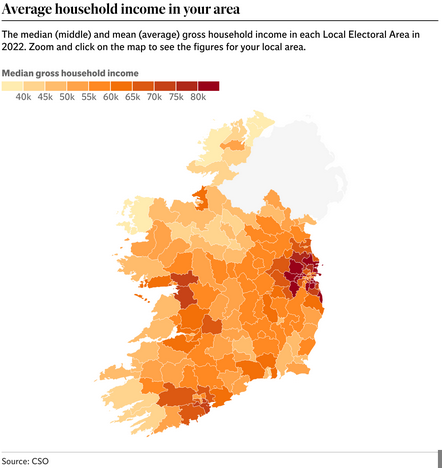
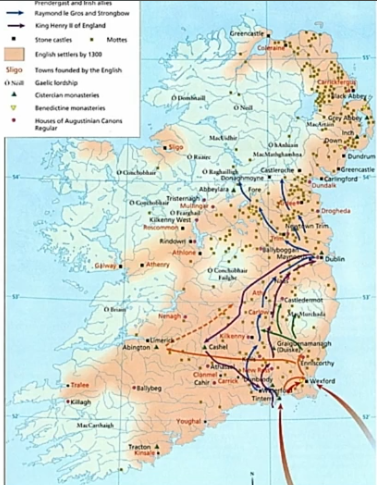
These admissions would not be politically comfortable. They would disturb the foundational narrative of the state. They would raise immediate questions about the legitimacy of institutions that operate in the name of a unified Irish nation while in practice serving one cultural formation. They would require the descendants of the Old English Catholic middle class — who have ruled the country for a century without acknowledging that this is what they have done — to reckon with their own history in a way that would be uncomfortable for many of them personally and politically destabilising for the institutions they have built. The reluctance to name what this article has been describing is not, therefore, mere oversight. It is the political reluctance of a dominant cultural formation to acknowledge its own dominance.
The reluctance is understandable. It is also indefensible if the consequence is the continued impoverishment of the populations and regions the dominant formation cannot see.
The Federal Vision Returns
What would a state look like that could see all three Irelands and serve them equally? The question is not new, and the answer was substantially worked out a century ago by people who were then ignored.
Bulmer Hobson’s federal vision proposed an Ireland organised so as to devolve real authority to regions and traditions — to allow Ulster Protestants, Gaeltacht communities, urban working classes, and rural smallholders to govern themselves through structures designed for their actual conditions rather than imposed from Dublin according to uniform diktat. Hobson was pushed out of the IRB in 1916 and his vision was buried by the centralising counter-revolution. But the vision remains usable. It was never disproved; it was merely defeated. The conditions that would allow its recovery are different now, and in some respects more favourable. The cultural plurality that Hobson tried to accommodate has been damaged, but it has not been destroyed. The recognition of multiple Irish traditions, which a century ago required difficult intellectual work against prevailing assumptions, is now made considerably easier by the cumulative collapse of those assumptions.
The post-Catholic Ireland that has emerged over the past three decades — through the marriage equality referendum, the abortion referendum, the loss of the Church’s moral authority, the public reckoning with institutional abuse — has dismantled some of the institutional infrastructure of the Old English Catholic dominance without yet replacing it with anything coherent. The state remains structurally what it was, but the cultural foundations have shifted. This is the window in which the recognition of the broader historical pattern becomes politically possible, because the formation that has been ruling is no longer in a position to enforce its denial of having ruled. The institutional Catholic Church, whose collusion was essential to the Old English Catholic project’s twentieth-century consolidation, no longer has the capacity to suppress the historical conversation. The educational system, the cultural institutions, the media — all of which were once aligned with the maintenance of the official narrative — are now more permeable to alternative readings.
This does not mean recognition will come easily. The political vehicles of the Old English Catholic formation remain in place — the two major parties, the senior civil service, the dominant professional and commercial networks — and their interest in maintaining the framework that has served them is undiminished. But the framework’s invisibility is no longer assured. The question is whether the populations who have been losers under that framework — in the west, in the inner cities, in the Gaeltacht, among the Travellers, in the marginalised Protestant communities of both jurisdictions, among the working class generally — will recognise themselves as such, will recognise the common structural cause of their marginalisation, and will articulate it politically.
The Museum
To return, finally, to the symbol with which we began. The museum that Sligo has been trying to establish for over seventy years has not been built because its construction is not, in any obvious sense, possible within the cultural framework of the state. The museum would have to tell Sligo’s actual history, and Sligo’s actual history is not the history that fits the state’s narrative.
It would have to tell the story of the Gaelic city — three hundred years of urban civilisation under Gaelic governance, manuscripts produced, trade conducted, an alternative form of Irishness that the standard narrative cannot accommodate. It would have to tell the story of the Protestant settler community that became the de facto middle class, and that has been steadily diminished over the past century by processes the state does not officially acknowledge. It would have to tell the story of the radical labour tradition, the cross-confessional alliances, the dock strikes, the Sligo contribution to the revolutionary period — much of which is absent from the standard national history. It would have to tell the story of the Gaelic Revival fusion attempt and its defeat, with Sligo at its centre. It would have to tell, in short, the history this article has been telling. And no state institution has had any reason to want that history told.
If the museum is ever built — and built with proper resources, with proper scholarly authority, with proper civic recognition — it will be because something has shifted in the framework that has prevented its construction for seventy years. The construction of the museum will not be the cause of that shift; it will be its sign.
The same can be said of the railway, the hospital services, the university designation, the EU funding application, the restored Borough Council. None of these is sufficient by itself. Each is a sign of whether the framework that has produced their absence has begun to give way. The question is not whether Sligo will get its rail line and its museum and its services. The question is whether the cultural blindness that has prevented Sligo from getting these things will be examined, named, and corrected, so that the same blindness stops producing the same outcomes elsewhere and everywhere it operates.
The question, finally, is not “What is wrong with Sligo people?”
The question is: What is wrong with us, that we cannot see what Sligo is?
That question has an answer. The answer is this article. It has been the work of these pages to make the answer sayable. The work of saying it, repeatedly and publicly until something changes, remains.
References
On Old English dominance of party and property into the modern age.
https://www.irishtimes.com/news/ff-and-fg-tribal-split-traced-back-to-12th-century-1.607729
https://www.irishtimes.com/news/environment/land-buys-in-boom-pushed-council-debt-to-94m-1.1702151
https://www.historyireland.com/pr-the-sligo-borough-election-of-1919/
I. Primary historical sources on medieval and early modern Sligo
Annals of Connacht (Annála Connacht). Compiled c. 1224–1544 by the Ó Maoilchonaire family among others. Edited by A. Martin Freeman, Annála Connacht: The Annals of Connacht (A.D. 1224–1544). Dublin: Dublin Institute for Advanced Studies, 1944. Online via CELT, University College Cork. — Used throughout Part II for the medieval dynastic history.
Annals of the Four Masters (Annála Ríoghachta Éireann). Compiled c. 1632–1636 by Mícheál Ó Cléirigh and collaborators at the Franciscan convent of Donegal. Edited by John O’Donovan, 7 vols., Dublin, 1851. — Used for the Tudor conquest period.
Annals of Ulster (Annála Uladh). Compiled at Senad Mac Manus in Fermanagh, late 15th century. Edited by William M. Hennessy and Bartholomew MacCarthy, Dublin, 1887–1901. Online via CELT. — Used for the O’Donnell-related material.
O’Sullivan Beare, Philip. Briefe relation of Ireland, and the diversity of Irish in the same. Manuscript, c. 1618. Various editions; available through CELT. — The “three types of Irish” passages quoted in Parts III, IV, V, and VII. Foundational text for the entire cultural-fault-lines argument.
Sidney, Sir Henry. Memorandum on Connacht, 1576. Quoted in Alice Stopford Green, The Making of Ireland and Its Undoing, p. 19. — The “haunted with strangers” testimony on Sligo, used in Part II.
II. Primary sources from the Gaelic Revival and revolutionary period
Hyde, Douglas. “The Necessity for De-Anglicising Ireland.” Lecture delivered at the inaugural meeting of the National Literary Society, Dublin, 25 November 1892. Reprinted in Charles Gavan Duffy, George Sigerson and Douglas Hyde, The Revival of Irish Literature. London: T. Fisher Unwin, 1894. — Central text for Part IV.
Connolly, James. Labour in Irish History. Dublin: Maunsel, 1910. — Used in Parts IV, V, VII.
Connolly, James. The Reconquest of Ireland. Dublin: Liberty Hall, 1915. — Used in Part V for the argument that political independence without economic restructuring would be hollow.
Hobson, Bulmer. Ireland Yesterday and Tomorrow. Tralee: Anvil Books, 1968. — Memoirs containing the “verbal differences” passage quoted in Part V. Hobson’s federal vision and his account of being pushed out of the IRB are central to Parts IV, V, and VII.
Tone, Theobald Wolfe. Life of Theobald Wolfe Tone, Founder of the United Irish Society. Edited by his son William Theobald Wolfe Tone, Washington, 1826. — The “common name of Irishman” passage quoted in Part IV.
Davis, Thomas. Essays Literary and Historical. Edited by D. J. O’Donoghue, Dundalk, 1914. — General reference for Part IV’s discussion of cultural pluralism in the Young Ireland tradition.
Yeats, John Butler. Letters to His Son W. B. Yeats and Others, 1869–1922. Edited by Joseph Hone, London: Faber & Faber, 1944. — Source for the “socialist anarchist Home Ruler” self-description, used in Part IV. (Note: this attribution should be verified against the published correspondence — the phrase is sometimes cited as coming from his unpublished letters or his memoir Early Memories.)
III. Secondary scholarship — Sligo specific
O’Dowd, Mary. Power, Politics and Land: Early Modern Sligo, 1568–1688. Belfast: Institute of Irish Studies, Queen’s University of Belfast, 1991. — The standard scholarly treatment of Sligo through the Tudor conquest and seventeenth century. Essential for Parts II and III. The book also documents the substantial Scottish settlement in Sligo, distinct from the Ulster Plantation pattern, which is relevant to the article’s argument about Sligo’s unusual demographic configuration.
Simms, Katharine. “A Lost Tribe: The Clan Murtagh O’Conors.” Journal of the Galway Archaeological and Historical Society, Vol. 53 (2001), pp. 1–22. — Primary source for the medieval dynastic history reconstructed in Part II, including the Lebor na hUidre ransom story.
O’Rorke, Rev. Terrence. The History of Sligo: Town and County. 2 vols. Dublin: James Duffy, 1889. — The classic local antiquarian history. Useful for medieval and early modern material; obviously dated in its interpretive frameworks but valuable as a compilation of sources. The author was a parish priest in the Sligo region.
Farry, Michael. Sligo 1914–1921: A Chronicle of Conflict. Trim: Killoran Press, 1994. — Used for the revolutionary period material in Part V.
Farry, Michael. The Aftermath of Revolution: Sligo 1921–23. Dublin: University College Dublin Press, 2000. — Source for the claim that the Civil War was approximately three times as destructive in Sligo as the War of Independence; for the Brian MacNeill killing on Slievemore; for the 2:1 anti-Treaty result in the 1922 election. Essential for Part V.
Deignan, Patrick. Sligo Protestants, 1912–26. PhD thesis, National University of Ireland Maynooth, 2014. — Documents the Sligo Protestant community through the revolutionary period; the source for the Bradshaw material expanded in Part V. Available via the Maynooth University Repository.
IV. Secondary scholarship — general Irish history
Stopford Green, Alice. The Making of Ireland and Its Undoing, 1200–1600. London: Macmillan, 1908. (Second edition, Dublin: Maunsel, 1920.) — Stopford Green’s account of medieval Sligo, including the Sidney testimony, is the textual anchor for Part II’s account of Sligo as “an Irish city whose buildings of wood and stone were said to be splendid, whose ships traded with Spain, and carried cloth to Southampton.” Stopford Green was a Protestant nationalist historian whose work explicitly rehabilitated the Gaelic civilisation against the dominant English-colonial historiography of her time. Available open-access via the Internet Archive.
Stopford Green, Alice. Irish Nationality. London: Williams & Norgate, 1911.
Stopford Green, Alice. The Old Irish World. Dublin: M. H. Gill, 1912.
Ellis, Steven G. “Why the History of ‘the Celtic Fringe’ Remains Unwritten.” European Review of History, 10:2 (2003), pp. 221–231. — Used in Parts III and V for the argument about the marginalisation of certain historical perspectives in Irish and British historiography.
Canny, Nicholas. [Work on Edmund Spenser and the colonisation of Ireland, c. 2025 — precise title to be verified from project files.] — Cited in Part II for the ideological background to the Tudor conquest. The relevant earlier work is Canny’s “The Attempted Anglicisation of Ireland in the Seventeenth Century: An Exemplar of ‘British History’,” in Ronald G. Asch (ed.), Three Nations — A Common History? Bochum, 1993.
Antman. [Work titled along the lines of “Total War in Ireland, 1558–1603” — full citation to be verified from project files.] — Cited in Part II for the Tudor military tactics that destroyed Gaelic Sligo.
V. Hobson, anarcho-nationalism, and the federal alternative
Hay, Marnie. Bulmer Hobson and the Nationalist Movement in Twentieth-Century Ireland. Manchester: Manchester University Press, 2009. — The standard biographical treatment. The project file “Hay_Resurrection_of_Bulmer_Hobson_MS.pdf” may be a working paper version of this material or a related manuscript.
[Anarcho-Nationalism and Irish Freedom.] Project file. — Full bibliographic details to be verified from the source document.
Hobson, Bulmer. A Short History of the Irish Volunteers, Vol. 1. Dublin: Candle Press, 1918.
Hobson, Bulmer. Defensive Warfare: A Handbook for Irish Nationalists. Belfast: West Belfast Branch of Sinn Féin, 1909. — The early articulation of his strategic and political vision, written before the militarist faction took over the IRB.
VI. Travellers and Gaelic continuity
Helleiner, Jane. Irish Travellers: Racism and the Politics of Culture. Toronto: University of Toronto Press, 2000.
TraVision, Outside the Colony Podcast
https://www.youtube.com/@OutsideTheColony
VII. The 1913 Sligo Dock Strike
National Library of Ireland. “Sligo Dispute.” Online exhibit drawing on contemporary Sligo Champion newspaper coverage. https://www.nli.ie/news-stories/stories/sligo-dispute — Primary documentary detail on the dispute, the employers affected (including Pollexfen and Gore-Booth’s Connacht Manufacturing Company), and the settlement terms. Central source for Part IV.
“1913 Sligo Dock Strike.” Wikipedia entry. https://en.wikipedia.org/wiki/1913_Sligo_Dock_strike — Useful summary; should be cross-checked against the NLI material and Farry’s books.
Irish Times. “West awakens to worker rights.” 11 September 2013. https://www.irishtimes.com/culture/heritage/west-awakens-to-worker-rights-1.1522292 — Coverage of the centenary of the strike, including the parallel between Arthur Jackson’s tactics in Sligo and William Martin Murphy’s in Dublin.
An Phoblacht. “Sligo prelude to Great Lockout 1913.” June 2013. https://www.anphoblacht.com/contents/23192 — Used for the settlement details and the County Council’s denunciation of Larkin’s “foul, anti-Christian doctrines.”
[The Irish Story.] “Remembering the Lockout.” August 2013. https://www.theirishstory.com/2013/08/27/remembering-the-lockout/ — Useful contextual material on the wider 1913 industrial confrontations including Sligo.
VIII. Bradshaw and the Sligo revolutionary period
“Bradshaw, Robert George.” Dictionary of Irish Biography. Royal Irish Academy. https://www.dib.ie/biography/bradshaw-robert-george-a0875 — Primary biographical source for Part V.
“Green, Alice Sophia Amelia Stopford.” Dictionary of Irish Biography. Royal Irish Academy. https://www.dib.ie/biography/green-alice-sophia-amelia-stopford-a3602 — Biographical context for Stopford Green’s intellectual project.
The Irish Story. “Book Review: Sligo. The Irish Revolution 1912–23.” 16 December 2012. https://www.theirishstory.com/2012/12/16/book-review-sligo-the-irish-revolution-1912-23/ — Useful commentary on Farry’s books, including the 2:1 anti-Treaty vote figure and the relative destructiveness of the Civil War in Sligo.
IX. The 2013 abolition and current Local Democracy Taskforce
Hogan, Phil. Statements as Minister for the Environment, Community and Local Government, 2013, on the abolition of town councils. The “Sligo is certainly one of the reasons we are reforming local authorities” quote is widely reported; specific source to be confirmed.
Local Government Reform Act 2014. Statute Book of Ireland. https://www.irishstatutebook.ie/eli/2014/act/1/enacted/en/html — The legislative vehicle for the abolition of the borough and town councils, including Sligo Borough Council.
Council of Europe, Congress of Local and Regional Authorities. Monitoring of the application of the European Charter of Local Self-Government in Ireland. October 2023. — Source for Ireland’s documented non-compliance with the Charter.
Programme for Government 2025: Securing Ireland’s Future. Department of the Taoiseach, January 2025. https://www.gov.ie/en/department-of-the-taoiseach/publications/programme-for-government-2025/ — The political commitment to establish the Local Democracy Taskforce.
Department of Housing, Local Government and Heritage. “Local Democracy Taskforce established to reform and strengthen local government.” Press release, 6 June 2025. https://www.gov.ie/en/department-of-housing-local-government-and-heritage/press-releases/local-democracy-taskforce-established-to-reform-and-strengthen-local-government/
Department of Housing, Local Government and Heritage. “Local Democracy Taskforce.” Webpage including terms of reference and membership. https://www.gov.ie/en/department-of-housing-local-government-and-heritage/publications/local-democracy-taskforce/
Department of Housing, Local Government and Heritage. “Local Democracy Taskforce presents final report with recommendations for reform of local government in Ireland.” Press release, March 2026. https://www.gov.ie/en/department-of-housing-local-government-and-heritage/press-releases/local-democracy-taskforce-presents-final-report-with-recommendations-for-reform-of-local-government-in-ireland/
Dáil Éireann written answers. “Local Government Reform.” 27 May 2025. https://www.oireachtas.ie/en/debates/question/2025-05-27/376/ — Departmental responses on the Taskforce process.
Dáil Éireann written answers. “Local Government Reform.” 20 March 2025. https://www.oireachtas.ie/en/debates/question/2025-03-20/section/93/
Tipp FM. “Healy calls on Taoiseach to confirm his stance on re-establishing Borough and Town Councils.” 4 May 2026. https://tippfm.com/news/healy-calls-on-taoiseach-to-confirm-his-stance-on-re-establishing-borough-and-town-councils/ — Source for the Taoiseach Micheál Martin’s “expressed disappointment with the report” comment and the “not to hold his breath” quote. Central source for the closing argument of Part VI.
Dundalk Democrat / Louth Live. “Councillors told reintroduction of Town Councils a matter for ‘higher Government’.” 17 February 2026. https://www.dundalkdemocrat.ie/news/home/2017298/councillors-told-reintroduction-of-town-councils-a-matter-for-higher-government.html — Source for the AILG spokesperson’s confirmation that town council restoration was not in the Taskforce’s terms of reference.
Connaught Telegraph. “Mayo Letters of the Week: We need solutions to a damaged democracy.” 26 April 2026. https://www.con-telegraph.ie/2026/04/26/mayo-letters-of-the-week-we-need-solutions-to-a-damaged-democracy/ — Documents the Taskforce’s submission of its report to Ministers Browne and Cummins.
Ó Riordáin, Seán. “Ireland’s taskforce on local democracy.” Administration, Vol. 73, No. 4 (December 2025), pp. 61–70. https://doi.org/10.2478/admin-2025-0026 — Scholarly analysis of the Taskforce process.
Association of Irish Local Government. Building Stronger Local Government: AILG General Election Manifesto. November 2024. — Background pressure for the Taskforce.
X. The Western Rail Corridor and contemporary infrastructure
[The author.] “Dublin’s Great Greenway Swindle.” allismotion.org. https://allismotion.org/dublins-great-greenway-swindle/ — Detailed forensic documentation of the WRC obstruction history. Referenced in Part VI.
XI. Background — genetic and prehistoric Ireland (project files)
These are not directly cited in the article but provide the broader empirical background for claims about deep continuity in Ireland’s population history:
Cassidy, Lara M., et al. “Neolithic and Bronze Age migration to Ireland and establishment of the insular Atlantic genome.” Proceedings of the National Academy of Sciences, 113:2 (2016), pp. 368–373.
Hofmanová, Zuzana, et al. “Early farmers from across Europe directly descended from Neolithic Aegeans.” Proceedings of the National Academy of Sciences, 113:25 (2016), pp. 6886–6891.
Gilbert, Edmund, et al. “Genomic insights into the population structure and demographic history of the Irish population.” Scientific Reports, 7 (2017), 17199.
Byrne, Ross P., et al. “The Irish DNA Atlas: Revealing Fine-Scale Population Structure and History within Ireland.” Scientific Reports, 8 (2018), 17199.
Keohane, F. M., et al. (2020). “Microbiome and health implications for ethnic minorities…” — Full citation to be verified from the project file.
XII. Other project files (cited or referenced)
Crampsie, Arlene. “Creating Citizens from Colonial Subjects: Reforming Local Government in Early Twentieth-Century Ireland.” [Journal and date to be verified from the project file.] — Relevant to the structural-continuity argument about how local government was reshaped in the period of independence.
A note on citation completeness
The references above are as complete as I have been able to make them given the materials available. Several references — particularly Antman’s piece on the Tudor period, the Canny essay on Spenser, the John Butler Yeats quotation, and the specific Phil Hogan source — would benefit from verification against the original project files or the user’s own notes before publication.
For a blog publication this level of citation is more than sufficient. For potential book chapter use, a final pass to confirm exact page numbers and to standardise citation format would be advisable.
The article makes some claims (particularly about the cultural composition of the 2013 Borough Council vs County Council in 1913, and about the specifics of the 2014 Local Government Reform Act’s effect on Sligo) that could be sharpened with citation of specific Borough Council records, electoral results, and council debates from the relevant periods. If access to the Sligo County Council archive is feasible, these primary documents would significantly strengthen the empirical case.