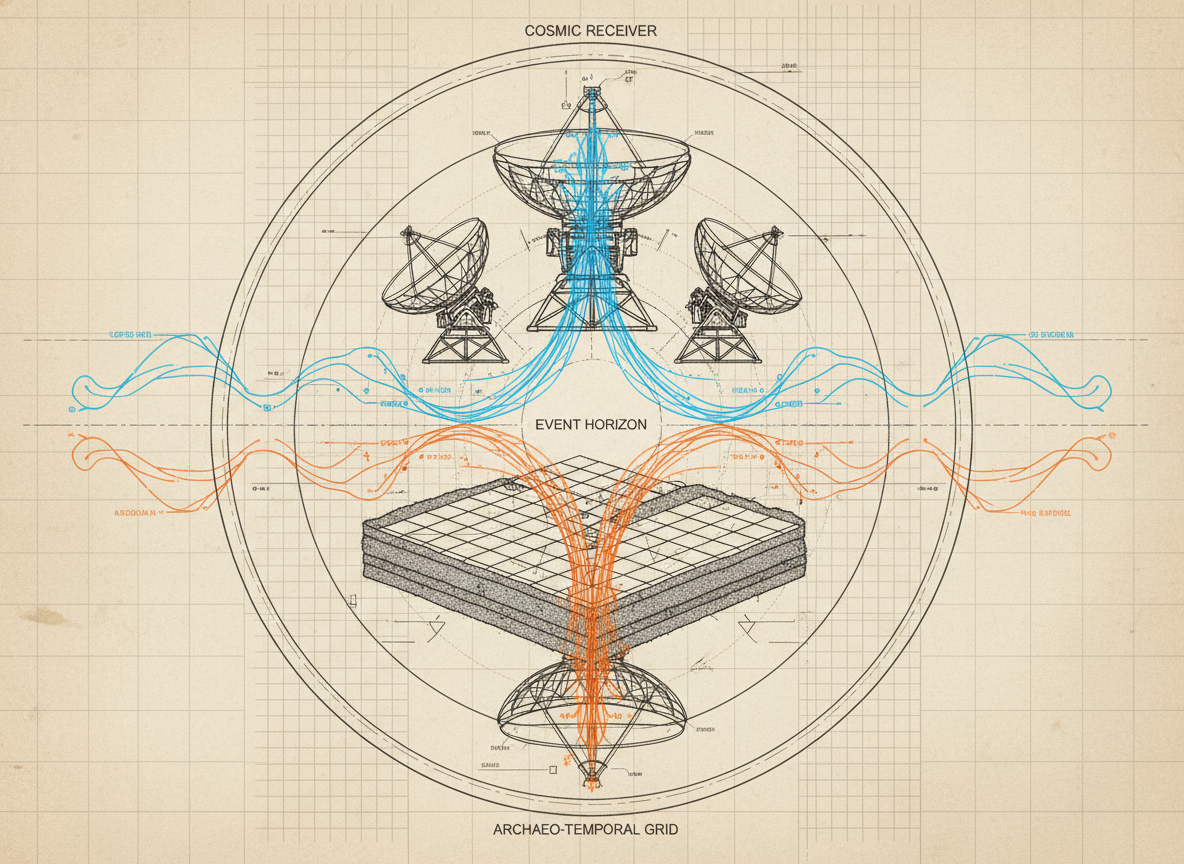
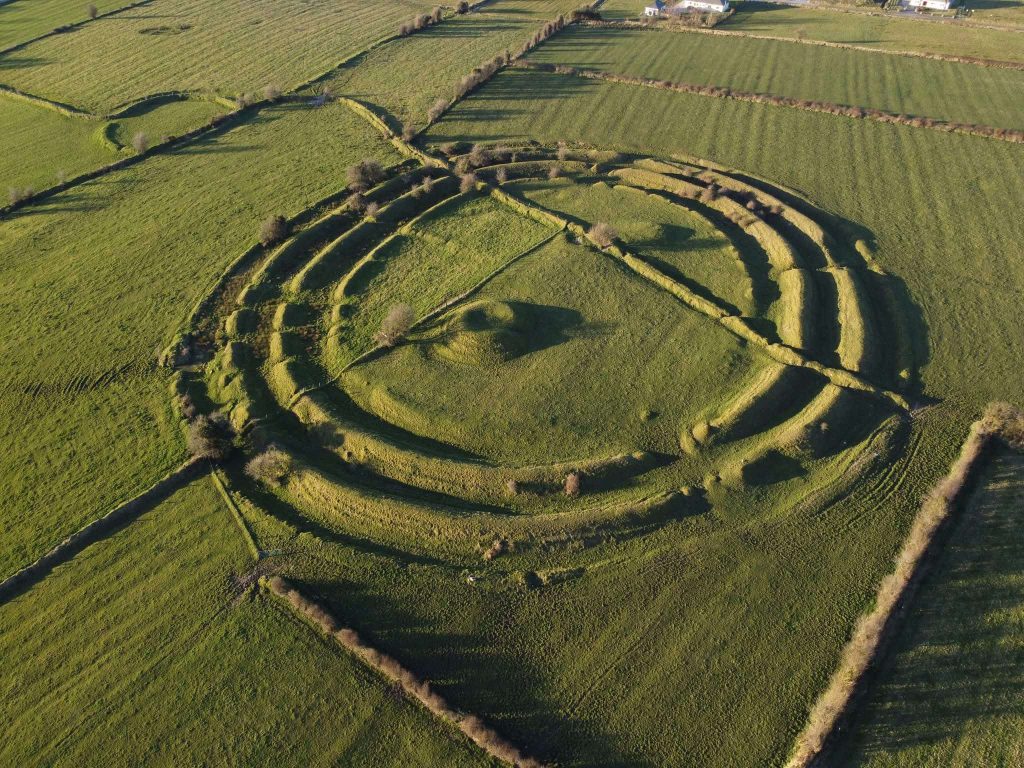
Second in a series. The first essay set out the ancient programme this work descends from — the ontology from Parmenides and Heraclitus, the method from Epicurus, and the argument that dualism is what froze the human sciences. This essay takes those foundations as given and follows the single most important consequence: that a living body is not the bounded thing we take it for, that its real edge moves, and that technology is the name for what happens when it moves outward into the world.
The first essay did the hard foundational work: one continuous being, in motion, with the dualisms dissolved because there is nowhere left for a real separation to stand. I want now to take the most familiar object there is — your own body — and show what those two axioms do to it. Because the place the whole programme turns from metaphysics into a science of human beings is here, at the boundary of the body, and it turns on noticing that the boundary is not where you think it is and does not stay still.
A body is a motion, not a thing
You think of yourself as a thing: a body, bounded by skin, that moves around inside an environment. The environment is outside, you are inside, and the skin is the line between. This is so obvious it is hard to see as a claim at all. But it is a claim, and on the view set out in the first essay it is the wrong one.
A living body is not a thing that happens to be moving. It is a motion that happens to hold a shape. Heartbeat, breath, the transport of molecules across membranes, the firing of neurons, the constant muscular work of holding posture against gravity — a body is a continuously regulated system of motion, sustained against a background of ambient motion that would otherwise dissipate it. This is not poetic licence. Stop the regulation and the shape goes: the structure that was a body becomes, within minutes, just matter subject to the ambient motion like any other, and then it disperses. What we call a body is precisely the regulation — the holding of a pattern of motion against the tendency of everything to even out. The “thing” is the verb, not the noun.
If that is what a body is, then its boundary is not the skin. The boundary is the edge of the motion the system can govern. Where the organism’s regulated motion ends and ungoverned ambient motion begins — that is the real edge of the organism, and most of the time it sits at roughly the skin, which is why we never notice that skin was never the point.
Watch the edge move
Now pick something up.
Grip a stone. For as long as you hold it, the stone’s possible motions are constrained by yours. It cannot fall, cannot roll, cannot move except as your regulated motion permits; it has entered your force-transmission system and become, for the duration, part of the governed pattern. The edge of the organism is now at the surface of the stone, not at the skin of the hand. Raise the stone and strike with it, and the governed motion now reaches through the stone into whatever you strike. Throw it, and for the duration of the flight your governed motion extends across the whole arc — you have flung the edge of yourself thirty feet downrange.
This is not a metaphor about feeling attached to your tools. It is a literal claim about where the regulated-motion system ends, and the answer is: not at the skin, and not at any fixed place. The boundary is wherever the governance currently reaches, and it moves in and out as the organism takes material under control and releases it again. The skin was just where the edge usually sits when the hands are empty.
And this is the whole definition of technology, arrived at from inside the organism rather than imposed from outside. Technology is structured motion that extends the organism’s governed boundary into external material — that brings the stone, the spear, the anvil under the same regulation that governs the heartbeat and the stride, and so reaches the edge of the self outward into the world. A stone tool, on this account, is not itself the technology. The technology is the motion; the stone is the trace it leaves and the medium through which the boundary momentarily extends. This is the reorientation the whole research programme rests on: away from the object and its type, toward the motion and its boundary.
The coupling, and why biology already has the language for it
There is an established way of talking about this in systems biology, and it is not borrowed loosely — it is the right frame, and the ontology delivers you straight to it.
An organism that brings external material under its own regulation, incorporating it into its governed dynamics, is engaged in what the systems-biology literature calls self-extending symbiosis: a system that maintains itself by recruiting parts of its environment into its own self-maintaining process. The recruited element is not metabolised, not made of the organism’s own tissue; it is coupled — brought into the regulatory loop while remaining external. The hand and the stone, while the knapping lasts, are one self-maintaining motion system with two materials in it, one of them flesh and one of them rock.
This matters because it tells you what kind of thing the organism–environment boundary is. It is not a wall and not a fixed membrane; it is the active surface where governed motion meets ambient motion and can reach across to pull some of the ambient into the governed. The boundary is where the organism does its homeostatic work — where it buffers itself against the environment’s departures from what it can tolerate. An organism with empty hands buffers itself only with its anatomy. An organism that can extend its boundary into material buffers itself with the material too, and the range of environmental departures it can survive grows accordingly. That is the seed of the entire evolutionary story the technical work tells — but the point for now is conceptual: the boundary is a place where work is done, the work is homeostatic, and extending the boundary outward is a way of doing more of it. The body’s moving edge is the organism’s primary tool for staying alive in a world that keeps changing.
The relations are the reality
Here is the part that I think is the conceptual core of the whole way of seeing, and the part I have been least willing, until now, to state without hedging. I have tended to write of technology producing “effective” changes in the organism’s world — as though the real situation were fixed and the technology only altered some experienced or measured overlay on top of it. That hedging is a mistake, and dropping it is what makes the idea land.
Start with something everyone knows in their body. Stand on a station platform as a train slides out. For a moment you cannot tell whether your train is moving or the one beside it is; the only fact available to you is the relative motion between them. This is not a quirk of perception. It is how motion is. Motion is only ever the motion of one body relative to another; there is no measurement you can make of your own motion except against something else. Classical mechanics has known this since Galileo: in an inertial frame, you measure motion only in relation to other bodies, and absent any such relation a body “may as well be at rest.” And here the programme’s first axiom finishes the thought that even Galileo left half-stated — there is no “at rest,” because all is motion. The absolute, motionless background against which things would “really” be moving or still is a fiction. It is, in the exact sense of the first essay, a what-is-not that we have wrongly granted being.
Hold onto that, because it is what licenses the strong claim. We habitually narrate a hunt from an imagined god’s-eye view: “really” the hominin stands here, the prey stands there, the spear flies between. From that imagined absolute frame, the relative-motion description looks like mere bookkeeping — a way of talking. But the absolute frame does not exist. The only frames that exist are the frames of the bodies actually in the interaction. And in those frames, the changes technology makes are not effective, not apparent, not as-if. They are the changes, full stop.
Take the cast spear. The instant it leaves the hand, the organism’s governed edge is travelling downrange at spear-velocity. Consider the moment in the frame of the prey — which is the only frame in which the prey’s life is decided. The prey had established a safe distance: thirty feet, say, judged against how fast a hominin can close on foot. The spear collapses that distance almost instantly. In the prey’s own frame, a lethal surface that should have taken seconds to arrive has crossed thirty feet in a fraction of one. The margin it had relied on is simply gone — not metaphorically, not in some analyst’s measure, but in the only frame that governs whether the prey lives. To be as safe as it was, it must now keep sixty feet, and then the next cast collapses that, and so the pressure ratchets. This is exactly the selective force that shapes prey into swervers and sprinters, and it is invisible if you insist on the god’s-eye frame and visible — calculable, real — the moment you stand where the prey stands. The distance really did collapse. There is no higher court in which it merely seemed to.
Now the cutting edge. A blade is primarily a transformation of force, and what it changes is the resistance of the material worked. With the right edge and the right motion, a hide that was too tough to part, a tendon that would not sever, parts and severs. In the user’s frame the material has become soft — and there is no other frame in which to ask whether it “really” did, because hardness is not a property a material has by itself. Hardness lives in the interaction between a material and the force brought to bear on it through a particular geometry. Change the geometry — bring an edge into the force-transmission chain — and you change the interaction, and hardness, which exists nowhere but in the interaction, changes with it. The result is not an effective softening laid over a real hardness. It is a real deformation of the environment: the flesh opens, the bone breaks, matter that would have held its shape yields and is reshaped. The organism’s structured motion has physically altered the world at its boundary.
So the three axes of the definition — force, distance, speed — are not effective modifications of the organism’s world. They are real changes in the relations between the organism and its environment, and relations are what is physically real; the absolute background in which they would be “merely apparent” is the thing that is not real. The prey really is nearer. The material really is softer. The reach really is longer. Each is true in the frame of the party it acts on, and there is no frame above those frames in which it is false. We think these changes are not “really” happening only because we are in the habit of believing in an absolute, independent reference frame — and that belief is precisely the dualist error the first essay diagnosed, smuggled back in as a picture of space.
I want to mark one boundary so the claim cannot be misread. This is classical, low-speed, Galilean relativity of motion — bodies on the surface of a planet, nothing approaching the speed of light, none of the spacetime contraction of Einstein’s relativity, with which the word “relative” is now unfortunately most associated. The effects here are not small relativistic corrections; they are large, everyday, and classical. The point is not exotic physics. The point is that ordinary motion is relative motion, that relative motion is the only motion there is, and that taking this seriously turns technology from a thing an organism has into a real reshaping of the relations that constitute the organism’s world.
The proof is in our language
There is a quiet piece of evidence that this is how human beings actually meet the world, and it is sitting in the structure of language.
We do not speak of distance, force, and speed as abstractions laid over experience. We speak of them as the substance of experience, and we use them to structure nearly everything else. A deadline approaches. A threat closes in. A solution comes within reach. A danger looms. Hardship is heavy; relief is light; we push through difficulty and move past grief; an argument gains momentum or runs out of steam. The work of Lakoff and Johnson on conceptual metaphor showed that this is not ornament — that the human mind natively builds its abstractions out of exactly these bodily experiences of relative distance, force, speed, and weight.
On the view set out here, that is not a curiosity. It is what you would predict. A creature whose entire evolutionary history was the manipulation of relative motion at its boundary — that spent three million years contracting the distances between itself and what it needed, softening the materials that resisted it, extending the reach of its governed edge — would be expected to encode that history in the deep structure of its thought and speech. The metaphors are fossil traces of the process this work describes. The reason the idea feels intuitive the moment it is stated plainly is that you are not learning something foreign; you are being shown the scaffolding you already think with, named for the first time. There is no rest. There is only motion, and how near, how fast, and how yielding the world is depends entirely on where you stand within it — which is exactly what every human language already knew.
Forward, to the stone
All of this has been the body’s moving edge described from inside, in the present, as experience and as physics. But the edge moved in the deep past too, and it left traces, and those traces are readable.
Around 2.6 million years ago there is a moment in the stone record where you can watch the boundary move. Earlier toolmakers stabilised the stone they were working on an external anvil — a separate object, on the ground, engaged only at the instant of the strike: the stabilising function sat outside the body. Later, the anvil is gone, replaced by the other hand: the stone is held continuously in the grip, oriented by the wrist, struck by a percussor in the opposite hand, and the stabilising function has moved into the body. The same mechanical job — hold the core still, deliver the blow — but reorganised from two loosely associated objects into one tightly coupled system with the material held inside the organism’s governed motion. The boundary moved inward to take up a function the world had been doing, and in doing so it committed the lineage to a path that selection would push on for the next two and a half million years.
That moment — the first time you can see the governed edge reorganise itself in the archaeological record — is where the empirical work finally touches the stone, and it is the subject of a later essay in this series. Before we get there, the next essay steps back to ask a question that the whole programme depends on: how we read any vanished motion from the trace it leaves, whether that trace is a stone, a star, or a burned scroll. The body’s edge moves; it has always moved; and once, long ago, it moved in a way that we can still read in the rock, because the motion left its mark and the mark is the only thing we ever have.
Dylan Foley is an independent researcher based in Ireland working at the intersection of physics, archaeology, and evolutionary biology, through his company Industrial Automata. The technical work these essays draw on is currently under peer review; details will follow on publication.
On conceptual metaphor and the bodily grounding of thought, see Lakoff & Johnson, Metaphors We Live By (1980). Companion conference paper: Foley & Furey, “From Geospatial Patterns to Ancient Signals” (IEEE Irish Signals and Systems Conference 2025, DOI: 10.1109/ISSC67739.2025.11291309).