Category: Signal Archaeology

  • Why Archaeologists Couldn’t Respond to SETI in 2014

    The Unanswered Question

    In 2014, NASA published “Archaeology, Anthropology, and Interstellar Communication,” edited by Douglas Vakoch. The initiative called for archaeologists to contribute their expertise in understanding past cultures to help SETI researchers design communication strategies for extraterrestrial contact. It was a reasonable request—archaeologists spend careers interpreting artifacts from societies separated from us by time, so why shouldn’t they help interpret signals from civilizations separated by space?

    The response from archaeology was near silence.

    Not vigorous debate. Not counter-proposals or methodological critiques. Just quiet non-engagement from a discipline that was apparently being offered relevance to one of humanity’s most compelling scientific questions.

    This silence is more revealing than any rejection would have been. It’s diagnostic evidence of something fundamental: archaeology couldn’t recognize a scientific question about information preservation and recovery across deep time as directly concerning their own discipline.

    What SETI Actually Asked

    Strip away the SETI framing, and Vakoch’s core question was purely archaeological. What do we know about how information degrades, transforms, and remains recoverable across vast temporal distances? What encoding strategies survive better than others? What makes signals interpretable despite massive context loss?

    These are archaeology’s central problems. Every excavation addresses them. Every artifact interpretation depends on understanding what information survives and what’s lost. Every chronological reconstruction requires accounting for temporal uncertainty and signal degradation.

    Yet archaeologists didn’t recognize the question as theirs.

    The Paradigm Gap Is Real

    This wasn’t a case of archaeologists making a reasoned decision that SETI was outside their purview. It was an inability to see the connection at all. And this failure reveals something fundamental about how archaeology operates theoretically. Its foundation is not scientific.

    As Lambros Malafouris described the field’s theoretical problems: “This territory is familiar, as when the hand grasps a stone and makes it a tool, yet it remains terra incognita, since—despite a long genealogy of analytic efforts—just what this grasping implies for the human condition remains elusive, and refuses to be read in the narrative fashion that hermeneutics have promised.”

    Archaeology has no mathematical formalisation of its core concepts. Technology, the primary evidence in archaeological records, remains theoretically undefined. Cultural transmission, the process archaeology claims to study, cannot be modeled with scientific rigor because, as Sperber and Claidière demonstrate, “cultural causality is promiscuous”—it cannot be neatly divided into replication mechanisms and environmental factors the way biological inheritance can.

    The field operates in what amounts to a pre-scientific paradigm. Not pre-scientific in the sense of being primitive or unsophisticated—archaeological work is often brilliant and insightful—but pre-scientific in lacking the fundamental formalisation that would make it compatible with physics-based frameworks.

    this matters because …

    When Vakoch framed his question in signal science terms—information preservation, encoding strategies, pattern detection across temporal distances—archaeology had no theoretical apparatus to engage with it. The discipline’s conceptual vocabulary operates in interpretive and hermeneutic modes that simply don’t connect to physics-compatible frameworks.

    This isn’t a failure of individual archaeologists. It’s a structural limitation of the paradigm itself. You cannot expect researchers trained in cultural interpretation and meaning-making to suddenly switch to signal processing and information theory when they have no conceptual bridge between these frameworks.

    But the consequences are significant. Archaeology is the only discipline with direct access to information about how patterns survive and remain recoverable across deep time. It’s the only field that routinely works with degraded signals from past events separated from us by thousands or millions of years. This makes archaeology potentially central to SETI’s actual challenge—detecting signals from extinct civilizations across vast temporal and spatial distances.

    Yet archaeology couldn’t engage with this opportunity because it lacks the theoretical foundation to do so.

    Historical Context: Decades of Crisis

    This isn’t a new problem. Archaeology has been in theoretical crisis for decades. The failure of processual archaeology’s attempts at scientization in the 1960s-70s led to post-processual retreat into pure interpretation. Cultural evolution remains unmodelable, if theres such a term.

    So, despite decades of attempts, as documented extensively by researchers like Richerson and Boyd, precisely because cultural phenomena cannot be formalised using biological inheritance models. The field has produced sophisticated phenomenological descriptions and rich interpretive narratives.

    But it has failed to achieve what Thomas Kuhn would recognize as normal science—a paradigm with mathematical formalisation, falsifiable predictions, and theories compatible with physics.

    My own work spans both archaeology and computational science, holding degrees in both fields. From that position, the paradigm gap is starkly visible. Archaeology operates with concepts that have no physics-compatible definitions. Technology, culture, cognition, social structure—these remain what philosophers call “folk psychological” categories rather than scientifically formalised entities.

    The Targeted Fix

    In this series I’ve argued that archaeology and SETI are fundamentally the same discipline—signal science across spacetime. But making that unification practically meaningful requires solving the problem the Vakoch silence exposed: archaeology needs reformulation in physics-compatible terms.

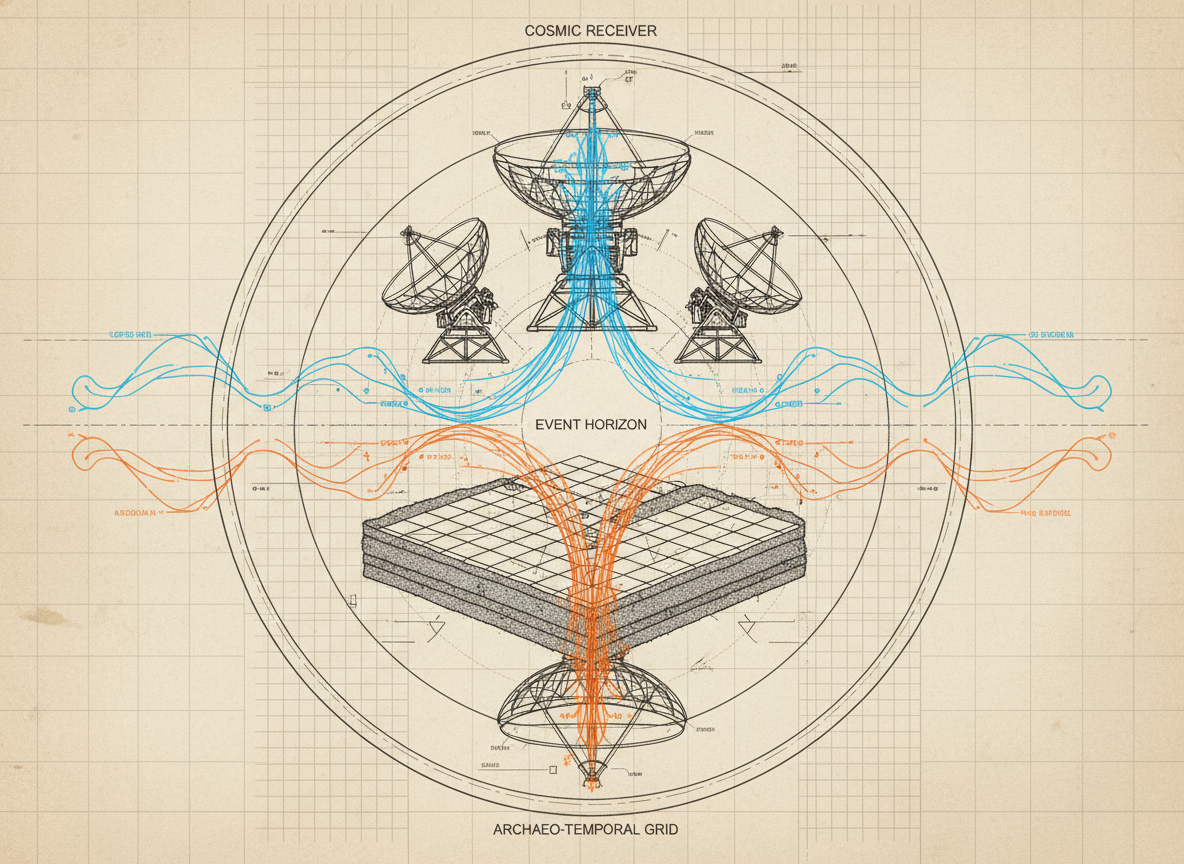
    This is exactly what our IEEE paper attempts. By treating archaeological data as degraded signals from past motion events, by representing temporal relationships as geometric manifolds, by applying signal processing methods to pattern recovery—we create a framework where archaeological concepts become mathematically defined and therefore physics-compatible.

    Technology becomes “controlled motion of material creating quantifiable environmental transformation.” Cultural transmission becomes “propagation of motion patterns through observation and replication.” Archaeological sites become “persistent signals of past motion events detectable through spatial-temporal pattern recognition.”

    These aren’t just semantic relabeling. They’re reformulations that make archaeological phenomena expressible in the same mathematical language used throughout physics and engineering. This creates the conceptual bridge that was missing in 2014.

    If the reformulation works, archaeologists should be able to engage with questions about temporal transmission protocols, information preservation across deep time, and signal detection in degraded data—without feeling like they’re abandoning their discipline for some alien framework.

    They should recognize these as core archaeological questions, now expressible in scientific terms. The Vakoch call shouldn’t produce silence. It should produce vigorous technical discussion about encoding strategies, redundancy requirements, and pattern preservation across geological timescales.

    We’re not there yet. This is early-stage paradigm work. But the IEEE paper demonstrates proof-of-concept with real archaeological data—150,000+ sites, 6,000 year temporal span, statistically significant pattern recovery from noisy legacy records.

    Conclusion

    The 2014 silence wasn’t archaeology’s failure. It was evidence that archaeology needs fundamental reformulation to function as science. The discipline has existed for over a century producing valuable insights while operating in a theoretical framework incompatible with the rest of science.

    This work attempts a targeted fix: reformulating archaeological concepts to be physics-compatible while preserving what makes archaeology distinctly valuable—its focus on information recovery across deep time. Whether this particular formulation succeeds, others can judge. But the Vakoch silence proves the attempt is necessary.

    In the next post, I’ll walk through the technical implementation—showing how the signal processing framework actually works with real archaeological data, what it reveals that traditional methods miss, and what it suggests about designing transmissions for future recovery.

  • Are We the Transmission?: The Archaeological Record Future Civilizations Will Discover

    Are We the Transmission?: The Archaeological Record Future Civilizations Will Discover

    Introduction

    Four billion years of planetary history, the complete evolutionary record of life on Earth, from single-celled organisms to technological civilization. The geological transformations of a living world. The extinctions, the radiations, the slow accumulation of atmospheric oxygen. The emergence of language, art, and science.

    All of it will vanish without a trace, like tears in rain.

    Not through some cosmic catastrophe—though that’s inevitable too—but simply through the passage of time. Erosion, tectonic recycling, stellar evolution. Given enough time, even mountains disappear. The question isn’t whether Earth’s history will be lost. The question is whether anyone will have recorded it before it’s gone.

    There’s no cosmological reason why preservation is necessary or, some might argue, even desirable. Opinions may reasonably differ on whether it should be a priority at all. But for archaeology and SETI (Search for Extra Terrestrial Intelligence) as actual research programs consuming real resources, the question must be asked explicitly: what is the ultimate objective? The answer determines everything else—methodology, funding priorities, measures of success.

    The Foundational Questions

    Why is archaeology pursued at all? To what end do we construct the record? For whom do we do it, and how much resources should society invest in it?

    The same questions apply to SETI: to what end do we search for technosignatures (signals from technically advanced civilisations)? For whom do we conduct this search, and how should we allocate resources between detection methods, target selection, and interpretation frameworks?

    These aren’t abstract philosophical questions—they’re practical ones that determine research priorities. Currently, both fields operate with implicit objectives that may not withstand scrutiny. Archaeology typically justifies itself through “cultural heritage” and historical understanding—valuable goals, but relatively weak when competing for funding against immediate social needs.

    SETI traditionally frames itself as searching for contemporary communication from active civilizations—an exciting prospect, but one that becomes increasingly implausible when you account for the temporal overlap problem I discussed in my previous post.

    A Logical Foundation

    We can establish a more rigorous objective by starting with what we know for certain: one technological civilization exists that can understand space and time—us. We exist, we’re capable of encoding information, and we can conceive of entities separated from us by vast distances in spacetime.

    From this single data point, we can reason that other such civilizations may exist in the future. They could be our own descendants after societal transformation or extinction and re-emergence. They could be entirely different lineages evolving on Earth after we’re gone. They could be civilizations arising elsewhere in the galaxy on timescales long after our extinction. We don’t know which scenario is likely, or if any will occur. But we know it’s possible, because we exist as proof of concept.

    This creates a concrete objective that unifies both archaeology and SETI: if we are the first, the only, or simply the present technological civilization in our temporal window, then even if SETI finds no signals now, we can dramatically increase the probability that a future SETI project will find a record—ours.

    This isn’t metaphysics. This is practical planning.

    The Dual Research Program

    Understanding preservation as the shared objective of archaeology and SETI creates a productive research program with two complementary branches.

    First, archaeology’s meta-objective becomes clearer: we’re not just reconstructing the past for present cultural understanding. We’re establishing what kinds of information structures survive degradation across time, what encoding strategies remain interpretable despite transformation, and what patterns remain detectable despite noise. Every successful archaeological recovery is a proof-of-concept for preservation. Every failed interpretation reveals encoding strategies that don’t work across deep time.

    Second, SETI should be designing temporal transmission protocols as a practical project. This serves a dual purpose: it enables us to create transmissions for future detection, and it informs what we should look for in the present. If we’re designing durable, interpretable information structures to survive millions of years, we’re simultaneously developing detection methods for finding similar structures left by others.

    The two research directions inform each other. Archaeological signal processing—like the framework we published in the recent ISSC Conference Proceedings using Ireland’s archaeological data—demonstrates what kinds of patterns survive degradation and remain detectable.

    These same patterns become design principles for creating future-detectable structures. Conversely, thinking about what we would create for long-term detection informs what we should be searching for in both archaeological records and astronomical observations.

    Why This Matters Practically

    This reframing doesn’t require accepting that preservation is cosmically important or morally necessary. It simply recognizes that if we’re already doing archaeology and SETI, we should have clear objectives that maximize the value of the resources invested.

    The preservation framework provides that clarity. It gives archaeology a concrete goal beyond heritage conservation: develop and test encoding strategies that survive geological timescales. It gives SETI a concrete goal beyond listening for messages we’ll likely never receive: design transmission protocols and detection methods for signals across deep time.

    And it creates a shared research agenda that leverages both fields’ expertise. Archaeologists understand how information degrades, what remains recoverable and how to reconstruct it, SETI researchers understand signal detection and pattern recognition in noise. Combined, they could develop systematic approaches to encoding Earth’s history in ways that maximize probability of future recovery.

    This is the preservation imperative, and we may be living in the only window where it’s possible to act on it.

    The Window Is Closing

    In my previous post, I argued that archaeology and SETI are fundamentally the same discipline—signal science. If that’s true, then both fields share a common challenge: signals degrade over time, and windows of opportunity are brief.

    Consider what we know about Earth’s technological window. Modern industrial civilization has existed for perhaps 200 years. Our capacity to encode and transmit information at scale—using digital systems, materials science, and signal processing—has existed for perhaps 50 years at a meaningful level. The archaeological record we’re trying to preserve spans 6,000 years of recorded history, hundreds of thousands of years of human evolution, millions of years of mammalian radiation, and billions of years of geological and biological transformation.

    We’re attempting to capture and encode four billion years of history using technology that has existed for half a century. And we’re doing it while the record itself is actively being destroyed by development, climate change, erosion, and simply the passage of time.

    This creates genuine urgency. We have advanced enough technology to attempt preservation—AI systems, signal processing frameworks, materials science capable of creating durable substrates. We still have an archaeological record that’s reasonably intact and interpretable. We have sufficient resources and stable enough societies to fund large-scale research programs. But these conditions are fragile.

    Climate change threatens both the physical record and our capacity to study it. Mass extinction erodes the paleontological data. Urban development destroys archaeological sites faster than we can excavate them. And societal collapse—whether through climate catastrophe, nuclear war, or pandemic—could eliminate our technological capacity entirely.

    If we’re in a unique window, we need to act as if it might close.

    Who Receives the Transmission?

    The elegant aspect of the preservation framework is that we don’t need to know who will receive the signal or when. We simply need to maximize the probability that it survives and remains interpretable across the longest possible timescales. But it’s worth considering the possible audiences, because each scenario reveals different technical requirements.

    Future earthlings after civilizational collapse represent the nearest-term scenario, perhaps 100 to 10,000 years out. If our current technological civilization collapses—whether through climate change, resource depletion, nuclear war, or pandemic—survivors would need to rebuild. Having durable archives of our accumulated knowledge could prevent restarting from scratch. This scenario requires robust local storage, perhaps geological encoding or orbital repositories that survive atmospheric reentry. It’s the most tractable scenario because the audience shares our biology, our planet, and much of our context.

    Distant Earth descendants operating on timescales of millions to hundreds of millions of years represent a more challenging scenario. These could be future intelligent species that evolve after we’re gone, or our own descendants so transformed by time and evolution that they’re effectively alien to us. This scenario requires extremely durable encoding—crystalline matrices, genetic insertions, or orbital megastructures that survive stellar evolution. The challenge here is interpretability: how do you create messages that remain meaningful after language, culture, and possibly even sensory modalities have completely changed?

    Alien archaeologists discovering Earth after the Sun has expanded and sterilized the planet represent the deepest time scenario—billions of years. This is SETI in its purest form, but from the transmitting side. Here, the encoding must survive not just time but planetary destruction. Space-based archives, artificial structures in stable orbits, or even engineered patterns in solar system architecture become relevant. The interpretability challenge is maximal: you’re communicating with entities that share no evolutionary history, no common sensory experience, possibly no comparable physics if they evolved in radically different environments.

    Our own SETI searches discovering similar preservation attempts by other civilizations could operate on any timescale, but likely fall in the range of 10,000 years to 10 million years—brief enough that technological signatures remain detectable, long enough that temporal overlap is unlikely. This scenario is particularly interesting because understanding what we would leave behind informs what we should look for when searching. If every technological civilization faces the same preservation imperative, then SETI should be searching for archives, not conversations.

    Are We the Transmission?

    There’s a fifth scenario worth considering, one that inverts the entire preservation framework: what if life on Earth is itself an example of temporal transmission from a previous technological civilization?

    This isn’t recycled panspermia speculation. It’s a testable archaeological question. If we’re serious about temporal transmission protocols and preservation across deep time, we should apply the same investigative framework to our own origins. Archaeological SETI shouldn’t just look outward and forward—it should look inward and backward.

    The timeline is suggestive. Life appears on Earth extraordinarily quickly after conditions stabilize following the Late Heavy Bombardment—perhaps within 100 million years, possibly much faster. This rapidity has always seemed remarkable. Chemical evolution from non-living to living systems is supposed to be slow, requiring vast numbers of random molecular combinations before self-replicating systems emerge. Yet it happened here almost immediately in geological terms.

    The standard explanation invokes probability—given Earth’s size and the number of chemical reactions occurring, even improbable events become likely. But there’s an alternative hypothesis worth investigating: life’s rapid emergence might indicate technological origin rather than purely naturalistic chemical evolution.

    If a previous technological civilization wanted to transmit information across the deepest possible timescales—spanning the death and rebirth of solar systems, surviving galactic-scale catastrophes—what would be the most durable encoding substrate? Crystalline matrices degrade. Orbital structures eventually decay. Even neutron star engravings face erosion across billions of years.

    But self-replicating molecular systems that actively maintain and propagate their own information? Systems that evolve error-correction mechanisms, adapt to changing environments, and spread across planetary surfaces? That’s genuinely durable encoding. Life itself becomes the transmission medium.

    Starting the Archaeological Trail: Solar Siblings

    If we’re investigating this hypothesis methodologically, we should start from what we know—proper archaeological practice. Our Sun formed 4.6 billion years ago in a molecular cloud alongside hundreds or thousands of sibling stars. These solar siblings scattered across the galaxy over billions of years, but many remain identifiable through their chemical signatures and orbital trajectories.

    This makes them the logical starting point for archaeological SETI. If life has technological origins involving panspermia or deliberate seeding, solar sibling systems are the most likely candidates for sharing that origin. They formed from the same material, at the same time, in the same region. If our system was seeded, theirs likely were too. If life emerged naturally here, similar conditions might have produced it there as well.

    Current solar sibling searches have identified candidates like HD 162826, a star roughly 110 light-years away that almost certainly formed with our Sun. More will be identified as Gaia mission data improves stellar kinematics. These aren’t random SETI targets—they’re archaeologically motivated searches working from known relationships outward.

    This is exactly how archaeology operates: start from documented connections, trace them through time, look for shared origins. Solar sibling searches become archaeological investigation across both space and time, following the trail from our Sun’s birth cloud to wherever those siblings migrated.

    Investigating Technological Signatures

    This hypothesis generates testable predictions. If life has technological origins, we should find evidence of engineering in its fundamental architecture. Not the kind of complexity that arises from natural selection—that’s expected regardless of origin—but signatures of deliberate design, optimization beyond what blind evolutionary processes would produce, or information encoding strategies that serve no survival function but might preserve transmittable data.

    We already know some puzzling features of life’s molecular machinery. The genetic code’s error-correction properties are remarkably sophisticated. The specific amino acids used by all Earth life represent a small subset of chemically possible options, chosen with apparent optimization for certain properties. The universal use of left-handed amino acids and right-handed sugars lacks obvious naturalistic explanation.

    None of this proves technological origin. But it establishes that investigating life’s origins through an archaeological SETI lens—looking for technological signatures rather than assuming purely naturalistic processes—is methodologically sound. We have one confirmed example of life. We can study its architecture in detail. We know it emerged rapidly after planetary conditions stabilized. We can identify and search our Sun’s sibling systems for related signals. These are exactly the conditions where archaeological investigation should operate.

    This creates a productive symmetry in the temporal transmission framework. We’re simultaneously designing preservation strategies for future recovery while investigating whether our own existence represents successful recovery of a previous civilization’s preservation attempt. Both directions use the same methodology: signal processing applied across deep time, pattern recognition in noisy data, distinguishing technological signatures from natural processes, working from known relationships outward.

    And both reinforce archaeology’s central role. Whether we’re encoding information for future discovery or decoding information from past transmission, we’re doing archaeology—recovering signals across temporal distances using physics-compatible methods.

    The Funding Implication

    Recognizing archaeology as informing preservation as well as reconstruction transforms its justification from cultural heritage to existential responsibility. Current archaeological funding operates on the logic of “understanding our past has educational and cultural value.”, which is true, but relatively weak when competing for limited resources.

    The preservation framework makes a stronger argument: we are potentially in Earth’s unique window to encode and transmit four billion years of planetary history. If we fail to do this, that information vanishes permanently, regardless of who might have been able to use it. This reframes archaeology from “nice to know our heritage” to “species-level imperative to preserve the only known record of life’s evolution in the universe.”

    This is comparable to climate science or asteroid detection—fields justified by their role in preventing existential catastrophe. If archaeological preservation is the only way to ensure Earth’s history survives beyond our technological window, then it deserves similar priority and funding.

    The practical implications are significant. Every archaeological excavation becomes part of a larger dataset encoding planetary history. Every paleontological dig contributes to the evolutionary record. Every geological survey maps deep-time transformations. The question shifts from “what happened at this specific site?” to “how do we encode this information for maximum recoverability across geological timescales?”

    Practical Implementation

    We have the technical frameworks to begin systematic preservation now. Our IEEE paper (Foley & Furey, 2025) demonstrates one approach: treating archaeological data as degraded signals and applying signal processing methods to extract patterns despite noise, gaps, and temporal uncertainty. Working with Ireland’s Record of Monuments and Places—over 150,000 archaeological sites spanning 6,000 years—we showed that we can recover territorial boundaries, administrative centers, and invasion patterns with statistical significance, even from noisy legacy data.

    But this is just the beginning. The same signal processing frameworks that extract patterns from archaeological data can inform how we encode information for future extraction. If we know what kinds of patterns survive degradation, we can deliberately create those patterns at larger scales. If we understand how temporal relationships transform into spatial geometries, we can design encoding strategies that remain interpretable despite transformation, degradation and deformation.

    The research questions that emerge are concrete and testable. What materials survive millions of years in various planetary environments? How do you design redundancy levels that ensure reconstruction despite 99.9 percent data loss? What geometric and statistical patterns remain obviously artificial despite transformation over geological timescales? These are engineering problems with testable solutions.

    And we have a laboratory to test them: Earth’s archaeological record. Everything we successfully recover from the past tells us something about what will be recoverable from our present.

    The Responsibility

    We don’t know if anyone will ever receive the transmission. We don’t know if Earth descendants, alien archaeologists, or post-collapse survivors will ever decode what we leave behind. We can’t even be certain that preservation is physically possible across the timescales involved.

    But the alternative is accepting that four billion years of planetary history simply vanishes, and no one ever knows it happened. If we’re right about technological windows being brief and rare—if temporal overlap really is unlikely—then preservation becomes the only realistic goal for both archaeology and SETI.

    This creates a clear imperative: use the window we have to encode as much as possible, as durably as possible, using every tool available. The archaeological sciences should receive funding commensurate with this responsibility. The theoretical frameworks should be developed urgently. The encoding strategies should be designed and tested systematically.

    We might be the only civilization in billions of years of galactic history that has both the record and the capability to preserve it. That’s not just an opportunity. It’s an obligation.

    If we succeed, Earth’s story survives. If we fail, it’s lost forever.

    Dylan Foley


    Next in This Series

    This post establishes why temporal transmission protocols matter—the practical foundation for both archaeology and SETI. In the next post, I’ll examine why the 2014 call for archaeologists to contribute to SETI failed to gain traction, and how the signal processing framework bridges the paradigm gap that kept these disciplines separated.

    Later in the series, I’ll walk through the technical implementation described in our recently published IEEE paper, showing how treating archaeological data as degraded signals enables pattern recovery across large timescales—and what this tells us about designing transmissions for future detection.

    Related Publication: Foley, D. Furey E. (2025). “From Geospatial Patterns to Ancient Signals: A Signal Based Framework for Archaeological Machine Learning.” 2025 Irish Signals and Systems Conference (ISSC). IEEE
    https://ieeexplore.ieee.org/document/11291309/metrics#metrics

  • SETI is Archaeology: Signal Science Across Spacetime

    SETI is Archaeology: Signal Science Across Spacetime

    Dylan Foley – Archaeological SETI (Search for Extra-Terrestrial Intelligence) Philosophy of Archaeology Series

    Words:1823

    Time to read:10 minutes


    We Know Exactly One Thing About SETI

    In the search for extraterrestrial intelligence, we face a lot of uncertainties. Although we can make educated guesses, we don’t know if life commonly emerges on other worlds. We don’t know if intelligence typically evolves. We don’t know if technological civilizations endure or quickly self-destruct. But we know one thing with absolute certainty: right now, on this planet, a technological civilization exists and actively transmits signals into space.

    This single fact reveals something profound that allows us to reframe both SETI and archaeology, and when we consider the timescales involved, the implications become clear and startling.

    The Temporal Overlap Problem

    Our galaxy is approximately ten billion years old. Technological civilizations, based on our only example, have existed for perhaps hundreds to thousands of years, possibly extending to tens of thousands if we’re fortunate. Even if technological life emerges regularly across the galaxy, the probability that two such civilizations exist simultaneously and within detectable range approaches zero, if, as seems likely, technologically advanced civilisations undermine their own ability to survive. We see from climate change to weapons that the bottleneck through which any reasonably advanced species must endure, is inevitable.

    So, if technological windows are brief compared to galactic timescales, then at any given moment, there may be only one or two technological entities active in an entire galaxy. The minimum we know is possible is one, because we exist. But this minimum also suggests that when we search for alien signals, we’re almost certainly not searching for contemporary transmissions from currently active civilizations.

    We’re searching for archaeological artifacts of extinct ones.

    SETI as Time-Delayed Archaeology

    This realisation inverts our understanding of what SETI actually does. The conventional framing treats SETI as a search for active communication from living civilisations, perhaps hoping for dialogue across the stars. But if temporal overlap is unlikely, then SETI is actually archaeology conducted at cosmic distances. We’re looking for traces, for signals that have outlasted their creators, for information preserved across timescales that dwarf human history.

    This makes SETI and terrestrial archaeology not merely analogous but fundamentally the same discipline applied in different spacetime directions. Archaeology recovers signals from entities separated from us by time. SETI searches for signals from entities separated from us by space. Both are exercises in detecting, interpreting, and reconstructing information from sources we cannot directly observe or communicate with.

    The Unified Framework: Long-Distance Signal Science

    If we accept this symmetry, then both disciplines are engaged in what we might call “long-distance signal science across spacetime.” The core challenges are identical in both fields. How do you detect intentional patterns against natural backgrounds? How do you interpret information without shared context or language? How do you distinguish artifact from accident, signal from noise, design from coincidence?

    More importantly, if both disciplines face the same fundamental problem, they should inform each other directly rather than superficially. Archaeology isn’t merely analogous to SETI in the way that, say, forensics might provide useful metaphors. Instead, archaeological methodology is directly applicable to SETI, and SETI’s engineering concerns should directly shape archaeological practice.

    The Preservation Imperative

    Here’s where the framework becomes potentially transformative rather than merely descriptive. If SETI searches primarily find evidence of extinct civilizations, and if technological windows are brief, then any civilization with foresight faces an obvious imperative: preserve your planetary history in a form that can survive and remain interpretable across geological and cosmic timescales.

    This isn’t just about ensuring your own descendants can access their history, though that’s valuable. It’s about recognizing that if you’re alone in your temporal window, your civilization might be the only one capable of encoding the story of your planet. Four billion years of evolutionary history, the emergence of life, the development of complexity, the appearance of intelligence—all of it vanishes unless someone preserves it before the window closes.

    That someone might be us. And the window might be now.

    Why This Matters for Archaeology

    This reframing elevates archaeology from a discipline concerned with understanding the past for cultural or educational purposes to one with species-level importance. The archaeological reconstruction of Earth’s history isn’t just valuable for us; it may be our only opportunity to transmit that history to the deep future, whether the audience is our own distant descendants, future terrestrial intelligence that evolves after we’re gone, or alien archaeologists investigating what happened on this planet millions of years after we’ve vanished.

    Every archaeological site excavated, every palaeontological fossil analyzed, every geological record interpreted becomes part of a dataset that we might encode and preserve. The urgency is real. Climate change, mass extinction, technological collapse, or simple erosion could eliminate both the archaeological record itself and our capacity to interpret it. We exist in a possibly unique window where we’re technologically advanced enough to attempt preservation while the record still exists and remains interpretable.

    The Paradigm Gap: Why Archaeology Didn’t Engage in 2014

    n 2014, Douglas Vakoch edited a NASA publication titled “Archaeology, Anthropology, and Interstellar Communication,” calling on archaeologists to contribute their expertise to SETI. The response from archaeology as a discipline was disappointingly sparse. Vakoch correctly understood that archaeologists work with traces of cultures distant from us in time and context, making their interpretive methods potentially valuable for thinking about communication with equally distant alien civilizations. The invitation was genuine and the reasoning sound from SETI’s perspective.

    But archaeology as a discipline was fundamentally unable to engage with this opportunity, and the reason goes deeper than lack of interest or imagination. The vast majority of archaeological practice, even at its highest professional levels, operates within paradigms that are not coherent with physics. While archaeology has successfully incorporated some scientific methods—radiocarbon dating being the prime example—these typically arrive as extensions from natural sciences and engineering rather than emerging from archaeology’s own theoretical foundations. The underlying philosophy of archaeological interpretation remains largely divorced from the frameworks that govern SETI research: signal processing, information theory, physical causation, and mathematical formalization.

    This isn’t a failure of individual archaeologists or even of Vakoch’s initiative. It’s a paradigm issue, an incompatibility in how the disciplines conceptualise their fundamental objects of study. SETI researchers think in terms of signals, transmission, detection, and information encoding because they work within frameworks derived from physics and engineering. Most archaeologists think in terms of culture, meaning, interpretation, and context because their discipline developed primarily within humanities and social science traditions. These are different languages, different epistemologies, different ways of understanding what counts as explanation.

    Without a bridging framework that allows archaeology to reconceptualise its work in terms compatible with signal science, the disciplines simply talk past each other. Archaeologists hear invitations to speculate about alien culture and correctly recognize this as beyond their expertise. They don’t hear the deeper connection: that they’re already doing long-distance signal recovery and interpretation, just aimed at temporal rather than spatial distances.

    The Research Reorientation

    This doesn’t mean archaeology or SETI should abandon their current work. Archaeologists should absolutely continue reconstructing the past, because that reconstruction is the prerequisite for any preservation effort. SETI should continue searching for contemporary signals, because we might be wrong about temporal overlap, and the cost of missing a real contact would be enormous.

    But both disciplines should recognize a deeper, unifying purpose: developing the science of long-distance signal transmission and detection across spacetime. Every archaeological excavation should ask not just “what happened here?” but also “what made this discoverable and interpretable to us, and how could we apply those principles to preserve our own record?” Every SETI search should consider not just active transmissions but also passive artifacts, durable structures, and encoding strategies optimized for discovery across geological rather than historical timescales.

    Multiple Futures, Same Solution

    The beauty of this framework is that it remains valuable regardless of which future scenario unfolds. Perhaps we successfully navigate our technological challenges, and our descendants millions of years from now need to understand their deep history. Perhaps we don’t survive, but other intelligence eventually evolves on Earth and could benefit from knowing what came before. Perhaps aliens eventually investigate our solar system long after the Sun has expanded and consumed the inner planets. Perhaps we discover that others attempted the same preservation, and recognizing the patterns helps us find them.

    In every scenario, the solution is the same: encode planetary history in the most durable, discoverable, and interpretable form possible. This gives both archaeology and SETI a concrete, achievable goal with existential importance. Because the attempt to figure out how to preseve and transit information into the far future will also inform us on what we should be looking for if such a thing already exists in the galaxy.

    Practical Next Steps

    The immediate research questions that emerge from this framework cut across multiple disciplines. What materials and encoding strategies survive millions of years in various planetary environments? How do you create self-interpreting information structures that remain meaningful without shared language or cultural context? What geometric and statistical patterns remain obviously artificial despite transformation over geological time? How do you design redundancy that ensures reconstruction despite massive data loss?

    These aren’t abstract philosophical questions. They’re engineering problems with testable solutions. And we have a laboratory to test them: Earth’s own archaeological record. Everything we successfully recover from the past tells us something about what will be recoverable from our present. Every failed interpretation reveals encoding strategies that don’t survive the test of deep time.

    Conclusion: A Science for Deep Time

    We stand at a potentially unique moment in Earth’s history—technologically capable of attempting preservation while the record still exists to preserve. Whether anyone ever receives the transmission is unknowable. But the attempt itself is worthwhile, because if we’re right about temporal windows being brief and rare, then the alternative is that four billion years of planetary history simply vanishes, and no one ever knows it happened. Which may well be the fate of countless other planets with life in our galaxy, and the reason we encounter no signals as yet.

    Archaeology and SETI, properly understood, are the same science: the detection and interpretation of signals across vast distances in spacetime. By making preservation the explicit goal of both, we create a framework that unifies these disciplines, justifies expanded research and funding, and ensures that if we’re alone in our window, we at least leave something behind for whoever comes after—whether that’s in a hundred years or a hundred million.

    The universe is full of signals waiting to be found. We might be the only ones in a position to create them. That’s not just an opportunity. It’s a responsibility.


    References

    Tarter, J. (2001). The Search for Extraterrestrial Intelligence (SETI). Annual Review of Astronomy and Astrophysics, 39(1), 511-548.

    Kuhn, T.S. (1962). The Structure of Scientific Revolutions. University of Chicago Press.

    Vakoch, D.A. (Ed.) (2014). Archaeology, Anthropology, and Interstellar Communication. NASA Office of Communications, Public Outreach Division.

    Foley, D Furey, E (2025). From Geospatial Patterns to Ancient Signals: A
    Signal Based Framework for Archaeological Machine Learning
    . ISSC Conference Proceedings 2025.