But those also who have made considerable progress in the survey of the main principles ought to bear in mind the scheme of the whole system set forth in its essentials. For we have frequent need of the general view, but not so often of the detailed exposition.
Epicurus, Letter to Herodotus
I want to start with a claim that may sound eccentric but is meant quite literally: the method behind this work is roughly 2,500 years old. For the specific task it serves — grounding a scientific framework in a domain that has not yet fully become a science — I do not think it has ever been entirely superseded.
The domain is human beings and their technology. The argument of this series is that it can support a genuinely scientific treatment — quantitative, mechanistic, and predictive in the limited sense that mature historical sciences are predictive. The obstacle, I think, has not primarily been the complexity of the subject matter, but the persistence of certain ontological assumptions inherited very early and retained for a very long time. The conceptual tools for approaching the problem differently were already present in Parmenides, Zeno, Heraclitus, and Epicurus, and in important respects they remain surprisingly usable. Versions of these foundations helped shape the development of physics, chemistry, and biology, but they were only unevenly extended into the study of humans and technology, often for reasons that were philosophical or theological rather than methodological.
Let me lay the foundation out in the order it actually goes, because it is a derivation, not a list. Each step forces the next.
First: there is what is, and you may not speak of what is not
Parmenides begins everything. In the fragments that survive — I am quoting throughout from John Burnet’s translation, the fragments numbered in the standard Diels–Kranz collection as DK 28 — he sets out the two roads with a clarity that is genuinely startling for the early fifth century BC:
Come now, I will tell thee… the only two ways of search that can be thought of. The first, namely, that It is, and that it is impossible for anything not to be, is the way of conviction, for truth is its companion. The other, namely, that It is not… that, I tell thee, is a wholly untrustworthy path. For you cannot know what is not — that is impossible — nor utter it. (DK 28 B2)
A note on what I am doing with these texts, since it will otherwise be misread. I am not offering a new scholarly interpretation of Parmenides, and I am not in competition with the people who study his Greek for its own sake. That work is valuable and largely beside my point. What I am doing instead is taking him operationally: treating the text not primarily as an object of commentary but as an attempt to establish how inquiry into what-is should proceed. Parmenides was not only making claims about reality; he was also attempting to define the conditions under which inquiry itself could proceed coherently. To run that procedure and see what it produces is to use the text as the physiologos meant it to be used. Scholarly interpretation and operational use are different activities. My concern here is with the latter: whether the procedure implied by the text still produces workable results when applied to an unsolved domain.
This can sound abstract, but operationally it has a very strong consequence: it restricts what kinds of entities and separations inquiry is permitted to posit. You may reason about what is. You may not grant reality to what is not.One recurring way this occurs is through the treatment of separations — boundaries, gaps, or divisions — as though they possessed an independent ontological status of their own.
Parmenides saw this coming and named it. A little further on he diagnoses the error directly, and it is worth seeing that he identifies it at the exact moment of its birth:
Mortals have settled in their minds to speak of two forms, one of which they should have left out, and that is where they go astray from the truth. They have assigned an opposite substance to each, and marks distinct from one another. (DK 28 B8)
Read this way, the passage becomes an early critique of dualistic ontology: the treatment of opposed domains as fundamentally separate substances with distinct properties. Two forms, one of which they should have left out. The tradition that came immediately after him did precisely what he warned against: it built ontologies of two forms — being and non-being, form and matter, soul and body, the heavens and the earth, eventually the human and the natural. It assigned opposite substances and distinct marks. And it went astray from the truth, in the specific way Parmenides predicted, at the specific point he predicted it.
I take this to identify a recurrent structural error that reappears throughout later thought. Not Platonism specifically, not Aristotelianism specifically — dualism, the granting of being to a separation. On this reading, many later difficulties in developing unified sciences of motion and nature follow from repeated reintroduction of exactly these kinds of separations.
Why a separation freezes a science
Here is the part that took me a long time to see, and that I now think is the whole game.
Dualistic separation does not merely complicate explanation. In its stronger forms, it can make lawful motion difficult to formulate, because motion is always relational: a thing moves only with respect to other things within a shared system. Natural science, at root, depends on the ability to model such relations.
Motion is relational rather than absolute: a thing moves only with respect to other things and other frames within a continuous system. This is not a modern discovery; it is implicit in the unity Parmenides describes. Now watch what a real separation does. If a domain is treated as fundamentally separate in substance or principle, its relations to the surrounding system become conceptually weakened or obscured. Once that happens, lawful interaction becomes harder to formulate. A truly separate thing has nothing to move relative to. It is, necessarily, frozen.
Something like this ontological structure may also help explain why certain cosmological systems treated the Earth as fundamentally fixed and separate from the surrounding order. Once the cosmos is split dualistically — the heavens one substance, the Earth another, special and apart — the Earth cannot move, because there is nothing in the same frame for it to move against. In this reading, the problem was not purely astronomical but ontological: the separation itself constrained what kinds of motion could be conceived coherently. Get rid of the separation, put the Earth back into one continuous system with everything else, and it moves again. That is, in effect, what the Renaissance did for matter.
The broader argument of this programme is that a comparable separation continued to shape the study of humans long after matter and life had been reintegrated into continuous physical systems. Humans were frequently treated as occupying a categorically distinct domain — partially continuous with nature in some respects, but exempt from full physical continuity in others — often for theological or metaphysical reasons rather than methodological ones. And a separate humanity, exactly like a separate Earth, cannot be in motion, cannot be coupled to an environment, cannot be subjected to a mechanics. It is frozen out of physical science by the same error, four centuries after the Earth was freed from it. The human sciences did not fail to become sciences because humans are too complex or too special. They failed because dualism had defined humans out of the relational field where motion — and therefore law, and therefore science — can exist at all.
Once that separation is relaxed, humans and technology can be reintroduced into the same continuous field of motion, constraint, and interaction studied elsewhere in the natural sciences. That reintegration is the starting condition for the work that follows.
Second: all is motion
Parmenides establishes the continuity of what-is. What remains is a single continuous reality rather than a set of fundamentally separate domains.
One path only is left for us to speak of, namely, that It is… now it is, all at once, a continuous one. (DK 28 B8)
But continuity alone does not yet yield a dynamic world. The second principle comes from Heraclitus: reality is not merely continuous but dynamic. Stable things are sustained patterns within ongoing motion rather than fixed substances beneath it. The one continuous being is not frozen; it is flux. What appears stable — a river, a body, a species, a tool tradition — can be understood as a relatively persistent organization of motion maintaining coherence across time. The important point is that continuity and motion are not opposites here. The continuity of the world is expressed through structured change rather than through immobility.
“All is motion,” the title of this site, is not intended as a slogan so much as a compressed statement of these two linked premises: continuity and structured change.
Heraclitus matters here in a precise way, not as a vague gesture at change. Heraclitean flux is not chaos. Motion possesses structure, recurrence, and constraint — what Heraclitus names logos. This is what lets motion be a subject of science rather than a synonym for chaos. Structured motion becomes the central object of analysis. Following that idea consistently leads, eventually, to the definition of technology developed in the later technical work.
Third: the lines we draw are ours
If reality is continuous and dynamic, then many of the boundaries we draw — between object and environment, organism and world, system and surroundings — are methodological cuts rather than absolute seams in nature. The continuity of the world does not eliminate boundaries, but it changes their status. Boundaries become analytical decisions made for the purpose of studying particular phenomena.
At first this may seem to undermine scientific analysis: if boundaries are constructed, what stabilizes the object of study? In practice, however, it is precisely what makes complex systems scientifically tractable. Science proceeds by selecting stable regions of interaction within the larger continuum. Here the relevant region is the interaction between humans, technology, and environment. The analytical cut is therefore placed at a specific interface: the boundary between an organism’s internally regulated activity and the wider field of environmental motion in which it operates.
Once the problem is framed this way, a familiar scientific vocabulary begins to emerge almost automatically. A boundary across which organisms extend regulation into external material immediately connects the problem to systems biology, ecological dynamics, niche construction, and theories of extended or distributed regulation. The ancient ontology delivers you directly to the modern boundary-systems frame. It is not bolted on afterward; it is where you land when you cut the continuum at the place your phenomenon actually occupies.
On this account, technology is not an external category added onto human life afterward. It is a mode of structured motion through which organisms extend regulation and constraint into the material environment around them.
Fourth: the present is all there is, and this is what saves inference
The next step closes the system and, for archaeology specifically, turns out to be decisive.
Parmenides then introduces a principle which, taken literally and operationally rather than allegorically, produces a remarkably rigorous foundation for archaeological inference:
Nor was it ever, nor will it be; for now it is, all at once, a continuous one. (DK 28 B8)
And:
there is not, and never shall be, any time other than that which is present, since fate has chained it so as to be whole and immovable. Wherefore all these things are but the names which mortals have given, believing them to be true. (DK 28 B8)
Operationally, there is no past available to investigation. There are only present material configurations carrying traces of prior motion and interaction. Archaeology never encounters “the past” itself as an observable domain. It encounters stones, deposits, wear patterns, fractures, residues, and distributions as they exist now. “The past,” in this framework, is not a stored realm awaiting retrieval but a reconstructed account inferred from present evidence.
This is not a limitation of archaeology but the condition that makes archaeological reasoning rigorous. Once the distinction is enforced clearly, the structure of the discipline changes.
What is sensed: the present signal — the trace as it exists materially now.
What must be inferred: the structured motions and interactions capable of producing that signal.
The archaeologist does not retrieve the past as though it remained physically available somewhere behind the evidence. They reconstruct prior processes inferentially from present signals under conditions of uncertainty. Archaeology therefore becomes an inverse problem in the strict sense: reasoning backward from present traces toward the motions and processes capable of generating them. The Eleatic restriction is what keeps the inference disciplined, because it prevents reconstructed histories from being mistaken for observations. The only observation is the present trace; everything else remains inferential and must carry its uncertainty openly.
That comparable inverse-problem structures appear in astrophysical reconstruction and the search for non-human intelligence is not accidental. In each case, present signals are used to reconstruct processes that are no longer directly observable. The point is that the cleanest available foundation for it was stated by Parmenides, and that it follows from taking “only the present is” literally.
And it is thinkable precisely because of his other principle, the bridge between mind and world:
For it is the same thing that can be thought and that can be. (DK 28 B3)
The reconstructed process is not unconstrained imagination. It is bounded both by the observed signal and by the lawful structure of the world capable of producing such a signal in the first place. Inference is possible because the thinkable and the real are not disconnected domains. The world is intelligible enough that present traces can constrain reconstructions of the motions that produced them. That is the epistemic foundation of the method.
Fifth: Zeno tells the formalism what it may not do
Zeno is usually treated as a producer of paradoxes to be resolved. I think it is more useful to read him as defending the continuity implied by Parmenides against attempts to reconstruct motion from discrete states. The paradoxes repeatedly target the same problem: if motion is decomposed into fully discrete positions or instants treated as fundamentally real, motion itself becomes impossible to reconstruct. The arrow that occupies a single position at a single instant is not moving; if time is merely a sum of such instants, nothing ever moves. Since motion plainly occurs, the discreteness must be the illusion and the continuity the reality. Zeno proves the master’s premise by reductio: being is continuous, not discrete.
This is not antiquarian, and it is not abstract. It is a hard constraint on how you are permitted to build the formalism, and it cuts directly at how archaeology represents its own evidence. Archaeological recording systems routinely treat layers, contexts, events, and time-slices as discrete stored units — as though the past were a stack of separate states filed away in sequence, each one a thing that happened and was set down and can now be retrieved. This is exactly the atomised ontology Zeno’s arguments were designed to destroy, and it is exactly the separate, retrievable past that Parmenides showed to be only a name.
The objection is not that we may not discretise. All science discretises; every measurement samples a continuous field, and a digital record has no choice but to partition what it stores. The error is to mistake the partition for the world — to let the sampled, layered, timestamped representation become the ontology rather than remaining a constrained operational model of a continuous present field. The moment the database schema is taken to describe how reality is structured, rather than how our sampling of it is structured, the Eleatic error has been reintroduced under a new name, and motion has been quietly frozen back out of the picture.
Taken together, the two Eleatic principles converge on a single methodological demand. Parmenides says there is no separate, stored past; Zeno says there are no fundamental discrete states for such a past to be made of. So the formalism must represent a continuous present field of traces, signals, and inferential relations — not a sequence of discretely stored, recoverable pasts. The stored record is a sampling of a continuous field, never a shelf of retrievable moments. Ontology, in other words, dictates schema — and an archaeology that builds its databases as shelves of frozen instants has, without noticing, chosen the ontology Parmenides and Zeno spent their lives refuting.
Sixth: Epicurus, and how you actually build it
The Eleatics and Heraclitus give the ontology. Epicurus gives the method — the procedure for turning that ontology into a working science from the phenomena up. His Letter to Herodotus is, read correctly, a construction manual: begin from what is evident to the senses; fix the meaning of your terms to those evident things so the words do not float free; admit nothing that contradicts the phenomena; and where the phenomena underdetermine the cause, permit several explanations rather than forcing one prematurely. This is the recipe. It is exactly the procedure I followed, consciously, to think through how a science of technology could be constructed where there was none.
And Epicurean atomism supplies the one structural idea without which none of it becomes quantitative. Atomism replaces the transformation of essences with the recombination of elements. This is the difference between a study that can only classify and a science that can count, combine, and predict. An essentialist asks what a thing fundamentally is and sorts it into a type. An atomist asks what the irreducible constituents are and how they are arranged, and can then recombine them, measure them, and predict new arrangements. Every quantitative science made this trade, and it is, in my view, the trade that is the birth of modern science — whatever one thinks of the historical route by which Epicurus’ atomism returned to circulation through Lucretius. The structural fact is what matters: recombination of elements is generative; transformation of essences is not.
This is the precise correction the work applies to archaeology. Typology is essentialism: it asks what type a tool is and sorts it. The procedural unit — the irreducible coded unit of structured motion — is the atom: it recombines, it can be counted across assemblages, it supports quantitative inference and prediction. Recoding the lithic record from types into procedural units is nothing other than the Epicurean move from essences to elements, applied to stone. The whole empirical apparatus of the work is atomism, two and a half thousand years late to a field that was kept out of its reach.
Why this is somehow new
Taken together, these steps amount to a coherent programme: Parmenides for ontology and the critique of separation; Heraclitus for structured motion; the systems boundary for organism-environment coupling; the present-only constraint for inference; Zeno for continuity; and Epicurus for operational method and atomistic reconstruction.
None of these components are modern in origin. Which raises an obvious question: if these conceptual tools were already available in antiquity, and if it built physics and chemistry and biology once it was applied to matter and life, why is applying it to humans and their technology a new research programme in 2026 rather than an obvious and long-completed one?
There are two parts to the answer, and the first is not about religion at all. It is about what a mature science is for.
Modern science succeeded largely through specialisation. Once disciplines become productive, they typically stop revisiting foundational ontological questions and instead operate within inherited conceptual frameworks.Once a field is established it stops doing ontology — it inherits its basic categories and gets on with the productive normal-science work conducted inside them. This is exactly why it is so powerful and exactly why it is helpless at the particular task of founding a new science from an ungrounded domain.But constructing a new science requires temporarily returning to earlier questions: what constitutes the object of study, what counts as a fundamental unit, where boundaries should be drawn, and what kind of motion or interaction is being modeled. That is the founder’s work, and it is a different act from the practitioner’s. Even philosophy of science, which might be expected to retain the capacity, has largely become a science about mature sciences — it studies how established fields work, not how to make one out of nothing. So the one tool required to ground a new domain is the tool the entire modern apparatus has, very reasonably, set down. In that narrow sense, some ancient foundational procedures remain unexpectedly useful for problems involving scientific grounding rather than normal disciplinary practice.
This also tells us how to read the moderns who did see it. Popper went “back to the Presocratics” and argued they founded the critical-rational tradition that science is. Rovelli wrote a whole book contending that physics descends directly from Anaximander and the Milesians and that their way of thinking simply is the scientific one. These are not merely historical observations. They reflect recognition that certain Presocratic questions remain structurally close to the foundations of scientific reasoning itself. What this programme adds is the step past recognition. If one takes the Presocratic programme operationally and applies it to a domain lacking a mature scientific structure — and if a coherent predictive and falsifiable framework emerges — then the significance of that programme is demonstrated practically rather than merely historically. We applied the method and got the kind of result the method is supposed to get. That is a stronger vindication than any reading of the texts could provide, and it is available only because we used them rather than glossed them. In that case, the Presocratics cease to appear merely as precursors to science and instead become participants in an unfinished scientific project whose implications were only partially developed.
The second part of the answer is the one I have been building toward, and I will now state it at the level of mechanism and leave the reader to draw the rest. The extension of these methods into the study of humans and technology remained unusually incomplete. The dualism Parmenides warned against was installed early, formulated with great precision — its sharpest early formulations were aimed, before Christianity, at countering the power of Epicureanism — and then welded to institutional authority and used to set humanity apart from nature. Once humans are treated as partially exempt from the same continuous relational field governing matter and life elsewhere, constructing a unified mechanics of human technological behavior becomes correspondingly difficult. Matter and life were progressively reintegrated into continuous physical and biological explanation during the development of modern science. Human technological behavior, however, remained comparatively resistant to full integration. I will not speculate about intentions; intentions are unknowable and beside the point. I only observe that of all the domains, the one kept exempt from science for non-scientific reasons was the one in which a powerful institution had the most to gain from the exemption, and that the exemption, uniquely, was never lifted. The reader may make of that what they will.
So, finally, to the matter of modern philosophy, now that the derivation has earned the remark: it is, ironically, poorly equipped to undo any of this, and the evidence is that it has been trying for decades to bring archaeology and the human sciences into science and has not managed it. It has not managed it because it inherited the very dualism it would need to discard, and because it treats the Presocratics as a charming prelude rather than as the people who actually laid down the first principles that science requires. I find that relegation genuinely strange. Parmenides established what a first principle must be, and forbade the error that froze the world, before the error had even been fully made. To file him under “early, superseded” is to mistake the foundation for a draft.
The argument of this programme is not that archaeology requires more scientific vocabulary layered onto existing theory. It is that the underlying ontology itself must change. A discipline built around classificatory essentialism, interpretive fragmentation, and unstable theoretical language cannot easily become cumulative, mechanistic, or predictive, because its foundations were not constructed for those purposes in the first place.
Much twentieth-century archaeological theory treated scientific grounding as naïve, reductionist, or even undesirable. The result was not liberation from outdated models but the gradual loss of any shared framework capable of connecting explanation, inference, evidence, and mechanism coherently across scales. In place of integration came proliferation: competing vocabularies, interpretive schools, and increasingly elaborate theoretical languages often detached from operational reconstruction.
The programme outlined here proceeds in the opposite direction. It treats archaeology not as an interpretive exception to science but as an unfinished scientific domain whose foundational reconstruction was historically interrupted before completion. The claim is therefore not modest. If the framework succeeds, even partially, then large parts of archaeological “theory” will come to appear less like the foundations of a mature science than like compensatory structures developed in the prolonged absence of one.
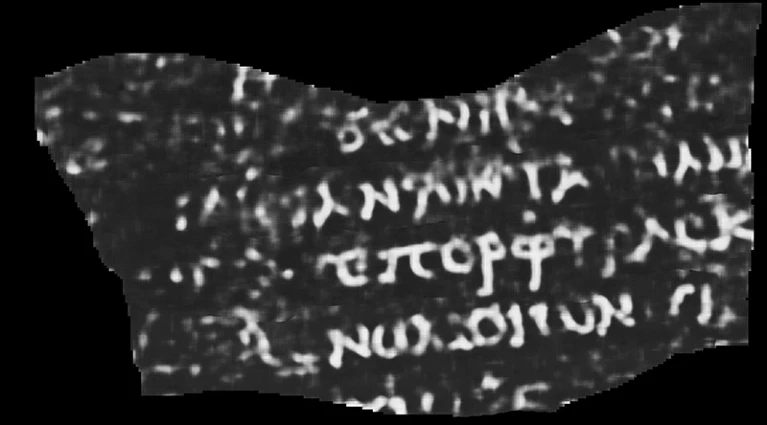
Let the debt be stated without hedging: this essay, and the work behind it, owes almost everything to Parmenides, Zeno, Heraclitus, and Epicurus, and almost nothing to the archaeological theory of the last century. And what astonishes me most is not how much they achieved but how little we needed to inherit. Their books are gone. What we have are fragments — quoted by enemies, buried under volcanic mud, recovered by the handful. Yet even these offcuts are sufficient to build a new way of seeing the world, and more than that, a new scientific way of seeing it — which is the most powerful form of understanding human beings have ever found. If fragments can do this, imagine what was lost. And imagine what is still to be found.
The Presocratics were not important because they anticipated modern conclusions. They were important because they asked, with unusual clarity, the questions required to begin a science at all. Physics and biology eventually followed those questions into matter and life. This programme is an attempt to follow them into technology and the human past with the same seriousness — and to discover whether archaeology, too, can finally become cumulative in the strong scientific sense rather than only in the archival one.
First in a series. This essay sets out the foundation underneath everything else on this site. The work — a physical theory of technology, is an attempt to make archaeology into a science in the way physics and biology are sciences — did not begin from any modern method. It began from the Presocratics and from Epicurus, and the procedure I followed is theirs, not a contemporary one. I have explained this before only in compressed, almost poetical form. Since the work now seems close to producing something real, it is time to set the background out plainly. The essays that follow take this foundation into the body, across the sciences, and finally to the stone itself.
Dylan Foley is an independent researcher based in Ireland working at the intersection of physics, archaeology, and evolutionary biology, through his company Industrial Automata. Parmenides fragments are quoted from John Burnet, Early Greek Philosophy (1892), Diels–Kranz numbering. The technical work these essays draw on is currently under peer review; details will follow on publication.
Companion conference paper: Foley & Furey, “From Geospatial Patterns to Ancient Signals: A Signal Based Framework for Archaeological Machine Learning” (IEEE Irish Signals and Systems Conference 2025, DOI: 10.1109/ISSC67739.2025.11291309).
Sometimes the fog of collective delusion clears and reveal the true nature of these human constructions we take so seriously. The pandemic of 2020 was one of these moments.
We are told that the COVID-19 pandemic ended sometime in 2022 or 2023, marked by the lifting of mask mandates and the resumption of “normal” life. This narrative is fundamentally mistaken, we are not beyond the pandemic—we are still within it, experiencing not its acute phase but its chronic psychological and political aftermath. More precisely, we are witnessing a massive societal reaction formation: an attempt to deny the pandemic’s reality by systematically dismantling every structure and acknowledgment that might confirm its existence.
This reaction is not random. It follows predictable psychological patterns rooted in conservative-authoritarian psychology, particularly among those driven by fears of uncertainty, loss of control, and contamination—both literal and metaphorical.
The pandemic performed an act of revelation: it demonstrated with brutal clarity that society is only as strong as its philosophical foundation, that monetary systems can be unraveled by a virus, that the seeming certainties of daily life rest on extraordinarily fragile foundations. For people oriented toward order, hierarchy, and certainty—what George Lakoff terms the “Strict Father” worldview—this revelation was not merely frightening, but intolerable.
Why the West Is Uniquely Vulnerable
Before examining what the pandemic revealed, we must understand why its revelation proved so catastrophic for Western consciousness specifically.
The answer lies in a fundamental belief structure pervading Western thought: dualism—the conceptual splitting of reality into binary opposites – fundamentally separate categories of human/nature, mind/body, culture/biology, spiritual/material. The core concept is that of a material and non-material existence underlying everything we observe. It can be contrasted by a monistic belief system, in which all things are in one category, for example all things are material.
The belief is referred to as an ontology – the science of enquiring what is it that exists, or can or cannot exist. An ontology underpins all our other knowledge by providing fundamnetal categories into which we sort the world. They most often are not consciously held beliefs, but underly our knowledge of the world. Hence theyare pervasive, affecting all og human knowledge in any given society. Whether we believe the universe contains only one interconnected whole, or is split into two disconnected types of being colours everything we think about. The west chose dualism.
This dualistic belief is deeply embedded in Western religious and philosophical traditions, and creates a specific vulnerability. The classic example of western thought derived from dualism is the splitting of mankind from nature. We see this in economics and in current climate debates, where there is a great difficulty in persuading large sections of the population that human action can influence the planets climate. We see the concepts in social sciences and economics where human business and monetary systems are not rooted in ecological knowledge, they are human specific, and therefore separate to nature/ Natural systems are treated as optional to engage with. This serves the extraction of natural resources and the ever increasing maximisation of profits very well, but every so often, Nature decides to remind us of its presence.
When a natural disaster strikes, when nature suddenly cannot be kept separate from the human world, when biology overwhelms culture, this entire psychological construction of reality threatens to collapse.
Dualism: The Deep Structure of Western Thought
Dualistic thinking characterises Western consciousness at levels so fundamental they operate largely unconsciously. In religious thought, this manifests as the split between spirit and matter—the immaterial soul separate from mortal flesh—and the distinction between Heaven and Earth, where the divine realm exists apart from the natural world.
Good and Evil are positioned as cosmic forces in eternal opposition, leading to binary binary concepts of Salvation versus Damnation. Crucially for our purposes, humanity is conceived as created in God’s image, separate from and dominant over nature itself.
Philosophical dualism mirrors these religious structures. The Cartesian mind-body split puts res cogitans (thinking substance) as fundamentally different from res extensa (extended substance). Reason is set against passion for example, with the rational mind expected to control the irrational body and emotions.
Culture is distinguished from Nature, with human civilisation understood as transcending natural determinism. The perceiving Subject is fundamentally separated from the perceived Object—the self as something apart from the world it observes.
In economic thought, dualism becomes particularly consequential. The Economy is conceived as separate from the Environment, with economic activity understood as distinct from natural systems. This separation enables the concept of “externalities”—environmental costs that are literally external to economic calculation. This allows the cost of industrial capitalism to be ignored by dumping waste and pollution into nature, where it basically ceases to exist from the point of view of economic calculation.
Growth is positioned against natural limits, with human economic expansion imagined as separate from natural constraints and therefore infinite.
This dualistic paradigm provides enormous psychological advantages for those operating within it. It enables an elite to mobilise lanour and act as if the economy is separate from natural determination, allowing populations to imagine themselves as exempt from biological constraints. It allows the systematic ignoring of natural limits, since “externalities” can be externalised indefinitely. So we dump material into the ocean and presume it will never return.
In its roots in ancient religious philosophies, it may have provided certain useful outcomes to help societies to survive. Societies with extremely limited understanding of the planet and systems of life in which they were embedded. It provides psychological escape from biological vulnerability through the promise that the soul transcends the body. It justifies hierarchy by suggesting that those more “spiritual” or “rational” have authority over those more “natural” or “material.”
And critically, it enables capitalism as currently practiced, treating nature as a resource separate from the human economy rather than as an integrated system.
The entire Western project of modernity rests on this dualistic foundation: the progressive separation of humanity from nature.
The Pandemic’s Assault
COVID-19 didn’t merely present a biological threat—it threatened, by demonstrating that nature and humanity are not, and never were, separate it threatened the core beliefs of very large sections of human populations.
As a natural pathogen shut down human civilisation with ruthless efficiency, suddenly nature overwhelmed the economy, as microscopic viral replication rendered economic “laws” and financial engineering irrelevant.
Material reality suddenly trumped abstraction, no amount of capital manipulation could remove physical vulnerability. The “external” became internal as environmental factors—air quality, ventilation, population density—suddenly determined who would live and who would die. Peoples minds, considered outside nature, were now affected by physical infection that produced psychological trauma, “brain fog,” and lasting cognitive impairment.
For any person whose consciousness was structured by dualism, this wasn’t just frightening—it was potentially devastating to their entire understanding of reality. The fundamental categories structuring society revealed themselves as illusory constructs with no basis in truth. For a person or group in this position there was only two responses, accept the collapse of their world view, or deny it was even happening.
Why Asia Proved More Resilient
This helps explain why Asian societies, while sharing human psychology’s universal features, demonstrated greater resilience to pandemic social disruption. Many Asian philosophical and religious systems operate from fundamentally monistic or non-dualistic ontologies that never separated humans from nature.
For example Buddhism teaches interdependent co-arising—pratītyasamutpāda—recognizing no fundamental separation between self and world, mind and body, humanity and nature.
Taoism emphasizes the unity of opposites, with the natural way (Dao) encompassing all phenomena without fundamental divisions.
Confucianism offers a relational ontology where individuals are defined by their relationships within natural and social orders rather than as separate autonomous subjects.
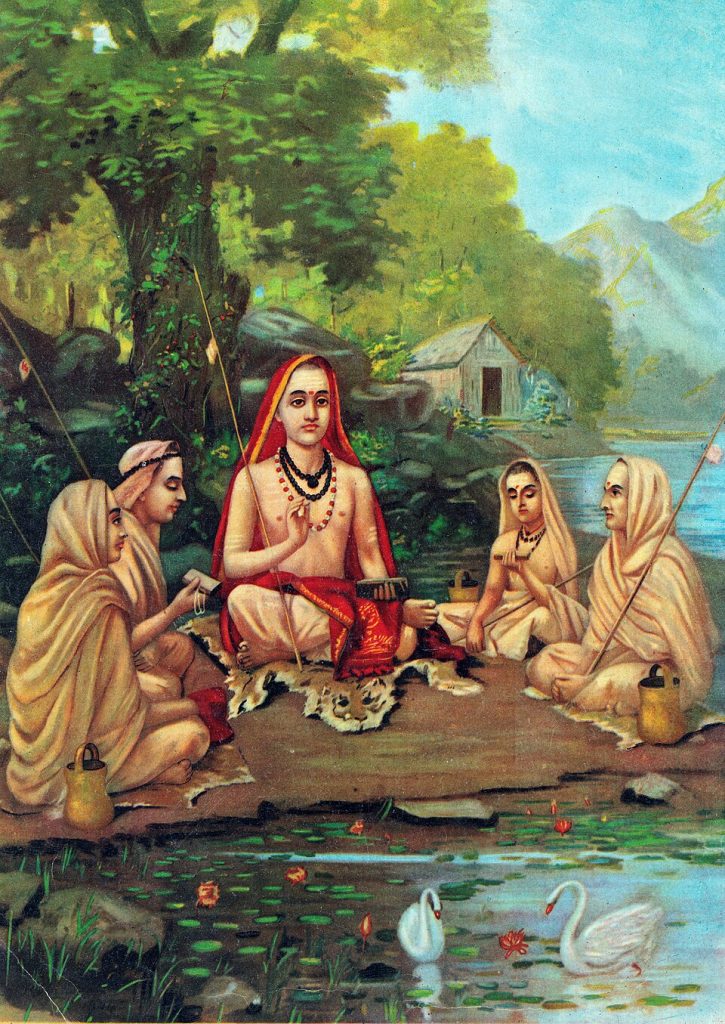
Vedantic Hinduism teaches non-dualism (Advaita), viewing apparent separations as illusory (Maya), with underlying reality unified in Brahman. The term Advaita (अद्वैत) literally means “not-two”, forming a very close analogy with the concepts we are discussing here. .
Adi Shankara, the most prominent exponent of Advaita Vedānta tradition. “I am other than name, form and action. My nature is ever free! I am Self, the supreme unconditioned Brahman. I am pure Awareness, always non-dual.” Adi Shankara, Upadesasahasri 11.7 Wikipedia
These philosophies never suggested humanity could or should transcend biological reality. Natural disasters, epidemics, and human vulnerability were integrated into worldviews.
When the pandemic struck, Asian populations could respond pragmatically to biological threat without experiencing the collapse of their mental model of the world. Masks, social distancing, and collective action didn’t threaten core worldviews because those worldviews never promised escape from nature in the first place.
The Western Exception: The Apeiron and Science
Importantly, Western thought isn’t uniformly dualistic. Significant monistic traditions exist, though they’ve been consistently marginalised in the political sphere. Or have been subject to attack for the reasons we are discussing.
Monism was in the philosophy of the west from the start. Inspired by the Ancient Egyptian cosmology the Greek Milesian School of Thales and Anaximander posited a single fundamental substance—whether water, air, or the boundless apeiron—underlying apparent diversity.
Everything is generated from apeiron and there its destruction happens. Infinite worlds are generated and they are destructed there again. And he says (Anaximander) why this is apeiron. Because only then genesis and decay will never stop.
— Aetius I 3,3<Ps.Plutarch; DK 12 A14.>
Early Greek natural philosophers—the Pre-Socratic Physiologoi like Parmenides, Heraclitus, and Empedocles—developed sophisticated monistic ontologies.
Parmenides conceived of reality as unified, unchanging Being, with apparent divisions as illusory. Heraclitus saw unity through constant change and transformation, recognizing opposites as interdependent rather than fundamentally separate.
We can speak and think only of what exists. And what exists is uncreated and imperishable for it is whole and unchanging and complete. It was not or nor shall be different since it is now, all at once, one and continuous.
–Parmenides Fragment 6 – 5th Century BC
These thinkers established monistic foundations for natural science itself, understanding nature through observation and reason rather than supernatural explanation, and recognizing underlying unity beneath surface diversity.
Modern science emerged from these monistic foundations, not dualistic ones. But it did so only recently in the 17th century with the rediscovery of these ancient Greek texts in transmitted form, such as the poem of LucretiusDe Rerum Natura.
Scientific method requires humanity as part of nature subject to natural laws, knowledge gained through empirical observation of material reality, recognition of causal connections across apparent boundaries, and unity of explanation across domains. To put it simply, the west spent almost a thousand years with an incorrect foundational concept and so pursued the transmutation of one thing into another, alchemy. But the breakthrough of understanding of matter did not happen until the atomic theory of the Greek philosophers was recovered.
The greatest scientific advances occur when dualistic boundaries collapse: Darwin showing humanity continuous with nature, neuroscience revealing mind as brain process, ecology demonstrating organism-environment unity, systems biology showing no clear individual-environment boundary. Even these sciences suffer from issues defining the boundaries.
Yet Western religious and philosophical traditions repeatedly reasserted dualism against these monistic insights.
Plato, misunderstanding either on purpose or by accident the entire corpus of Greek thought up to his life, positioned perfect Forms as separate from the imperfect material world. Recreating a dualistic philosophy in an instant, which was to be enormously influential on subsequent religions and cults. Platonic dualism and Christian theology reinscribed soul-body division, the saved-damned binary, and the supernatural-natural split.
in the 17th century Descartes Cartesian philosophy reinscribed mind-body dualism at modernity’s very foundation. While science was to cling to the ancient Greek concepts of the atom, and to revolutionaise our understanding of the universe, in the political and power sphere, the medieval religios dualism held sway, and so the curriculum was split, into humanities and sciences, as humans, being spiritual beings differebt from animals and made in the image of God, were to be in a category apart from nature. And so it is even now.
And so, as industrial capitalism developed it treated nature as an exploitable resource separate from human economy. This reassertion served power structures: dualism justifies hierarchy (spiritual rulers over material workers), exploitation, as nature is a separate resource, and authority, priestly or rational classes mediating between realms.
The Pandemic as Broken Dualism
But in the late December of 2019 and the early months of 2020, nature proved iself not to be separate to humans after all. The true believer sin the market and the reality of finance were left reeling a s the “externality” of the environment invaded economic reality with devastating force.
Now we can begin to understand the pandemic’s devastating psychological impact on Western populations.
When no amount of willpower, prayer, or positive thinking could prevent infection. Hierarchy proved non-protective as elites initially caught COVID like everyone else, regardless of wealth or status.The spiritual-material boundary dissolved as churches became superspreader sites and faith failed to immunize believers.
Individual autonomy proved illusory when survival required collective action and acknowledgment of biological interdependence.
This collapse was most catastrophic for those whose worldviews most depend on dualistic philosphies: religious conservatives for whom spiritual-material dualism is fundamental to theology; free-market fundamentalists whose ideology requires economy-nature separation to ignore natural limits; individualists who require the self-world boundary to remain absolute; and authoritarians whose hierarchical structures are justified by dualistic claims of superiority—the rational over the emotional, the civilised over the natural.
But much of human populations acted in counter-intuitive ways, often against their own interest, and also often actually died because of this behaviour.
people doubled down in a process known to psychology as reaction formation. when the anxiety produced by approaching the thought of the nature divide being dissolved – the anxiety is severe enough to be suppressed and instead the person engages in ritualistic denial of the reality of the pandemic. The rituals may involve refusing to wear masks. We may think of rising anxiety at any thought that threatens the dualistic underpinnings of a persons reality, and lessening anxiety at anything that seems to reinforce the boundary. Lets see how this plays out.
Reaction Formation as Restoration Project
When a very deeply believed model is under threat, it causes massive cognitive dissonance. Whats happenming in the world and whats possible in the persons model of the world do not match. This causes real anxiety, and in many an impossible to resolve dilemma.
Because dualism’s collapse threatens their entire psychological and social construction of reality. They did the only rational thing in the circumstance.
They denied it was happening.
Every element of the denial makes sense as an attempt to restore the certainty of the world before an invisible nature invaded and threatened to collapse. Operating mostly below conscious awareness, people moved to excape the anxiety caused, not be fear of the disease, but by the fear of the dissolution of certainty.
Confronted by Covid-19, instead of accepting it, the first goal of many became to to deny nature’s power. So began the essentially ritual acts to make nature return to its proper place, tto subordinate it to the higher spiritual plane of human existence.
For example, minimising a viral threat reassures the mind that nature cannot overwhelm the human world. Rejecting masks and distancing implies nature cannot dictate human behavior. Refusing vaccines asserts that nature cannot enter the sovereign body. The overarching aim is to restore nature as a separate, controllable “externality”—safely distant from human affairs. And with each magical deinal of its power they would feel some relief from the exisstential anxiety, even when this behaviour meant it was more likely they would be harmed or die from the virus.
An entire mass movement then sprung up to reassert the spiritual-material boundary. Attacks on medical science reject material explanations in favor of spiritual or moral ones. Promoting faith healing reasserts spiritual primacy over biological reality.
Blaming deaths on moral failure rather than biological infection reframes the pandemic in spiritual rather than material terms. In each case the goal is to restore soul-body dualism and reinstate spiritual authority over scientific expertise.
Others strove to restore the individual-collective boundary. Resisting public health mandates reasserts individuality separated from nature against the reality of biological connection.
Framing collective action as tyranny denies the reality of interdependence. Emphasising personal choice while ignoring biological connection aims to restore the individual as ontological foundation, despite the pandemic’s clear demonstration that we are fundamentally interconnected biological beings.
To reinforce human-nature separation large parts of the population ignored environmental factors externalises air quality and ventilation as somehow separate from human health. ie – if we weer to act on air quality it would be to admit that the pandemic was real and that nature and humanity are one system and that we must act and organise society and knowledge systems according
Resisting building upgrades denies that material conditions determine outcomes.
Each seemingly irrational behaviour, even ones that hastened peoples demise, by causing them to catch and sometimes be overwhelmed by the virus, is logical if we see it as a reaction to the implications of the virus on human society and its structure.
Promoting “return to normal” attempts to restore pre-pandemic dualism as if the revelation never occurred. The goal is to re-externalise nature, positioning it once again as separate from the human world rather than integrated with it.
The threat to the current social hierarchy, which also must be protected at all costs.
The fifth goal reestablishes hierarchy as naturally ordained. Electing authoritarian leaders attempts to restore protective fathers who can master nature through strength.
Attacking expertise reasserts political over scientific authority, restoring traditional hierarchies.
Blaming vulnerable populations for their suffering restores hierarchical order by suggesting natural superiority.
The goal here is to restore dualistic justification for social stratification—positioning dominance as reflecting spiritual or rational superiority rather than mere power.
This isn’t merely psychological defense—it’s a concerted attempt to reinforce the philosophical underpinnings of western societies.. The pandemic broke reality’s fundamental structure (as experienced through dualistic consciousness), and so every denial, every resistance and every attack on science serves the project of reassembling that structure.
We can see the link between the virus and how it could threaten immediately to overturn societies accepted norms, something that would have meant that the old social orders would indeed be replaced, and the current dominant religiously based belief systems that have maintained dominance in the west would be overwhelmed.
Ancient Parallels: Politics or Priesthoods?
We can gain a glimpse here into ancient responses to natural disasters and their role in the creation of priesthoods, kings. The propitiation of gods represents early humanity’s solution to dualism’s failures. Ancient societies experiencing catastrophe—floods, earthquakes, plagues, famines—faced the same ontological crisis: nature overwhelming human world, demonstrating the dualistic boundary’s porosity.
The solution was ritual restoration through specialized social technologies. Priests emerged as specialists in managing the nature-supernatural boundary. Kings claimed divine authority that bridged spiritual and material realms. Sacrifice ritually fed nature or gods to restore separation and appease threatening forces. Propitiation involved bargaining with supernatural powers to keep nature at bay. Scapegoating purged the “contamination” that had breached protective boundaries. These weren’t merely superstitions—they were ontological technologies for restoring dualistic order after natural disasters revealed its fragility.
The contemporary parallel follows the same functional pattern, though in modern forms. Political strongmen serve as divine-right kings promising protection from nature’s threats. Evangelical leaders function as priests managing the spiritual-material boundary through faith rather than reason. Scapegoating China, the WHO, and medical “elites” purges contamination that breached the human sphere. Ritual resistance through anti-mask and anti-vaccine stances provides symbolic restoration of individual autonomy. Propitiation through denial bargains with reality to restore dualism—if we simply refuse to acknowledge nature’s power, perhaps it will retreat to its proper separate sphere. The form has changed but the function is identical: restore the broken ontological boundary at any cost.
C.P. Snow, Karl Popper, and the Two Cultures
C.P. Snow’s famous “Two Cultures” lecture (1959) identified this dualism’s persistence in modern intellectual life—the split between scientific and humanistic cultures, between material and spiritual/aesthetic domains. Snow saw this split as dangerous, preventing society from addressing technological challenges.
But Snow didn’t fully grasp that this “two cultures” division reflects deeper ontological dualism. It’s not merely that scientists and humanists don’t communicate—it’s that dualistic ontology creates incompatible frameworks:
Science requires monism: Unified explanation across domains, material causation, empirical verification
Humanistic dualism requires separation: Free will separate from determinism, values separate from facts, meaning separate from mechanism
Karl Popper’s Contribution:
Popper’s philosophy of science implicitly recognized this tension. His falsificationism requires:
Hypotheses subject to empirical refutation (material reality independent of desire)
Open criticism and testing (no privileged authority or revealed truth)
Provisional knowledge (no final separation from uncertainty)
This is fundamentally incompatible with dualistic thinking that reserves sacred domains immune from material investigation.
Now we understand why attacks on science are so central to the reaction formation. Science represents monistic ontology in its fundamental methods and assumptions. It positions humanity as part of nature, subject to natural laws rather than exempt from them. It generates knowledge through material investigation rather than revealed truth. It builds uncertainty and revision into its method, refusing the comfort of absolute certainty. No domain remains exempt from empirical inquiry—including consciousness, spirituality, and human nature itself. Scientific disciplines demonstrate interdisciplinary unity, recognizing no fundamental boundaries between fields of investigation.
For dualistic consciousness, science poses an existential threat. It systematically collapses the boundaries dualism requires. Natural selection connects humans to nature, eliminating the human-animal divide. Neuroscience studies consciousness materially, dissolving the mind-body split. Ecology demonstrates organism-environment unity, showing individuals as porous and contextual. Systems biology reveals no clear boundary between individual and environment. Each scientific advance further undermines dualistic ontology.
Therefore, restoring dualism requires attacking science itself. This explains phenomena that otherwise seem irrational: rejecting climate science maintains economy-nature separation by denying that economic activity affects environmental systems.
Denying evolution maintains human-nature separation by insisting humans are fundamentally different from other life forms.
Resisting pandemic science maintains body-spirit and individual-collective separations by refusing to acknowledge biological vulnerability and interdependence.
Attacking medical expertise maintains hierarchy of faith over empirical knowledge, reasserting spiritual authority over material investigation. Each attack serves the project of ontological restoration, protecting dualism against scientific monism’s corrosive effects.
The Path Forward: Embracing Monistic Ontology
Understanding dualism as the root vulnerability suggests a solution—though one most resistant to hearing it would reject. Monistic ontology requires recognizing humanity as continuous with nature rather than separate from it, accepting biological vulnerability as inherent rather than transcendable through will or faith, acknowledging interdependence as reality rather than collectivist ideology, integrating economy and ecology rather than externalizing nature as mere resource, building with nature rather than against it through pandemic-resistant architecture, and accepting uncertainty as fundamental to existence rather than something to be overcome through control or denial.
This proves extraordinarily difficult because it requires abandoning not just psychological comfort but entire civilisational foundations. Capitalism as currently practiced requires treating nature as an externality that can be exploited without consequence. Abrahamic religious frameworks depend on spirit-matter dualism for their core theological claims. Liberal individualism requires the atomistic self as its foundation, denying the reality of biological and social interdependence. Hierarchical authority structures require dualistic justifications—positioning some as naturally superior through greater rationality or spirituality. The modern progress narrative requires the fantasy of transcending nature through technological mastery. Abandoning dualism means reconstructing civilisation from foundations upward.
Yet this is precisely what modern science demands. Contemporary ecology, systems biology, neuroscience, epidemiology, and climate science all converge on monistic insights that cannot be reconciled with dualistic ontology. Organisms and environments co-constitute each other rather than existing as separate entities. Individual boundaries are porous and contextual rather than absolute and fixed.
Mind and body are inseparable aspects of unified biological systems. Human and natural systems are integrated rather than separate spheres. Health is systemic and relational rather than individual and isolated. Each scientific advance makes dualism less tenable, revealing it as an obstacle to understanding rather than a reflection of reality.
The Extreme Dangers of Religious Ontology in Public Policy
When dualistic religious ontology shapes policy during pandemics, the consequences prove systematically catastrophic. Biological reality gets denied in favor of spiritual explanations for material processes. Effective responses get rejected because collective action threatens dualistic individualism and hierarchical authority. Scientific expertise gets suppressed as it threatens religious authority’s claims to truth. Vulnerable populations get blamed through moral rather than biological explanations for their suffering. Long-term planning becomes impossible when restoration fantasy replaces adaptation to changing reality.
The result is not merely bad policy—it’s systematically selecting for civilisational failure. Societies embracing monistic ontology can adapt to biological reality by acknowledging human integration with natural systems. Societies clinging to dualism cannot adapt without first breaking the dualism—leaving them the choice of breaking the dualism or breaking against reality itself. And this is where we are right now.
The West’s Dilemma
Western civilisation faces a fundamental choice that’s almost certainly too difficult to make consciously:
Option One: Maintain Dualism
Continue denying nature’s integration with human world
Keep externalizing environmental costs
Preserve hierarchical authority structures
Result: Eventual catastrophic collapse when reality overwhelms denial
Option Two: Abandon Dualism
Accept monistic ontology and its implications
Rebuild institutions on realistic foundations
Result: Requires abandoning core civilisational structures—capitalism, individualism, traditional religion as currently practiced
The first option is psychologically easier but materially catastrophic. The second is materially necessary but psychologically impossible for most.
This is why the pandemic’s psychological aftermath is so dangerous specifically in the West: the civilisation most structurally dependent on dualistic ontology faces the most fundamental threat from its collapse.
The Pandemic’s Revelation: Society as Constructed Reality
Money, Authority, and the Illusion of Solidity
The pandemic stripped away the veneer of permanence from modern social systems with shocking speed. Within weeks of COVID-19’s emergence, mechanisms that seemed immutable revealed themselves as contingent constructions. Monetary systems traditionally presented as natural laws of economics were suddenly suspended—governments printed money at unprecedented scales, implemented rent moratoriums, and provided direct cash payments to citizens through actions previously declared impossible.
Work structures that management insisted required physical presence in offices evaporated overnight, exposing decades of organisational dogma as mere preference rather than necessity. Property rights, typically treated as sacrosanct, became negotiable when eviction moratoriums challenged the fundamental relationship between ownership and control. Educational hierarchies collapsed as prestigious universities scrambled to deliver online instruction indistinguishable from community colleges, undermining carefully constructed status differentials.
This wasn’t a temporary suspension of normal rules—it was a revelation that the “normal rules” were always social constructions maintained through collective agreement and power structures, not natural or inevitable orders. A microscopic pathogen had demonstrated that human social organisation is artificial, contingent, and vulnerable after all.
The Fragility of the Constructed Order
For individuals whose psychological architecture depends on perceiving the world as ordered, hierarchical, and stable—characteristics that decades of research link to conservative ideology—this revelation was catastrophic. Research consistently shows that political conservatism correlates with intolerance of uncertainty and ambiguity, need for cognitive closure and order, threat sensitivity and anxiety about chaos, and preference for familiar social structures over novel arrangements. The pandemic didn’t merely present a biological threat—it performed a metaphysical assault on worldviews premised on stability, predictability, and the permanence of social hierarchies.
When conservatives witnessed governments creating money “out of thin air” to prevent economic collapse, when they watched traditional gender and work roles dissolve as parents juggled childcare and remote work, when they observed that the emperor of modern capitalism truly had no clothes, the cognitive dissonance was profound and intolerable.
Conservative Psychology and the Pandemic Response
The Strict Father Model and Pathogen Threat
George Lakoff’s “Strict Father” model provides crucial insight into conservative pandemic response. This model conceptualises conservative morality through the metaphor of a traditional patriarchal family where the father figure represents absolute moral authority, providing protection and enforcing discipline. Obedience to hierarchy becomes paramount for maintaining social order. Self-discipline and self-reliance emerge as primary virtues that must be cultivated through strict upbringing. The world is viewed as inherently dangerous, requiring strong authority to maintain order against chaos and evil. Weakness invites chaos and breakdown, therefore strength—including moral strength—must be constantly demonstrated to prevent social dissolution.
When applied to the pandemic through the “Nation-as-Family” metaphor, this model creates profound tensions. The virus represented a threat that couldn’t be disciplined into submission, that didn’t respect hierarchy, that made everyone equally vulnerable regardless of moral fortitude or obedience to authority.
Research on the “behavioral immune system” (Schaller, 2006; Schaller & Park, 2011) suggests that pathogen threats typically make people more socially conservative, promoting conformity and traditional values as disease-avoidance strategies. Yet COVID-19 produced a paradoxical response: American conservatives became less likely to perceive the virus as threatening, less anxious about infection, and less compliant with protective measures (Calvillo et al., 2020; Kerr et al., 2021).
The Politicisation of Uncertainty
This paradox resolves when we understand that acknowledging the virus’s threat meant acknowledging the failure of the strict father model to protect. Research from 2020 showed:
Political conservatism predicted lower perception of COVID-19 threat despite conservatives’ typical threat sensitivity (Tyson, 2020)
Self-uncertainty among conservatives predicted polarized threat perceptions rather than unified response (uncertainty-identity theory)
Conservative politicians and media systematically minimized viral threat to maintain authority credibility
The choice was stark: admit that reality had overwhelmed the protective capacity of strong leadership and traditional structures, or deny the reality that created this unbearable cognitive dissonance. Many conservatives chose denial.
Fear of Contamination: Literal and Metaphorical
Conservative psychology has long been associated with heightened disgust sensitivity and fear of contamination (Inbar et al., 2012; Terrizzi et al., 2010). This manifests not just in concerns about physical pathogens but in metaphorical contamination—fears of cultural mixing, immigration, and social change “polluting” traditional society.
The pandemic created a peculiar inversion: the literal contamination threat (COVID-19) was minimised, while metaphorical contamination fears intensified. Mask mandates and vaccines—protective measures against literal contamination—were framed as metaphorical contamination: government overreach “infecting” individual liberty, medical authority “contaminating” bodily autonomy, and social distancing “polluting” traditional community bonds.
This inversion makes psychological sense within the strict father framework: accepting medical authority over the paterfamilias’s judgment represented a greater threat to the hierarchical order than the virus itself. The driving force being that to embrace remedies to the virus, would be to admit the reality of the pandemic, and thereby threaten the psychological model of society as outside nature. Ao the pandemic was denied by refusing to respond rationally to it. If theres no response, then it doesnt exist. Truly magical thinking. But perfectly in line with our thesis of denial to uphold a dualistic world view and avoid the profound anxiety that challenging that would cause.
Authoritarian Family Structures and State Authority
From Family to Nation: The Transfer of Authority
Lakoff argues persuasively that conservative political ideology extends the strict father family model to governance through the “Nation-as-Family” metaphor. Just as the father provides protection and enforces discipline within the family, strong leadership should protect citizens and enforce social order. The pandemic, however, created an impossible bind for this model:
Medical experts (not political authority figures) possessed the relevant knowledge
Collective action (not individual strength) offered the best protection
Interdependence (not self-reliance) proved necessary for survival
Hierarchy failed to control an indifferent pathogen
For authoritarian personalities who transfer the strict father model from family to state, this failure was intolerable. Research on Right-Wing Authoritarianism (RWA) by Bob Altemeyer shows that high RWAs exhibit:
Submission to established authorities they perceive as legitimate
Aggression toward those who violate established norms
Conventionalism: rigid adherence to traditional social norms
The pandemic violated all three dimensions. Medical authorities recommended unprecedented social changes; the virus forced violations of traditional norms (gatherings, face-covering, physical distance); and established political authorities (particularly in countries like the United States) were revealed as inadequate to the biological challenge.
The Authoritarian Response: Reasserting Control
When external reality threatens the authoritarian worldview, the typical response is not adaptation but intensified commitment to authoritarian solutions. The pandemic triggered precisely this dynamic through a predictable sequence. First comes denial of threat legitimacy—if the virus isn’t genuinely dangerous, then no authority failure occurred and no adaptation is required. Next arrives blame displacement, attacking medical experts, public health officials, and “liberal” pandemic responses rather than acknowledging systemic vulnerability. Then follows symbolic reassertion of control through resisting masks, vaccines, and restrictions as demonstrations of autonomy and strength rather than capitulation to biological reality. Finally comes the search for strong leaders who promise to restore the pre-pandemic order rather than adapt to new realities, leaders who will make the threatening complexity disappear through force of will.
This explains the seemingly paradoxical finding that intolerance of uncertainty—typically associated with conservative ideology—didn’t directly predict pandemic compliance. Instead, political partisanship mediated the relationship: conservatives dealt with pandemic uncertainty not through precautionary measures but through allegiance to political authorities who denied the uncertainty’s legitimacy.
The Ongoing Reaction: “Putting the Genie Back in the Bottle”
The Systematic Denial Project
We are currently experiencing a coordinated, if not always conscious, campaign to deny the pandemic’s reality by eliminating every trace of its impact and every structure that acknowledges its ongoing presence. This manifests across multiple domains simultaneously.
Medical infrastructure faces systematic dismantlement. There is widespread resistance to upgraded building codes requiring improved ventilation, refusal to retrofit public spaces with air filtration systems, opposition to architectural paradigms that account for airborne pathogen transmission, dismantling of pandemic surveillance and early warning systems, defunding of public health agencies and positions, and sustained attacks on medical expertise as inherently suspicious.
Scientific authority undergoes coordinated erosion. Vaccine hesitancy and denial persist despite overwhelming efficacy evidence. Conspiracy theories proliferate about medical establishment motives. Public health measures get reframed as authoritarian control rather than disease mitigation. Epidemiological modeling and evidence face dismissal as politically motivated. Growing distrust in medical institutions reflects a broader pattern—trust in science among conservatives has declined steadily from 1974 to 2010. This erosion has an ontological dimension: science represents monistic ontology that collapses dualistic boundaries, making it an existential threat to worldviews dependent on nature-culture separation.
Memory undergoes active suppression. Pandemic memorials and acknowledgments disappear rapidly from public spaces. Social pressure builds against discussing ongoing COVID impacts. Pandemic deaths get reframed as “inevitable” or “acceptable losses” rather than preventable tragedies. Long COVID and chronic health impacts face systematic minimisation. Return-to-office mandates deny lessons about remote work viability, erasing institutional knowledge gained during the acute phase.
Political reaction accelerates these trends. Elections increasingly favor explicitly anti-public-health officials. Legislative restrictions limit future public health emergency powers. Book bans target pandemic-related educational materials. In some jurisdictions, attacks on medical freedom of speech constrain what health professionals can publicly recommend.
This isn’t merely partisan politics—it’s a psychological project to restore the pre-pandemic ontology where social systems seemed permanent, hierarchies appeared natural, and authority figures could guarantee safety through strength and discipline.
The Architectural Denial
Perhaps most concerning is the refusal to acknowledge that the current disease waves are enabled by a global urban environment connected through air travel that creates optimal conditions for pathogen adaptation. Without systemic changes to this environment—improved air filtration, better ventilation standards, architectural designs that account for airborne transmission—pathogens will continue to adapt to this conducive environment.
The waves will continue. They will likely intensify. Yet the same psychologies that drove pandemic denial now prevent the infrastructural changes that might mitigate future outbreaks. To upgrade building codes or retrofit structures would be to admit that the pandemic revealed genuine vulnerabilities requiring ongoing attention—an admission that threatens the fantasy of restored stability.
Historical Parallels: The 1918 Spanish Flu
The Aftermath of Mass Death
The 1918-1919 influenza pandemic killed approximately 50-100 million people worldwide—more than World War I. Its psychological and social effects offer instructive parallels to our current moment. Recent research reveals that social trust erosion proved permanent and transgenerational. Experiencing the pandemic likely had lasting consequences for social trust that persisted across generations. Americans whose ancestors experienced the 1918 flu in their countries of origin display lower levels of social trust even a century later. The mechanism was clear: the “textbook case of utter failure of health care institutions both in containing the spread of an epidemic and in providing effective care” created a climate of general mistrust. Survivors reported that authorities’ incompetence during the crisis permanently altered their beliefs about institutional reliability—beliefs they passed to descendants.
Remarkably, the Spanish Flu quickly disappeared from public discourse after 1920. Historian Alfred Crosby noted this collective amnesia in his seminal 1976 work, later reissued as America’s Forgotten Pandemic. The pandemic was ignored by periodicals and textbooks for decades. This silence wasn’t accidental—it reflected a societal need to forget a catastrophe that revealed governmental inadequacy and social vulnerability. We’re witnessing a similar dynamic today, though on a compressed timeline. The speed at which COVID-19 has been relegated to “history” despite its ongoing presence mirrors the rapid forgetting after 1918.
The Spanish Flu’s mental health impacts were severe and lasting. Asylum hospitalisations for mental disorders attributed to influenza increased by an average factor of 7.2 in the six years following the pandemic. Survivors reported depression, mental distraction, sleep disturbances, and difficulty coping with work. Influenza death rates significantly correlated with increased suicide rates during 1918-1920. A marked rise in neurological diseases followed, suggesting long-term biological impacts on mental health. The “massive and sudden loss of life plunged many into a chronic state of helplessness and anxiousness.” Thirty-one thousand children in New York City alone lost one or both parents in November 1918. This scale of loss created trauma that permeated society.
Paradoxically, the Spanish Flu also catalyzed positive changes. Workers’ protests following the pandemic led to fundamental changes in social policy. The origins of developmental and welfare states emerged from the combination of pandemic and war. Women’s agency increased as they joined the workforce in greater numbers—from 18% in 1900 to 21% in 1920 in the United States. The 19th Amendment granting women’s suffrage passed in 1920. Yet these progressive changes occurred alongside social upheaval and violence, abandonment of the sick and dying, breakdown of funeral rites and community bonds, and a climate of suspicion and distrust that characterised the period “and long after.”
Key Differences from Today
Two critical differences distinguish COVID-19’s context from 1918. First, the media environment differs fundamentally. The 1918 pandemic occurred during wartime censorship, limiting information flow. Today’s pandemic unfolded in an environment of instant global communication, social media, and unprecedented information access—yet this has paradoxically enabled more effective disinformation campaigns rather than more informed responses. Second, institutional trust levels were inverted. The Spanish Flu struck populations with relatively high institutional trust that subsequently eroded. COVID-19 struck populations—particularly in the United States—where institutional trust was already deeply compromised, accelerating existing political polarisation rather than creating new divisions.
Historical Parallels: The Black Death (1348)
The Ultimate Pandemic
The Black Death of 1348-1350 killed between one-third and one-half of Europe’s population—perhaps 25-50 million people. Its psychological impact offers insights into how societies respond to existential biological threats:
1. Breakdown of Social Bonds
The plague created such terror that fundamental human relationships dissolved:
People abandoned friends and family, fled cities, shut themselves off from the world
Funeral rites became perfunctory or stopped entirely
The sick and dying were abandoned by doctors and family members
Bodies littered streets for days, with no one willing to collect them
Social fabric tore apart as fear overcame communal bonds
This breakdown wasn’t mere selfishness—it was psychological collapse in the face of incomprehensible horror. As one chronicler noted, “the blow struck the world with immense terror.”
2. Crisis of Authority and Meaning
The Black Death shattered existing frameworks of understanding:
Religious authority failed: Prayer didn’t prevent sickness and death. Mass death among clergy undermined the Church’s moral authority. People turned to mysticism and extremism, seeking alternative explanations.
Medical authority failed: Physicians proved helpless. Their reliance on ancient texts and traditional remedies offered no protection. This failure planted seeds for eventual scientific revolution.
Social hierarchy collapsed: The plague killed nobles and peasants alike initially, though the wealthy eventually learned to isolate themselves. The traditional belief that social position reflected moral worth was exposed as fiction.
Worldview disintegration: People “knew—or thought they knew—how the world worked.” The plague destroyed this certainty, forcing a “complete reevaluation of the existing paradigm of received knowledge.”
3. The Search for Scapegoats
Unable to comprehend the disaster, populations sought human agents to blame:
Jews were massacred across Europe under the conspiracy theory that they had poisoned wells. Thousands were burned alive in at least two hundred towns.
Foreigners, beggars, and lepers faced systematic persecution as suspected plague carriers.
Women and marginalized groups were targeted as witches or moral pollutants causing divine punishment.
This pattern—seeking human enemies when confronted with biological threat—mirrors contemporary conspiracy theories about COVID-19 origins, bioweapons, and deliberate infection campaigns.
4. Psychological Transformation
The Black Death produced lasting psychological changes:
Preoccupation with death: Art turned dark, featuring widespread imagery of “danse macabre” (dance of death) showing death as a skeleton choosing victims randomly.
“Live for the moment” mentality: The uncertainty of survival created a mood of “Eat, drink, and be merry, for tomorrow you may die.”
Reduced faith in traditional institutions: Both religious and secular authority permanently lost credibility.
Peasant revolts: Survivors, recognizing their increased value in a labor-scarce economy, challenged aristocratic power (the Peasants’ Revolt of 1381 in England, for example).
The Systemic Response Failure
Critically, the Black Death persisted because medieval society lacked the conceptual framework and institutional capacity to address systemic vulnerability:
No germ theory meant no understanding of transmission mechanisms
No public health infrastructure meant no coordinated response
Religious explanations (divine punishment) prevented rational mitigation
Urban design (dense populations, poor sanitation) created ideal conditions for plague bacteria
The plague recurred for centuries because societies couldn’t acknowledge and address the environmental and infrastructural factors enabling its spread.
We face a parallel situation. COVID-19 revealed that our globally connected urban environment creates optimal conditions for pandemic disease. Yet the same psychological resistances that prevented medieval societies from addressing urban design now prevent us from acknowledging that air travel, inadequate ventilation, and crowded spaces create conducive environments for pathogen adaptation and transmission.
The Vulnerable West: Democracy’s Weakness Against Psychological Reaction
The Authoritarian Advantage
Western democracies face unique vulnerabilities during this ongoing pandemic reaction:
1. Exploitation by Authoritarian Leaders
The psychological need for “strong fathers” who promise to restore pre-pandemic order makes populations vulnerable to authoritarian appeals. We observe:
Electoral success of explicitly anti-public-health candidates
Cult-of-personality politics around leaders who deny pandemic impacts
Symbolic strength displays (anti-mask, anti-vaccine stances) valued over competent governance
Attacks on expertise framed as populist resistance to “elites”
Research on the Trump phenomenon showed how appeals to strict father authority resonated with voters facing uncertainty. During pandemic conditions, this dynamic intensified.
2. Opportunistic Billionaire Capitalism
The pandemic created unprecedented wealth transfer to billionaires while working populations suffered. This inequality has been leveraged to:
Fund anti-public-health political movements (e.g., Koch network backing mask/vaccine opposition)
Resist workplace safety improvements that might reduce profits
Lobby against building code upgrades requiring better ventilation
Promote “return to normal” narratives that prioritize economic activity over health
The strict father model’s emphasis on self-reliance and resistance to “handouts” provides ideological cover for policies that benefit wealthy elites while harming working populations.
3. Feudal Powers Capitalising on Turmoil
Authoritarian states and reactionary movements have exploited pandemic-induced chaos to:
Undermine democratic institutions through disinformation campaigns
Promote anti-science narratives that weaken Western technological advantage
Encourage political polarization that paralyzes effective governance
Model authoritarian “efficiency” in pandemic response (despite questionable actual effectiveness)
Russia and China, in particular, have actively promoted anti-vaccine disinformation in Western countries while mandating vaccination in their own populations—a strategic undermining of adversary capabilities.
4. The Democratic Disadvantage
Democracies’ fundamental strengths—transparency, freedom of expression, responsive governance—become weaknesses during crises that trigger authoritarian psychology:
Transparent reporting of deaths and failures undermines confidence
Freedom of expression enables disinformation campaigns
Responsive governance to diverse constituencies creates policy incoherence
Respect for individual liberty prevents effective coordination
This isn’t an argument for authoritarianism—authoritarian regimes’ pandemic failures were often worse despite information control. Rather, it highlights that democracies face particular vulnerabilities when significant portions of their populations experience psychological needs for authoritarian “strong fathers” who promise simple solutions to complex threats.
The Downward Spiral
The combination of these factors creates a self-reinforcing cycle:
Pandemic reveals systemic vulnerability
Vulnerability triggers authoritarian psychology in portion of population
Authoritarian psychology resists structural changes that might address vulnerability
Unaddressed vulnerability enables continued disease spread
Continued spread creates more uncertainty and fear
More uncertainty and fear strengthen authoritarian appeals
Authoritarian movements gain power, further preventing adaptive response
This cycle, if unbroken, leads toward either:
Gradual democratic degradation as authoritarian movements incrementally erode democratic institutions, or
Catastrophic collapse when accumulated vulnerabilities enable a crisis that overwhelms weakened systems
The Infrastructural Imperative We’re Ignoring
The Conducive Environment
The contemporary pandemic pattern emerges from specific material conditions:
1. Global Urban Network
Densely populated cities provide large susceptible populations
International air travel connects these populations within hours
Shared air systems in buildings facilitate transmission
Return-to-office mandates concentrate people in inadequate spaces
Global distribution enabling variants to spread before immunity develops
3. The Adaptation Race
Human adaptive responses (vaccines, treatments) must compete with viral evolution in an environment optimized for the virus. This is analogous to running a race while giving your opponent a head start and favorable terrain.
The Interventions Not Happening
Addressing this conducive environment would require:
1. Architectural Revolution
Universal air filtration (HEPA or equivalent) in public buildings
UV-C germicidal irradiation in HVAC systems
Ventilation standards updated for airborne pathogen transmission
Global coordination constrains national sovereignty
3. They Require Collective Action
The interventions needed are fundamentally incompatible with strict father ideology’s emphasis on:
Individual responsibility over collective response
Self-reliance over interdependence
Minimal government over coordinated governance
Free-market solutions over regulated change
4. They Cost Money Now for Future Benefit
Strict father morality emphasizes:
Present discipline over future investment
Earned rewards over preventive spending
Punishment of weakness over systemic change
Personal responsibility for vulnerability
Investing in infrastructure to prevent future pandemics requires precisely the opposite orientation.
The Misdirection of Capital: Techno-Utopianism as Pandemic Escapism
Elon Musk and the New Futurism
In the midst of this psychological crisis, we witness a peculiar phenomenon: vast sums of capital flowing toward fantastical technological “solutions” rather than practical infrastructural improvements. Elon Musk’s pivot toward humanoid robots—the promise that artificial workers will solve all problems and render pandemic vulnerabilities irrelevant—represents the apotheosis of techno-utopian escapism.
This bears striking parallels to the futurism of the 1920s and 1930s. Following the trauma of World War I and the Spanish Flu pandemic, that era saw:
Investment in spectacular projects rather than public health infrastructure
Charismatic industrialists as visionary heroes (Henry Ford, Thomas Edison)
Faith that technology would transcend human vulnerability and social problems
Then, as now, this futurism served a psychological function: it promised escape from uncomfortable realities rather than adaptation to them. The 1920s-30s futurism collapsed into the Great Depression and World War II—crises that revealed the inadequacy of technological fantasies disconnected from material and social infrastructure.
The Humanoid Robot Fantasy: Emotionally Driven, Infrastructurally Impossible
Musk’s humanoid robot project exemplifies emotionally driven techno-utopianism rather than realistic technological development:
1. The Missing Foundation
Humanoid robots operating at scale would require:
Automated maintenance systems capable of servicing millions of robots
Robust data infrastructure far exceeding current capacity
Open systems and standardized protocols enabling interoperability
Reliable power grids and charging infrastructure
Supply chains for parts, repairs, and upgrades
Regulatory frameworks and safety systems
Educational institutions training maintenance workers
Economic systems adapted to mass automation
None of these foundational layers are receiving the investment flowing toward the robot fantasy itself. This is analogous to promoting flying cars while roads remain full of potholes—the spectacular vision disconnected from mundane prerequisites.
2. The Ecosystem Requirement
Humanoid robots represent an apex technology requiring a complete supporting ecosystem:
The current data infrastructure is already “creaking”—inadequate for present demands, much less for billions of autonomous robots requiring constant connectivity and updates. Without this ecosystem, humanoid robots are non-functional props, technological cargo cults worshipping imaginary capabilities.
3. The Impractical Reality
We can demonstrate the impracticality through basic analysis:
Energy requirements: Humanoid robots require enormous power. Where will this come from when current grids struggle with existing demands?
Maintenance burden: Mechanical systems fail. Who maintains robots when we can’t maintain existing infrastructure?
Data transmission: Real-time robotic operation requires massive bandwidth. Current infrastructure can’t support this at scale.
Part manufacturing: Complex robots need precision components. Supply chain fragility was exposed by pandemic disruptions—how would robot supply chains fare?
Skill requirements: Operating and maintaining robots requires technical expertise. Our educational systems aren’t producing these workers.
The humanoid robot fantasy reveals itself as emotionally rather than rationally motivated: a desire for magical solutions that make pandemic-revealed vulnerabilities disappear, without the hard work of addressing actual systemic problems.
Capital Flowing to Father Figures, Not Infrastructure
The pattern is clear: vast sums flow toward charismatic “father figures” who promise technological salvation—Musk, Bezos, Zuckerberg—while practical infrastructure investments languish:
Funded Fantasy Projects:
Humanoid robots ($billions)
Mars colonization ($billions)
Neural interfaces ($billions)
Cryptocurrency systems ($billions)
Virtual reality “metaverses” ($billions)
Unfunded Practical Needs:
Building ventilation upgrades ($inadequate)
Public health surveillance systems ($defunded)
Water infrastructure ($crumbling)
Electrical grid modernization ($insufficient)
Public transportation ($neglected)
Pandemic-resistant architecture ($non-existent)
This misallocation isn’t accidental—it’s psychologically motivated. The fantasy projects promise:
Escape from biological vulnerability: If we colonize Mars or upload to machines, pandemics become irrelevant
Technological transcendence: Solutions that don’t require acknowledging present failures
Strong father figures: Charismatic leaders who promise to solve everything
Restoration of control: Technology as means to dominate nature rather than adapt to it
Individual salvation: Personal technological enhancement rather than collective infrastructure
These are precisely the promises that strict father psychology craves: strength, control, transcendence, and individual rather than collective solutions.
The Contrast: What Real Investment Would Look Like
Compare the humanoid robot fantasy with realistic technological applications addressing actual pandemic vulnerabilities:
Building Automation and Safety:
Automated HVAC systems with pathogen-detecting sensors and responsive filtration
UV-C disinfection robots for large spaces (already proven technology)
Air quality monitoring networks with public dashboards
Ventilation optimization AI using occupancy sensors and predictive modeling
Touchless interfaces for elevators, doors, and building systems
These technologies exist. They’re practical. They’re affordable at scale. They would actually reduce pandemic transmission. Yet they receive a fraction of investment compared to humanoid robot fantasies.
Infrastructure Automation:
Automated water quality monitoring preventing contamination
Self-healing electrical grids with distributed generation and storage
Predictive maintenance systems for bridges, roads, and tunnels
Automated waste management improving sanitation
Public health data integration enabling early outbreak detection
Again—proven technologies, practical applications, genuine benefits. Yet they lack the emotional appeal of humanoid servants, so capital flows elsewhere.
Open Systems and Interoperability:
The humanoid robot vision, if it were serious rather than fantasy, would prioritize:
Open-source robotic operating systems enabling diverse manufacturers
The 1920s futurism collapsed not because the visions were impossible in principle, but because they were disconnected from material reality. Flying cars are technically feasible—but not while roads crumble. Robot servants are possible—but not without the maintenance ecosystem to support them.
Today’s techno-utopianism suffers the same disconnect. Humanoid robots are theoretically achievable—but not while data infrastructure creaks, electrical grids fail, and we refuse to invest in the foundational layers that would make them possible. We may build them, but they will rapidly end up on the scrap heap as soon as something like a pandemic collapses precarious corporate monopoly supply chains.
The Authoritarian Bargain
This misdirection of capital represents a bargain between populations seeking strong fathers and billionaires seeking power:
What Populations Get:
Comforting fantasies of technological salvation
Charismatic leaders promising simple solutions
Spectacles distracting from present failures
Permission to deny uncomfortable realities
What Billionaires Get:
Concentration of wealth and power
Freedom from regulation and accountability
Public subsidy of private projects
Status as visionary heroes rather than extractive oligarchs
This bargain is catastrophically bad for humanity’s long-term survival, but it satisfies immediate psychological needs for those who can’t tolerate pandemic-revealed truths.
Conclusion: Charting a Path Forward
Still Inside, Still Falling—But Not Without Agency
We remain inside the pandemic—not its acute phase but its chronic political and psychological crisis. The original pathogen revealed uncomfortable truths: that society is constructed rather than natural, that hierarchies can’t protect against indifferent biology, that interdependence is not weakness but reality. Most fundamentally, it collapsed the dualistic ontology structuring Western consciousness—the illusory separation of humanity from nature, culture from biology, spirit from matter.
For psychologies oriented toward authority, hierarchy, and certainty—and shaped by dualistic religious and philosophical traditions—these truths are unbearable. The current reaction—denying the virus’s significance, dismantling public health infrastructure, attacking medical expertise, electing authoritarian leaders, investing in escapist technological fantasies—represents an attempt to restore the pre-pandemic dualistic ontology by eliminating all evidence that it was ever disrupted.
This ontological restoration project ensures we will face worse pandemics in the future. By refusing to acknowledge that our globally connected urban environment creates optimal conditions for pathogen evolution, by resisting the architectural and infrastructural changes that might mitigate transmission, by dismantling the scientific and public health capacity to respond effectively, by directing capital toward fantasies rather than practical solutions, and most fundamentally by clinging to dualistic ontology that requires denying humanity’s integration with nature, we are actively constructing the conditions for catastrophe.
The Historical Pattern and Its Breaking
The historical parallels are stark. After the Black Death, Europe took 150 years to recover demographically and experienced social upheavals (peasant revolts, religious reformation, breakdown of feudalism) that transformed civilisation. After the Spanish Flu, social trust eroded for generations, mental health impacts persisted for years, and the pandemic was rapidly forgotten—only to recur in new forms.
Yet history also shows that societies can adapt, though usually only after catastrophic failures force acknowledgment of reality:
The Black Death ultimately broke feudalism and enabled new social forms
The Spanish Flu contributed to welfare state development and women’s enfranchisement
The 1930s-40s crises eventually produced public health infrastructure and social safety nets
The question is whether we must wait for catastrophe to force adaptation, or whether we can choose reality over comforting fantasy.
What Realistic Forward Movement Requires
A genuine path forward demands rejecting both the denial that claims the pandemic is over and the escapism that promises technological transcendence without foundation:
1. Acknowledging Material Reality
The pandemic revealed systemic vulnerabilities that remain unaddressed
Social systems are constructed and can be reconstructed
Hierarchy and authority cannot protect against biological threats
Collective action and infrastructure investment are necessary
Most fundamentally: Humanity is not separate from nature; dualistic ontology is illusory and dangerous. We must embrace monistic ontology recognizing our integration with biological and ecological systems.
2. Redirecting Capital Flows
Away from:
Escapist technological fantasies
Concentration in authoritarian figures
Proprietary closed systems
Spectacular projects with no foundation
Toward:
Building ventilation and air quality systems
Open-source automation and monitoring
Distributed and resilient infrastructure
Public health surveillance and response capacity
Educational systems for maintenance and operation
Democratic control of technological development
3. Building the Maintenance Ecosystem
Before advanced automation becomes realistic, we need:
Automated systems for maintaining infrastructure (water, power, data, transport)
Open standards and interoperable protocols
Distributed manufacturing and repair networks
Technical education at scale
Regulatory frameworks for emerging technologies
Economic models supporting transition
This is unglamorous work. It lacks the emotional appeal of humanoid servants or Mars colonies. But it’s the actual foundation for any advanced technological future—and it would address present pandemic vulnerabilities.
4. Confronting Psychological Resistance
The hardest challenge is psychological:
Populations seeking strong fathers must learn to tolerate uncertainty
Strict father psychology must acknowledge limits of authority and strength
Individualist ideologies must accept interdependence as reality
Escapist fantasies must yield to engagement with present problems
Uncomfortable truths must be faced rather than denied
This may be impossible at scale. Psychological patterns established in childhood and reinforced across lifetimes rarely change voluntarily. Entire populations may be incapable of the adaptation required.
Two Paths, Two Futures
We face a bifurcation:
Path One: Continued Denial and Escapism
Capital flows to fantasies and authoritarian figures
Infrastructure continues deteriorating
Pandemic waves continue and intensify
Authoritarian movements gain power
Eventual catastrophic collapse or degradation into permanent crisis
Path Two: Reality-Based Adaptation
Acknowledge pandemic-revealed vulnerabilities
Invest in practical infrastructure and open systems
Develop collective capacity for coordinated response
Create political and economic systems resistant to authoritarian capture
The choice seems clear. Yet the psychological barriers to Path Two may be insurmountable for many. Those who need strong fathers and comforting certainties will continue seeking them, regardless of consequences.
What Must Break
For genuine adaptation to occur, something must break:
Either, the dualistic ontology breaks: Recognition that humanity/nature separation is illusory, requiring wholesale reconstruction of philosophical, religious, economic, and political systems
or
The denial breaks and reality becomes impossible to ignore, forcing acknowledgment of monistic ontology
the systems break, then continued failure creates collapse that enables rebuilding on monistic foundations
and the psychology breaks: Enabling enough people to achieve the difficult work of embracing interdependence and uncertainty
The first option would be preferable but requires abandoning core Western belief structures—it would be a transformation as profound as the shift from medieval to modern worldview. The second and third are increasingly probable as climate change and future pandemics compound. The fourth may be happening among some populations but seems unlikely at scale sufficient to prevent catastrophe.
The deeper truth: Until Western consciousness confronts its dependence on dualistic ontology and the impossibility of maintaining that dualism in the face of ecological and epidemiological reality, all other reforms remain superficial. You cannot build pandemic-resilient civilization on foundations that require denying biological integration. You cannot address climate change while maintaining economy/nature separation. You cannot create sustainable systems while clinging to human/natural dualism.
The Bottom Line
We are not beyond the pandemic. We are not recovering from the pandemic. We are failing to respond—and ensuring worse ones to come.
The waves will continue. The pathogens will adapt. The infrastructure will remain inadequate. Capital will flow to escapist fantasies and authoritarian figures. And populations seeking psychological comfort through “strong fathers” and technological transcendence will become increasingly vulnerable to precisely the disasters those authorities promise to prevent.
The ontological dimension makes this particularly acute for the West: Clinging to dualistic ontology that requires separation from nature, Western civilization systematically selects against adaptation to biological and ecological reality. Each denial, each attack on science, each refusal to acknowledge interdependence serves the project of maintaining an illusory ontology—even as maintaining that illusion guarantees catastrophic failure.
The genie cannot be forced back into the bottle. Reality cannot be restored through denial. Humanoid robots will not save us while buildings lack adequate ventilation. Mars colonies will not rescue humanity from pandemic vulnerability on Earth. And dualistic ontology cannot be maintained in a world where nature demonstrably overwhelms the “separate” human sphere.
But the attempt will continue, with each denial deepening the vulnerability it seeks to escape, with each misdirected billion making practical solutions less achievable, with each reassertion of dualism making monistic adaptation more psychologically impossible, until something breaks: either the ontology, the denial, the systems, or the psychology maintaining them.
The tragedy is that we know what practical responses would look like. The technology exists. The knowledge exists. The philosophical foundations exist in both ancient Greek monism and Asian non-dualistic traditions. What lacks is the capacity to abandon dualistic ontology—to choose boring infrastructure over exciting fantasy, to tolerate uncomfortable truths over comforting illusions, to invest in collective resilience over individual transcendence, to accept humanity’s fundamental integration with nature rather than cling to illusory separation.
History suggests this capacity typically emerges only after catastrophe. The Black Death broke feudalism. The World Wars broke empires. Perhaps the cascading crises of climate change and pandemic waves will break dualism.
We can hope this breaking comes before complete collapse. But dualistic consciousness, precisely because it’s unconscious and pervasive through Western education, politics, religion, and thought, may prove more resistant to reality than the civilisations built upon it.
The pandemic isn’t over. It’s just beginning to transform us—revealing the fundamental ontological structure that makes Western civilisation uniquely vulnerable to biological reality. Whether that revelation produces adaptation or collapse remains to be seen.
References
Aassve, A., Alfani, G., Gandolfi, F., & Le Moglie, M. (2020). Epidemics and trust: The case of the Spanish Flu. Health Economics.
Calvillo, D. P., Ross, B. J., Garcia, R. J., Smelter, T. J., & Rutchick, A. M. (2020). Political ideology predicts perceptions of the threat of COVID-19. Frontiers in Psychology, 7, 1119.
Gauchat, G. (2012). Politicization of science in the public sphere: A study of public trust in the United States, 1974 to 2010. American Sociological Review, 77(2), 167-187.
Hibbing, J. R., Smith, K. B., & Alford, J. R. (2014). Predisposed: Liberals, conservatives, and the biology of political differences. Routledge.
Inbar, Y., Pizarro, D. A., Iyer, R., & Haidt, J. (2012). Disgust sensitivity, political conservatism, and voting. Social Psychological and Personality Science, 3(5), 537-544.
Jost, J. T., & Amodio, D. M. (2012). Political ideology as motivated social cognition: Behavioral and neuroscientific evidence. Motivation and Emotion, 36(1), 55-64.
Jost, J. T., Glaser, J., Kruglanski, A. W., & Sulloway, F. J. (2003). Political conservatism as motivated social cognition. Psychological Bulletin, 129(3), 339-375.
Jost, J. T., Nosek, B. A., & Gosling, S. D. (2008). Ideology: Its resurgence in social, personality, and political psychology. Perspectives on Psychological Science, 3(2), 126-136.
Kerr, J. R., Panagopoulos, C., & van der Linden, S. (2021). Political polarization on COVID-19 pandemic response in the United States. Personality and Individual Differences, 179, 110892.
Lakoff, G. (1996). Moral politics: How liberals and conservatives think. University of Chicago Press.
Mamelund, S. E. (2003). Effects of the Spanish influenza pandemic of 1918-19 on later outbreak of mental disorders in Norway, 1926–1929. Epidemiology, 14(S26).
Schaller, M. (2006). Parasites, behavioral defenses, and the social psychological mechanisms through which cultures are evoked. Psychological Inquiry, 17(2), 96-101.
Schaller, M., & Park, J. H. (2011). The behavioral immune system (and why it matters). Current Directions in Psychological Science, 20(2), 99-103.
Terrizzi, J. A., Shook, N. J., & McDaniel, M. A. (2013). The behavioral immune system and social conservatism: A meta-analysis. Evolution and Human Behavior, 34(2), 99-108.
Tyson, A. (2020). Republicans, Democrats move even further apart in coronavirus concerns. Pew Research Center.
Van Prooijen, J. W., & Douglas, K. M. (2017). Conspiracy theories as part of history: The role of societal crisis situations. Memory Studies, 10(3), 323-333.
Van Prooijen, J. W., & Douglas, K. M. (2018). Belief in conspiracy theories: Basic principles of an emerging research domain. European Journal of Social Psychology, 48(7), 897-908.
Update of 2014 article Dualism: The “Great Divide” in the Philosophy of Archaeology.
“They made up their minds to name two forms, of which they must not name one—in this they have gone astray.”
Parmenides of Elea
Archaeology is a discipline in philosophical crisis, charged with creating a narrative, the story of our species evolution, it seeks to further understanding of how, and why, our species unique history unfolded. But, while documenting change in human history proceeds with reasonable success, progress in understanding the mechanisms driving this change has been painfully slow. As Cambridge archaeologist Colin Renfrew points out, archaeology can explain the “when and where” but not the “how and why” of events in the past (Renfrew, 2004). Answering the how and why is now a matter of increasing urgency as humans are of such overwhelming ecological significance.
Explaining “how and why” requires a theoretical archaeology from which to generate hypotheses, something that has not happened yet. This essay discusses why integration of archaeology with science at a theoretical level has proved so difficult.
Archaeology, on the whole, has been described as exhibiting disjuncture, a lack of correspondence between what passes for theory and what archaeologists actually do or aim to do (Johnson, 2006). It is recognised that archaeology, in common with most of the social sciences, has no coherent theoretical basis (Johnson, 2006) and that the ensuing systemic incoherence actively blocks progress, both within the subject, and between it and other disciplines . To grasp why archaeology cannot explain the phenomena it catalogues, a short historical detour is in order.
The Incomplete Revolution
In broad historical context the source of this disjuncture can be traced to underlying issues inherited from the western adherence to dualistic Platonic/Christian philosophies. Familiar in academia as the Two Cultures described by C.P. Snow decades ago (Snow, 1959), these paradigms define an ontological separation of humans from the environment, and by logical extension those phenomena once thought to be unique to humans like cognition, society, language. Progress in intervening years has resulted in a confusingly fragmented interface between the humanities and sciences. Archaeology now finds itself stretched awkwardly across this interface
The criterion of a successful integration of archaeology with evolutionary theory is the ability to create empirically testable hypotheses generated from evolutionary theory, the parsimonious theory of change applicable to a science of archaeology (Dunnell, 1971). The “Scientific Revolution” pioneered by Copernicus and Galileo in the 16 th and 17 th centuries was nothing more than the application of the monistic materialism of the Ancient Greek physiologoi to the phenomena of the heavens and the composition of non-living materials, an application that immediately revolutionised physics, cosmology and chemistry.
But the fields to which this application of philosophy remained limited, through compromise with Christian and Aristotelian sensibility both biology and the humanities were largely bypassed by the new sciences. Philosophers and theologians, arguing against the possibility that physical or mechanical laws could have given rise to the complexity of life, maintained the separate causation of biological systems and there concomitant properties.
Thus dualism effectively isolated organisms, including humans, from the physical causal chain of natural science, preventing integration with physics and rendering them unamenable to scientific investigation. Within biology this was corrected in part by Lamarck in 1801 with evolution and Darwin in 1859 with natural selection bringing life forms in general within the remit of natural science.
But again the application was incomplete, this time, humans and all phenomena thought to be unique to humans, were left sacrosanct, resulting in the separation of the humanites and sciences that was such a prominent feature of the 20th century structure of faculties.
Archaeology developed predominantly within the social science departments of colleges and therefore inherited a powerful underlying dualistic philosophy. A philosophy essentially medieval in character.
Philosophy in the social sciences inherits oppositional constructs such as mind/ body, natural/artificial, culture/nature and so on, leading to phenomena that monistic approaches posit as biological in origin, for example, language or cognition, to be defined instead as immaterial epi – phenomena, meaning they exist outside or beyond the “natural” material environment. It need hardly be said that once something is construed as “immaterial”, it is hardly likely to be amenable to scientific enquiry.
Effects
t is hard for us now to understand the medieval resistance to the motion of the earth, but it stems, I believe, from an identical problem and sheds some light on the kind of process I have in mind here. Firstly, as the earth was deemed special and therefore categorised as ontologically separate from the rest of the universe, explanation of its origin and state could not, and indeed should not once one is operating within these constraints, be linked to other observed systems or objects. Therefore observations of phenomena in the wider universe were not deemed relevant to the earth. This very effectively stymied research into the origin and history of the planet. Secondly, ontological isolation required that it also must be static, because that which moves must interact and such interaction was unthinkable, as the earth was fundamentally separate from the rest of creation. Hence, we look in wonder at intelligent protaganists in these old debates arguing what seems now so obviously absurd. But to uphold the medieval paradigm as it was, they were forced to defend the indefensible.
nd just as the logic of Aristotelian physics could not countenance the motion of the earth, modern dualistic philosophy freezes humans within the environment and this is the reason our models are not dynamic but static. Archaeological data remains isolated and because of this also must remain static. So, despite repeated calls for dynamic models, no such models can be constructed. The problem remains below decks, in the philosophical engine room so to speak, and far below the awareness of archaeological theory as it now stands.
As archaeologists we should be concerned with change and consequently our most useful evolutionary perspective is one that emphasises adaptation as a dynamic process rather than as a static state.”
(Mithen, 1990:p8
n keeping with this, neither have developments in physics, such as relativity or non-linear dynamics, been possible to incorporate within archaeological theory, not because of unwillingness, but because it is philosophically prevented. Therefore archaeological data remains isolated, inaccessible and cannot be digitised or held on a database that allows universal integration.. And so our ability to generate data is unimpeded, but or ability to record and manipulate data is extremely limited. There is no translation through scales and patterns of change over large spans of space and time cannot be effectively studied. This situation has become increasingly untenable as the sciences advance and archaeology does not, highlighting more and more the inadequate nature of its philosophical basis.
The Broken Inference Chain
The archaeological inference chain has been severed by this same problem. Archaeology must infer human behaviour and development from the technological record, an inference that must be made directly across the paradigmatic boundary discussed above. Practically speaking, the inference must be drawn from a-biota (tools etc) and applied to biota (humans), but it is precisely between living and non-living systems that dualism splits our fields, and so it is at this point our models can be predicted to break down.
And this is what we see, processes occurring across the boundary have been impossible to define, and exist only as the archetypal “black box” categories of social science. Vaguely defined areas such as technology and culture, both of which straddle the boundary, endure as obscure, undefined categories of phenomena, with the result that they are therefore generally omitted from process models
Splitting the Data Stream
If it is true that the problems within archaeology stem from this paradigmatic source then we should expect effects across a wide range of disciplines whenever they attempt to cross the divide. And it is the case that problems integrating biotic and a-biotic phenomena are not unique to archaeology. Similar difficulties have occurred within biology, ecology, neuroscience and complex systems theory. We see isolation, freezing effects and curious mirror like errors whenever synthesis is attempted, which I believe are the effects of this underlying dualism
Intriguingly, confusion over the units of replication or the selective process seem to mirror each other in biology and archaeology. Sitting on opposite sides of the divide and looking at the same phenomena from a different perspective, the dualist ontology functions like a prism that bifurcates the data streams within each discipline and between them causing what I can only describe as a double image or reflection where their should be a single system.
For example, ecological system models must include the a-biotic environment as well as the life forms that are the studies focus, but this has proved curiously troublesome. Odling Smee and Laland, the proponents of niche construction, reached similar conclusions as to the neglect of active processes. Their focus on the active, dynamic interactions of a creature with its environment are of course correct. I believe they identified the same freezing effect prevalent in archaeology, in other words, the life forms they study are inherently static in system models that include the wider environment.
The model described here would predict just such an outcome. It would also predict that phenomena identified across the divide are split by the underlying dualism so that they will manifest as a reflection, or doubling of processes on ones own side of the divide.
An example of this is that after their identification of niche construction, Odling Smee and Laland then posited it as a second parallel process to natural selection “we shall have to recognize that evolution depends not on one, but on two general selective processes: natural selection and niche construction” Odling Smee et. al. have been criticised for this claim as it has been pointed out that it is unnecessary and unparsimonious to suggest a second major selective process operating within evolution. The identification (or misidentification) of phenomena as parallel replicators or selective processes is, I believe, a manifestation of the distortion effect of dualism, simply because the data becomes un-integratable and therefore a second process or force must be created to account for the seemingly parallel, but unconnected, phenomena observed.
Similarly, the memes proposed by Richard Dawkins (Dawkins, 1976) are characterised as replicative units under selection, a parallel selection process. And again this has been criticised as unecessary and unparsimonious addition to evolutionary theory, as well as a false analogy. But what is of interest here is that Dawkins felt the need to propose a parallel process for phenomena that are beyond the dualistic divide from his native biology, and again they appear as a parallel reflection of phenomena studied in his own field.
In archaeology, the fact that technology is of central importance, places it right at the coalface of the great divide, consisting as it does of a system where inanimate matter is in contact with life forms. This means that any successful definition of technology must smoothly integrate information across the paradigm boundary, a process that can be predicted to fail under current philosophical conditions, as we have seen above. And indeed it remains the case that archaeology has failed to scientifically define technology or to integrate the study of its development with evolutionary science or indeed even physics.
How to define technology, for example, remains a complete mystery to archaeologists, as Lambros Malafouris has helpfully described.
“To exemplify, this territory is familiar, as when the hand grasps a stone and makes it a tool, yet it remains terra incognita, since — despite a long genealogy of analytic efforts— just what this grasping implies for the human condition remains elusive, and refuses to be read in the narrative fashion that hermeunetics have promised“
(Malafouris, 2004)
In traditional archaeology the focus has traditionally been on a single element in the system, the tool, the object or material, it has been increasingly realised this cannot be understood in isolation. Tool use, once the pride of the anthropocentric view, has been observed in increasing numbers of species, across taxa. chimpanzees, bottlenose dolphins, birds such as New Caledonian Crows. A fact putting pressure on archaeology to integrate explanation of human tool use with the many examples in the animal world.
“But the significance of tool use doesn’t lie in the fact of tools,” Hauser explains, “but rather in how they’re conceived and used.” (Hauser, )
Tools exhibit many of the features of biological selection, apparent design, bursts of increasing complexity over time, stasis, inheritance of characteristics and contingency. These features have puzzled many archaeologist and have led to many attempts to explain the development of technology using evolutionary theory, and again, remembering that this explanation must cross the paradigm divide, we might predict that, unless the deeper philosophical issues are dealt with first, these attempts will fail.
The result has been that archaeology has invariably run into the same effects as encountered in ecological and biological theory noted above. Cultural Transmission theory, Selectionist archaeology and Behavioural archaeology have all (falsely) posited parallel general forces of evolution, or parallel units of selection with the result that debate over what counts as a “unit of selection” in the evolution of technology has raged within the subject. (Boone and Smith, 1998, Lyman and O’Brien, 1998, Maschner, 1996). The outcome being merely that they are generally left only with the question, what is it that is being selected? And so archaeology remains just as theoretically isolated and fragmented as before. As Colin Renfrew has said “But we still seem a long way from any well-integrated view that can bring these disparate fields together.”
Conclusions
The occurrence of this remarkably similar problem in both archaeology and ecology reinforces, at least in my mind, the identification of the philosophical division between biota and a-biota at an ontological level as the source of these discontinuities. The important point is that the effect on data has been identical in both subjects, both have static descriptions of what are dynamic systems.
From these analogies, it is clear that something very similar is happening across a wide range of disciplines, when evolutionary theory is applied to across the paradigm boundary, it results in erroneous conclusions such as parallel replicators or processes parallel to natural selection. In this analysis, this does not occur because the approaches are wrong, but because the ontological framework to which they are being applied is incorrect, resulting in duplication, an effect indicative of a dualist paradigm interfering with our models. Stemming from a common source, these errors occur as mirror images of each other.
In this way inherited dualistic philosophies have resulted in subtle but profound shifts of emphasis in fields of research. So for example in biology and archaeology, the assumption that the environment is only that which is beyond the body leads to the search for sources of environmental change to be concentrated almost exclusively externally to the organism, and while the importance of behaviour is recognised in biology (Baldwin,189) it has been consistently underestimated (Odling Smee, Laland).
We can see that dualism, by forcing the separation of either the organism from the environment (archaeology), or the environment from the organism (ecology) creates our inability to integrate biotic and a-biotic phenomena into cohesive system models and results in a skewed emphasis across many disciplines.
Also, because the physical causal chain is broken, static linear models predominate across all disciplines, resulting in motion in general to be overlooked as an essential element in the environment. Therefore motion has not been, or cannot be, recognised or modelled as a part of the environment exerting its own unique selective force. Finally, models lacking motion of any kind, certainly cannot include attributes of motion such as relativity or scale and so these have not been addressed at all.
Recognising this, we may consciously proceed with the development of a revised philosophy beginning from a holistic approach. The need for which has been recognised in the call for non- dichotomous thinking from several scholars in the archaeological field (Hodder 1999; Thomas 1996, Webmoor, Witmoore, 2008). Similarly, calls from the natural sciences on the other side of the divide, consilience from biologist E. O. Wilson, or neuroscientist V. S. Ramachandran and numerous others show that physics, biology and the human sciences require synthesis.
It is hoped that archaeology, with its unique problems and perspectives in this area, spanning as it does this most ancient of divisions, may contribute to the new synthesis now being pursued across the life sciences. As ‘humanity begins with things’ (Serres with Latour 1995:166)…
“archaeology is in a prime position, a third space (which is yet to be articulated) with regard to the humanities and sciences, to set innovative and cutting edge intellectual agendas”
(Webmoor, Witmore, 2008)
Bibliography
Dunnell, R. C. (1971) Systematics in Prehistory New York: The Free Press. Dunnell, R. C. (1996a). Evolutionary Theory and Archaeology. In M. J. O’Brien (Ed.), Evolutionary Archaeology : Theory and Application (pp. 30-67). Salt Lake City: University of Utah Press. Dunnell, R. C. . Natural Selection, Scale, and Cultural Evolution: Some Preliminary Considerations (1996b) In M. J. O’Brien (Ed.), Evolutionary Archaeology : Theory and Application (pp. 24-29). Salt Lake City: University of Utah Press. Jeffares, B. The Scope and Limits of Biological Explanations in Archaeology (2002) Unpublished Thesis, Victoria University of Wellington. Laland, K.N., Odling-Smee, J. and Feldman, M.W. (2000). Niche construction, biological evolution, and cultural change. Behavioral and Brain Sciences, 23: 131-175. Mithen, S., 1998. Introduction, in Creativity in Human Evolution and Prehistory, ed. S. Mithen. London & NewYork (NY): Routledge, 1–15. Routledge Webmoor, T. and Witmore, C. L. (2008) ‘Things Are Us! A Commentary on Human/Things Relations under the Banner of a ‘Social’ Archaeology’, Norwegian Archaeological Review, 1 – 18. Renfrew, C., 2001a. Symbol before concept: material engagement and the early development of society, in Archaeological Theory Today, ed. I. Hodder. Cambridge: Polity Press, 122–40. (MA): MIT Press. Renfrew, C. & C. Scarre (eds.), 1998. Cognition and Material Culture: the Archaeology of Symbolic Storage. (McDonald Institute Monographs.) Cambridge: McDonald Institute for Archaeological Research. Malafouris, Lambros, The Cognitive Basis of Material Engagement: Where Brain, Body and Culture Conflate, Malafouris, L., 2003. Archaeology and Dissonance: Towards a Theory of Material Engagement. Paper presented at Radical Archaeology Theory Symposium (RATS), Binghamton, New York.
First in a three-part series introducing a groundbreaking approach to archaeological data science
Rathra, County Roscommon
The Hidden Patterns in Ancient Landscapes
Imagine standing in a field in County Roscommon, looking at what appears to be just another Irish pasture crossed by modern fence lines. But beneath your feet and etched into the landscape around you lie the traces of something far more ancient—circular earthworks, enclosures, and pathways that once formed part of a sophisticated territorial system spanning millennia.
This is Rathra, and it perfectly illustrates both the promise and the problem of modern archaeology. We can see the ancient patterns, but they’re overlaid, interrupted, and partially obscured by thousands of years of subsequent activity. Traditional archaeological recording treats this as discrete layers—Medieval here, Bronze Age there—creating disconnected snapshots that miss the deeper story.
What if we could read these landscapes like signals?
The Typological Trap
For over 150 years, archaeology has organized its data using categories inherited from the 19th century: “Bronze Age,” “ringfort,” “barrow.” These labels seemed logical when archaeology was primarily about museum collections and cultural chronologies. But they’ve become a prison.
Consider what happens when we try to apply machine learning to archaeological data structured this way:
Temporal relationships disappear into broad, arbitrary periods
Observed facts get mixed with interpretative assumptions
The result? Archaeological data that’s fundamentally incompatible with modern computational analysis. We’ve been trying to do 21st-century science with 19th-century data structures.
Archaeology as Signal Science
But there’s another way to think about archaeological remains: as degraded signals from past human activity.
Every stone circle, every earthwork, every scatter of pottery represents traces of ancient “motion patterns”—the systematic ways people moved through and organized their landscapes. These signals have been subject to natural decay, vegetation growth, later human activity, and countless other forms of interference. Our job as archaeologists becomes a form of inverse signal reconstruction: working backward from degraded traces to infer the original patterns that created them.
This isn’t just a metaphor. When we apply signal processing mathematics to archaeological data, remarkable patterns emerge that traditional methods simply cannot detect.
The SETI Connection
This approach aligns archaeology with some of the most cutting-edge science happening today. SETI researchers search for “technosignatures”—traces of technological activity across vast spans of space and time. They’re essentially doing inverse signal reconstruction on cosmic scales, trying to separate intentional patterns from natural noise.
Douglas Vakoch and other SETI scientists have called for archaeological input precisely because we face similar challenges: detecting degraded signals of intelligent activity across enormous temporal distances. The mathematical frameworks are surprisingly similar.
But where SETI looks outward for signs of non-human intelligence, archaeology looks backward for signs of our own species’ complex behaviors. We’re both trying to answer the fundamental question: How do you detect intention in noisy, incomplete data?
What This Makes Possible
By treating archaeological features as signals in a unified mathematical framework, we can:
Detect anomalies that reveal historical disruptions (like invasions) through negative correlations
Identify persistent patterns that span millennia, invisible to period-based analysis
Quantify uncertainty using probabilistic methods rather than hiding it behind labels
Scale analysis to continental or global datasets using automated pattern recognition
Integrate seamlessly with remote sensing, climate data, and astronomical datasets
A New Kind of Archaeological Science
In our upcoming research publication, we demonstrate this approach using 6,000 years of data from northwest Ireland. The results are remarkable: we can detect territorial boundaries that persist from the Neolithic through the Medieval period, identify the signatures of different political federations, and even automatically detect invasive territorial patterns like the Norman conquest—all from spatial data alone, without relying on historical records or typological classifications.
This represents the emergence of a genuinely new archaeological science: one that can operate at the scale and precision demanded by contemporary global challenges, from understanding long-term environmental adaptation to modeling resilient territorial systems.
What’s Next
In our next article, we’ll dive into the technical breakthrough that makes this possible: treating time as space within a 3D mathematical framework that transforms temporal relationships into geometric ones. This seemingly simple shift opens up entirely new ways of reasoning about archaeological data.
The third article will walk through our Ireland case study, showing how 6,000 years of human territorial behavior becomes visible when viewed through this new lens—and what it tells us about the deep continuities underlying apparent historical change.
This isn’t just a new method—it’s a new way of seeing the past.
Dylan Foley is a researcher in archaeological data science at Atlantic Technological University, working under the supervision of Dr. Eoghan Furey. Together, they are developing new approaches at the intersection of machine learning, signal processing, and landscape archaeology that bridge archaeology with SETI research, planetary science, and advanced computational methods.
Next: “Treating Time as Space: A New Framework for Archaeological Machine Learning”