Category: Philosophy

“All is motion” concepts, theoretical frameworks

  • SETI is Archaeology: Signal Science Across Spacetime

    SETI is Archaeology: Signal Science Across Spacetime

    Dylan Foley – Archaeological SETI (Search for Extra-Terrestrial Intelligence) Philosophy of Archaeology Series

    Words:1823

    Time to read:10 minutes


    We Know Exactly One Thing About SETI

    In the search for extraterrestrial intelligence, we face a lot of uncertainties. Although we can make educated guesses, we don’t know if life commonly emerges on other worlds. We don’t know if intelligence typically evolves. We don’t know if technological civilizations endure or quickly self-destruct. But we know one thing with absolute certainty: right now, on this planet, a technological civilization exists and actively transmits signals into space.

    This single fact reveals something profound that allows us to reframe both SETI and archaeology, and when we consider the timescales involved, the implications become clear and startling.

    The Temporal Overlap Problem

    Our galaxy is approximately ten billion years old. Technological civilizations, based on our only example, have existed for perhaps hundreds to thousands of years, possibly extending to tens of thousands if we’re fortunate. Even if technological life emerges regularly across the galaxy, the probability that two such civilizations exist simultaneously and within detectable range approaches zero, if, as seems likely, technologically advanced civilisations undermine their own ability to survive. We see from climate change to weapons that the bottleneck through which any reasonably advanced species must endure, is inevitable.

    So, if technological windows are brief compared to galactic timescales, then at any given moment, there may be only one or two technological entities active in an entire galaxy. The minimum we know is possible is one, because we exist. But this minimum also suggests that when we search for alien signals, we’re almost certainly not searching for contemporary transmissions from currently active civilizations.

    We’re searching for archaeological artifacts of extinct ones.

    SETI as Time-Delayed Archaeology

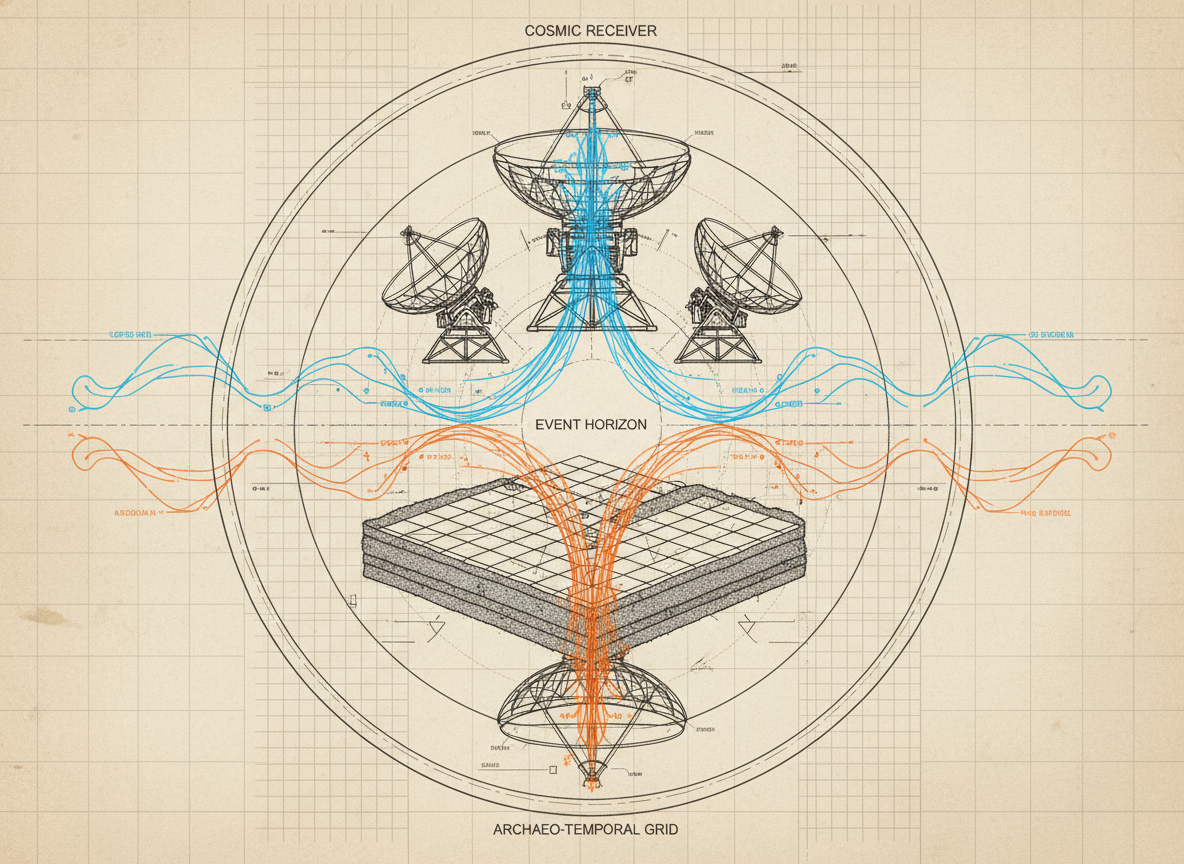
    This realisation inverts our understanding of what SETI actually does. The conventional framing treats SETI as a search for active communication from living civilisations, perhaps hoping for dialogue across the stars. But if temporal overlap is unlikely, then SETI is actually archaeology conducted at cosmic distances. We’re looking for traces, for signals that have outlasted their creators, for information preserved across timescales that dwarf human history.

    This makes SETI and terrestrial archaeology not merely analogous but fundamentally the same discipline applied in different spacetime directions. Archaeology recovers signals from entities separated from us by time. SETI searches for signals from entities separated from us by space. Both are exercises in detecting, interpreting, and reconstructing information from sources we cannot directly observe or communicate with.

    The Unified Framework: Long-Distance Signal Science

    If we accept this symmetry, then both disciplines are engaged in what we might call “long-distance signal science across spacetime.” The core challenges are identical in both fields. How do you detect intentional patterns against natural backgrounds? How do you interpret information without shared context or language? How do you distinguish artifact from accident, signal from noise, design from coincidence?

    More importantly, if both disciplines face the same fundamental problem, they should inform each other directly rather than superficially. Archaeology isn’t merely analogous to SETI in the way that, say, forensics might provide useful metaphors. Instead, archaeological methodology is directly applicable to SETI, and SETI’s engineering concerns should directly shape archaeological practice.

    The Preservation Imperative

    Here’s where the framework becomes potentially transformative rather than merely descriptive. If SETI searches primarily find evidence of extinct civilizations, and if technological windows are brief, then any civilization with foresight faces an obvious imperative: preserve your planetary history in a form that can survive and remain interpretable across geological and cosmic timescales.

    This isn’t just about ensuring your own descendants can access their history, though that’s valuable. It’s about recognizing that if you’re alone in your temporal window, your civilization might be the only one capable of encoding the story of your planet. Four billion years of evolutionary history, the emergence of life, the development of complexity, the appearance of intelligence—all of it vanishes unless someone preserves it before the window closes.

    That someone might be us. And the window might be now.

    Why This Matters for Archaeology

    This reframing elevates archaeology from a discipline concerned with understanding the past for cultural or educational purposes to one with species-level importance. The archaeological reconstruction of Earth’s history isn’t just valuable for us; it may be our only opportunity to transmit that history to the deep future, whether the audience is our own distant descendants, future terrestrial intelligence that evolves after we’re gone, or alien archaeologists investigating what happened on this planet millions of years after we’ve vanished.

    Every archaeological site excavated, every palaeontological fossil analyzed, every geological record interpreted becomes part of a dataset that we might encode and preserve. The urgency is real. Climate change, mass extinction, technological collapse, or simple erosion could eliminate both the archaeological record itself and our capacity to interpret it. We exist in a possibly unique window where we’re technologically advanced enough to attempt preservation while the record still exists and remains interpretable.

    The Paradigm Gap: Why Archaeology Didn’t Engage in 2014

    n 2014, Douglas Vakoch edited a NASA publication titled “Archaeology, Anthropology, and Interstellar Communication,” calling on archaeologists to contribute their expertise to SETI. The response from archaeology as a discipline was disappointingly sparse. Vakoch correctly understood that archaeologists work with traces of cultures distant from us in time and context, making their interpretive methods potentially valuable for thinking about communication with equally distant alien civilizations. The invitation was genuine and the reasoning sound from SETI’s perspective.

    But archaeology as a discipline was fundamentally unable to engage with this opportunity, and the reason goes deeper than lack of interest or imagination. The vast majority of archaeological practice, even at its highest professional levels, operates within paradigms that are not coherent with physics. While archaeology has successfully incorporated some scientific methods—radiocarbon dating being the prime example—these typically arrive as extensions from natural sciences and engineering rather than emerging from archaeology’s own theoretical foundations. The underlying philosophy of archaeological interpretation remains largely divorced from the frameworks that govern SETI research: signal processing, information theory, physical causation, and mathematical formalization.

    This isn’t a failure of individual archaeologists or even of Vakoch’s initiative. It’s a paradigm issue, an incompatibility in how the disciplines conceptualise their fundamental objects of study. SETI researchers think in terms of signals, transmission, detection, and information encoding because they work within frameworks derived from physics and engineering. Most archaeologists think in terms of culture, meaning, interpretation, and context because their discipline developed primarily within humanities and social science traditions. These are different languages, different epistemologies, different ways of understanding what counts as explanation.

    Without a bridging framework that allows archaeology to reconceptualise its work in terms compatible with signal science, the disciplines simply talk past each other. Archaeologists hear invitations to speculate about alien culture and correctly recognize this as beyond their expertise. They don’t hear the deeper connection: that they’re already doing long-distance signal recovery and interpretation, just aimed at temporal rather than spatial distances.

    The Research Reorientation

    This doesn’t mean archaeology or SETI should abandon their current work. Archaeologists should absolutely continue reconstructing the past, because that reconstruction is the prerequisite for any preservation effort. SETI should continue searching for contemporary signals, because we might be wrong about temporal overlap, and the cost of missing a real contact would be enormous.

    But both disciplines should recognize a deeper, unifying purpose: developing the science of long-distance signal transmission and detection across spacetime. Every archaeological excavation should ask not just “what happened here?” but also “what made this discoverable and interpretable to us, and how could we apply those principles to preserve our own record?” Every SETI search should consider not just active transmissions but also passive artifacts, durable structures, and encoding strategies optimized for discovery across geological rather than historical timescales.

    Multiple Futures, Same Solution

    The beauty of this framework is that it remains valuable regardless of which future scenario unfolds. Perhaps we successfully navigate our technological challenges, and our descendants millions of years from now need to understand their deep history. Perhaps we don’t survive, but other intelligence eventually evolves on Earth and could benefit from knowing what came before. Perhaps aliens eventually investigate our solar system long after the Sun has expanded and consumed the inner planets. Perhaps we discover that others attempted the same preservation, and recognizing the patterns helps us find them.

    In every scenario, the solution is the same: encode planetary history in the most durable, discoverable, and interpretable form possible. This gives both archaeology and SETI a concrete, achievable goal with existential importance. Because the attempt to figure out how to preseve and transit information into the far future will also inform us on what we should be looking for if such a thing already exists in the galaxy.

    Practical Next Steps

    The immediate research questions that emerge from this framework cut across multiple disciplines. What materials and encoding strategies survive millions of years in various planetary environments? How do you create self-interpreting information structures that remain meaningful without shared language or cultural context? What geometric and statistical patterns remain obviously artificial despite transformation over geological time? How do you design redundancy that ensures reconstruction despite massive data loss?

    These aren’t abstract philosophical questions. They’re engineering problems with testable solutions. And we have a laboratory to test them: Earth’s own archaeological record. Everything we successfully recover from the past tells us something about what will be recoverable from our present. Every failed interpretation reveals encoding strategies that don’t survive the test of deep time.

    Conclusion: A Science for Deep Time

    We stand at a potentially unique moment in Earth’s history—technologically capable of attempting preservation while the record still exists to preserve. Whether anyone ever receives the transmission is unknowable. But the attempt itself is worthwhile, because if we’re right about temporal windows being brief and rare, then the alternative is that four billion years of planetary history simply vanishes, and no one ever knows it happened. Which may well be the fate of countless other planets with life in our galaxy, and the reason we encounter no signals as yet.

    Archaeology and SETI, properly understood, are the same science: the detection and interpretation of signals across vast distances in spacetime. By making preservation the explicit goal of both, we create a framework that unifies these disciplines, justifies expanded research and funding, and ensures that if we’re alone in our window, we at least leave something behind for whoever comes after—whether that’s in a hundred years or a hundred million.

    The universe is full of signals waiting to be found. We might be the only ones in a position to create them. That’s not just an opportunity. It’s a responsibility.


    References

    Tarter, J. (2001). The Search for Extraterrestrial Intelligence (SETI). Annual Review of Astronomy and Astrophysics, 39(1), 511-548.

    Kuhn, T.S. (1962). The Structure of Scientific Revolutions. University of Chicago Press.

    Vakoch, D.A. (Ed.) (2014). Archaeology, Anthropology, and Interstellar Communication. NASA Office of Communications, Public Outreach Division.

    Foley, D Furey, E (2025). From Geospatial Patterns to Ancient Signals: A
    Signal Based Framework for Archaeological Machine Learning
    . ISSC Conference Proceedings 2025.

  • The Persistence of Dualism: Why a Decade of Theoretical Innovation Has Failed to Advance Archaeological Science

    Update of 2014 article Dualism: The “Great Divide” in the Philosophy of Archaeology.

    Prism splits light into two beams

    “They made up their minds to name two forms, of which they must not name one—in this they have gone astray.”

    Parmenides of Elea


    Archaeology is a discipline in philosophical crisis, charged with creating a narrative, the story of our species evolution, it seeks to further understanding of how, and why, our species unique history unfolded. But, while documenting change in human history proceeds with reasonable success, progress in understanding the mechanisms driving this change has been painfully slow. As Cambridge archaeologist Colin Renfrew points out, archaeology can explain the “when and where” but not the “how and why” of events in the past (Renfrew, 2004). Answering the how and why is now a matter of increasing urgency as humans are of such overwhelming ecological significance.

    Explaining “how and why” requires a theoretical archaeology from which to generate hypotheses, something that has not happened yet. This essay discusses why integration of archaeology with science at a theoretical level has proved so difficult.

    Archaeology, on the whole, has been described as exhibiting disjuncture, a lack of correspondence between what passes for theory and what archaeologists actually do or aim to do (Johnson, 2006). It is recognised that archaeology, in common with most of the social sciences, has no coherent theoretical basis (Johnson, 2006) and that the ensuing systemic incoherence actively blocks progress, both within the subject, and between it and other disciplines . To grasp why archaeology cannot explain the phenomena it catalogues, a short historical detour is in order.

    The Incomplete Revolution

    In broad historical context the source of this disjuncture can be traced to underlying issues inherited from the western adherence to dualistic Platonic/Christian philosophies. Familiar in academia as the Two Cultures described by C.P. Snow decades ago (Snow, 1959), these paradigms define an ontological separation of humans from the environment, and by logical extension those phenomena once thought to be unique to humans like cognition, society, language. Progress in intervening years has resulted in a confusingly fragmented interface between the humanities and sciences. Archaeology now finds itself stretched awkwardly across this interface

    The criterion of a successful integration of archaeology with evolutionary theory is the ability to create empirically testable hypotheses generated from evolutionary theory, the parsimonious theory of change applicable to a science of archaeology (Dunnell, 1971). The “Scientific Revolution” pioneered by Copernicus and Galileo in the 16 th and 17 th centuries was nothing more than the application of the monistic materialism of the Ancient Greek physiologoi to the phenomena of the heavens and the composition of non-living materials, an application that immediately revolutionised physics, cosmology and chemistry.

    But the fields to which this application of philosophy remained limited, through compromise with Christian and Aristotelian sensibility both biology and the humanities were largely bypassed by the new sciences. Philosophers and theologians, arguing against the possibility that physical or mechanical laws could have given rise to the complexity of life, maintained the separate causation of biological systems and there concomitant properties.

    Thus dualism effectively isolated organisms, including humans, from the physical causal chain of natural science, preventing integration with physics and rendering them unamenable to scientific investigation. Within biology this was corrected in part by Lamarck in 1801 with evolution and Darwin in 1859 with natural selection bringing life forms in general within the remit of natural science.

    But again the application was incomplete, this time, humans and all phenomena thought to be unique to humans, were left sacrosanct, resulting in the separation of the humanites and sciences that was such a prominent feature of the 20th century structure of faculties.

    Archaeology developed predominantly within the social science departments of colleges and therefore inherited a powerful underlying dualistic philosophy. A philosophy essentially medieval in character.

    Philosophy in the social sciences inherits oppositional constructs such as mind/ body, natural/artificial, culture/nature and so on, leading to phenomena that monistic approaches posit as biological in origin, for example, language or cognition, to be defined instead as immaterial epi – phenomena, meaning they exist outside or beyond the “natural” material environment. It need hardly be said that once something is construed as “immaterial”, it is hardly likely to be amenable to scientific enquiry.

    Effects

    t is hard for us now to understand the medieval resistance to the motion of the earth, but it stems, I believe, from an identical problem and sheds some light on the kind of process I have in mind here. Firstly, as the earth was deemed special and therefore categorised as ontologically separate from the rest of the universe, explanation of its origin and state could not, and indeed should not once one is operating within these constraints, be linked to other observed systems or objects. Therefore observations of phenomena in the wider universe were not deemed relevant to the earth. This very effectively stymied research into the origin and history of the planet. Secondly, ontological isolation required that it also must be static, because that which moves must interact and such interaction was unthinkable, as the earth was fundamentally separate from the rest of creation. Hence, we look in wonder at intelligent protaganists in these old debates arguing what seems now so obviously absurd. But to uphold the medieval paradigm as it was, they were forced to defend the indefensible.

    nd just as the logic of Aristotelian physics could not countenance the motion of the earth, modern dualistic philosophy freezes humans within the environment and this is the reason our models are not dynamic but static. Archaeological data remains isolated and because of this also must remain static. So, despite repeated calls for dynamic models, no such models can be constructed. The problem remains below decks, in the philosophical engine room so to speak, and far below the awareness of archaeological theory as it now stands.

    As archaeologists we should be concerned with change and consequently our most useful evolutionary perspective is one that emphasises adaptation as a dynamic process rather than as a static state.”

    (Mithen, 1990:p8

    n keeping with this, neither have developments in physics, such as relativity or non-linear dynamics, been possible to incorporate within archaeological theory, not because of unwillingness, but because it is philosophically prevented. Therefore archaeological data remains isolated, inaccessible and cannot be digitised or held on a database that allows universal integration.. And so our ability to generate data is unimpeded, but or ability to record and manipulate data is extremely limited. There is no translation through scales and patterns of change over large spans of space and time cannot be effectively studied. This situation has become increasingly untenable as the sciences advance and archaeology does not, highlighting more and more the inadequate nature of its philosophical basis.

    The Broken Inference Chain

    The archaeological inference chain has been severed by this same problem. Archaeology must infer human behaviour and development from the technological record, an inference that must be made directly across the paradigmatic boundary discussed above. Practically speaking, the inference must be drawn from a-biota (tools etc) and applied to biota (humans), but it is precisely between living and non-living systems that dualism splits our fields, and so it is at this point our models can be predicted to break down.

    And this is what we see, processes occurring across the boundary have been impossible to define, and exist only as the archetypal “black box” categories of social science. Vaguely defined areas such as technology and culture, both of which straddle the boundary, endure as obscure, undefined categories of phenomena, with the result that they are therefore generally omitted from process models

    Splitting the Data Stream

    If it is true that the problems within archaeology stem from this paradigmatic source then we should expect effects across a wide range of disciplines whenever they attempt to cross the divide. And it is the case that problems integrating biotic and a-biotic phenomena are not unique to archaeology. Similar difficulties have occurred within biology, ecology, neuroscience and complex systems theory. We see isolation, freezing effects and curious mirror like errors whenever synthesis is attempted, which I believe are the effects of this underlying dualism

    Intriguingly, confusion over the units of replication or the selective process seem to mirror each other in biology and archaeology. Sitting on opposite sides of the divide and looking at the same phenomena from a different perspective, the dualist ontology functions like a prism that bifurcates the data streams within each discipline and between them causing what I can only describe as a double image or reflection where their should be a single system.

    For example, ecological system models must include the a-biotic environment as well as the life forms that are the studies focus, but this has proved curiously troublesome. Odling Smee and Laland, the proponents of niche construction, reached similar conclusions as to the neglect of active processes. Their focus on the active, dynamic interactions of a creature with its environment are of course correct. I believe they identified the same freezing effect prevalent in archaeology, in other words, the life forms they study are inherently static in system models that include the wider environment.

    The model described here would predict just such an outcome. It would also predict that phenomena identified across the divide are split by the underlying dualism so that they will manifest as a reflection, or doubling of processes on ones own side of the divide.

    An example of this is that after their identification of niche construction, Odling Smee and Laland then posited it as a second parallel process to natural selection “we shall have to recognize that evolution depends not on one, but on two general selective processes: natural selection and niche construction” Odling Smee et. al. have been criticised for this claim as it has been pointed out that it is unnecessary and unparsimonious to suggest a second major selective process operating within evolution. The identification (or misidentification) of phenomena as parallel replicators or selective processes is, I believe, a manifestation of the distortion effect of dualism, simply because the data becomes un-integratable and therefore a second process or force must be created to account for the seemingly parallel, but unconnected, phenomena observed.

    Similarly, the memes proposed by Richard Dawkins (Dawkins, 1976) are characterised as replicative units under selection, a parallel selection process. And again this has been criticised as unecessary and unparsimonious addition to evolutionary theory, as well as a false analogy. But what is of interest here is that Dawkins felt the need to propose a parallel process for phenomena that are beyond the dualistic divide from his native biology, and again they appear as a parallel reflection of phenomena studied in his own field.

    In archaeology, the fact that technology is of central importance, places it right at the coalface of the great divide, consisting as it does of a system where inanimate matter is in contact with life forms. This means that any successful definition of technology must smoothly integrate information across the paradigm boundary, a process that can be predicted to fail under current philosophical conditions, as we have seen above. And indeed it remains the case that archaeology has failed to scientifically define technology or to integrate the study of its development with evolutionary science or indeed even physics.

    How to define technology, for example, remains a complete mystery to archaeologists, as Lambros Malafouris has helpfully described.

    “To exemplify, this territory is familiar, as when the hand grasps a stone and makes it a tool, yet it remains terra incognita, since — despite a long genealogy of analytic efforts— just what this grasping implies for the human condition remains elusive, and refuses to be read in the narrative fashion that hermeunetics have promised“

    (Malafouris, 2004)

    In traditional archaeology the focus has traditionally been on a single element in the system, the tool, the object or material, it has been increasingly realised this cannot be understood in isolation. Tool use, once the pride of the anthropocentric view, has been observed in increasing numbers of species, across taxa. chimpanzees, bottlenose dolphins, birds such as New Caledonian Crows. A fact putting pressure on archaeology to integrate explanation of human tool use with the many examples in the animal world.

    “But the significance of tool use doesn’t lie in the fact of tools,” Hauser explains, “but rather in how they’re conceived and used.” (Hauser, )

    Tools exhibit many of the features of biological selection, apparent design, bursts of increasing complexity over time, stasis, inheritance of characteristics and contingency. These features have puzzled many archaeologist and have led to many attempts to explain the development of technology using evolutionary theory, and again, remembering that this explanation must cross the paradigm divide, we might predict that, unless the deeper philosophical issues are dealt with first, these attempts will fail.

    The result has been that archaeology has invariably run into the same effects as encountered in ecological and biological theory noted above. Cultural Transmission theory, Selectionist archaeology and Behavioural archaeology have all (falsely) posited parallel general forces of evolution, or parallel units of selection with the result that debate over what counts as a “unit of selection” in the evolution of technology has raged within the subject. (Boone and Smith, 1998, Lyman and O’Brien, 1998, Maschner, 1996). The outcome being merely that they are generally left only with the question, what is it that is being selected? And so archaeology remains just as theoretically isolated and fragmented as before. As Colin Renfrew has said “But we still seem a long way from any well-integrated view that can bring these disparate fields together.”

    Conclusions

    The occurrence of this remarkably similar problem in both archaeology and ecology reinforces, at least in my mind, the identification of the philosophical division between biota and a-biota at an ontological level as the source of these discontinuities. The important point is that the effect on data has been identical in both subjects, both have static descriptions of what are dynamic systems.

    From these analogies, it is clear that something very similar is happening across a wide range of disciplines, when evolutionary theory is applied to across the paradigm boundary, it results in erroneous conclusions such as parallel replicators or processes parallel to natural selection. In this analysis, this does not occur because the approaches are wrong, but because the ontological framework to which they are being applied is incorrect, resulting in duplication, an effect indicative of a dualist paradigm interfering with our models. Stemming from a common source, these errors occur as mirror images of each other.

    In this way inherited dualistic philosophies have resulted in subtle but profound shifts of emphasis in fields of research. So for example in biology and archaeology, the assumption that the environment is only that which is beyond the body leads to the search for sources of environmental change to be concentrated almost exclusively externally to the organism, and while the importance of behaviour is recognised in biology (Baldwin,189) it has been consistently underestimated (Odling Smee, Laland).

    We can see that dualism, by forcing the separation of either the organism from the environment (archaeology), or the environment from the organism (ecology) creates our inability to integrate biotic and a-biotic phenomena into cohesive system models and results in a skewed emphasis across many disciplines.

    Also, because the physical causal chain is broken, static linear models predominate across all disciplines, resulting in motion in general to be overlooked as an essential element in the environment. Therefore motion has not been, or cannot be, recognised or modelled as a part of the environment exerting its own unique selective force. Finally, models lacking motion of any kind, certainly cannot include attributes of motion such as relativity or scale and so these have not been addressed at all.

    Recognising this, we may consciously proceed with the development of a revised philosophy beginning from a holistic approach. The need for which has been recognised in the call for non- dichotomous thinking from several scholars in the archaeological field (Hodder 1999; Thomas 1996, Webmoor, Witmoore, 2008). Similarly, calls from the natural sciences on the other side of the divide, consilience from biologist E. O. Wilson, or neuroscientist V. S. Ramachandran and numerous others show that physics, biology and the human sciences require synthesis.

    It is hoped that archaeology, with its unique problems and perspectives in this area, spanning as it does this most ancient of divisions, may contribute to the new synthesis now being pursued across the life sciences. As ‘humanity begins with things’ (Serres with Latour 1995:166)…


    “archaeology is in a prime position, a third space (which is yet to be articulated) with regard to the humanities and sciences, to set innovative and cutting edge intellectual agendas”

    (Webmoor, Witmore, 2008)

    Bibliography

    Dunnell, R. C. (1971) Systematics in Prehistory New York: The Free Press.
    Dunnell, R. C. (1996a). Evolutionary Theory and Archaeology. In M. J. O’Brien (Ed.), Evolutionary Archaeology : Theory and Application (pp. 30-67). Salt Lake City: University of Utah Press.
    Dunnell, R. C. . Natural Selection, Scale, and Cultural Evolution: Some Preliminary Considerations (1996b) In M. J. O’Brien (Ed.), Evolutionary Archaeology : Theory and Application (pp. 24-29). Salt Lake City: University of Utah Press.
    Jeffares, B. The Scope and Limits of Biological Explanations in Archaeology (2002) Unpublished Thesis, Victoria University of Wellington.
    Laland, K.N., Odling-Smee, J. and Feldman, M.W. (2000). Niche construction, biological evolution, and cultural change. Behavioral and Brain Sciences, 23: 131-175.
    Mithen, S., 1998. Introduction, in Creativity in Human Evolution and Prehistory, ed. S. Mithen. London & NewYork (NY): Routledge, 1–15. Routledge
    Webmoor, T. and Witmore, C. L. (2008) ‘Things Are Us! A Commentary on Human/Things Relations under the Banner of a ‘Social’ Archaeology’, Norwegian Archaeological Review, 1 – 18.
    Renfrew, C., 2001a. Symbol before concept: material engagement and the early development of society, in Archaeological Theory Today, ed. I. Hodder. Cambridge: Polity Press, 122–40. (MA): MIT Press.
    Renfrew, C. & C. Scarre (eds.), 1998. Cognition and Material Culture: the Archaeology of Symbolic Storage. (McDonald Institute Monographs.) Cambridge: McDonald Institute for Archaeological Research.
    Malafouris, Lambros, The Cognitive Basis of Material Engagement: Where Brain, Body and Culture Conflate,
    Malafouris, L., 2003. Archaeology and Dissonance: Towards a Theory of Material Engagement. Paper presented at Radical Archaeology Theory Symposium (RATS), Binghamton, New York.

  • Beyond Typologies: Why Archaeology Needs a Signal Processing Revolution

    First in a three-part series introducing a groundbreaking approach to archaeological data science


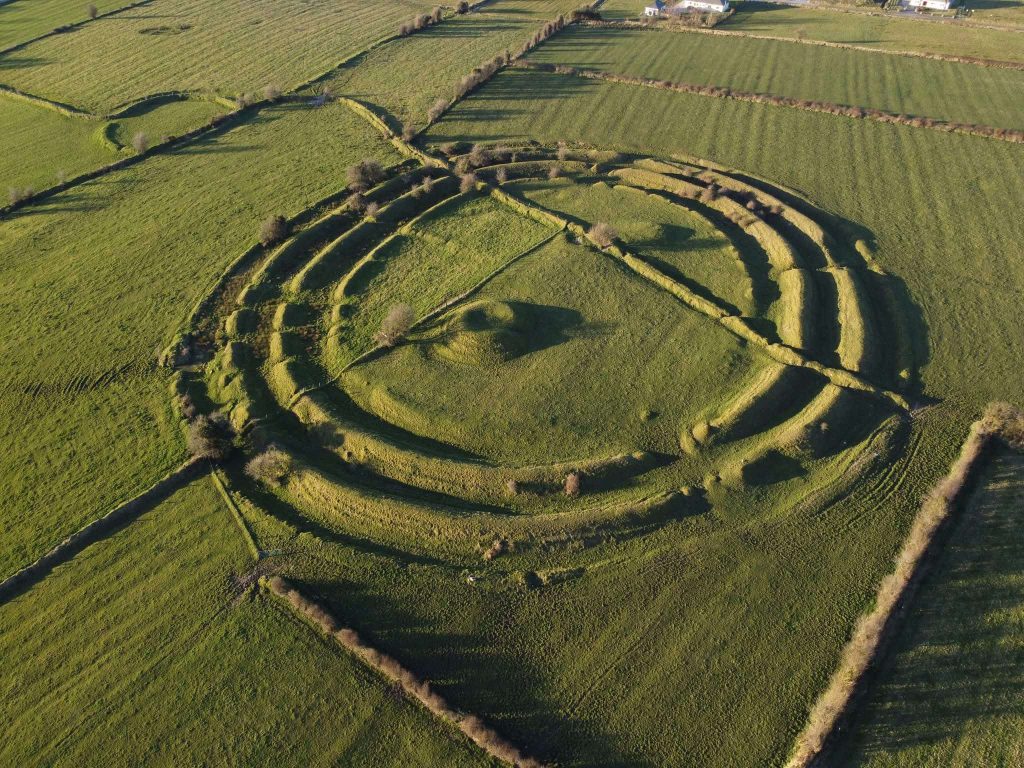
    Rathra, County Roscommon

    The Hidden Patterns in Ancient Landscapes

    Imagine standing in a field in County Roscommon, looking at what appears to be just another Irish pasture crossed by modern fence lines. But beneath your feet and etched into the landscape around you lie the traces of something far more ancient—circular earthworks, enclosures, and pathways that once formed part of a sophisticated territorial system spanning millennia.

    This is Rathra, and it perfectly illustrates both the promise and the problem of modern archaeology. We can see the ancient patterns, but they’re overlaid, interrupted, and partially obscured by thousands of years of subsequent activity. Traditional archaeological recording treats this as discrete layers—Medieval here, Bronze Age there—creating disconnected snapshots that miss the deeper story.

    What if we could read these landscapes like signals?

    The Typological Trap

    For over 150 years, archaeology has organized its data using categories inherited from the 19th century: “Bronze Age,” “ringfort,” “barrow.” These labels seemed logical when archaeology was primarily about museum collections and cultural chronologies. But they’ve become a prison.

    Consider what happens when we try to apply machine learning to archaeological data structured this way:

    • Temporal relationships disappear into broad, arbitrary periods
    • Uncertainty gets hidden behind confident-sounding labels
    • Dynamic processes become static categories
    • Observed facts get mixed with interpretative assumptions

    The result? Archaeological data that’s fundamentally incompatible with modern computational analysis. We’ve been trying to do 21st-century science with 19th-century data structures.

    Archaeology as Signal Science

    But there’s another way to think about archaeological remains: as degraded signals from past human activity.

    Every stone circle, every earthwork, every scatter of pottery represents traces of ancient “motion patterns”—the systematic ways people moved through and organized their landscapes. These signals have been subject to natural decay, vegetation growth, later human activity, and countless other forms of interference. Our job as archaeologists becomes a form of inverse signal reconstruction: working backward from degraded traces to infer the original patterns that created them.

    This isn’t just a metaphor. When we apply signal processing mathematics to archaeological data, remarkable patterns emerge that traditional methods simply cannot detect.

    The SETI Connection

    This approach aligns archaeology with some of the most cutting-edge science happening today. SETI researchers search for “technosignatures”—traces of technological activity across vast spans of space and time. They’re essentially doing inverse signal reconstruction on cosmic scales, trying to separate intentional patterns from natural noise.

    Douglas Vakoch and other SETI scientists have called for archaeological input precisely because we face similar challenges: detecting degraded signals of intelligent activity across enormous temporal distances. The mathematical frameworks are surprisingly similar.

    But where SETI looks outward for signs of non-human intelligence, archaeology looks backward for signs of our own species’ complex behaviors. We’re both trying to answer the fundamental question: How do you detect intention in noisy, incomplete data?

    What This Makes Possible

    By treating archaeological features as signals in a unified mathematical framework, we can:

    • Detect anomalies that reveal historical disruptions (like invasions) through negative correlations
    • Identify persistent patterns that span millennia, invisible to period-based analysis
    • Quantify uncertainty using probabilistic methods rather than hiding it behind labels
    • Scale analysis to continental or global datasets using automated pattern recognition
    • Integrate seamlessly with remote sensing, climate data, and astronomical datasets

    A New Kind of Archaeological Science

    In our upcoming research publication, we demonstrate this approach using 6,000 years of data from northwest Ireland. The results are remarkable: we can detect territorial boundaries that persist from the Neolithic through the Medieval period, identify the signatures of different political federations, and even automatically detect invasive territorial patterns like the Norman conquest—all from spatial data alone, without relying on historical records or typological classifications.

    This represents the emergence of a genuinely new archaeological science: one that can operate at the scale and precision demanded by contemporary global challenges, from understanding long-term environmental adaptation to modeling resilient territorial systems.

    What’s Next

    In our next article, we’ll dive into the technical breakthrough that makes this possible: treating time as space within a 3D mathematical framework that transforms temporal relationships into geometric ones. This seemingly simple shift opens up entirely new ways of reasoning about archaeological data.

    The third article will walk through our Ireland case study, showing how 6,000 years of human territorial behavior becomes visible when viewed through this new lens—and what it tells us about the deep continuities underlying apparent historical change.

    This isn’t just a new method—it’s a new way of seeing the past.


    Dylan Foley is a researcher in archaeological data science at Atlantic Technological University, working under the supervision of Dr. Eoghan Furey. Together, they are developing new approaches at the intersection of machine learning, signal processing, and landscape archaeology that bridge archaeology with SETI research, planetary science, and advanced computational methods.

    Next: “Treating Time as Space: A New Framework for Archaeological Machine Learning”