Tag: Shipwrecks

  • What Streedagh Still Holds

    What Streedagh Still Holds

    The Galeón Andalucía in Sligo, June 30th 2026

    Article modified to correct errors on mass and scale in the first version. This research is ongoing!


    Four hundred and thirty-eight years ago, three ships of the Levant squadron drove ashore at Streedagh — in the same autumn that opened what a contemporary would call the Fifteen Years’ War— the most formidable Gaelic resistance to the English conquest. That conquest was administered from a single node: Dublin, the seat of the crown’s government in Ireland, the centre from which armies were raised, supplied, and sent against the north and west...


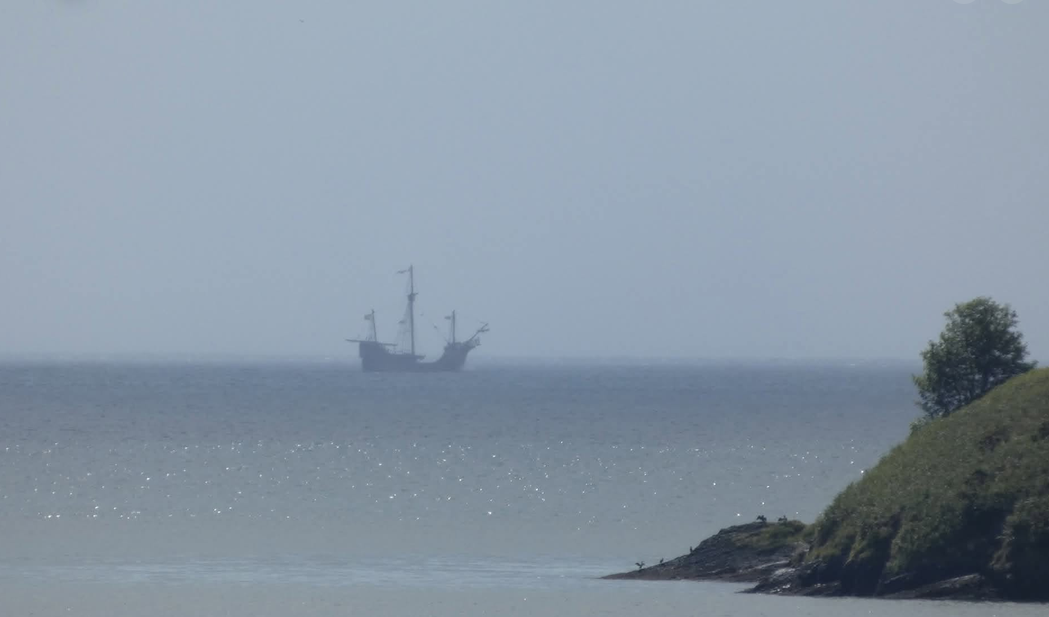
    On the last day of June a Spanish galleon comes into the bay. The Galeón Andalucía — the largest sailing replica of her kind afloat — will pause off Streedagh before she enters the harbour, and her crew will drop a wreath on the water for the roughly eleven hundred men who drowned there in September 1588. Then, for a fortnight, anyone can walk her decks.

    It is worth going. A reconstruction like this does something no document can: it lets you stand on a deck and feel a size that records only assert. But the most useful thing the Andalucía can do is send you a few miles up the coast in your mind, to the three ships lying in the sand off Streedagh Strand — because she is not quite the same kind of ship.

    The yardstick

    TThe Andalucía is rated at a little under 600 tons. The three ships wrecked at Streedagh — La Juliana, La Lavia and the Santa María de Visón — carried ratings of roughly 860, 728 and 566 toneladas respectively. It is tempting to line those figures up and conclude the Streedagh ships were simply bigger. That is the first trap,, because a tonelada is not a weight. It is an administrative capacity rating from a different system entirely, and you cannot convert it into modern tonnes and set it beside a replica’s stated tonnage as if they were the same measurement.

    The accurate comparison is not about mass — it is about shape. The Andalucía is a galleon: long, relatively narrow, built to sail and to fight, with a length-to-beam ratio around four to one. The Streedagh ships were not galleons. They were large Mediterranean merchant naos — broad, deep, full-bodied carriers with a ratio closer to three to one, requisitioned for the Armada and pressed into one of the biggest seaborne invasions in European history. They were built to hold things, not to race.

    Armada vessels at anchor, not the high built up fore and aft castles, it sthese that arethe most likely explanation gotr several features of the wrecks.

    When you reconstruct La Juliana‘s hull carefully — stated assumptions — her measured body comes out at something like thirty metres in the rated length, around eleven in the beam, six or so deep. In other words, the actual hull of the largest Streedagh ship is not obviously longer than the replica you’re standing on at Sligo quays. What made these ships capacious military transports was not a bigger galleon-shaped hull. It was a broad, deep carrying body plus towering fore-and-aft castles stacked several levels high to take hundreds of soldiers and their gear.

    So the replica is genuinely useful — walk her deck and you feel the real weight and scale of a period ship in a way no drawing conveys. But she is a yardstick of the wrong shape. The ships up the coast were a different animal: broader in the body and taller at each end.

    The Andalusia, Sllgo bay 2026, she has a lower profile than many of the Armada vessels, particularly the fore and aft castles are not built up. her hull size is very similar though to the ships at Streedagh.
    Armada merchantman, Peter Breughel

    The guns we have raised — and what they are not

    Twelve bronze cannon have been brought up from La Juliana, three in the 1980s and nine in the great storm-driven recovery of 2015. They are beautiful objects: cast in Genoa in 1570 — the very year the ship was built — each carrying a saint in relief, among them St. Matrona, patron of Barcelona, where La Juliana was launched. The National Museum is conserving them still.

    Those twelve guns are her own armament — the sakers, falcons and stone-throwing pedreros that made up the thirty-two-gun complement a merchantman of this size carried to fight off corsairs. They are the deck guns and the swivel guns: the self-defence kit. The whole recovered battery weighs about six tonnes, and the heaviest single piece is around a tonne.

    For scale, compare to the famous siege gun raised from the Trinidad Valencera, the other big Levant nao wrecked off Donegal: a single bronze battering piece of two and a half tonnes, made in Brussels, firing a forty-one-pound ball. That is what an Armada siege train looks like — and nothing of that weight is among the twelve guns lifted at Streedagh.

    Which tells you something important. What we have raised is what the ship needed to defend herself. Her anti Corsair armament. It has almost nothing to do with what she was carrying. What she was carrying is still down there.

    A floating warehouse for an invasion

    These ships were heavy-lift transports. The plan in 1588 was to land an army in England and march on London, and that required a siege train — heavy guns, gun carriages, entrenching tools, munitions, the engineering gear to batter and dig. We know La Juliana was carrying it, because the first thing found on her site was a spoked carriage wheel a metre and a half across, and four more like it: the dismantled remains of siege carriages, exactly as found on the Valencera. The guns those carriages were built for are far heavier than her defensive battery, and they would have been stowed deep as cargo, well below it. None of that weight is among the twelve guns raised.

    La Juliana‘s thirty-two documented guns, twelve have been recovered. The other twenty are unresolved. “Not recovered” is not the same as “still on the seabed” — burial, dispersal, or salvage we have no record of are all possible — and the siege train’s survival is a hypothesis to be tested, not a fact to be asserted. But the carriage wheels are hard evidence that the heavy gear was aboard, and nothing in the record says it was ever taken off.

    There is more than ordnance. The Santa María de Visón took on a share of the whole fleet’s medical supplies after the dedicated hospital ship was condemned as unseaworthy on the way north. One of the three Streedagh wrecks is, in effect, carrying an Armada field hospital. And La Juliana was built for exactly this kind of work: the amphibious conquest of Terceira in the Azores in 1583 gives us the doctrine — the same class of hull, the same kind of cargo, the same task, rehearsed in the years before the main event. One of her guns is even of Turkish manufacture, very likely captured at Lepanto in 1571: a barrel that travelled from the Ottoman fleet to a Catalan merchantman to an Irish beach.

    Why Streedagh is different — and of world importance

    The Valencera comparison is instructive, because the two sites are nothing alike as deposits. The Valencera came to rest on a hard seabed. The lighter material washed away; what remained were the heaviest objects, left exposed on the bottom. Streedagh is the opposite. The hulls filled with sand, and the excavators who have worked there report something remarkable: articulated ship timbers — the structure of the ships themselves — surviving in place beneath the overburden.

    There is a mechanism behind that. A contemporary watching from the shore saw the ships destroyed — and in a sense he was right, because the tall castles and upper works, driven onto a bar and hammered by surf, would have failed fast and violently. But the heavy lower hull, constrained on the sand and loaded with ballast and cargo, need not have broken up with them. It could sit, coherent, and be buried. That is how you reconcile an eyewitness account of total wreck with articulated timber surviving on the seabed four centuries later: the ship you see destroyed is the upper ship; the ship that survives is the buried floor of it.

    If the lower hulls are partly intact and sand-sealed, then the holds may be partly intact too, and the heavy gear — the siege guns, the bulk munitions, the stores, the medical assemblage — may still be where it was stowed, sealed in by the same sand that hid the sites. That is a prediction, not a promise; the sea is dynamic and even large timbers can move once uncovered. But it is a prediction the deposit type supports.

    And the reason any of it survived to be predicted is that nobody could rob it. Bronze guns are normally the first thing stripped from any wreck; gunmetal was worth more than the ship. They survived at Streedagh because the wrecking, in September 1588, opened what a contemporary historian called the Fifteen Years’ War. The north-west of Ireland was a contested war zone from that autumn until 1603, with no settled authority and no secure access for the divers and time that organised salvage needs — and by the time the fighting ended, the sand had done its work. The archaeological survey found no evidence of any historic salvage at all. What lies at Streedagh is something genuinely rare in the world: an unsalvaged, sand-sealed 16th century invasion cargo.

    Putting numbers on it

    For the past while I have been trying to assemble the actual figures for this site as part of an archaeological assessment — not impressions, but a reconstruction with stated assumptions and honest error bars, in which every value is marked as observed, derived, inferred or hypothesis.

    It bounds La Juliana‘s measured hull body. It reads her recorded complement — something like 355 to 395 people aboard — as a constraint on her architecture: fit that many soldiers and mariners, with their artillery and stores, and you are forced into the broad-bodied hull and the stacked castles, because a single flat deck cannot hold them.

    :thirty-two guns documented, twelve recovered, up to twenty unresolved, their status left open rather than assumed. The siege train sits on top of that, evidenced by the carriage wheels and not yet found.

    I will be setting out the full reconstruction separately — the hull-form envelope, the personnel and architecture argument, the calibrated ordnance, and the wreck-process model — because I think it amounts to something we are oddly missing: a proper assessment of what this site actually contains.

    The sea will not wait

    There is one reason for a sense of some urgency. The sea at Streedagh is very active. The same dynamic sand that buried and preserved these ships also, periodically, un-buries them — and an exposed timber or gun in a high-energy surf zone is a timber or gun being destroyed. The 2015 recovery happened because storms tore the sand off the Juliana and left her material exposed and, in the divers’ word, vulnerable; the ship’s own rudder shifted after long burial, a reminder that “preserved in place” is a dynamic condition, not a permanent one.

    That is not a situation a reactive scramble can manage. Every storm that exposes the site starts a clock, and answering it from a standing start, with expertise and equipment brought in from elsewhere each time, is no way to look after a wreck complex of this importance. What a world-class site needs is a standing plan — and, just as much, the capacity to act on it: the physical infrastructure and the local expertise, based here in Sligo, to survey, recover, conserve and interpret what the sea keeps offering up and then threatening to take back. Building that capacity where the site is, rather than depending on it arriving from away, is the difference between stewarding this place and merely reacting to it.

    The wreath

    When the Galeón Andalucía drops her wreath off Streedagh this week, it falls above a grave. More than a thousand men died there in the space of an hour, and the sand that may yet hold an intact field hospital and a buried siege train also holds them. The numbers and the reconstructions matter — they are how we understand the scale of what is there —

    A replica is coming to the harbour. The real ships are in the sand a few miles up the coast, in a place that both preserves them and, slowly, takes them apart. They are worth the plan, the infrastructure, and the people to do it properly. We have, lying off one Sligo beach, one of the most important Armada sites in the world.


    The reconstruction figures referred to above are part of ongoing work to assemble a full archaeological assessment of the Streedagh site. I will publish the technical detail — the hull reconstructions, the cargo mass-budget, and the calibrated ordnance — separately.