A disguised kingdom: Ó hEoghusa’s Odyssey, and what it says about being unrecognised.
Understanding Sligo Series -1
Sligo’s last untranslated native name, and the failure of Sligos heritage protection.
The Waterfall
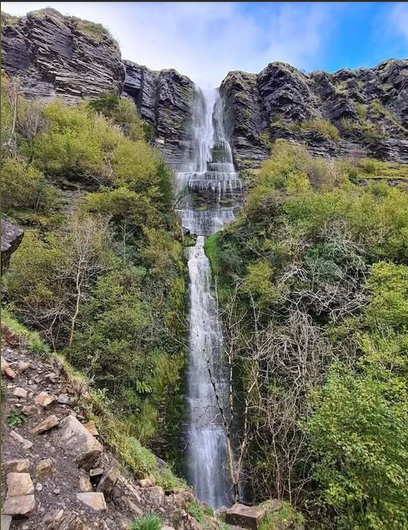
There is a waterfall on the Sligo–Leitrim border that most people who photograph it have never actually seen. What I mean by that should become plain shortly. It cascades nearly five hundred feet off the limestone edge of Kings Mountain — the Benbulben massif — down into the Glencar valley. Perhaps the highest waterfall drop in Ireland. On a still day it is a thin white thread. But when the wind comes up the glen from the south-west and strikes the scarp, it catches the falling water and drives it back up over the lip, so that the stream appears to climb the cliff it is falling from. The water runs the wrong way.
That is not a trick of the light. It is the thing the place is named for.
Its name — its only real name, and until very recently its only name of any kind — is Sruth in Aghaidh an Aird. Literally, the stream against the height. But, the phrase in aghaidh an aird is an old idiom for something running upstream, backwards, against the current. The Electronic Dictionary of the Irish Language records the phrase plainly: anaghaidh aird, “uphill”; and glosses a line about the river Jordan turning in its course — a n-aghaidh áird— as “flowed backwards, up-stream.” So the name resolves, without much strain, to the stream that flows backwards. It is a precise folk-observation of an anomaly, fixed in speech. You have to earn the sight of it — wait for the right wind, in the right season, and look. Most people miss it. The name is the reading that a patient eye, over a long time, arrived at and passed on.
You can now find this waterfall on signposts, on the county’s tourist pages, on a thousand phone screens, under the name the Devil’s Chimney.
That name is not old. That name is not a translation. That name did not exist before December 2016.
A name that was never rendered into gibberish
To see what has actually happened here, it helps to distinguish three quite different operations that the last four centuries performed on Irish placenames. They are not the same.
The first is translation — Irish into English, meaning carried across. It is rare, and it is comparatively benign: the content survives the crossing even when the sound does not.
The second is anglicisation — the Irish rendered into English phonetic gibberish, the meaning destroyed, but a trace of the sound left behind. Sligeach becomes Sligo. Cúil Irra becomes Coolera. The word is disfigured, but a thread remains: you can work back along the sound to the body of the original. This is the operation that fell on very nearly every name in the county in the nineteenth century, most systematically through the Ordnance Survey. It is a partial glamour — a disfigurement but recognisable.
The third is fabrication — the Irish name discarded whole, a new English name invented in its place, and false content installed where the reading used to be. No sound survives. No thread. And, characteristically, a phantom meaning is fitted over the gap so that the absence does not show.
Sruth in Aghaidh an Aird had survived the second operation entirely. It was never anglicised, never mapped into gibberish, never flattened. It kept both its Irish form and its meaning, intact, into the twenty-first century — one of the very last prominent features in the county of which that could be said. (This is the sense in which it is “the last”: not that no other Irish name survives in speech, but that this was among the last major, visible landmarks whose name had never been mapped, translated, or mangled — it remained live, meaningful Irish.)
And then, having escaped anglicisation for four hundred years, it was subjected to the most total of the three operations — fabrication — in living memory. In 2016.
The manufacture of a name
The name the Devil’s Chimney appears to enter the record with a video uploaded to YouTube in December 2016.
From there the sequence is ordinary. A walking-trail listing adopts the new name. The county’s own tourism material carries it. Signage goes up. Each step is individually unremarkable — a trail needs an English signpost, a marketing page needs a title that pays off, a sign follows the path already worn by the ones before it. No single act in the chain looks like an erasure.
And note what the new name does, beyond replacing the old one. “The Devil’s Chimney sounds dramatic, and it is.” It invents a folklore. It implies a local belief — that the people of this valley looked at this cliff and thought of the devil, named it for him, carried some association we might now recover.
Ask what that association was and the answer is: nothing. There was no such belief. The rising spray read as a chimney’s smoke, a devil supplied to furnish the chimney, and a piety back-projected onto people who never held it. The fabrication does not merely empty the slot. It manufactures a false depth to fill it — a heritage-shaped object where the heritage used to be. And the phantom is satisfying: it feels like folklore, so nobody enquires whether it is.
Why it survived, and why it was vulnerable
The obvious question is why this one name, alone, survived the nineteenth century intact —
It survived because it was obscure. It was never on a map. It was a thing of local knowledge, pointed out to visitors sometimes as the place where the water flows backwards — a gnomic puzzle, a wonder you had to be shown and then had to wait to see. Its visibility to officialdom was low precisely because its meaning was conditional: the anomaly only appears in the right wind, and a surveyor passing on a calm day would see nothing to record. Hidden in plain sight, it slipped under the machinery that mangled every name it could actually catch hold of. Obscurity was its shelter.
And obscurity is what it lost, all at once, in December 2016. The video, the trail, the signage made it visible — and visibility is what took it.
The Poem
Eochaidh Ó hEoghusa, writing of the whole territory of Sligo around 1600, built his case on a single counter-intuitive idea: Not that Sligo is poor, but that Sligo’s wealth is the cause of her destruction, that she is taken because she has something to take, that her fertility is her wound.
Mairg dhi nach díthreabh ndocranó cairge chuas bhfaolchonta
Woe to her that she is not a harsh wilderness,or wolf-haunted hollows of rock.
She would be better off, the poet says, if her banks were rough, her plains covered in heather, her fields worthless. Because then nobody would come for her.
He puts the covetous look and the spear-point under one word — renna — so that to be seen and to be struck are the same act. Sáithid Gaoidhil is Goill … renna a rosg: they drive in the points of their gaze.
Sáithid Gaoidhil is Goill Bhredhrenna a rosg, rún a gcroidhe
Gaels and Foreigners of Bréifne drive in the spear-points of their gazeand the desire of their hearts.
The name obeyed that law exactly. The property that made it worth stealing — its vivid, brandable, share-able wonder — is the very property that had kept it safe for four centuries by keeping it off the map. Spared by obscurity; destroyed by exposure. Once seen, it was taken. As it was in the 16th century, so is it now.
Where the Danger Comes From
Quatrain 16: eang as goimhemhla um ghort Bhréifne — the tract that smarts most at Bréifne’s tilled field.
That is a specific, secure claim: the most painful zone is the arable margin adjoining Bréifne, to the east. It is not, on its own, a claim about who is causing the harm — only about where it lands.
The poem opens by placing Sligo tar chrích Bhréifne, “beyond the land of Bréifne” (q. 1) — but this is best read as simple positioning, the kind of landmark-reference common in bardic geography, rather than an accusation. Ó hEoghusa was a Fermanagh poet, writing for a Fermanagh audience; Bréifne is the territory an audience at Maguire’s court would already know, lying between them and Sligo. Naming it locates Sligo. It does not, by itself, indict it.
One further quatrain may name Bréifne as the direction from which a mixed force strikes — Sáithid Gaoidhil is Goill Bhréifne, “Gaels together with Foreigners drive at Bréifne” (q. 8) — but this line’s reading is still unsettled; the word could equally be bréid, a border-strip, describing the object of the attack rather than its origin. Until the manuscript is checked, this cannot be used to build a case.
What can be said with more confidence is that the danger, wherever exactly it originates, is routine:
Quatrain 17: do ghuasacht do ghnáthaimsibh — danger in ordinary seasons.
Not the noise of one campaign. An endemic condition.
And the poem is unambiguous, three times over, that the sea stands outside this danger entirely. The wave (q. 2) endures gan tnúth, without envy. The land (q. 17) is ar nach tóir tonn, a place no wave assails. The territory (q. 42) is tonn-mhaoineach, wave-wealthy. Whatever harms Sligo, it does not come from the water. It comes from the land.
That much is secure: Sligo’s wealth is maritime and safe; her wound is landward and to the east, centred on the Bréifne march.
The principal overland route from Dublin and the midlands into Sligo runs along the southern edge of Bréifne, through the country around Carrick-on-Shannon, before crossing into the Sligo lordship. Anyone campaigning against Sligo from the east or from the centre of English administration — Crown forces most of all — would in practice arrive by way of Bréifne, whatever their actual origin or allegiance. If that is right, “Bréifne” in the poem may function less as an accusation against O’Rourke’s territory and more as a direction — a way of naming the corridor a threat travels through, which lets the poet locate the danger precisely without having to name, or risk naming, whichever power is actually sending it. Bardic poets had good reason to avoid naming the Crown outright in a poem of this kind; naming the road it travels solves the same problem.
That reading is attractive and it would explain why Ó hEoghusa — writing in a period when O’Donnell, the Burkes, and Crown forces under Bingham were all live threats to Sligo — settles on a single place-name rather than an enumeration of enemies. But it is an inference about the poem’s method, not something the text states, and it should be held as such until the addressee is dated and the actual campaigns active against Sligo in that year are checked against it, something ive not quite finalised yet.
The third thing: the landscape itself
Here is where the poem becomes something different from what some modern readers expect a bardic poem to be ( the few that get this far !). Ó hEoghusa is describing a real place, in vocabulary that turns out to be observationally precise.
The hills are limestone. The slopes are aol-chorcra, lime-purple: white stone and heather in the same phrase (q. 6). The cliffs are all gruaidh-fhliuch, “wet-cheeked” — streaming with water down their faces (q. 22). The summits are maoilinn, bald and rounded (q. 10). There are hollow caves in the rock (cuas, qq. 4, 6). Anyone who has stood at the base of Ben Bulben in wet weather knows exactly what he means. This is Dartry limestone, described from life.
The woods are hazel on that limestone.Call (q. 7), craobh (q. 7), fedh (q. 6), fiodhbhaidhe (q. 9), grian-fhiodh — a “sunlit wood” (q. 22) literally “sun-wood”. The ecology is coherent: hazel-dominated scrub with open, lighter stands, growing on thin soil over limestone. It is the same vegetation still recorded in the Sligo lowlands.
The hydrology is karst. The poem gives Sligo an epithet, tirm-shreabh, “dry stream,” and uses it three separate times (qq. 3, 5, 39). At the same time it describes her uplands as braontana, dripping wet (q. 25). Rain-drenched hills, streams that run dry: those two things are only paradoxical to a reader who does not know limestone country. On karst, rainfall is heavy, infiltration is rapid through fissured rock, and surface streams sink and reappear. The poem is describing sinking streams, and it does not know that it is. It is simply reporting what the poet or his informants saw.
Intriguingly, Ó hEoghusa’s poem is not describing Sligo in general. Its landscape vocabulary almost certainly describes this escarpment. He speaks of the all gruaidh-fhliuch— the “wet-cheeked” cliff, the rock-face streaming with water down its front (q. 22). He places the danger on the bearna fuara a himeall, the cold passes on the margin, the very rim of the territory (q. 23). He calls the uplands braontana, dripping (q. 25), and the slopes aol-chorcra, lime-purple, white stone and heather in one word (q. 6). And he locates the tract from which the danger comes um ghort Bhréifne — at Bréifne’s tilled field, the landward eastern edge (q. 16). Wet-faced limestone cliffs; cold passes on the border; dripping karst summits; the wound on the Bréifne march. That is certainly the Dartry scarp above Glencar, and it is the boundary this waterfall marks.
The harbour is articulated in detail, in three tiers.Rian bairc, the ship-lane (q. 22). Ethar-ród, the boat-road — the navigable channel (q. 6). Rian caol-eathair, the small-boat lane (q. 12). These are three distinct water routes for three distinct hull types. A poet does not distinguish three vessel-classes by route unless the depths actually differ. The estuary at Sligo will bring ships of about three metres draft; the outer bays and side channels are shallower. Ó hEoghusa’s vocabulary maps that gradient. And ethar-ród is a personal coinage of his — the only attestations known are in this manuscript, both by him, nine folios apart. The standard dictionary of Old and Middle Irish tentatively gives it as “of swift boats”; on the evidence of the two attestations and their contexts, that is almost certainly wrong. It means boat-road: a channel navigable by working vessels.
The uplands carry flocks.Benn n-eltach, flock-bearing peaks (q. 5); gorm-eltach, green-flocked (q. 24). Summer grazing on the summits. Booleying is not being invented in the eighteenth century; it is in the poem.
And the settlements have towers, walls, ditches, and grain stores.Tuir corra, tapering towers, thrown down (q. 10). Tuir shoillse, bright towers, empty (q. 11). Múr, walls (q. 2). Cladh, an earthen bank (q. 11). And most concretely of all, iothlonna, corn-yards or haggards, set on fire (q. 10). The iothlann is the bulk grain store. To burn it is to convert a raid into a famine, and the poet knows this and lists it in the same breath as the towers.
None of this is stock. Or rather: some of it is drawn from the standard bardic lexicon, but the combination is not, and the accuracy of the combination against the actual landscape is remarkable. This is a poet describing a place he has looked at.
How the harm is done
Do tresgradh a tuir chorrado hadhnadh a hiothlonnado bhán glaise a griamhadh slimdo siabhradh maise a maoilinn.
Her tapering towers were thrown down.Her corn-yards were set alight.The green of her sunlit slopes was blanched. *The beauty of her bare summits was bewitched.
The first two lines are what a raiding party literally does. The third line escalates to the wider landscape — pasture, streamlets, ground colour. And the fourth line does something odd: the summits, which cannot be burned or thrown down, are siabhradh — glamoured, enchanted, made spectral, made uncanny.
Siabhradh is a strong word. It is not decay. It is not decline. It is the transformation of a thing’s aspect into something not-itself, something eerie. And the poet uses it here because the hills, being indestructible, could not be attacked in the ordinary way — so what was done to them was done to their appearance.
Note that word, siabhradh, It is going to be useful.
The poem then does something unusual in a bardic poem. Two-thirds of the way through, Ó hEoghusa takes twelve full quatrains — nearly a third of the whole work — and retells the story of Penelope and Odysseus.
Here he lays out his argument by analogy.
Odysseus returns to Ithaca after twenty years, disguised by Athena as a beggar. Nobody in the palace recognises him. Even Penelope, his wife, does not know him. She had reckoned him dead. She was reasonable to have reckoned him dead; twenty years is good evidence. Her error is not stupidity — it is conclusion.
nír aithin é acht go hionmhallfedh a ré re ces cumhadhdo mheas gan é d’aontughadh.
She did not know him, and then only slowly.Through her whole life, under grief’s affliction,she had reckoned there would be no reunion.
Meas – a judgement — she had assessed, judged, concluded. And having concluded he would not return, she could not see him standing in front of her. The problem is not that Odysseus has been destroyed. He has not. The problem is that he has been rendered unrecognisable — and the person who most needs to recognise him has already, on good evidence, concluded that he is gone.
The poet describes something subtle but powerful, you cannot see what you do not look for. That your opinion or belief aboiut something often dictates how you see it. One of the most powerful tricks of imperilaism was to alter the names of the territories it invaded. And this act of renaming would both alienate the natives, rendering the familiar unrecognisable. and make the land amenable to exploitation by the incoming system.
But the poet has a solution..
The poem is quite explicit that recognition, when it eventually happens, has three parts, in order. First fiosrú: someone has to ask. Second éisteacht: someone has to listen to the thing itself, not to reports of it. Third aithne, knowing, which comes slowly slowly (go hionmhall): recognition is laborious and gradual, not a flash. And only then does anything follow.
The corresponding failure is stated flatly at q. 35:
nír fhiosruigh, ‘s nír aithin
they did not enquire, and they did not recognise.
The failure to recognise is preceded, in the syntax, by the failure to enquire. Nobody asked. They walked past him because they had already reached their conclusion, and having reached it, they never posed the question that would have overturned it.
What cannot be carried off is changed instead
Taken, though, is not quite the right word for what happens to a waterfall. The renna describes the taking of things that can be taken — cattle, grain, worked and defended land. But a waterfall cannot be carried off. Five hundred feet of falling water on a cliff of Dartry limestone is not portable, not burnable, not destructible by any raid. And this is precisely the case the poem reserves its strongest word for.
In Ó hEoghusa’s catalogue of what was done to Sligo, the summits come last, and they are handled differently from everything else. The towers can be thrown down; the corn-yards can be burned; the pastures can be blanched. But the bare summits — maoilinn, indestructible — cannot be attacked in any of those ways.
So what is done to them is done to their appearance: do siabhradh maise a maoilinn, “the beauty of her bare summits was bewitched” (q. 10). Siabhradh is the poem’s word for the operation performed on what cannot be destroyed. It is not decay and it is not decline. It is the changing of a thing’s aspect into something not-itself — glamoured, made spectral, made uncanny. When the substance is invulnerable, the operation moves to the countenance.
That is exactly the operation on the waterfall. The water cannot be taken, so the name is changed — and the name is the countenance, the aspect under which the thing is known and reached. “Devil’s Chimney” is a siabhradh in the poem’s precise sense: an uncanny, demonic guise laid over a feature that could not otherwise be touched, or in modern terms, could not be commercialised.
Sligo has been made unrecognisable, exactly as Odysseus was made unrecognisable.
.In Ó hEoghusa the siabhradh is an act of malice — a thing done to a territory by its enemies to disfigure what they could not destroy. In 2016 it is an act of commerce. Here the enchantment is not the end of the operation; it is the enabling first move of an appropriation. You cannot sell a five-hundred-foot cliff. But you can change its countenance — enchant the un-sellable landscape feature into a branded product — and the branded product can be sold, indefinitely, to everyone who arrives to photograph the devil. The siabhradh is what converts the immovable into the monetisable. Enchant first; then take.
This is a synthesis of the poem’s two ideas: it welds the renna— the covetous gaze that takes what it covets — to the siabhradh— the changing of what cannot be taken . The poet kept them apart, one for the moveable wealth and one for the indestructible hills. The marketer joins them. What cannot be carried off is first changed in its aspect, and once changed, it can be sold.
That is the poem’s central argument. What Domhnall mac Cathail is being asked to do is not, in the first instance, to fight. He is being asked to recognise. Q. 14, the hinge of the whole poem, says outright that Sligo’s problem is not that she has no champion. Her problem is that she has no fer a hégcaoine d’éisteacht — no man to hear her lament. The requital, when it comes (qq. 37–38), follows recognition automatically: Penelope speaks only after Odysseus is known; Odysseus strikes immediately after Penelope has spoken. The whole crisis is epistemic. Force is downstream of aithne.
That is a sophisticated piece of thinking about how a place is lost. It says: a territory can be so disfigured — physically, politically, semantically — that even those who ought to know it do not; and the recovery of the territory begins not with an army but with someone asking what it is.
The name is a key, but the brandname is just noise
Set the two names side by side as information, and the material core of the case comes clear —
Sruth in Aghaidh an Aird encodes an observation: at this cliff, under certain conditions, water moves against gravity. It is a fact about the behaviour of a specific place, arrived at by attention over time and stored in the name so that the attention need not be repeated from scratch by each generation. It is of a piece with the other precise water-language the same poet uses of the same country: he calls Sligo tirm-shreabh, the place of dry-streams, three separate times, and in the same breath describes her uplands as dripping wet. Rain-soaked hills, streams that run dry — a paradox only to someone who does not know limestone.
On karst, rain sinks fast through fissured rock and surface streams vanish and resurface. The poet reports this accurately; he is simply recording what was seen. In aghaidh an airdis the twin of tirm-shreabh: two folk-readings of anomalous limestone-water, each one true, each one carried in a name.
The Devil’s Chimney, in contrast, encodes nothing. It is a misreading of the same upward spray — the rising mist taken for smoke — stripped of context, stripped of the territory, and refilled with an invented devil. It carries no recoverable observation. It only pretends to. The irony being of course that such a name could not be ancient – because such chimneys simply did not exist in Ireland. And this alone gives it a way as a modern invention, even if the renaming had not been catalogued on the internet.
So the operation is not simply Irish-replaced-by-English. It is a reading replaced by noise dressed as a reading. A name that was an instrument is swapped for a name that is a brand — and the difference is that the instrument required something of you (patience, the right conditions, the earned sight) while the brand requires nothing and delivers its devil on schedule, every visit, in any weather.
That is the deeper reason a marketeer cannot tolerate the true name: a name that only reads sometimes is, to the tourist industry “footfall as god” gaze, a defect to be corrected. The wonder that had to be waited for is re-cut as a product that never disappoints.
What the name holds, and what losing it destroys
It would be easy to file this under trivial vandalism — a signpost, a lost word, no great matter. That underrates what a name of this kind actually is.
Sruth in Aghaidh an Aird is not a label stuck onto a boundary. It is the boundary’s retrieval-key. The waterfall marks the Sligo–Leitrim county line — but the county line is only the latest tenant of a far older division. It follows the ancient border between the tuath of Cairbre Drom Cliabh and that of Dartraighe, the country of the MacFhlannchadha (Clancy), a sept under the O’Rourke of Bréifne. Hanging off the name, reachable through it, is that whole territorial memory: the tuath boundary, the sept, the confederation, and the geographical observation all at once. The name is the index by which every one of those things stays retrievable in ordinary speech.
Ó hEoghusa has a word for the destruction of a store like this. In his catalogue of what a raiding party does to Sligo, alongside the towers thrown down, he lists do hadhnadh a hiothlonna— her corn-yards were set alight. The iothlann is the bulk grain store. To burn it is not to win a battle; it is to convert a raid into a famine, to destroy not the visible object but the means by which life reproduces itself through the coming year. The poet knows this and lists it in the same breath as the towers.
Erasing the name burns the index — the means by which the deeper territorial history reproduced itself in the mouths of the people who used the name daily. The event is small; the famine of memory it produces is not. That is why renaming of this kind should be charted by anyone who takes heritage seriously. It is the modern equivalent of the burning of a grain-store, done quietly, with a signpost.
The Failure of Sligos “Heritage” Sector
There is one institution that has an obligation to prevent precisely this destruction, and it is the heritage function of the County Council. The machine that devours the heritage was set up centuries ago. But the council and its agents have no such escape route.
Its own published best-practice document opens by insisting that “perhaps the most important feature of our heritage is that it is non-renewable and unique,” and lists among its own duties to “provide advice to Sligo’s local authorities and communities on signage and placenames.” Signage and placenames. Non-renewable and unique. The remit could not be more exactly the shape of this case. Sligo County Council not only failed to protect the name, it actively used public money to erase it.
Mistakes are made sometimes, but when confronted with this there is a stony silence. The council, its heritage officer, and its public advisory committees, such as the PPN committee on placenames, have not shown any interest in enforcing their own stated objectives, and have instead, through silence, become the agents of destruction of irreplaceable heritage. And in a manner far more complete than the remapping in the 19th century.
Silence is also the default position of most of Sligos archaeological authorities, whether individuals or institutional who have left it up to the public alone to take up the issue.
Against that remit, two facts. The county’s signage now carries the fabricated name. And through years of petitions, radio phone-ins, social-media argument and direct complaint, the council has issued no statement whatsoever on the matter. This is a very serious failure of the council, its heritage function and archaeology in Sligo.
I report that silence as a fact, because it is one. The silence is the evidence. The evidence is unanswerable: nír fhiosruigh, ‘s nír aithin— the poet’s five-word diagnosis of how a thing is lost.
They did not enquire, and so they did not recognise.
Here it is nearly literal. The name that went onto the signs was not asked-after; it was sourced, at one remove, from a video and the mistaken belief that the waterfall had no name. Nobody posed the question that would have overturned it. And having not asked, they could not recognise what was already there.
In the poets diagnoses, They cannot see the land.
Epilogue
Against the current
There is a last thing..
This poem that gives us the tools to read this erasure is built, at its centre, on the return of Odysseus — the man who comes home unrecognised and must be slowly, laboriously known again before anything can be put right.
The word Ó hEoghusa uses for that homecoming is frithing (q. 30): a word meaning the counter-motion, the going-back, the retracing of a path home. The whole nostos (longing for home)of the Odyssey is a frithing. And the concept echoes the name being erased — in aghaidh an aird,, the going-back-against made visible in falling water.
The poet asks for a counter-motion that restores what was lost
So let this essay be what the poem asks for and what nobody yet supplied. The fiosrú: someone, asking what the place is called. The éisteacht: listening to the thing itself and what it tells us — the record, the water — rather than to the report of it on a signpost. And the aithnewill come as it always comes, go hionmhall, slowly, against the current.
The name was never destroyed. It cannot be. It was only made unrecognisable by the councils imposition of its siabhradh, and that is a condition with a cure.
The stream still flows backwards.
This is a working document, not a finished one. Corrections, and especially the pinning-down of the first-appearance date and the scope of the “last untranslated name” claim, are welcomed — the piece will be better for them. The full documentary timeline, with the search-and-fail record and the council correspondence, is set out separately.
Article modified to correct errors on mass and scale in the first version. This research is ongoing!
Four hundred and thirty-eight years ago, three ships of the Levant squadron drove ashore at Streedagh — in the same autumn that opened what a contemporary would call the Fifteen Years’ War— the most formidable Gaelic resistance to the English conquest. That conquest was administered from a single node: Dublin, the seat of the crown’s government in Ireland, the centre from which armies were raised, supplied, and sent against the north and west...
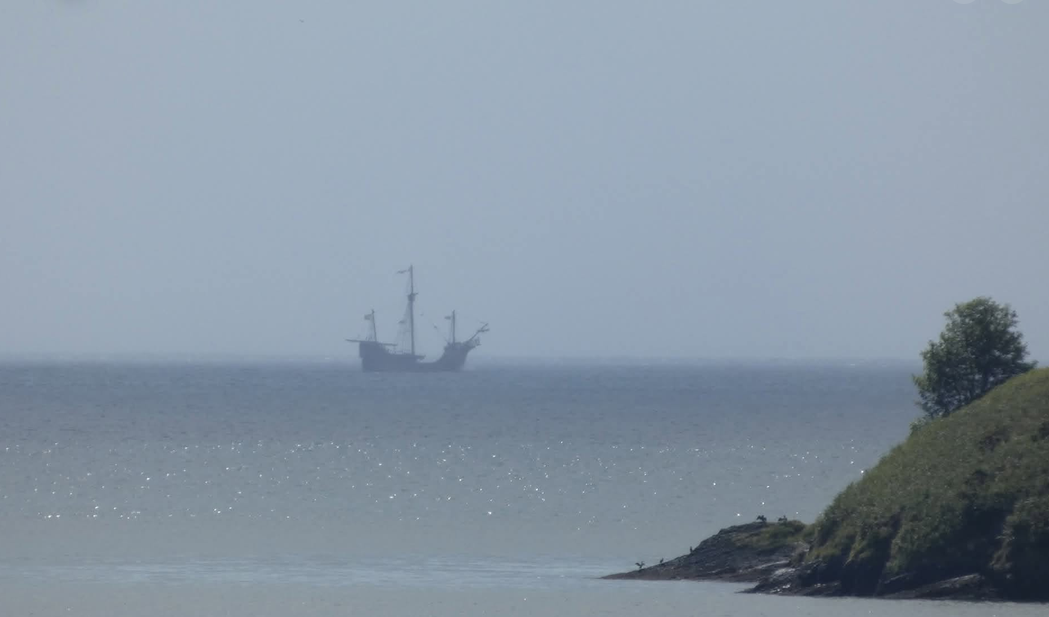
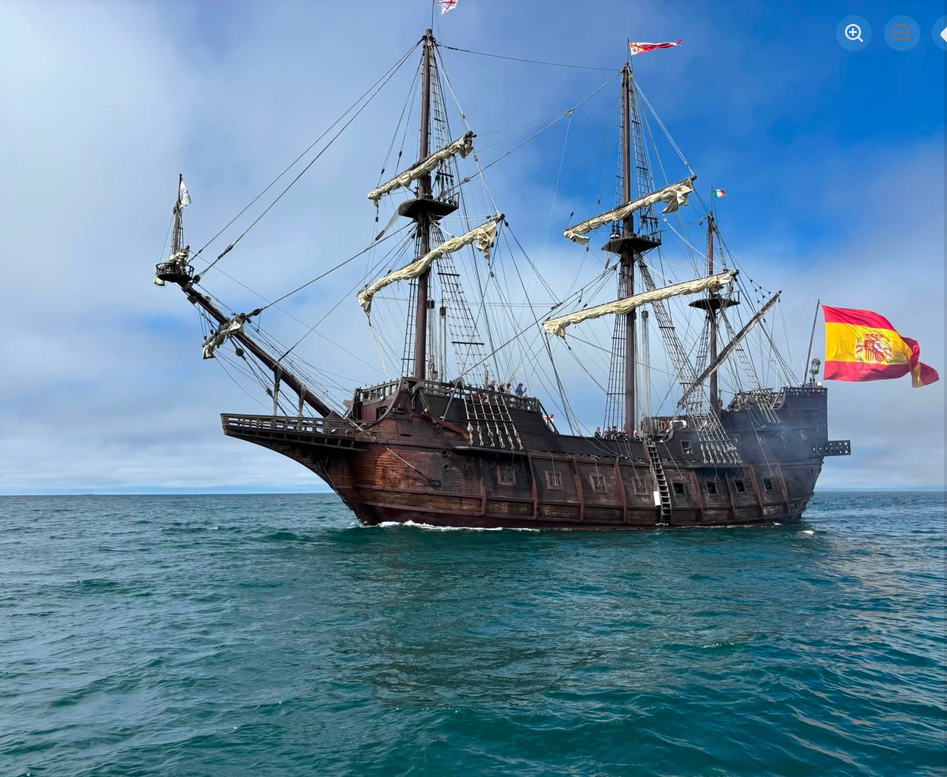
On the last day of June a Spanish galleon comes into the bay. The Galeón Andalucía — the largest sailing replica of her kind afloat — will pause off Streedagh before she enters the harbour, and her crew will drop a wreath on the water for the roughly eleven hundred men who drowned there in September 1588. Then, for a fortnight, anyone can walk her decks.
It is worth going. A reconstruction like this does something no document can: it lets you stand on a deck and feel a size that records only assert. But the most useful thing the Andalucía can do is send you a few miles up the coast in your mind, to the three ships lying in the sand off Streedagh Strand — because she is not quite the same kind of ship.
The yardstick
TThe Andalucía is rated at a little under 600 tons. The three ships wrecked at Streedagh — La Juliana, La Lavia and the Santa María de Visón — carried ratings of roughly 860, 728 and 566 toneladas respectively. It is tempting to line those figures up and conclude the Streedagh ships were simply bigger. That is the first trap,, because a tonelada is not a weight. It is an administrative capacity rating from a different system entirely, and you cannot convert it into modern tonnes and set it beside a replica’s stated tonnage as if they were the same measurement.
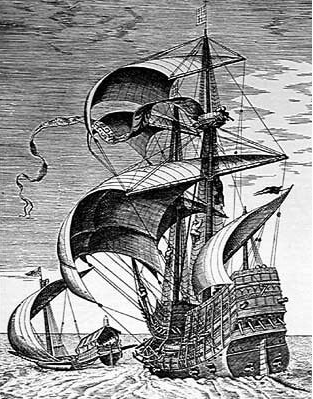
The accurate comparison is not about mass — it is about shape. The Andalucía is a galleon: long, relatively narrow, built to sail and to fight, with a length-to-beam ratio around four to one. The Streedagh ships were not galleons. They were large Mediterranean merchant naos — broad, deep, full-bodied carriers with a ratio closer to three to one, requisitioned for the Armada and pressed into one of the biggest seaborne invasions in European history. They were built to hold things, not to race.
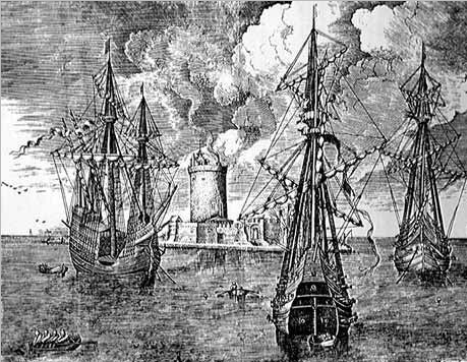
Armada vessels at anchor, not the high built up fore and aft castles, it sthese that arethe most likely explanation gotr several features of the wrecks.
When you reconstruct La Juliana‘s hull carefully — stated assumptions — her measured body comes out at something like thirty metres in the rated length, around eleven in the beam, six or so deep. In other words, the actual hull of the largest Streedagh ship is not obviously longer than the replica you’re standing on at Sligo quays. What made these ships capacious military transports was not a bigger galleon-shaped hull. It was a broad, deep carrying body plus towering fore-and-aft castles stacked several levels high to take hundreds of soldiers and their gear.
So the replica is genuinely useful — walk her deck and you feel the real weight and scale of a period ship in a way no drawing conveys. But she is a yardstick of the wrong shape. The ships up the coast were a different animal: broader in the body and taller at each end.
The Andalusia, Sllgo bay 2026, she has a lower profile than many of the Armada vessels, particularly the fore and aft castles are not built up. her hull size is very similar though to the ships at Streedagh.
Armada merchantman, Peter Breughel
The guns we have raised — and what they are not
Twelve bronze cannon have been brought up from La Juliana, three in the 1980s and nine in the great storm-driven recovery of 2015. They are beautiful objects: cast in Genoa in 1570 — the very year the ship was built — each carrying a saint in relief, among them St. Matrona, patron of Barcelona, where La Juliana was launched. The National Museum is conserving them still.
Those twelve guns are her own armament — the sakers, falcons and stone-throwing pedreros that made up the thirty-two-gun complement a merchantman of this size carried to fight off corsairs. They are the deck guns and the swivel guns: the self-defence kit. The whole recovered battery weighs about six tonnes, and the heaviest single piece is around a tonne.
For scale, compare to the famous siege gun raised from the Trinidad Valencera, the other big Levant nao wrecked off Donegal: a single bronze battering piece of two and a half tonnes, made in Brussels, firing a forty-one-pound ball. That is what an Armada siege train looks like — and nothing of that weight is among the twelve guns lifted at Streedagh.
Which tells you something important. What we have raised is what the ship needed to defend herself. Her anti Corsair armament. It has almost nothing to do with what she was carrying. What she was carrying is still down there.
A floating warehouse for an invasion
These ships were heavy-lift transports. The plan in 1588 was to land an army in England and march on London, and that required a siege train — heavy guns, gun carriages, entrenching tools, munitions, the engineering gear to batter and dig. We know La Juliana was carrying it, because the first thing found on her site was a spoked carriage wheel a metre and a half across, and four more like it: the dismantled remains of siege carriages, exactly as found on the Valencera. The guns those carriages were built for are far heavier than her defensive battery, and they would have been stowed deep as cargo, well below it. None of that weight is among the twelve guns raised.
La Juliana‘s thirty-two documented guns, twelve have been recovered. The other twenty are unresolved. “Not recovered” is not the same as “still on the seabed” — burial, dispersal, or salvage we have no record of are all possible — and the siege train’s survival is a hypothesis to be tested, not a fact to be asserted. But the carriage wheels are hard evidence that the heavy gear was aboard, and nothing in the record says it was ever taken off.
There is more than ordnance. The Santa María de Visón took on a share of the whole fleet’s medical supplies after the dedicated hospital ship was condemned as unseaworthy on the way north. One of the three Streedagh wrecks is, in effect, carrying an Armada field hospital. And La Juliana was built for exactly this kind of work: the amphibious conquest of Terceira in the Azores in 1583 gives us the doctrine — the same class of hull, the same kind of cargo, the same task, rehearsed in the years before the main event. One of her guns is even of Turkish manufacture, very likely captured at Lepanto in 1571: a barrel that travelled from the Ottoman fleet to a Catalan merchantman to an Irish beach.
Why Streedagh is different — and of world importance
The Valencera comparison is instructive, because the two sites are nothing alike as deposits. The Valencera came to rest on a hard seabed. The lighter material washed away; what remained were the heaviest objects, left exposed on the bottom. Streedagh is the opposite. The hulls filled with sand, and the excavators who have worked there report something remarkable: articulated ship timbers — the structure of the ships themselves — surviving in place beneath the overburden.
There is a mechanism behind that. A contemporary watching from the shore saw the ships destroyed — and in a sense he was right, because the tall castles and upper works, driven onto a bar and hammered by surf, would have failed fast and violently. But the heavy lower hull, constrained on the sand and loaded with ballast and cargo, need not have broken up with them. It could sit, coherent, and be buried. That is how you reconcile an eyewitness account of total wreck with articulated timber surviving on the seabed four centuries later: the ship you see destroyed is the upper ship; the ship that survives is the buried floor of it.
If the lower hulls are partly intact and sand-sealed, then the holds may be partly intact too, and the heavy gear — the siege guns, the bulk munitions, the stores, the medical assemblage — may still be where it was stowed, sealed in by the same sand that hid the sites. That is a prediction, not a promise; the sea is dynamic and even large timbers can move once uncovered. But it is a prediction the deposit type supports.
And the reason any of it survived to be predicted is that nobody could rob it. Bronze guns are normally the first thing stripped from any wreck; gunmetal was worth more than the ship. They survived at Streedagh because the wrecking, in September 1588, opened what a contemporary historian called the Fifteen Years’ War. The north-west of Ireland was a contested war zone from that autumn until 1603, with no settled authority and no secure access for the divers and time that organised salvage needs — and by the time the fighting ended, the sand had done its work. The archaeological survey found no evidence of any historic salvage at all. What lies at Streedagh is something genuinely rare in the world: an unsalvaged, sand-sealed 16th century invasion cargo.
Putting numbers on it
For the past while I have been trying to assemble the actual figures for this site as part of an archaeological assessment — not impressions, but a reconstruction with stated assumptions and honest error bars, in which every value is marked as observed, derived, inferred or hypothesis.
It bounds La Juliana‘s measured hull body. It reads her recorded complement — something like 355 to 395 people aboard — as a constraint on her architecture: fit that many soldiers and mariners, with their artillery and stores, and you are forced into the broad-bodied hull and the stacked castles, because a single flat deck cannot hold them.
:thirty-two guns documented, twelve recovered, up to twenty unresolved, their status left open rather than assumed. The siege train sits on top of that, evidenced by the carriage wheels and not yet found.
I will be setting out the full reconstruction separately — the hull-form envelope, the personnel and architecture argument, the calibrated ordnance, and the wreck-process model — because I think it amounts to something we are oddly missing: a proper assessment of what this site actually contains.
The sea will not wait
There is one reason for a sense of some urgency. The sea at Streedagh is very active. The same dynamic sand that buried and preserved these ships also, periodically, un-buries them — and an exposed timber or gun in a high-energy surf zone is a timber or gun being destroyed. The 2015 recovery happened because storms tore the sand off the Juliana and left her material exposed and, in the divers’ word, vulnerable; the ship’s own rudder shifted after long burial, a reminder that “preserved in place” is a dynamic condition, not a permanent one.
That is not a situation a reactive scramble can manage. Every storm that exposes the site starts a clock, and answering it from a standing start, with expertise and equipment brought in from elsewhere each time, is no way to look after a wreck complex of this importance. What a world-class site needs is a standing plan — and, just as much, the capacity to act on it: the physical infrastructure and the local expertise, based here in Sligo, to survey, recover, conserve and interpret what the sea keeps offering up and then threatening to take back. Building that capacity where the site is, rather than depending on it arriving from away, is the difference between stewarding this place and merely reacting to it.
The wreath
When the Galeón Andalucía drops her wreath off Streedagh this week, it falls above a grave. More than a thousand men died there in the space of an hour, and the sand that may yet hold an intact field hospital and a buried siege train also holds them. The numbers and the reconstructions matter — they are how we understand the scale of what is there —
A replica is coming to the harbour. The real ships are in the sand a few miles up the coast, in a place that both preserves them and, slowly, takes them apart. They are worth the plan, the infrastructure, and the people to do it properly. We have, lying off one Sligo beach, one of the most important Armada sites in the world.
The reconstruction figures referred to above are part of ongoing work to assemble a full archaeological assessment of the Streedagh site. I will publish the technical detail — the hull reconstructions, the cargo mass-budget, and the calibrated ordnance — separately.
There is a particular conversation you only have while leaning on a shovel. In the rain. Up to your ankles in water and mud. Mine happened years ago, while digging some endless ancient ditch, on minimum wage, the rain finding the gap between collar and neck. We worked out — between us, idly, the way you do to keep warm — that it seemed half the films showing in the cinema that month were built on archaeology. Lost tombs. Cursed idols. Buried cities. Maps to vanished civilisations. The public clearly could not get enough of it, and was paying handsomely for the privilege. And here we were, the people who actually do the thing those films are about, being paid roughly what a teenager earns stacking shelves, to recover the real past with our hands.
That mismatch is not an accident, and it is not ironic. It is structural. Once you see the structure, you also see that it is fixable — and that almost all the campaigning energy archaeologists spend is aimed at the wrong target.
The Pincer
Working archaeologists are told two incompatible things.
On one side, we are told our output is a minority interest that produces no wealth. The past is a luxury; knowledge of it is nice-to-have; be grateful for whatever subvention the state can spare, and don’t expect much, because none of this pays.
On the other side — the moment a road or a housing scheme hits the ground — we are told the opposite: that archaeology is a service that ought to be commercially viable, that consultancies should compete for the developer’s money, and that the discipline should behave like any other line item to be priced down.
Held separately, each claim sounds reasonable. Held together, they are a trap. The first justifies starving the public side; the second justifies squeezing the commercial side. Both conclusions are “fund it less,” reached from opposite premises. The way out is to stop arguing on the terms we’ve been handed and look at how value actually moves through the discipline.
Crude Knowledge
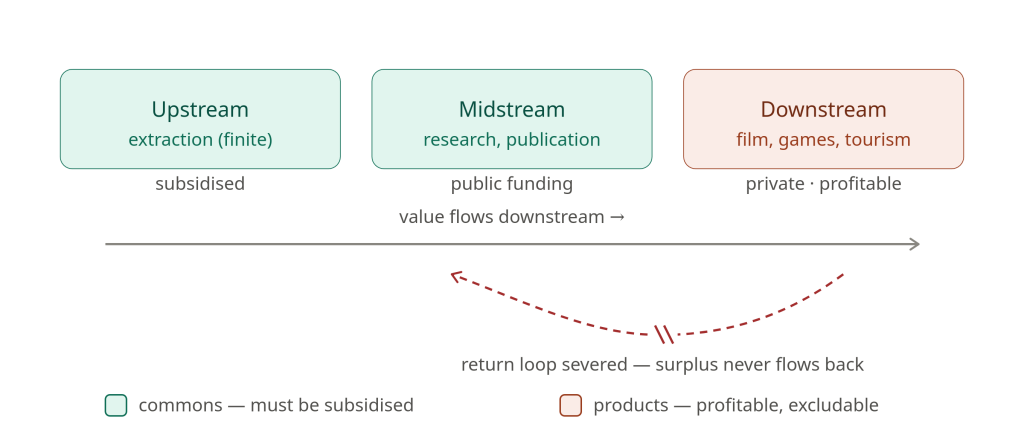
Lets borrow a frame from the industry that understands extracted, finite resources better than any other: petroleum. Oil people talk about upstream, midstream, and downstream. Upstream is extraction — expensive, risky, capital-hungry, and where the raw substance comes out of the ground. Midstream is processing and transport. Downstream is refining and the thousand branded products where the actual margin lives.
Nobody looks at a barrel of crude and declares the extraction worthless because crude, as it comes up, is useless. Nobody demands that drilling turn a profit on its own, in isolation, without the refinery and the forecourt downstream to justify it. The whole chain is understood as one system, and the enormous downstream value is exactly what justifies subsidising, protecting, and carefully marshalling the upstream end.
Archaeology has precisely this shape.
Upstream is the dig: survey, geophysics, remote sensing, excavation — the recovery of information from a finite, irreplaceable, non-renewable resource. Midstream is the refining: post-excavation analysis, scientific dating, conservation, archives, peer-reviewed publication, the museum. Raw stratigraphy is as useless to the public as raw crude until it has been refined into knowledge. Downstream is where the value is realised and where the money is: film and documentary, computer games, narrative books and comics, tourism, heritage, education, even the music and the merchandise.
So far this is just description. Here is the mechanism
Why the money never flows back
The reason the value concentrates downstream — and stays there — is excludability.
Knowledge of the past is a commons. Once it is published, no one can be charged at the gate for knowing it; it cannot be fenced, and what cannot be fenced cannot be sold. The upstream and midstream, by their nature, produce a public good. The romance, on the other hand, is perfectly excludable: a cinema seat, a game licence, a branded heritage experience, an intellectual-property right. Value pools wherever a fence can be built.
The result is a value chain with the return pipe missing. The surplus that the public’s genuine, deep fascination with the past generates is captured downstream, behind fences, and almost none of it routes back to refund the commons that produced the raw material in the first place. The diggers in the ditch generate the substance the whole edifice rests on, and see none of the wealth it creates, because the part they produce is structurally unsellable.
This is where the wrong conclusion gets drawn. Because the upstream “makes no money,” it is funded as an afterthought. But by the logic of every other extractive industry, that is exactly backwards: the colossal downstream value is the justification for increasing the upstream subvention, not the excuse for withholding it. And archaeology has an advantage oil does not — there is no pollution at the wellhead, no externality to clean up. It is a finite resource that, once refined, pays society back in identity, tourism, knowledge and stories, and harms nothing on the way out. The case for public subvention is not weaker than oil’s. It is cleaner.
I do not, for the record, begrudge the downstream its fences. The studio that puts a ticket price on a story about the past is doing nothing wrong; it is putting money into telling the public a tale they want to hear. The fault is not the fence. The fault is that we never built the pipe that sends a fair share back up the chain.
The conflict of interest we should simply abolish
Development-led archaeology — the model that exploded across Ireland and Britain during the building booms — rests on an absurdity. The developer pays for the excavation. The more is found, the more it costs the developer, and the longer they are delayed. So every incentive in the arrangement points in one direction: toward finding and recording less. Consultancies compete for the developer’s contract, and the competition rewards whoever can promise to find less, faster, cheaper. The people doing the recovery are paid by the one party in the whole transaction with a direct interest in minimising what is recovered.
We have built a system in which developers pay archaeologists to destroy archaeology efficiently, and then we wonder why morale, wages and standards are where they are.
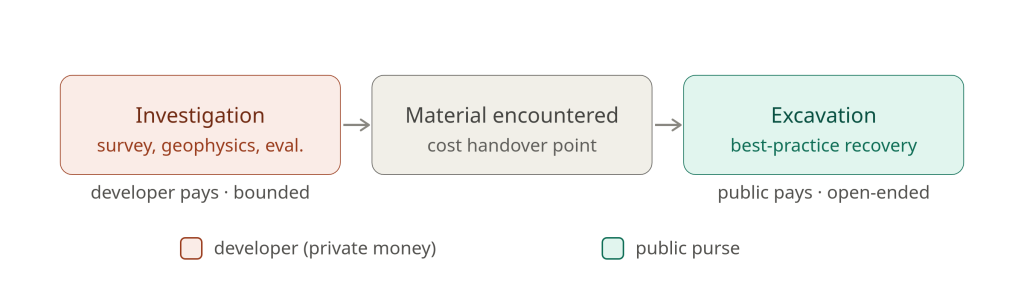
The fix is a single cut, moved to the right place: split the cost at the point of encounter.
Let the developer pay for the looking part— survey, geophysics, evaluation, monitoring, watching briefs. That cost is bounded and predictable, an almost normal line item any project can price in advance. The search and monitoring phase is certainly the most predictable part of archaeological costs. But the moment significant material is actually encountered, finding — the excavation itself, done properly, to the best standard we can manage — becomes a public charge.
This does two things at once. First, it caps the developer’s open-ended risk. The terror of the bottomless archaeological bill is precisely what drives the panic, the corner-cutting, and the quiet midnight destruction. Remove the unbounded cost and you remove that panic. Second, and more importantly, it severs the corrupting coupling. The excavator stops answering to the party who profits from finding less, and starts answering to the public, whose interest is in finding the most.
And here is the part that turns this from a subsidy into a transfer of power. Control follows payment. Under the current model the developer pays, so the developer effectively owns the decision; the archaeology serves their timeline and their convenience. Move the payment to the public, and the ownership moves too. Because the developer is no longer paying for the important site, they no longer hold a veto over it. The site can be ordered preserved in place, incorporated into the new structure, opened to public access, the plan modified — and in the rare extreme, the development altered or abandoned — precisely because the public, not the developer, is now carrying it. What developers lose is not money. It is the purchased leverage to destroy or ignore.
“But then they’ll just build anywhere”
The obvious objection is that if developers no longer pay for what they find, they lose the incentive to avoid sensitive ground in the first place.
In practice this is far smaller than it sounds, because it is the wrong tool for the job anyway. Avoidance does not belong in the excavation bill; it belongs in planning. We already know where the high-risk, high-value ground is — the cores of ancient towns, monastic enclosures, known archaeological landscapes. The right place to handle a Viking waterfront or an early church is at the planning stage: by refusing unsuitable developments before they start, and by attaching conditions in advance — preserve in situ, design around it, incorporate it, provide access. Developers in such zones should know going in that an important discovery may mean modifying their plan, and in extreme cases losing it.
So the sequence is: known risks are controlled by planning; everything is done to avoid and mitigate what we can predict; and it is only when, despite all that, an unexpected site emerges that the public authority steps in to pay for its proper recovery. Developers still have every reason to avoid trouble — the cost of investigation, the delay, the planning friction — they simply no longer pay to suppress archaeology. One can even imagine a graduated arrangement: a developer contribution that steps down as a find’s significance and value step up, so that the more important the site, the more fully the public carries it, and the less say the developer has over its fate.
The emphasis falls on planning that controls development with appropriate clauses, rather than on a perverse market that pays people to find as little as possible.
The missing pipe
Both halves of this point to the same reconnection. The reform needs a funding source, and the funding source is sitting in plain sight at the downstream end. A modest, ring-fenced levy on the profitable, excludable products that already monetise the public’s appetite for the past — the very industries this argument began with — is nothing more than the return pipe the chain has been missing. The arrow runs back from the fenced downstream to refund the open commons upstream.
The outcome is one almost everyone should accept. The public pays to recover and preserve the sites that genuinely matter. Developers are no longer bankrupted excavating a field of muddy, undatable postholes that nobody needed dug at a cost of a million euro. Resources are marshalled toward significance rather than wasted on incident. And the people in the ditch, who produce the raw material the whole shining downstream is built on, are finally paid out of the wealth their work makes possible.
We already extract the past. We refine it, and we sell it, and we make fortunes at the far end. We simply built the chain with the return pipe left off. Reconnect it.
“The starting-point of critical elaboration is the consciousness of what one really is, and is ‘knowing thyself’ as a product of the historical process to date which has deposited in you an infinity of traces, without leaving an inventory. Therefore it is imperative at the outset to compile such an inventory.”
Antonio Gramsci, Prison Notebooks, Q11-12
I. “What is wrong with Sligo people?” “Why do they resist progress so much?”
The question was asked of me directly, more than once, by a person who had moved to Sligo from elsewhere (Galway i think) and had spent years working in the local authority. They had never come to terms with what they perceived as the town’s opposition to progress, its resistance to development schemes, its tendency to frustrate the well-intentioned efforts of those trying to improve it. They asked the question with genuine puzzlement, not malice. They could not understand the place. Why were these people, in this town, so determinedly difficult? Why were they against progress?
The question deserves an answer. The answer is not the one the questioner expected, and it is not flattering to the official narrative of the country in which the question is being asked. But it is the answer that the historical evidence forces upon anyone who actually examines it, and the purpose of this article is to lay out that evidence and follow it where it leads.
In 2013, the Fine Gael and Labour government abolished Sligo Borough Council. The council had accumulated a debt of approximately €94 million, much of it incurred through land purchases at top-of-market prices during the Celtic Tiger years. Phil Hogan, then Minister for the Environment, observed that “Sligo is certainly one of the reasons we are reforming local authorities.” It was a striking statement. It was also a misleading one: the debt had been accumulated by the County Council, not by the Borough. What the reform actually achieved was the abolition of a different democratic institution — one that had existed in various forms since 1613, that had survived four hundred years of political upheaval, and that had nothing to do with the financial mismanagement being cited as justification for its removal. The wrong body was abolished. Democratic representation was reduced rather than restored. The reformers proceeded anyway.
This was a small administrative event, easily overlooked, easily justified in the language of necessary modernisation. But it was also an indicator of something larger. It was the latest in a long series of decisions, stretching over decades, in which the Irish state had responded to Sligo’s difficulties by removing capacity rather than adding it. Services rationalised; routes closed; institutions consolidated elsewhere; investment directed to other regions; democratic structures abolished. The pattern was so consistent that it could not reasonably be attributed to unfortunate coincidence. It was, evidently, something else.
The European Union, in its periodic regional assessments, classifies the Northern and Western region of Ireland as a “lagging region.” This is technical language: it indicates an area whose economic performance falls significantly below both the national and EU averages, attributable to long-term underinvestment in regional infrastructure. The classification is not contested by the Irish state. The data behind it — GDP per capita, infrastructure density, transport connectivity, broadband penetration, healthcare access, third-level education attainment, demographic stability — are consistent across all measures. By every objective indicator, the region of which Sligo is a central town is one of the most chronically underdeveloped parts of Western Europe.
What is contested, or rather what is not addressed at all, is the explanation. Official descriptions, when they exist, are in the passive voice. There has been underinvestment. Services have been rationalised. Demographic factors have produced unfavourable outcomes. The phrasing treats the situation as the cumulative product of impersonal forces operating on a region that simply, somehow, mysteriously ended up disadvantaged. The active subjects who made the relevant decisions — the ministers, the civil servants, the agencies, the bodies that allocated the funding and routed the rail lines and located the hospitals and designated the universities — disappear from the account. So does the question of why they made the decisions they did.
This passive-voice account is not, in fact, satisfactory. The region in question is not an isolated, resource-poor periphery in the way that some European peripheries are. It contains more land area than the east coast, albeit a lot of it not great agricultural land admittedly. It has three international airports — Shannon, with the only US customs pre-clearance facility in Europe; Knock, one of the fastest-growing airports in Ireland; and Derry, providing exactly the kind of cross-border connectivity that EU policy actively prioritises. It contains the largest natural harbour in the British Isles, at Cork. It has a distributed regional university, Atlantic Technological University, with campuses stretching from Letterkenny to Galway. It has nineteenth-century intermodal port infrastructure at Sligo that aligns precisely with EU coastal shipping policy. It has substantial agricultural, fisheries, tourism, and renewable energy and water resources. By any objective measure, this is a region that could be thriving.
It is not thriving. It is, instead, the region that has been emptying out for over a century, generation after generation, as its young people leave to find in Dublin, in Britain, in North America, in Australia the opportunities that are not provided at home. The Greater Dublin Area now contains over forty per cent of the national population and continues to grow at a rate that has produced one of the most acute housing crises in Europe. The northwest continues to lose people. The infrastructure that might allow it to develop independently is not built. The Western Rail Corridor, the proposed restoration of the existing Atlantic seaboard rail line connecting Cork through Limerick, Galway, and Sligo to Derry, has been blocked for over fifteen years through a documented sequence of administrative obstructions, despite available EU funding and a strong economic case. The museum that Sligo town has been trying to establish since the 1950s remains unrealised, more than seventy years after the project was first proposed. The Borough Council, as we have seen, was abolished in 2013.
A pattern of this consistency, repeated across this many dimensions of state activity, over this length of time, requires an explanation. The pattern itself is the data; the explanation has not been provided. A substantial body of writing — investigative journalism, policy analysis, community advocacy — now documents the symptoms in considerable detail. What none of this writing does, with any rigour, is provide the underlying cause. The implicit theory has been that the symptoms are a series of independent failures, each individually explicable in technical terms, that have cumulatively produced an outcome no one explicitly intended. This article will argue that the implicit theory is wrong. The symptoms are not independent. They follow a pattern. The pattern has a structural source. The source can be identified, and once identified, it explains not only the specific case of Sligo but the broader phenomenon of which Sligo is the most acute and most visible instance.
The source is historical. It is not, however, the history that most readers will expect. The conventional history of post-independence regional inequality in Ireland is told in terms of geographical disadvantage, economic adjustment after the rupture of partition, the slow modernisation of an underdeveloped agrarian economy, and the comparatively recent shift toward concentrated urban service economies. This conventional account is not wrong about the symptoms it describes, but it is wrong about their causes. The actual causes lie much deeper, in cultural and institutional patterns that were established in medieval Ireland, consolidated through the centuries of English colonial rule, and — most consequentially — were not dissolved but were preserved and given new institutional form at independence in 1922. The post-independence Irish state is not, structurally, what its official narrative claims it to be. Once one sees what it actually is, the pattern of regional inequality becomes immediately and completely explicable.
Seeing what the state actually is requires, first, seeing what its constituent populations actually are. It requires accepting that there are not, and never have been, “the Irish” as a single cultural formation, but rather several Irelands with distinct historical trajectories whose relationships with each other have shaped the political development of the country since the thirteenth century. It requires recognising that the religious vocabulary in which Irish history is conventionally narrated — Catholic Ireland against Protestant Ireland, native against settler, Irish against English — obscures more than it reveals about the actual cultural fault lines, which are not religious in origin and are not adequately described in religious terms. It requires reading the period 1916–1923 not as the culmination of the Irish revolutionary tradition but as something quite different and considerably less straightforward.
And, finally, it requires looking at Sligo itself with new eyes. Sligo is not a peripheral town that has somehow failed to keep up with national development. Sligo is the most acute case of a structural pattern that operates wherever the post-independence state encounters a place or population that does not fit its cultural template. Once that pattern is understood, the apparent puzzle of Sligo’s chronic underdevelopment dissolves. The town’s condition is not anomalous. It is the predictable and necessary outcome of a framework that was constructed precisely to render places like Sligo — and the cultural traditions they represent — invisible to the state that nominally serves them.
To see this clearly, we must go back to the beginning. Not to 2013, or 1922, or even 1798. We must begin, where the relevant story actually begins, in 1245.
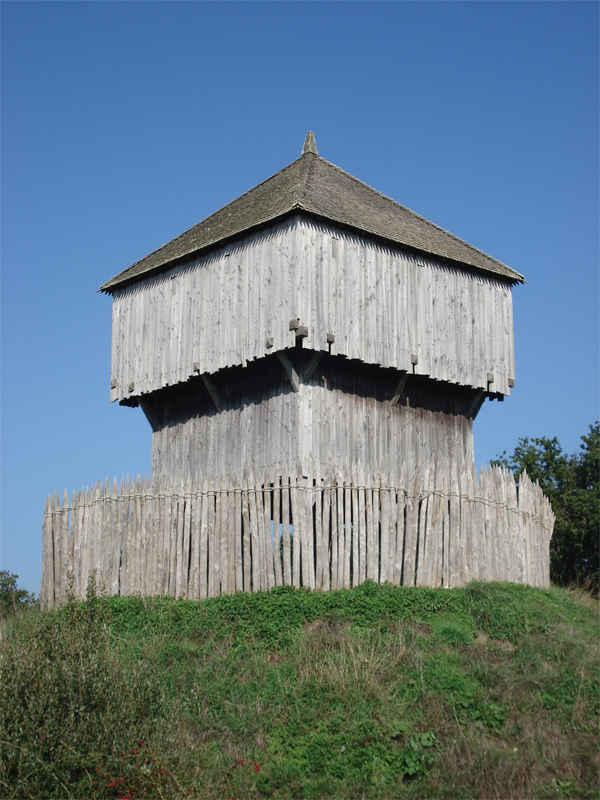
Norman wooden castle – reconstruction in Anjou, France. These were the most common types of castles nuilt by the Normans, Motte nad Bailey, the bailey being the small fortified enclosure below the motte mound with the Keep like above on it — Ballymote has the two Norman words in the name the Baile and the Motte.
In that year, the Anglo-Norman magnate Maurice Fitzgerald — at the time one of the most powerful men in Ireland — and Feidlim Ó Conchobhair, King of Connacht, together founded a town on the south bank of the river Sligech, at the point where it spills out of Lough Gill toward the Atlantic. The location was deliberate. The river offered a natural defensive line. The lough behind it controlled the inland routes. The harbour ahead opened onto the western sea routes that linked Atlantic Ireland to Scotland, the Hebrides, and through them to Norway, and to the south towards Galway, France, and Spain. Whoever held this point held the gateway between the interior of Connacht and the wider Atlantic world.
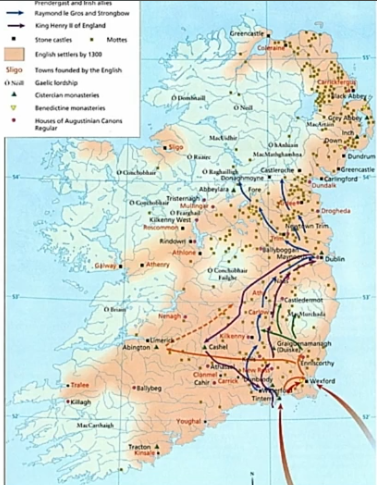
Sligo was the northern tip of a two point prong extending into Connacht from the bridgehead at Lough Ree. Here the Normans had finally organised the invasion of Connacht, 80 years after invading the east of the country. To make good these speculative grants of the English kings and especially the Pope, they had to enforce on the ground what was written in the documents. At a promontory on the west side of Lough Ree the Normans set up the bridhead and supply depot, walling off the base of the peninsula to pretect it. From there one line adbanced southwest towards Galway, founding Athenry and Galway that were to remain in Engliush hands. The second line ran northwest, a chain of castles including Ballymote, hitting the coast at Sligo. From the two seaports at each end of Connacht the Normans could resupply by ship without trying to conquer the vast mountainous districts of western Connacht. All they had to do was hold them.
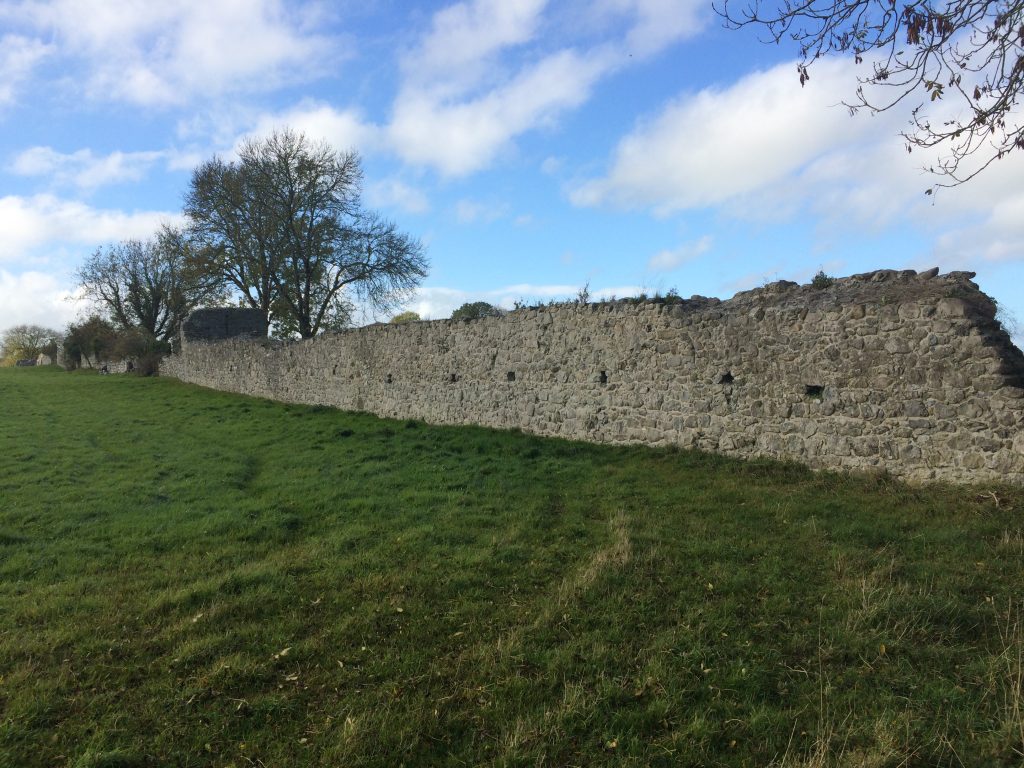
The large city wall at the “lost city” of Rindoon, Co. Roscommon. Here a city wall cuts of the base of a large peninsula, but behind it there is no city. Abandoned within less than a century of its founding, it stands as a unique reminder of the 13th century expansion during Europes medieval warm period.
The town that rose on the river bank at Sligo followed the standard continental medieval template: a Dominican friary, a market cross, a castle, a hospital, and a port. This was urbanism in the European sense — the kind of integrated commercial-religious-military settlement that the Normans had built across England, France Wales, Sicily, the Levant, and the Atlantic seaboard wherever they went. By the standards of thirteenth-century Connacht, where the indigenous settlement pattern remained dispersed and clan-based, it was a remarkable imposition.
What is too often forgotten is that it was a joint imposition. Maurice Fitzgerald and Feidlim Ó Conchobhair did not found Sligo as conqueror and conquered. They founded it (ostensibly)as allies. The same king of Connacht had welcomed Norman builders into his territory because Norman engineering, Norman fortifications, and Norman commercial reach offered things the Gaelic political economy could not yet provide. Sligo, from the moment of its foundation, was a hybrid: a continental town built on a Gaelic invitation. This hybrid character would shape everything that followed. Although as the annals mention, Fitxgerald slyly gathered stone for the agreed upon hospital, only to arrive and switch the building materials to a castle at the last minute, catching the Irish king by surprise.
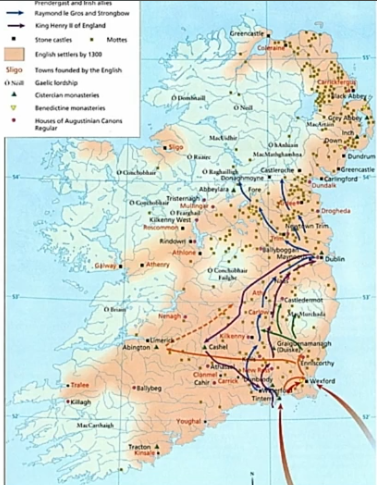
Areas of Norman political control at their hieght in the 13th century. After Kieran O’Conor.
The Collapse of Norman Control
The Norman lordship over Sligo was brief. Within twelve years of the founding, in 1257, Maurice Fitzgerald was dead after the Battle of Credran-Cille, (near modern Rosses point) killed in a Gaelic counter-attack at the northern fringe of his own lordship. The Fitzgeralds held on for another generation under his nephew Maurice fitz Maurice — known to the annalists as Muiris Maol, “Maurice the Bald” — but by the death of Muiris Maol in 1286 the position was already untenable. Three powers were converging on north Connacht: the Fitzgeralds themselves, increasingly absentee; the de Burghs, the rising Anglo-Norman earls of Ulster and lords of Connacht; and the various branches of the Uí Chonchobhair, the royal family of Connacht, now fragmented into competing dynastic lines. The Normans had more luck along the coast in Tireragh and towards modern Mayo, ousting the O’Dowds for a time, but by the 1350s at the latest they had either intermarried and become absorbed or were driven out of the area and Gaelic chiefs re-estanlished control of the coastline.
The years between 1286 and 1310 were chaotic. As Katharine Simms has reconstructed from the annals, the lordship of Sligo became a contested borderland in a four-cornered conflict involving the Fitzgeralds, the de Burghs, the O’Donnells of Tír Conaill pressing down from the north, and the Clan Murtagh O’Conors pressing up from the south. Kings were made and unmade in months. Cathal Ruadh O’Conor took the kingship of Connacht in 1293 and was assassinated within three months. Aodh son of Eoghan O’Conor was deposed by his own Gaelic vassals in 1294 and reinstated by the English justiciar within months. The whole region, in the half-century after Maurice Fitzgerald’s foundation, was in a state of permanent succession crisis. The one effect the Normans did have in Connacht was to destabilise it – the Kings of Connacht never really reestablished proper authority, instead fracturing into rival dynasties.
This was the wider context for what happened in 1310, the date that fixes Sligo’s medieval fate. Richard de Burgh, the Red Earl of Ulster — by then the dominant Anglo-Norman magnate of the entire north and west of Ireland — undertook a serious effort to consolidate his control over Sligo. He rebuilt the castle, which had been allowed to decay, and attempted to bring the surrounding territory back under his lordship. It was the last serious Anglo-Norman attempt to hold the place.
It failed. Within a generation the de Burgh interest in Connacht itself was disintegrating, undone by the assassination of William, the Brown Earl, in 1333 and the civil war between the Mayo and Galway branches of the family that followed. Sligo passed into the hands of the Ó Conchobhair Sligigh — a Gaelic branch descended from the royal line of Connacht — and remained there.
The Wider Recession
What happened at Sligo between 1267 and 1333 was not an isolated regional setback. It was part of a much larger pattern. The Norman colonisation of Ireland had reached its high-water mark in the second half of the thirteenth century, and from about 1300 onwards it began to retreat. Town after town, lordship after lordship, was lost to Gaelic recovery. The Bruce invasion of 1315–1318 accelerated the process; the Black Death of 1348–49 finished it off in many places. By the early sixteenth century, English officials were complaining that the walled towns of the Pale could only communicate with each other by sea, because the Gaelic Irish had retaken almost all the land between them.
One reason for this retreat of the Normans was the arrival into the west of heavy infantry – the armoured Galloglas – Gaelic-Norse warriors with an origin of a fightlig style in Western Scotland, but who proved effective in countering the Norman heavy armoured horsemen who wrought such devastation on the battlefileds of Europe. Here, combined with the terrain, and the traditional Irish light infrantry known as Ceatharna or Kern, the Normans were stopped in their tracks and gradually retreated or were absorbed into the Gaelic world.
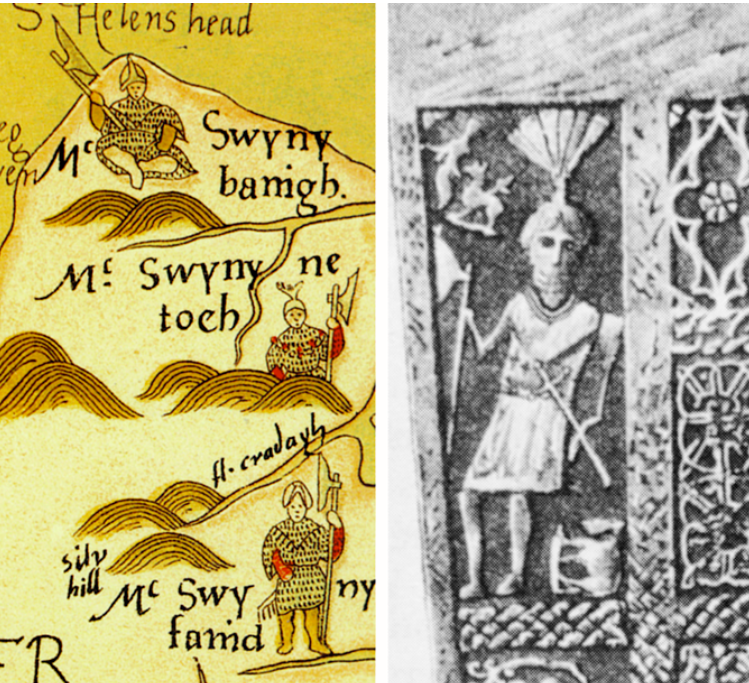
MacSuibhne Galloglaigh –Goghe’s 1567 map showing MacSweeney soldiers with the chainmail, classic long handled sparth axes and various styles of padded head armour. Right, MacSweeney grave slab at Killybegs, circa 1550, note the plumes on the headdress or helmet. — taken from www.wildeirish.com
Sligo was part of this recession. But Sligo was unusual in two respects, and these two anomalies are the foundation of everything that follows.
The first anomaly is geographical. Most Norman towns lost in the recession either vanished or were absorbed into the surrounding Gaelic countryside, reverting to dispersed patterns of settlement. Rindoon is the textbook case — the walled town on a peninsula jutting into Lough Ree, founded as a bridgehead during the invasion of Connacht, by the fifteenth century a ruin. Athenry survived as a Norman town but only by remaining tightly Norman, walled, English-speaking, isolated. The general rule was that when Norman control collapsed, urbanism collapsed with it.
Sligo did not follow this rule. The town survived. The friary continued to function and continued to attract burial endowments from the surrounding Gaelic nobility — a sign of ongoing wealth and institutional continuity. The port continued to operate, exporting hides and fish, importing wine and salt. The castle was repaired and held, changing hands frequently but never abandoned. The market continued. The street pattern, identifiable on the earliest surviving maps, preserves the medieval layout to this day.
Why did Sligo survive where Rindoon did not? The most likely answer is geographical and political. Sligo sat at the southwestern edge of the Gaelic zone that included Tír Conaill (Donegal), Tír Eoghain (Tyrone), and the wider Ulster lordships. This zone was never effectively conquered by the Normans in the first place. After 1300 it became the great unconquered redoubt of Gaelic Ireland. Sligo’s proximity to this redoubt — its position as the southern gateway into and out of it — gave it a strategic value that could be defended. The Ó Conchobhair Sligigh, the O’Donnells, and the O’Neills all had reasons to keep the port functioning and the town viable. Rindoon, perhaps just wasnt situated on a traditional route, and stands now as one of the very strangest and most unique sites in Europe, a full town laid out for occupation but abandoned shortly after.
The abbey mattered too. The Dominican friary at Sligo was not just a religious institution; it was an administrative, economic, and educational hub. Friaries of this kind, in this period, functioned as something like medieval universities, hospitals, and archives all at once. They were international institutions, plugged into networks that ran from Spain to Poland. The Sligo Dominicans were patronised by Gaelic chiefs who endowed the friary, were buried in its grounds, and used it as a meeting place. The friary gave the town a continuity that did not depend on whoever was sitting in the castle in any given year.
The Anomaly Within the Anomaly
The second anomaly is what makes Sligo not just exceptional among Norman foundations but exceptional within the Gaelic world itself. After the Norman recession, most of what is now western and northern Ireland reverted to a non-urban, pastoral, political economy. Cattle were the medium of wealth. Movement was seasonal. The dominant settlement form was the ringfort or the unfortified clachan, not the town. Cities and large towns were, by the fifteenth century, a feature of Old English Ireland — Dublin, Drogheda, Kilkenny, Waterford, Cork, Limerick, Galway, Athenry — not of Gaelic Ireland.
Sligo violated this pattern. It remained a town under Gaelic governance. The Ó Conchobhair Sligigh ruled it as a Gaelic dynasty but operated it as a continental city. This combination was rare to the point of being almost unique. It is the central historical fact about medieval Sligo, and it explains everything that comes after.
The evidence for the town’s continued urban functioning is not abundant, because the Gaelic world did not produce the same density of administrative records that the English colonial system did. The annals — the great Gaelic chronicles compiled by hereditary historians attached to noble households — record what they considered worth recording: battles, dynastic successions, deaths of nobles, occasional natural disasters. They are not municipal records. But what they do record about Sligo, together with the surviving archaeological evidence, is enough to establish that Sligo was something other Gaelic regions did not have: a small, but working medieval city.
An idea of its culture can be gleaned from an incident recorded in the early 16th century of a Dublin merchant travelling to Sligo overland, presumably with pack-horses to sell his wares, who then before he left purchased the rights to poem from local poets – which turned out to have already been sold to someone else. We know of this because the merchant complained and was brought before Oconnor Sligo who restored the merchants 10 pounds he had paid and gave him ten more for his trouble. Presumably the sellers were tracked down by O’ Connor afterwards!. This shows us though what the place was known for – and interestingly that such poems could command prices and value even within the Pale.
However, perhaps the most telling evidence is the books.
The Manuscript Wealth
Making a manuscript in fifteenth-century Ireland was an enormous undertaking. Vellum had to be prepared from calf skins — perhaps two hundred animals for a substantial codex. Pigments had to be sourced, some of them imported from continental suppliers and worth their weight in silver. A trained scribe might take a year to copy a major text; an illuminator longer. The work required a secure space, sustained patronage, access to source texts that themselves had to be copied or borrowed from other patrons’ libraries, and the kind of long-term political stability that would allow such an investment to be safely completed.
Most of Gaelic Ireland after 1400 could not afford this. The pastoral economy generated enough wealth to support warrior aristocracies, hereditary professional families, and modest courts, but not enough surplus, and not enough security, to sustain large-scale manuscript production. Where the great manuscript collections were assembled, they were assembled in a handful of places where unusual concentrations of wealth and stability allowed it.
Sligo and its hinterland was one of these places. The Ó Conchobhair Sligigh, the MacDonnchadha, the O’hEadhra and O’Dubhda, drawing revenues from the port and from the agricultural surplus of north Connacht, were among the most consistent manuscript patrons of late medieval Gaelic Ireland. The clearest single piece of evidence for this is the history of the Lebor na hUidre, the “Book of the Dun Cow” — the oldest surviving manuscript in the Irish language, written at Clonmacnoise around 1100. In 1359, after a defeat in battle, Seaán O’Donnell of Tír Conaill was compelled to hand over the Lebor na hUidre to Cathal Óg O’Conor of Carbury as part of the ransom for two hostages. The fact that the book could function as ransom — and that the O’Conors of Carbury immediately commissioned the scribe Siograidh Ó Cuirnín in 1380 to restore its faded script — tells us something about the cultural priorities and the disposable wealth of Gaelic Sligo. A century later, in 1470, Aodh Ruadh O’Donnell took Sligo castle and recovered the manuscript, an event so important to him that it was inscribed into the manuscript itself. Books, in this region, in this period, were treated as objects of dynastic value comparable to land.
The wider regional pattern bears this out. The Book of Ballymote and the Book of Lecan, two of the great compendia of Gaelic learning, were both produced in the Sligo region in the late fourteenth and early fifteenth centuries, the work of the hereditary historian families — the MacFhirbhisigh, the Ó Cuirnín, the Ó Maolchonaire — who served the local Gaelic nobility. The scribal tradition was so deeply rooted in Sligo that it continued long after the medieval Gaelic order had been destroyed: as late as the eighteenth century, a scribe was still working in High Street in Sligo town, compiling the Leabhar na nGenealach. The town’s manuscript culture outlived the political order that had created it by more than a century.
This matters because it tells us something about what kind of place Gaelic Sligo actually was. It was not a backward outpost of pastoral subsistence. It was a regional capital with the wealth, the institutions, and the political stability to sustain one of the most demanding forms of intellectual production known to its world. Other Gaelic areas of comparable population could not do this. Sligo could.
The Three Hundred Years
The Gaelic city lasted, by any reasonable accounting, from the failure of de Burgh’s reconquest around 1310 until the Tudor conquest in the 1590s. Almost three centuries. Twelve generations.
That is a long time. It is a century longer than the United States has existed as a country. During those three centuries, Sligo was a working town, governed by Gaelic dynasties, operating in the Gaelic political and legal order, but maintaining continental urban forms — port, friary, market, castle — and supporting a culture of learning that produced some of the most important manuscripts in the Irish tradition. The Ó Conchobhair Sligigh were not provincial chiefs imitating something they did not understand. They were running a city. They had been running it for generations. By the time the Tudor armies arrived at the end of the sixteenth century, Sligo had been a Gaelic city for longer than it had been anything else. When Henry Sidney arrived in SLigo in 1567 he reported that
“the castle is fair and the greatest of any that we have seen in an Irishmans posession. It standeth upon a good haven and hath been full of merchants houses, all of which are now disinhabited and in ruins. Therein is a large monastery of Whitefriars and a bishops palace. “
The end came, as all such endings came in sixteenth-century Ireland, in violence. The Nine Years War, which began as a confederation of Gaelic lordships under Hugh O’Neill in 1594 and ended with the surrender at Mellifont in 1603, devastated the entire Gaelic north and west. English commanders under Lord Mountjoy pioneered what would now be called total war: burning crops, slaughtering cattle, deliberately starving civilian populations. The pastoral economy that had sustained Gaelic Ireland for a thousand years was systematically destroyed. By the end, contemporary accounts describe Irish populations reduced to eating grass and carrion. The Flight of the Earls in 1607 — when the great Ulster lords abandoned their territories for continental exile — completed the political defeat.
Sligo was caught in this destruction. The town was burned and rebuilt more than once during the war. The Ó Conchobhair Sligigh were broken as a ruling dynasty. By the time James I issued the borough charter to a reconstituted Sligo in 1613, the three-hundred-year-old Gaelic city had been effectively annihilated. The borough that replaced it was a colonial creation, a node in the new English administrative system, no longer connected to the dynastic and ecclesiastical networks that had sustained the older town. The continuity of place was preserved — the same river, the same harbour, the same friary site, even some of the same street lines — but the continuity of political and cultural life had been broken.
The three hundred years were over.
But their consequences were not. Three hundred years of Gaelic urban life had created something that did not exist anywhere else in Ireland: a population, a regional culture, a sense of what was possible, that had developed outside the framework of Old English colonial urbanism and outside the framework of pastoral Gaelic ruralism. When the colonial system arrived in seventeenth-century Sligo, it arrived in a place that already had three centuries of its own urban memory. That memory shaped everything that followed.
It is to those consequences that we now turn.
But in another sense, the destruction was only the beginning. What had happened to the Gaelic city in the 1590s would, over the following three hundred years, be done to Gaelic Ireland as a whole — first by the British colonial system, and then, in a different way, by the population that succeeded the British. And this second process — the slow, structural, often invisible reconfiguration of Irish cultural identity in the nineteenth and early twentieth centuries — is the one that explains how the cultural fault lines O’Sullivan Beare had described in 1618 came to be obscured rather than acknowledged in the modern Irish state. It is also what explains why a town like Sligo, with its unusual configuration of surviving and inherited identities, would end up structurally illegible to the state that emerged after 1922.
To see how this happened, we have to follow the long arc from the destruction of Gaelic Sligo through the famine, the Catholic emancipation, the romanticisation of the dying west, and the construction — in the second half of the nineteenth century — of a wholly new Irish identity that bore little real relationship to the actual cultural traditions it claimed to represent.
The Plantation Aftermath in Sligo
The Sligo that received the borough charter in 1613 was not a planted town in the Ulster sense. The Ulster Plantation, organised after the Flight of the Earls, involved the systematic settlement of Lowland Scots and English colonists onto confiscated lands across the northern six counties. Sligo received no comparable programme. The seventeenth-century arrivals — soldiers granted land after the Cromwellian campaigns of the 1650s, Williamite veterans after 1690, and the steady drift of merchant and professional settlers who came in their wake — were less systematic, less concentrated, and less ideologically driven than the Ulster planters. They came as opportunists into a region that had been broken open by conquest, and they settled where the opportunities were.
What they encountered in Sligo was a town that had lost its old elite but retained its physical and commercial infrastructure. The port still worked. The friary site still drew local devotion. The street pattern, the harbour, the agricultural hinterland — all remained productive. What was missing was the indigenous urban middle class that, in other Irish towns, would have absorbed the new settlers into existing social structures over generations. Sligo had had no Old English Catholic middle class to begin with, and the Tudor conquest had eliminated whatever indigenous mercantile elite the Gaelic city had supported. The new Protestant settlers, by default, became Sligo’s middle class. There was no other.
This was the structural inheritance that would shape everything that followed. Across most of the Old English towns — Dublin, Drogheda, Kilkenny, Cork, Limerick, Galway, and the rest — the seventeenth-century Protestant settlers arrived into towns where a Catholic mercantile elite already existed and where, despite the penal laws, that elite would survive as a parallel commercial class. The two communities would coexist and eventually merge in commercial life, with the Old English Catholic merchants gradually re-emerging as the dominant local force after Emancipation. In Ulster, the rural plantation produced a different pattern: a smallholding Protestant population alongside dispossessed Gaelic tenants, with no significant Catholic middle class until the late nineteenth century. Sligo combined features of both patterns and was identical to neither. It had an urban Protestant middle class — small relative to the urban populations of the planted Ulster towns, large relative to the tiny Protestant minorities of the Old English towns — and almost no Catholic middle class at all. A situation that will become very important later.
This unusual configuration would persist, with modifications, into the twentieth century. It is the foundation of everything that follows.
The Penal Era and the Cultural Inheritance That Survived
The eighteenth century in Ireland is usually described as the Penal Era — the period during which a series of laws systematically restricted Catholics from owning land above a certain value, holding public office, practising law, serving in the army, voting in parliamentary elections, or educating their children abroad. The penal laws were enforced with varying intensity in different periods and different places, and the modern historiography has generally moved away from the older nationalist account that treated them as a uniform programme of religious oppression. But what is undisputed is that throughout the eighteenth century, the Catholic Irish — both Old English Catholic and Gaelic Catholic — were excluded from formal political and economic power, while the Protestant Ascendancy consolidated its ownership of the land and its control of the institutions of state.
What this concealed, however, was the survival of distinct cultural formations within the Catholic population. The Old English Catholics, concentrated in the towns of the old Pale and the southern walled towns, maintained their distinctive features through the penal era: English language as their first language, urban commercial orientation, continental Catholic religious practice, networks that connected them to Catholic merchants across Europe. They sent their sons to be educated in France, Spain, and the Low Countries. They maintained marriage networks within their own community. They preserved, as the central marker of their identity through this period of exclusion, their Catholic faith — but it was a specific kind of Catholicism: continental, post-Tridentine, hierarchical, sacramentally focused, organised around the parish and the clergy in the model that had been consolidated by the Council of Trent.
This was not the only Catholicism in Ireland. The Catholicism of the Gaelic-speaking countryside, which had survived the Tudor and Cromwellian destructions in the form of an underground hedge-school clerical culture and a network of patrons of native saints, was quite different. It was less hierarchically organised, more locally embedded, more integrated with pre-Christian elements that had never been fully suppressed by the medieval Gaelic Church. Holy wells, pattern days, pilgrimages to ancient sites, devotion to local saints who were often barely distinguishable from earlier pagan figures — these were the substance of the Catholicism that the Gaelic countryside had maintained through centuries of formal repression.
It was a Christianity that bears comparison, in its locality, its fusion with the pre-existing religious landscape, and its lack of strong central institutional control, with Japanese Shinto. The comparison is unusual and requires defence. Most of the cultures conventionally used to illuminate Ireland — Anglican England, the Catholic continent, post-Reformation Scotland, Norman France — are cultures shaped by strong central religious authority operating through systematised doctrine. They are useful for measuring Ireland by what Ireland was not. The Catholicism of Gaelic Ireland, like the Shinto of Japan, was something else: a religion held in the practice of the people, in landscape and season and kinship and local saint, rather than in the writ of an episcopate or the consensus of a curia. The bishops, when they were present in Gaelic Ireland at all, often had only nominal authority over the actual religious life of the people. Whatever doctrinal communion existed with Rome existed at a great institutional distance, mediated by hereditary church families and local custom rather than by parish priests answering to a chancery.
The Irish-born Japanologist Lafcadio Hearn — who arrived in Japan in 1890 with a sensibility shaped, as it turns out, by his Connacht nanny rather than by his Protestant Anglo-Irish family — saw the structural parallel directly and drew on Irish material throughout his Japanese writings: Glimpses of Unfamiliar Japan (1894), In Ghostly Japan (1899), and his late synthesis Japan: An Attempt at Interpretation (1904). The biographical detail is worth pausing on, because it pins Hearn’s comparative insight to the actual cultural region this article is concerned with. Hearn’s early imagination was formed by Catherine Costello, a native Irish-speaking woman from Cong, Co. Mayo, who introduced the child to folk Catholicism, fairy lore, and the pishogues and ghost stories of the western Gaelic world. Costello’s transmission was the channel through which Hearn — by background a member of precisely the cultural formation that would have marginalised her — encountered the actual living religious imagination of Gaelic Ireland. His central observation about Japan, that Shinto “lived not in books but in Japanese people’s hearts,” applies equally to the world Costello had given him. Both were religions of place, ancestor, season, and local saint; both were syncretic to a degree that scandalised the missionaries of more systematised traditions; both had survived institutional weakness because they did not depend on institutions in the first place.
It is worth noting, while we are with Hearn, that the body of work he produced from Costello’s gift became foundational to modern Japanese self-understanding and is honoured annually at the Lafcadio Hearn Memorial Museum at Matsue. Kwaidan, his most influential collection, was not translated into Irish until 2018. The Connacht woman whose folklore reached Tokyo through Hearn’s hand had no easy route to reach the Gaeltacht through her own. The pattern by which Gaelic Irish material is recognised abroad while remaining marginal at home is not specific to Hearn; it runs through the entire post-1922 cultural history of the country, and it is one of the structural consequences of the cultural framework this article is attempting to describe.
The parallel between the two religious cultures is not identity, but the differences are themselves illuminating. Japan, too, received an imported elite religion: Buddhism arrived from Korea in the sixth century, brought there from China and originally from India, and it was thoroughly foreign in its texts (classical Chinese), its concepts, its clergy, and its aesthetics. The Japanese imperial court adopted it. Prince Shōtoku in the seventh century, and the great state Buddhism of the eighth-century imperial capitals at Nara and Kyoto, were the products of elite conversion to a foreign creed.
But Buddhism in Japan did not displace Shinto. Instead the two entered into a syncretic relationship that defined Japanese religious life for over a thousand years — Shinbutsu-shūgō, the syncretism of kami and buddhas. Kami were understood as local manifestations of buddhas, or buddhas as universal forms whose Japanese local manifestations were the kami. Shrines and temples shared sites and personnel. Priests moved between traditions. Rural folk religion combined elements of both with much older devotional practices. The formal separation of Shinto from Buddhism, shinbutsu bunri, was a Meiji-era state project of the 1860s, not an organic religious development. For most of recorded Japanese history, “religion” was an integrated Buddhist-Shinto-folk complex with no sharp internal boundary.
The Irish case followed a similar trajectory until much earlier, and was broken by different means. Christianity arrived in Ireland in the fifth century. It encountered an existing devotional landscape — holy wells, sacred groves, calendar festivals, cults of place and ancestor — that it did not displace but absorbed. The medieval Gaelic Church, like medieval Japanese religion, operated as a syncretic settlement in which the imported elite religion and the indigenous folk substrate merged rather than competed. Local saints often inherited the attributes of pre-Christian deities. Holy wells continued to be venerated under new dedications. The brehon legal order persisted alongside canon law. The hereditary clerical families that ran the major monasteries were as much a feature of the older Gaelic social order as of Roman Christianity.
What is striking, then, is not that the two cultures had comparable religious forms — many traditional societies did — but that both maintained their syncretic settlements for over a millennium, and that the breaking of each was the work of a specific reformist project rather than the natural evolution of religious life.
Japan’s syncretism was broken by the Meiji state in the 1860s and 1870s, as part of the construction of modern Japanese nationalism. The new state needed a religion of national identity, distinct from Buddhism (which was tainted by association with the previous shogunal regime) and capable of supporting imperial ideology. State Shinto was the result: a deliberate, top-down disentangling of the syncretic complex, with Buddhism pushed back into a recognisably “religious” sphere and Shinto reconstituted as a national-cultural identity. It was an internal political project, carried out by the Japanese state itself.
Ireland’s syncretism was broken earlier and by an external project: the post-Tridentine Counter-Reformation Catholicism that arrived from the continent in the seventeenth century and consolidated itself through the eighteenth and nineteenth. The Counter-Reformation in Ireland sought, with substantial success, to discipline the holy wells, regulate the pattern days, control the local saints, suppress the hereditary clerical families, and replace them with seminary-trained priests answering to bishops who answered to Rome. The model was continental and centralising. Its institutional vehicle, after Maynooth was founded in 1795 and after Catholic Emancipation in 1829, was the rising Old English Catholic middle class — the population for whom this post-Tridentine, hierarchical, parish-centred Catholicism was the cultural marker of identity. The Gaelic syncretic Christianity was, to them, superstition. The reform of it was a civilising project — carried out by Irish Catholics against other Irish Catholics, but operating with cultural assumptions imported from the continent and aligned politically with the British administrative state that was simultaneously rationalising the country’s political-legal structures along similar centralising lines.
The interesting question is not “did Ireland have an indigenous religion?” but “what kind of religious culture was Gaelic Christianity, and what broke it?” The answer is that it was a syncretic settlement of the same general type as Japanese pre-Meiji religion, and it was broken by a reformist Catholic project that was, in religious terms, doing the same kind of work that the British administrative state was doing in political-legal terms: replacing localised, decentralised, customary structures with centralised, standardised, institutionally controlled ones. The post-Tridentine reformist Catholicism and the British centralising state were not the same thing, but they operated on the same kinds of objects and through similar logics. They worked, in their effects, in coordination.
Lafcadio Hearn’s Glimpses of Unfamiliar Japan repeatedly notices the survivals of the older syncretic settlement in the rural Japan of the 1890s — the holy mountains, the village shrines, the festival processions, the easy commerce between Buddhist and Shinto elements in the religious imagination of the people. His descriptions read, almost interchangeably, as descriptions of the rural Gaelic religious culture his Connacht nanny had given him as a child. The point is not that the two cultures were the same. The point is that they had the same structural form — syncretic, localised, decentralised, surviving institutional weakness because they did not depend on institutions — and that the standard European comparators do not describe this form. To see what Gaelic Ireland actually was, we need comparators that match its structural type. Japan is one. There are others indeed, the work of identifying them, and of seeing Gaelic Ireland clearly through them, is largely undone, and it is part of what an honest historiography of Ireland will need to take up.
These two Catholicisms — the post-Tridentine continental Catholicism of the Old English towns and the localised, syncretic, decentralised Catholicism of the Gaelic countryside — would later be conflated as “Irish Catholicism” in the official narrative. They were not the same thing. They were the religious expressions of two of O’Sullivan Beare’s three Irelands, and the relationship between them, through the eighteenth century, was one of mutual suspicion. The continental Catholic clergy regarded the rural devotional culture as superstitious and corrupt, badly in need of reform. The rural population regarded the educated continental clergy as foreigners who did not understand local religious life.
The Trigger: Catholic Emancipation
The political settlement of 1829, which removed the major civil disabilities on Catholics and allowed them to sit in parliament, hold office, and enter the professions, transformed the situation. It is conventionally read as the moment when “the Catholics” of Ireland began their rise to political and economic power. This reading misses the crucial fact that the population most positioned to benefit from Emancipation was specifically the Old English Catholic middle class. They were the ones who already had the English language, the urban commercial networks, the capital, the education, and the cultural orientation to step immediately into the spaces that opened up. The Gaelic Catholic population — rural, Irish-speaking, often impoverished, with no commercial or professional infrastructure — was not in a position to compete for these spaces. What Emancipation produced, in practice, was the rapid expansion of the Old English Catholic middle class across the country.
The decades after 1829 saw this class (and those able to make their way into this class, whatever their background) take over local government as it was successively reformed, dominate the Catholic professional and commercial life of every town, build the parliamentary Catholic political movement under O’Connell and his successors, and increasingly come to be identified, in both their own self-understanding and in the wider public discourse, as the Catholic Irish.
Their position would be changed by an event none of them had foreseen.
The Famine and the Collapse of the Gaelic West
The Great Famine of 1845–52 killed approximately one million people and drove another million into emigration, with both mortality and emigration concentrated overwhelmingly in the western and southwestern counties — that is, in the surviving Gaelic-speaking heartland. The famine did not affect Ireland uniformly. The Old English towns and the eastern counties suffered, but the catastrophe was disproportionately a catastrophe of the Gaelic west. Mayo, Sligo, Leitrim, Donegal, Galway, Clare, Kerry, west Cork and along the south Ulster belt— these were the counties where the population collapse was most severe and most permanent. By 1900, parts of the western Gaeltacht had less than half the population they had supported in 1841.
What this destroyed was not just demographic. It was cultural. The Gaelic language collapse, which had begun in the eighteenth century and accelerated through the early nineteenth, became precipitous after the famine. The hereditary professional families — the bards, the historians, the legal specialists — that had survived in attenuated form into the early nineteenth century lost their patrons and their audiences as the Gaelic-speaking population was destroyed. The devotional culture of the holy wells and pattern days continued, but it lost the demographic base that had given it institutional weight. The actual living tradition of Gaelic Ireland, which had been wounded by the Tudor conquest but had survived in modified forms for two and a half centuries afterwards, was largely finished by 1880.
It is important to be clear about what this means. The land of the Gaelic west was not depopulated. People still lived there. But the population that survived was a fragment, traumatised by mass death and emigration, increasingly English-speaking, increasingly disconnected from the older cultural forms. The Gaelic Ireland that had been a substantial cultural presence in 1840 had become, by 1900, a remnant — confined to scattered districts on the western fringe, watched by anthropologists and folklorists, materially impoverished, with no political weight and no institutional infrastructure of its own.
The land thus emptied was opened up to commercial exploitation in a way it had not been before. The post-famine decades saw the consolidation of large grazing farms across the west, the conversion of small subsistence holdings into pasture for the British market, the systematic clearance of the remaining Irish-speaking smallholders into emigration. Ireland became, in this period, one of the great cattle-export economies of the world. The economic transformation was as profound as the demographic one, and it benefited two groups in particular: those in the Protestant landlord class who consolidated their holdings, and the Old English Catholic merchant class who built the export trade. It did not benefit the surviving Gaelic-speaking population, whose role in the new economy was largely to provide cheap labour or to emigrate.
The Romanticisation
What happened next was unexpected. Once the Gaelic west had been thoroughly broken — once its population was collapsing, its language dying, its economic base destroyed, its political weight reduced to nothing — it became, for the first time in centuries, culturally fashionable. The same Old English Catholic middle class that had spent the previous two hundred years regarding Gaelic culture as backward, superstitious, and embarrassing began, in the late nineteenth century, to embrace it as picturesque, ancient, and authentically Irish. Albeit in some casesa vision of a pure peasant idyll, populated by devout Roman Catholics. A projection of their own beliefs rather than anyhthing grounded in reality.
The parallel with the American West is exact. As long as the indigenous populations of the American plains had been a military and political threat, they had been regarded by the settler population as savages to be eliminated. Once they had been broken — herded into reservations, their economic base destroyed, their numbers collapsed — they became the romanticised inhabitants of an idealised landscape, suitable subjects for sentimental literature and tourist promotion. The same logic, in the same period, governed the new Irish attitude toward the Gaelic west. Yeats’s Sligo, Synge’s Aran Islands, the antiquarian interest in holy wells and dolmens and round towers — all of this depended on the prior destruction of the actual culture being celebrated. The Gaelic west became picturesque at the exact moment it stopped being a threat.
It also became the subject of aniquarian and archaeological interest. This interest was to lay the foundations for the professional construction of a history that tended to ignore the problematic elements that might survive of the old culture – and focus on Gaelic Ireland like it was some ancient mystery akin to Sumer – ie long gone and mysterious, and not something that the state had up until recently been systematically destroying.
This romanticisation was not, in itself, a bad thing. Some of it produced real cultural achievement, as we saw in the previous section; some of it served the fusion project that the Gaelic Revival attempted; some of it preserved knowledge that would otherwise have been lost entirely. But it also performed a quite different function, which is the function that concerns us here. It allowed the Old English Catholic middle class to begin appropriating Gaelic identity for itself — to claim, as the dispossessed and impoverished population of the actual Gaelic west could no longer effectively contest, that they were the Irish, that their culture was the authentic native tradition, that the country belonged to them by historical right.
This was the switch.
The Switch
What the Old English Catholic middle class culture did, in the second half of the nineteenth century and the first decades of the twentieth, was carry out one of the most successful identity substitutions in modern European history. They adopted the symbols, the rhetoric, and the historical claims of Gaelic Ireland — language revival movements, mythological literature, native sports, antiquarian preservationism — and built on top of these adopted symbols an Irish national identity whose substance was, in fact, the cultural inheritance they had been preserving for centuries: English language as primary, urban and commercial orientation, English common law, English administrative structures, and most importantly, post-Tridentine continental Catholicism as the central marker of national belonging.
The Catholicism that became the official religion of the new Irish identity was not the Catholicism of the Gaelic Irish. It was specifically the Catholicism of the Pale and the Old English towns: hierarchical, sacramentally focused, parish-organised, clerically dominated, morally policing. It was the Catholicism that had been imported into Ireland by the Counter-Reformation in the seventeenth century, consolidated by Maynooth College after 1795, and brought to full institutional flower under Cardinal Cullen and his successors in the second half of the nineteenth century in what historians have called the “devotional revolution.” It looked nothing like the Catholicism of medieval Gaelic Ireland, which had been decentralised, locally embedded, fused with pre-Christian devotional practices, and characterised by weak episcopal authority. It looked, instead, like a continental Catholic-state model imported into Ireland by the population that had been most exposed to continental Catholic influence through their commercial and educational networks.
The Roman Catholic Church, properly speaking, had never been a dominant political institution in Ireland before the nineteenth century. The medieval Gaelic Church had operated under its own rules; the Tudor and Cromwellian conquests had broken the institutional Catholic Church in Ireland; the penal era had pushed it underground; the Catholic hierarchy as we now know it — the bishops with their palaces, the seminary system, the network of parish priests with effective social control — was a creation of the nineteenth century. It was, in important respects, given its institutional position by the British state, which after 1795 funded Maynooth, after 1829 conceded political emancipation, and through the rest of the century used the Catholic Church as an instrument of social order — a counter-weight to nationalist and revolutionary movements, a guarantor of stability and “respectability” in the rural and urban populations alike. The British were handing the institutional keys to a Catholic hierarchy that was, for most of its history, a recent and partial presence in Irish life.
An example of this was the stamping out by the Roman church of the Gaelic psalm singing of the Gaelic masses. Something that ironically was to suvive only in the western isles of Scotland because here, the Catholic church lost control as the locals adopted Protestantism in the 16th and 17th century.
This hierarchy, when it received those keys, behaved exactly as one would expect. It enforced English-language education and discouraged Irish in the schools it controlled. It supported the new commercial and professional classes against the surviving rural and traditional cultures. It denounced the radical labour movements and the cross-confessional republican traditions. It actively shamed the surviving Gaelic devotional practices as superstition. It became, in short, a central part of the Anglicising project — not in service of Britain, but in service of the Catholic continental model and of the Old English Catholic middle class that had brought that model to dominance.
Individual priests, particularly in the Gaelic-speaking areas, often resisted this institutional logic. Many parish priests in the west were themselves of Gaelic background and maintained respect for the local culture. But the institution as a whole, and the bishops and the Catholic press and the religious orders, operated in alignment with the cultural project of the Old English Catholic middle class. When the new Irish identity was being constructed in the late nineteenth century, the Catholic Church was its principal institutional vehicle, and the version of Catholicism being installed was the version that had been preserved by the population that was now installing itself as the authentic Irish.
The genius of this construction was that it absorbed the symbols of Gaelic Ireland without requiring any change in the substance of the identity being constructed. You could sing rebel songs in English about Gaelic chieftains, organise GAA matches in counties whose Gaelic-speaking populations had been destroyed in the famine, learn enough Irish to recite the national anthem at sporting events, and still operate within an entirely Old English commercial, legal, administrative, and religious framework. The cultural fault lines O’Sullivan Beare had described in 1618 were not abolished by this construction. They were buried under a layer of symbolic Gaelic identity that allowed the dominant culture to claim continuity with what it had, in fact, replaced.
The Collapse of the Protestant Aristocracy
The same period that saw the construction of the new Catholic Irish identity also saw the destruction of the population that had been, since the seventeenth century, the dominant cultural and economic force in Ireland: the Protestant Ascendancy. Their wealth had depended on rents from a substantial tenant population, much of which was Gaelic-speaking. The famine destroyed that population. The Land Acts of the late nineteenth century, beginning with Gladstone’s in 1870 and culminating in the Wyndham Act of 1903, transferred ownership of agricultural land from the landlords to the tenants. The political reforms of the same period — the extension of the franchise, the reform of local government in 1898 — destroyed the political power of the gentry. By 1900, the Anglo-Irish Ascendancy was a class in terminal decline.
What did the surviving members of this class do? Some emigrated; some withdrew into reduced gentility; some, as we saw in the previous section, joined the fusion project of the Gaelic Revival, taking the family’s identification with Ireland to its democratic and sometimes revolutionary conclusion. But the class as a whole was, by the early twentieth century, no longer in a position to influence the construction of the new Irish identity. They had been historically capable of contesting the Old English Catholic middle class’s claim to define Irish nationality. By 1900 they were not.
The same period also saw the slow erosion of the urban Protestant middle classes in the small towns of the south and west — including Sligo. Some of this was direct emigration. Some was the long demographic effect of mixed marriages under the Ne Temere decree of 1908, which required the children of Protestant-Catholic marriages to be raised Catholic. Some was simply the cumulative result of being a small minority in towns where commercial and political life was increasingly dominated by the rising Catholic middle class. Sligo’s Protestant middle class survived longer than most because it was unusually substantial to begin with, but it was already on the long downward trajectory that would, by the end of the twentieth century, reduce it to a small remnant.
The Unusual Configuration of Sligo by 1900
By the turn of the twentieth century, Sligo had developed into a configuration that was unusual in Ireland and that had no exact parallel anywhere on the island. It had a devastated but still present Gaelic-speaking rural population in its hinterland, particularly in the southern parts of the county and along the Leitrim and Roscommon borders. It had an impoverished but culturally significant Anglo-Irish gentry, of which the Gore-Booths of Lissadell were the most prominent but by no means the only example. It had a substantial Protestant middle class, rooted in the town and increasingly identifying with the place rather than with the colonial power. It had an active working class with cross-confessional union organisation. And it had almost no Old English Catholic middle class to play the dominant role that this population was playing in nearly every other Irish town of comparable size.
This configuration was the structural precondition for the fusion politics we examined in the previous section. It explains why Sligo and its hinterland produced figures like the Gore-Booths and the Pollexfens and the Yeatses and the Hyde family in such concentrations. It explains why the dock strikes took the cross-confessional form they did. It explains why the town’s politics, through the revolutionary period, were unusually open to socialist, republican, and Gaelic Revivalist alignments simultaneously.
It also explains why what happened next was so catastrophic for the place. The new manufactured Catholic Irish identity that had been constructed over the previous half-century was about to become the official identity of the new state. The state would be administered by that class, would speak in its cultural voice, would enforce its religious institutions, and would treat the configurations that did not fit its model as problems to be solved rather than diversity to be respected. Sligo’s configuration did not fit. The town’s unusual demographic and cultural mixture — a substantial Protestant middle class, a radical labour movement, an Anglo-Irish gentry that had joined the revolution, a Gaelic hinterland that had no place in the official Catholic-nationalist narrative — was structurally incompatible with the state that was about to be built.
The starkest evidence of how this incompatibility would be handled, in the decades after independence, was provided by the population that represented, more clearly than any other, the actual living continuity with pre-modern Gaelic Ireland: those known as ” Travellers”. Their fate under the new state will give us, more vividly than any other case, the answer to the question of what the manufactured Catholic Irish identity required to be buried in order to maintain itself. To that question, and to the broader pattern of which the Travellers’ case is the most acute instance, we now turn.
What makes the Free State a counter-revolution rather than simply a conservative settlement is that there had been a real revolution to counter. The decades immediately before 1916 saw the emergence in Ireland of something genuinely new, and genuinely fragile: the first serious attempt since the United Irishmen of the 1790s to build a politics that would bridge the cultural fault lines O’Sullivan Beare had described in 1618.
This attempt is conventionally called the Gaelic Revival, but the name is misleading. The Revival was not simply a cultural movement to recover Irish language, music, sport, and literature, though it was that. It was something more dangerous, and more interesting. It was an effort by figures from each of the three Irelands — Gaelic, mixed, and Old English — to construct a shared Irish identity that would belong to all of them and exclude none of them. It was, in effect, an attempt to make the cultural fault lines politically irrelevant by creating a common ground on top of them.
That attempt nearly succeeded. Its near-success is what made the counter-revolution necessary.
The Strange Window
The conditions that made the Revival possible were peculiar to the late nineteenth century and would not last. By the 1880s, two of the three Irelands were collapsing.
The Protestant Ascendancy — the Anglo-Irish gentry who had dominated the country since the seventeenth-century plantations — was being dispossessed. Within a single generation, the economic basis of the Ascendancy was being destroyed. The great country houses began their long decline. The political power of the landed Protestant class was being curtailed by every reform act and every extension of the franchise. By the 1900s, a significant portion of the Anglo-Irish gentry had lost most of what had made them a ruling class.
At the same time, the Gaelic-speaking population was completing its long collapse. The decades of post-Famine emigration — sustained at extraordinary rates for the rest of the century — continued to drain the Gaelic-speaking populations specifically. By 1900 the proportion of the population speaking Irish daily had fallen to under fifteen per cent, concentrated in scattered western and southwestern districts. The death of Gaelic Ireland as a living mass culture was visibly underway, and many of those who cared about it believed they were watching the last generation.
These two collapses — the Ascendancy and the Gaeltacht — were happening simultaneously. Ironically enough they were of course dependent on the population paying the rents. And as the Irish speaking districts emptied out with emigration – the rents collapsed. And they created, for the first time in two centuries, the conditions for a different kind of Irish politics.
The Protestant gentry whose world was ending began, in significant numbers, to look around for what would replace it. Many emigrated. But a substantial minority did something more interesting: they began to identify themselves as Irish in a way they had not done in earlier generations, and to seek out the surviving elements of native Irish culture as the foundation for that identity. Especially those who had spent time in the west – WB Yeats great grandfather had been sent to Drumcliff at the turn of the 18th to 19th century. Here these Protestant clergy found themselves immersed in Gaelic districts, often preaching to tiny populations and seeing foirst hand the effects of the Imperial colony on the people. The piper Canon James Goodman in Kerry is a good example – who learned his craft from a blind piper on the Dingle pininsula, while preaching in Irish as a Protestant minister. This man went on to teach Douglas Hyde and Synge in Trinity college. These people laid the foundation for the next generations of Protestant zIreland that turned to the Gaelic culture as a wy to create a better Ireland.
The Gaelic-speaking population, on the other hand — or rather the educated Catholic descendants of that population, often now English-speaking themselves — began to look for allies in preserving what was being lost. The alliance was unlikely on paper. In practice, it became one of the most productive cultural movements in Irish history.
The Inheritance
The intellectual resources for this alliance were already in place. Three traditions, all of them suppressed or marginalised after independence, were available in the 1890s as living political and cultural inheritances.
The first was the tradition of Wolfe Tone and the United Irishmen — the late-eighteenth-century republicanism that had explicitly sought to
“unite the whole people of Ireland, to abolish the memory of all past dissensions, and to substitute the common name of Irishman in place of the denominations of Protestant, Catholic, and Dissenter.”
Tone’s writings were widely available and were treated, in the late nineteenth century, as foundational documents for any serious republican politics. The fact that Tone had been a Protestant who built an alliance with Catholic and Presbyterian radicals around a non-sectarian republican programme made his tradition a usable resource for anyone trying to do something similar a century later.
The second was the cultural pluralism of Thomas Davis and the Young Irelanders of the 1840s. Davis was Protestant, wrote in English, and understood that authentic Irish identity could not be reduced to romantic Celticism. His project was a cultural nationalism that celebrated Irish distinctiveness while explicitly accommodating Protestant and Catholic, urban and rural, Gaelic-speaker and English-speaker. He argued passionately for a non sectarian education system that would educate all faiths and none equally, but here he clashed with Daniel O’Connell – a Catholic landlord from Kerry who embodied the bourgeois principles we have described- who though an Irish speaker, ennvouraged the discarding of the language, and who vehemntly blocked the idea of secular and open education. This caused Davis and the Young Irelnaders much distress, and he foresaw and predicted that bloodshed wouyld ensue in the future from the insistence on separation of the population along religious lines. He was right. But O’Connell and the forces of Roman Catholic Ireland won the day, and Irish education from primary to university became divided on religious lines. Those progressives who believed in open education were driven to the fringes in the Republican and revolutionary moveemnets such as the IRB, which were to plah a pivotal role in the Rising to come. The Famine (and his untimely death from Scarlet Fever) cut short Davis’s movement, but his idea — that diversity within Ireland strengthened rather than weakened national identity — survived as a usable resource.
The third was the social republicanism of James Connolly, then in active development. Connolly understood that political independence without economic restructuring would reproduce colonial patterns under new management — that an Irish state run on colonial economic logic would be hollow regardless of who was nominally in charge. His socialism explicitly demanded land reform, labour rights, women’s equality, and protection of the poor as integral to independence rather than as separate questions. By 1910 Connolly was developing this position in active engagement with both Irish nationalism, but perhaps more importantly he absorbed some knowledge of the Gaelic past and its importance in being fused to his socialist principles, and his synthesis offered a way of thinking about Irish independence that put the economic conditions of the working class at the centre.
Behind these three traditions stood a fourth, less developed but quietly influential: the anarcho-nationalism of Bulmer Hobson, the Belfast Quaker who organised the IRB in the 1910s, founded the Dungannon Clubs, edited Irish Freedom, and helped plan the 1916 Rising. Hobson argued for a federal Ireland that would devolve real authority to regions and cultural communities — that would accommodate Ulster Protestants, Gaeltacht districts, urban workers, and rural smallholders within structures designed for plurality rather than uniformity. Hobson’s federal vision was the explicit alternative to the centralised state model that eventually triumphed, and it was widely known and discussed in revolutionary circles before 1916.
These four traditions — Tone’s non-sectarian republicanism, Davis’s cultural pluralism, Connolly’s social republicanism, Hobson’s federalism — together formed the intellectual scaffolding of a possible Ireland that was very different from the one that emerged. They were not fringe positions. They were the mainstream of advanced republican thought before the Rising. The figures most centrally associated with them — Tone, Davis, Connolly, Hobson — were figures the post-independence state could not entirely repudiate without losing its own legitimacy, and so it commemorated them as heroes while ignoring or burying their actual programmes. What they had in common and what is often not remarked upon – is that in each case the features of the Gaelic past were to figure prominenly in what led them to the particular barand of federal decentralised and secular republic they envisaged. They were led there because this history was what still animated the people, and it was the fusing of modern political concepts like equality, anarchism, socialism to the knowledge of the old Gaelic world that underlay the culture of the country that gave these movements their power.
The Revival as Fusion
Against this intellectual background, the Gaelic Revival proper — the cultural and linguistic movement of the 1890s and after — takes on a different significance than it is usually given. The conventional reading treats the Revival as essentially nationalist, with figures like Douglas Hyde, Patrick Pearse, and the Gaelic League providing the cultural infrastructure for what eventually became the independence movement. This reading is not wrong. It is incomplete.
What it misses is the structural character of the Revival as a fusion project. The Gaelic League, founded in 1893, was deliberately non-sectarian and non-political. Its founding president was Douglas Hyde, a Protestant clergyman’s son from Roscommon, born into the Church of Ireland gentry of the western marches. Its early leadership included Protestants, Catholics, urban professionals, rural priests, socialists, conservatives, and ascendancy figures. The shared project — recovery of Irish as a living language, preservation of Irish music and oral traditions, building of a literary culture that drew on native sources — was deliberately framed as belonging to all Irish people regardless of religious or political affiliation.
Hyde himself was not just nominally a regional figure. Though born at Castlerea in Roscommon, he spent significant portions of his youth at Kilmactranny in Co. Sligo, in the same townland that contains the mythological battlefield of the second battle of Moytura, where the Tuatha Dé Danann fought the Fomorians for control of Ireland. The geographical specificity matters. The fusion project Hyde would later articulate intellectually he had already lived geographically: his formation was simultaneously his family’s Protestant clerical-rectory Ireland and the deepest layer of pre-Christian Gaelic mythology, both present in the same Sligo landscape. He delivered the lecture that would define the Revival’s intellectual programme — “The Necessity for De-Anglicising Ireland” — at the inaugural meeting of the National Literary Society in November 1892, at W. B. Yeats’s invitation. The fusion thesis was thus placed, from the founding moment, at the institutional centre of the Revival’s literary wing.
Hyde and his collaborators understood exactly what they were doing. The “De-Anglicising” lecture. It was an argument that Irish people of every background had been culturally damaged by the abandonment of their own traditions in favour of imported English ones, and that recovery of those traditions would benefit all of them equally. The recovery Hyde had in mind was the recovery of distinctive Irish cultural forms; it was not the imposition of any particular religious or political programme. He was attempting to create a shared cultural ground on which Protestant and Catholic, English-speaker and Irish-speaker, gentry and tenant could meet as equal participants in a common project.
W. B. Yeats’s literary nationalism worked along parallel lines. Yeats was emphatically not interested in producing a Catholic-nationalist literature. He wanted a national literature that drew on Gaelic mythological and folk sources but was produced in English and Irish (he tried but failed to learn Irish), by writers of all backgrounds, and was capable of representing the country as a whole. The Abbey Theatre, founded in 1904 with Yeats and Lady Gregory as central figures, was a Protestant Ascendancy project deliberately framed as a national institution. Its founders saw no contradiction in this — and there would have been no contradiction if the fusion project had succeeded.
The Gaelic Athletic Association, founded in 1884, was a more complicated case. It was more deeply marked from the start by Catholic and sectarian elements than the Gaelic League or the Abbey, and it would eventually become one of the institutional vehicles of the Old English Catholic culture’s dominance after independence. But even the GAA, in its earliest decades, drew Protestant participants in significant numbers, and its founding rhetoric was framed in inclusive terms. It was only in the post-independence consolidation that it became unambiguously aligned with one of the three Irelands.
The cumulative effect of these institutions, in the two decades before 1916, was the creation of a substantial cultural space in which the cultural fault lines O’Sullivan Beare had described were being deliberately and successfully bridged. People who could not have collaborated on any other ground were collaborating on the recovery of Irish language and culture. The collaboration was producing real cultural achievements — a literary movement that would win two Nobel Prizes, a theatre tradition that influenced world drama, a linguistic recovery that, however incomplete, prevented the total disappearance of Irish as a living language. And it was producing, more importantly, a shared cultural identity that crossed the older fault lines.
Sligo at the Centre
This fusion was not evenly distributed across Ireland. in the late 18th and early 19th century the first wave of Church of Ireland preachers were posted to the remote parishes in Gaelic speaking areas. Many of them learned the lkanguage and they became the first generation from the colony that began to see a possibility that lay beyond the sectarian and colonial divisions. Some places had the conditions for it more strongly than others, and Sligo had them as strongly as anywhere on the island.
The town’s Protestant middle class — descendants of the seventeenth-century settlers, by 1900 a substantial community of merchants, professionals, and skilled workers integrated into the economic and civic life of the town — was unusual in its scale and its rootedness. Sligo had a higher Protestant population than any other town in Connacht, upt around 15-20%. These were not absentee landlords or visiting officials. They were locally embedded, and increasingly identified themselves as people of the place rather than as outposts of a colonial power. They had every reason to seek arrangements that would secure their position in a changing Ireland, and many of them did so by participating actively in the cultural and political life of the region.
The Anglo-Irish gentry of the Sligo hinterland included some of the most significant fusion figures in the country. The Gore-Booths of Lissadell are the textbook case. Sir Robert Gore-Booth, in the 1840s, had been the rare landlord whose treatment of his tenants during the Famine was remembered with respect rather than bitterness. His granddaughters Constance and Eva, born into the Ascendancy at its declining moment, took the family’s identification with Ireland to its logical conclusion. Eva became a socialist, suffragist, and labour organiser in Manchester, working with women textile workers; Constance became — improbably for a Polish-married countess raised at Lissadell — a revolutionary socialist, an officer in the Irish Citizen Army, a participant in the 1916 Rising, the first woman elected to the Westminster parliament in 1918, and the Minister for Labour in the first Dáil Éireann. Her trajectory is conventionally treated as exceptional. It was not. It was an extreme expression of a pattern visible across the Anglo-Irish gentry of the late nineteenth century, in which the children of the dispossessed Protestant ruling class chose Irish identity and democratic equality over the colonial loyalties of their parents and grandparents. The estate they inhabited would itself, a century later, become the most acute single test of the state’s relationship to its own founding narrative.”
W. B. Yeats’s roots in Sligo are too well-known to need rehearsal. His maternal family, the Pollexfens, were Sligo merchants — substantial Protestant business owners in the town, ship-owners and millers, the kind of locally rooted commercial family that defined Sligo’s distinctive middle class. He spent much of his childhood in Sligo; his lifelong identification with the region shaped the bulk of his poetry. What is worth noticing is the specific quality of that identification. Yeats was not a Sligo Protestant looking nostalgically at a Gaelic peasantry. He was a Sligo Protestant trying to construct, through literature, a national identity that would include him and his community as Irish rather than English, but without suppressing the other identities on the island. His Sligo was deliberately a Gaelic Sligo as well as a Protestant Sligo; the conscious project of his work was to refuse the choice between those identities.
The poet’s father, the painter John Butler Yeats, described his own political position with the phrase “socialist anarchist Home Ruler.” It was a self-description that captured the political stance of an entire generation of Anglo-Irish intellectuals who saw the cultural fusion of Gaelic and Protestant Ireland as the necessary basis for a successful and non-sectarian country. The line from John Butler Yeats’s politics to Constance Markievicz’s revolutionary socialism is not a long one. He was not an isolated eccentric. He was the type case of the Anglo-Irish father whose children would carry the fusion project into active revolutionary politics.
Douglas Hyde, though born in Castlerea in Roscommon and shaped (as we have seen) by his Sligo years at Kilmactranny, belonged to the same regional cultural world. The Protestant clergyman’s son who founded the Gaelic League and would later become the first President of Ireland was a product of the same Connacht Anglo-Irish formation that produced the Gore-Booths and the Yeatses. His fusion project — Gaelic culture as common ground for all Irish people regardless of religion — was a project that made specific sense in this region, where the cultural fault lines were closer together than they were elsewhere and where the historical possibility of bridging them was more visible. Sir William Wilde, father of Oscar, was also born and grew up in Connacht – in Roscommon. Wildes collection of artefacts and stories were to form the basis of the national museum collections in the future.
These figures — Markievicz, Yeats, Hyde, the Wildes— are conventionally read as exceptional individuals. They were more usefully read as representative of a regional cultural formation that had produced the conditions for fusion politics. Sligo and its hinterland was not just incidental to their emergence.
The Labour Dimension
The cultural fusion attempted by the Gaelic League and the literary movement was paralleled, and reinforced, by an industrial fusion attempted by the labour movement. The Irish Transport and General Workers’ Union, founded in 1909 under James Larkin and James Connolly, organised across confessional lines from its founding. Its industrial actions — the Belfast dock strike of 1907, the Cork City strike of 1909, the Wexford foundry strike of 1911, the Sligo dock strike of 1913, the Dublin Lockout of the same year — repeatedly demonstrated that Catholic and Protestant workers could and did make common cause against employers when given the institutional vehicle for it.
The Sligo Dock Strike of 1913 deserves particular attention because it is the case that contradicts the conventional narrative most clearly, and that has, for that reason, been most thoroughly forgotten. The dispute began on 8 March 1913, six months before the Dublin Lockout would erupt in August. Its origins were in a confrontation initiated by Arthur Jackson, the dominant port employer, who — having been forced to concede union recognition in a shorter dispute in 1912 — was determined to break the ITGWU’s grip on Sligo labour. His tactics anticipated, in remarkable detail, those that William Martin Murphy would deploy in Dublin six months later. He liaised with the Royal Irish Constabulary, contacted the international Shipping Federation, arranged for scab labour to be imported from Liverpool, and prepared for a confrontation he expected to win.
The strike lasted fifty-six days. It was violent: there were repeated clashes on the docks, riots in the town, baton charges by the RIC, and one death — a union member named Dunbar, struck on the head with a shovel by an imported strike-breaker named Garvey. The property of leading firms was attacked, including that of Pollexfen and Company — the Yeats family business — and of the Connacht Manufacturing Company, of which Sir Josslyn Gore-Booth, Constance Markievicz’s brother, was a director. The cultural fault lines of the town were visible on both sides of the dispute: the Yeats family’s commercial interests and one of the Gore-Booth siblings were on the employer side, while Constance Markievicz herself, in Dublin, was supporting the union side from the platforms of the Irish Citizen Army. Sligo County Council formally denounced Larkin’s “foul, anti-Christian doctrines” — the explicitly religious framing of the denunciation is itself significant. But the Mayor of Sligo took the opposite position, hosting mass meetings of the strikers in the Town Hall and backing their cause publicly.
The strike was settled at the beginning of May. The settlement preserved union recognition and improved working conditions. The workers had won. James Larkin would later regard the Sligo victory as one of the ITGWU’s major achievements of the period.
This outcome is the key piece of evidence the conventional narrative cannot accommodate. The Dublin Lockout, beginning in August of the same year, was fought to total defeat. The Dublin employers, under Murphy’s leadership, refused all negotiation and broke the union completely; the Dublin workers suffered famine-level deprivation through the winter; by January 1914 the ITGWU had been forced to concede defeat. The conventional story of 1913 — taught for generations in Irish schools as the doomed heroic moment of the labour movement — is the story of that Dublin defeat in isolation. The Sligo precursor, in which the same union pursued the same tactics against employers using the same anti-union strategies and won, is not in the standard story. It is so absent from the standard story that even people raised in Sligo town can complete a full Irish education without ever encountering it.
The contrast between the two outcomes deserves examination. The Sligo and Dublin disputes had the same union, the same tactical playbook on the employer side, the same period, the same political context. They were different in one major respect: the cultural composition of the employer class. Murphy was the leader of the Dublin employer alliance, a Catholic businessman whose political networks ran deep into the Old English Catholic establishment that dominated Dublin commerce. His coalition was reinforced by sustained pressure from the Catholic Church, which denounced Larkin from pulpits across the city and organised the campaign to remove starving Dublin children from their families when sympathisers in England offered to feed them. The Sligo employer class was differently composed. Jackson himself was Protestant; the most prominent affected firms — Pollexfen, Gore-Booth’s Connacht Manufacturing — were Protestant-owned; the local Catholic church and the County Council denounced the strike, but the institutional weight of clerical opposition was substantially less than what was deployed in Dublin a few months later. A settlement that was unthinkable in Dublin was reachable in Sligo. The hypothesis is not that Protestant employers are intrinsically more amenable to union recognition than Catholic ones. The hypothesis is that the combination of Catholic employer leadership, Catholic Church institutional weight, and the wider Old English Catholic political-commercial network in Dublin produced a unified ideological opposition to labour rights that did not have its equivalent in Sligo’s more culturally plural commercial environment. The fusion politics that the Revival was attempting culturally were, in Sligo, also possible economically.
This is precisely the kind of evidence the post-independence narrative could not afford to preserve. The Sligo victory of 1913 — cross-confessional workers achieving union recognition through municipal support, against the wishes of the Catholic Church — was a model of what the alternative Ireland might have looked like. The state that emerged after 1922 had no use for such models. The Dublin defeat could be commemorated as tragic heroism; the Sligo victory had to be forgotten, because remembering it would have raised the question of why the same union with the same tactics had succeeded in one place and failed in another. The answer to that question pointed directly at the cultural and ideological character of the new state itself.
The pattern would repeat. The alliances of which the Sligo Dock Strike was a model would continue, briefly, into the revolutionary period. Their persistence into the early 1920s — particularly in figures like the Sligo Protestant republican and newspaper editor Robert George Bradshaw, whose biography we will examine in the next section — would constitute one of the principal threats to the cultural framework of the new state, and would be suppressed accordingly.
The Window Closes
The fusion attempt had a narrow window. The conditions that made it possible — the simultaneous collapse of the Ascendancy and the Gaeltacht, the availability of the Tone-Davis-Connolly-Hobson intellectual inheritance, the institutional emergence of the Gaelic League and the Abbey and the ITGWU, the active leadership of figures like Hyde and Markievicz and Yeats and Connolly and Hobson — were specific to the period from roughly the 1890s to 1916. The Rising itself was, in part, an attempt to capitalise on this window before it closed.
It closed faster than anyone expected. The execution of Connolly in May 1916 removed the most powerful synthesising figure on the labour-republican side. The increasing dominance of military rather than cultural and social arguments through the War of Independence narrowed the political space. The split over the Treaty in 1922 forced every individual and institution to choose sides on a question that had nothing to do with the fusion project and everything to do with the conservative reconsolidation of state power. The Civil War of 1922–23 destroyed the personal and political networks that had carried the fusion through the previous two decades.
By 1923 the window was closed. The Free State that emerged was governed by the cultural formation that had always been least committed to fusion — the Old English Catholic middle class — and that had every reason to ensure that the alternative possibilities never reopened. Markievicz lived until 1927, increasingly marginalised. Hobson lived until 1969, writing memoirs nobody read. Hyde was given the ceremonial role of first President under the 1937 Constitution, a symbolic recognition that excluded him from any actual power. Yeats wrote, in his late poetry, the bitter recognition of what had been lost.
The fusion attempt was real. It had achieved real things. It had produced, in Sligo and elsewhere, the conditions for an Ireland that would have been federal, plural, socially radical, and culturally inclusive. It lost. The question to which we now turn is how, exactly, it lost — and what the structural consequences of its loss have been for the places that had positioned themselves to lead it.
The conventional account of Irish independence runs as follows. After centuries of colonial occupation, a generation of revolutionaries — cultural, political, and military — built a movement that achieved, through the Rising of 1916, the War of Independence, and the Treaty of 1921, the partial liberation of the island from British rule. The Free State that emerged was imperfect — partition, the oath, dominion status — but it was nonetheless Irish self-government, the recovery of native sovereignty, and the natural culmination of everything from Wolfe Tone forward.
This account has the virtue of being simple. It also has the disadvantage of being substantially wrong.
What actually emerged from the period 1916–1923 was not the culmination of the revolutionary tradition but its defeat. The state that consolidated itself under Cumann na nGaedheal in the 1920s, and then more durably under Fianna Fáil from 1932, was the political vehicle of one specific Irish cultural formation: the descendants of O’Sullivan Beare’s “Englished” — the urban, English-speaking, Catholic, commercial middle class of the Pale and the Old English towns. The revolution they completed was not the revolution Tone or Davis or Connolly or Hobson had envisaged. In key respects it was the opposite of that revolution.
For places like Sligo — which had everything the new state was structurally hostile to — independence in this form was not liberation. It was a second colonisation.
The Opposition Came From Within
To see what happened, we have to start by correcting a basic confusion. The Gaelic Revival of the late nineteenth and early twentieth centuries was not opposed primarily by the British. The British were already withdrawing. By 1900 the colonial administration was contemplating Home Rule; by 1912 the third Home Rule Bill had passed; by 1918 the British had effectively conceded that some form of Irish self-government was inevitable. The British state, in the decades when the Revival was reshaping Irish culture, was not its main antagonist.
The main antagonist was inside Ireland. It was the population or perhaps more accurately by this stage – those culturally identified with what O’Sullivan Beare had described three hundred years earlier — the “Englished” — now no longer English in their own self-understanding but Catholic and “Irish” in a particular sense of that word. This was the population that had inherited the commercial and administrative skills of the medieval Pale, had maintained Catholic faith through the Reformation and the Penal Laws, had accumulated capital through urban trade, and had, after Catholic Emancipation in 1829, moved rapidly into the professional, commercial, and increasingly political life of the country. By 1900 they constituted the dominant English-speaking middle class of Catholic Ireland: shopkeepers and merchants in every market town, lawyers and doctors and clergy, civil servants and Land League organisers, the bedrock of the Irish Parliamentary Party.
For this class, the Gaelic Revival was a problem. Not because they were hostile to Gaelic culture as such — many of them sponsored it, learned the language, joined the Gaelic League — but because the Revival’s deeper logic threatened their position. The Revival, in the hands of figures like Douglas Hyde, Constance Markievicz, W. B. Yeats, James Connolly, and Bulmer Hobson, was not just a cultural movement. It was an attempt at something far more dangerous: a reconciliation of the three Irelands that O’Sullivan Beare had named. It tried to bring the impoverished Anglo-Irish Protestant gentry, the devastated Gaelic-speaking populations of the west, and the urban working class into a single political project that would transcend the cultural fault lines that had divided the island since the thirteenth century.
If that project had succeeded, it would have produced an Ireland in which the Old English Catholic middle class would have been one cultural formation among several — important, yes, but not the defining one. They would not have been able to claim, as they came to claim after 1922, that their particular version of Irish identity was the authentic article. They would have had to share cultural authority with Gaelic-speakers whose claim to native authenticity was older and stronger than theirs, with Protestants whose contribution to the revolutionary tradition stretched from Tone through Davis to Markievicz, and with workers whose internationalist socialism cut across all the cultural categories.
They could not allow this. And so the opposition that did the most damage to the Revival came not from Dublin Castle but from the parish priests, the parliamentary politicians, the Catholic newspapers, the temperance societies, the strike-breaking merchant employers, and the respectable Catholic middle class who together formed the social weight of Old English Catholic Ireland. They did not oppose the Revival openly — that would have been politically impossible by the 1910s — but they shaped it, contained it, redirected it, and ultimately captured it.
Partition as Strategy
The standard interpretation of partition treats it as a tragedy imposed on Ireland by Britain over the opposition of all shades of Irish nationalism. The reality is more complicated and, from the perspective of the Old English Catholic middle class, considerably less tragic.
A united Ireland of thirty-two counties would have included approximately one million Protestants, the great bulk of them concentrated in the northeast, almost all of them descendants of the seventeenth-century Plantation. It would also have included the Protestant working class of Belfast, organised into the most powerful labour movement on the island; the radical Presbyterian tradition that had produced the United Irishmen; and an industrial economy whose interests were quite different from the agricultural and commercial economy of the south. Such an Ireland would have been culturally plural in ways the Old English Catholic middle class could not control.
The twenty-six-county state that emerged from partition was, by contrast, structurally homogeneous along the cultural lines that mattered. It had a Catholic supermajority. Its urban centres were dominated by the commercial middle class. Its Gaelic-speaking populations were reduced to politically negligible remnants on the western fringe. Its surviving Anglo-Irish Protestants — perhaps five percent of the population in 1922 — were demoralised, scattered, and largely accommodated to their declining position. It was a state that could be governed as a single cultural unit.
The Catholic middle class did not need to advocate openly for partition. They needed only to accept it when it was offered, to fight a civil war against those who would not accept it, and to consolidate the truncated state along the cultural lines it had inherited. This is what they did. Cumann na nGaedheal under W. T. Cosgrave, Fine Gael’s predecessor, was the political expression of this class. Fianna Fáil under de Valera, though it would later capture much of the rural Gaelic vote through populist rhetoric, governed within the same cultural framework. The Irish Civil War of 1922–23 was not, at its deepest level, about the oath of allegiance or the boundary of partition. It was about which Ireland would be built — and the side that won was the side of the Old English Catholic middle class.
The Treaty as Counter-Revolution
Bulmer Hobson, one of the principal organisers of the Irish Republican Brotherhood and one of the architects of the 1916 Rising, lived long enough to write his memoirs and to record what he had seen. He had wanted, he wrote, “to end the British government of Ireland and get an Irish government established precisely with this object in view” — the object being the building of an Ireland whose economic, cultural, and political structures would be designed for Irish conditions rather than inherited from British ones. “Instead we had protracted and barren conflicts over verbal differences… the problems remained.”
The problems remained because the Treaty was not a revolution. It was a transfer of administrative authority from one set of officials to another, conducted within frameworks that were preserved deliberately and completely. The English common law system was retained. The English administrative apparatus was retained. The English-language commercial economy was retained. The civil service was largely the same civil service. The judiciary was largely the same judiciary. The economic relationships with Britain were retained. The currency was tied to sterling. The trade flows continued in their colonial patterns.
Edward Said, who delivered the foundational analysis of Ireland’s post-colonial condition at the Yeats Summer School in Sligo in 1986, named the mechanism:
At some stage in the antiresistance phase of nationalism there is a sort of dependence between the two sides of the contest, since after all many of the nationalist struggles were led by bourgeoisies that were partly formed and to some degree produced by the colonial power; these are the national bourgeoisies of which Fanon spoke so ominously. These bourgeoisies in effect have often replaced the colonial force with a new class-based and ultimately exploitative force; instead of liberation after decolonization one simply gets the old colonial structures replicated in new national terms.
— Edward Said, Yeats and Decolonization (Field Day Pamphlet No. 15, 1988); reprinted in Culture and Imperialism (1993)
The Treaty of 1921 is the Irish instance of the structure Said describes. The Free State that emerged was, in Said’s terms, the old colonial structures replicated in new national terms, governed by a national bourgeoisie that had been partly formed and to some degree produced by the colonial framework it nominally replaced.
What changed was the political ownership of this apparatus. It passed from the hands of the British Protestant Ascendancy and the British colonial administration into the hands of the Irish Catholic middle class — which is to say, into the hands of the very population that had spent the previous century preparing itself to inherit exactly this kind of state. The Land Acts of the late nineteenth century had transferred ownership of agricultural land to the existing tenant farmers. The Local Government Act of 1898 had transferred administration of the counties to elected councils dominated by the existing Catholic middle class. The Treaty of 1921 completed the process by transferring the central state itself.
This was not the social revolution Connolly had died for. Connolly had understood that political independence without economic restructuring would be hollow — that an Irish state operating on colonial economic logic would reproduce the colonial pattern under new management. He had said so explicitly. He had been executed in 1916 and his programme had been quietly dropped. The Free State that emerged was, in his terms, precisely the hollow independence he had warned against.
It was also not the federal, plural Ireland Hobson had argued for. Hobson had understood that genuine unity required structural recognition of difference — that Ulster Protestants, Gaeltacht communities, urban workers, and rural smallholders could not be governed by uniform diktat from Dublin. He had proposed federal arrangements that would devolve real authority to regions and traditions. He had been pushed out of the IRB by the more militarist faction around Tom Clarke and Seán Mac Diarmada, who wanted a single Rising and a single national state. He had spent the rest of his life in obscurity, watching his federal vision be replaced by what would become one of the most centralised state structures in Europe.
What Connolly and Hobson both understood, in different ways, was that the political form of post-independence Ireland was not predetermined. There were genuinely alternative possibilities. The fact that one specific form emerged — centralised, Catholic, English-speaking, commercially conservative, governed by and for the descendants of the Old English — was not historical necessity. It was a political outcome, the result of one cultural formation winning a contest that other formations had also had a real chance of winning.
The Theocracy and Its Roots
The Free State became, with remarkable speed, what has accurately been called a Catholic theocracy in all but name. Censorship was imposed in 1929. Divorce was prohibited. Contraception was banned. The 1937 Constitution gave the Catholic Church a “special position” and adopted a social philosophy explicitly modelled on papal encyclicals. The Mother and Baby homes, the Magdalene Laundries, the industrial schools — the entire apparatus of institutional cruelty toward the poor and especially toward women — was run by religious orders with state collusion and protection. By the 1950s, the entanglement of Church and State in Ireland was as complete as anywhere in Catholic Europe outside the Iberian dictatorships.
Why did this happen? The conventional explanation is that Ireland was simply a Catholic country and the Church naturally dominated its public life. This explanation misses the most important historical point. Ireland had been a Catholic country for centuries without being a theocracy. Gaelic Ireland had been Catholic but its Catholicism had been quite different — more decentralised, more locally embedded, more integrated with secular legal and social structures, less dependent on the parish-priest model of clerical control. The post-Tridentine Catholicism that came to define the Free State was a specific cultural product of post-Reformation Old English Catholic survival, brought to full institutional flower in the nineteenth century under figures like Cardinal Cullen, and made into the dominant religious culture of Catholic Ireland by the same processes that made Old English Catholic culture the dominant cultural form of independent Ireland.
In other words: the theocracy of the Free State was not the natural expression of Irish Catholicism. It was the natural expression of the particular Catholicism — Roman, hierarchical, post-Tridentine, parish-centred, morally policing, and rooted in Empire — that had been the cultural inheritance of the Old English Catholic middle class, and that this class brought with them when they inherited the state. The Church was their cultural infrastructure. They had maintained it through the penal era as the marker of their identity. When they took power, they made their cultural infrastructure into the cultural infrastructure of the state.In other words it was itself an artefact of colonialism.
The Gaelic Christian tradition — older, more decentralised, integrated with the brehon legal order and the regional saints’ cults — had been broken in the Tudor conquest and never restored. It would have produced a quite different relationship between religion and state. But it had no political vehicle in 1922. The Old English Catholic tradition did.
The Hostility List
The state that emerged from this counter-revolution was, in its first half-century, structurally hostile to almost everything that the revolutionary tradition had stood for and almost everything that places like Sligo had become.
It was hostile to Gaelic culture, despite its rhetoric. Irish was made compulsory in schools in ways designed to fail — taught through grammar drills and literary set texts rather than as a living spoken language; tested by examinations that screened working-class and rural Gaelic-speakers out of professional careers while rewarding middle-class urban students who learned it as a credential. The Gaeltacht regions were left to depopulate through emigration with minimal economic support. Brehon legal traditions were not studied, not consulted, not revived. The actual living holders of Gaelic continuity — the Traveller community whose social patterns preserved late-medieval Gaelic forms, the elderly native speakers in the Connemara and Donegal Gaeltachts, the remnants of the hereditary historian families — were patronised, romanticised, or persecuted, but never empowered.
It was hostile to Protestants. The Anglo-Irish gentry, who had produced more revolutionary leaders per capita than any other group in Ireland from Tone through Markievicz, were systematically driven out. Some left after their houses were burned in the Civil War; more left in the slow attrition of the following decades as land legislation, social marginalisation, and the Ne Temere decree on mixed marriages reduced the Protestant population of the twenty-six counties from approximately 10 percent in 1911 to under 4 percent by 1971. The Northern Catholics, the other group with a strong claim on the new state’s solidarity, were maintained as a rhetorical priority and abandoned as a practical one. The state’s irredentist claim to the six counties became, over the decades, a piece of constitutional theatre that allowed the actual abandonment of the population it nominally represented.
It was hostile to socialists. Connolly was canonised as a martyr of 1916 and his actual programme was buried. The Catholic social teaching of the bishops became the framework for state economic policy — corporatist, paternalist, suspicious of class organisation. The Irish Labour Party was kept structurally subordinate, never permitted to break through to majority support, its trade-union base systematically demobilised by clerical pressure from the 1920s through the 1950s. The Dublin Lockout of 1913 — the moment when Connolly and Larkin had built a movement that almost transformed Irish politics — was commemorated as historical heritage and never repeated as political programme. The Sligo Dock Strike of the same year — the moment when the same union, with the same tactics, had actually won against a culturally different employer class — was simply forgotten. The memory of the Sligo victory could not be allowed to survive in the official narrative, because the victory itself, properly understood, would have raised the question of why the same union with the same playbook had succeeded in one place and failed in another. The answer pointed too directly at the cultural and ideological character of the new state.
It was hostile to republicans in the original Wolfe Tone sense. The 1798 rebellion, with its Presbyterian and Catholic and Anglo-Irish leadership united around a non-sectarian republican programme, was reduced to a heritage festival. Tone’s actual writings — explicit, internationalist, anti-clerical, federalist — were not curriculum material. The anti-Treaty IRA was suppressed; the surviving republican left was marginalised; the various attempts at non-sectarian republican politics through the twentieth century never broke through. The “Republic” of 1948 was a republic in name only, retaining all the cultural and institutional features of the dominion state it had replaced.
It was hostile, above all, to cross-confessional alliances of any kind between these groups. The very thing the Gaelic Revival had been trying to build — a unity that crossed the religious and cultural fault lines — became culturally invisible after 1922. Each community was assigned its proper place in the new order: Catholics in the south as the dominant majority; Protestants in the south as a tolerated minority confined to their own institutions; Catholics in the north as a problem for someone else to solve; Protestants in the north as enemies. The categories themselves became politically constitutive in a way they had not been a generation before, because the state needed them to be.
Sligo as Test Case
Recall what Sligo had become by 1922. Three hundred years of Gaelic urban life had ended in 1603, but its consequences had shaped everything since. Sligo had no significant Old English Catholic middle class — the population that had inherited the new state nationally was almost absent locally. Its de facto middle class was Protestant — descendants of the seventeenth-century settlers, by 1922 a community of merchants, professionals, and skilled tradesmen who had over generations come to identify increasingly with the place rather than with the colonial power. Its surviving Gaelic-speaking population, devastated by the Famine, was rural and impoverished but still present. Its working class, organised through the ITGWU and proven capable of winning the kind of cross-confessional industrial victory that had eluded Dublin in 1913, had built the type of alliance the Gaelic Revival had pointed toward.
Every one of these features put Sligo on the wrong side of the new dispensation. Its Protestant middle class was the very kind of population the state could not accommodate. Its Gaelic-speaking remnant was the very kind of community the state would rhetorically claim and practically neglect. Its labour movement was the very kind of organisation the state would isolate and weaken. Its cross-confessional radical history was the very kind of memory the state would erase.
The treatment of Sligo through the revolutionary period and immediately after makes this concrete in ways that are difficult to dismiss as coincidence.
In the general election of June 1922 — the so-called “Pact election” that effectively functioned as a referendum on the Treaty — Sligo returned anti-Treaty candidates by a margin of approximately two to one. This was one of the strongest anti-Treaty results anywhere in the country. It expressed exactly what the previous analysis would predict: a population whose cultural composition and political traditions were aligned with the radical republican wing of the revolutionary movement, against the conservative settlement the Treaty represented.
The new state’s response was disproportionate violence. The Civil War in Sligo, as the historian Michael Farry has documented, was approximately three times as destructive as the War of Independence had been. The Free State army conducted a systematic campaign to break the local Republican forces, who were strong in numbers and politically representative of the majority of the county. The campaign included the killing, on Slievemore mountain near Ben Bulben in September 1922, of Brian MacNeill — the son of Eoin MacNeill, the founder of the Irish Volunteers and a serving minister in the Free State government — together with the Republican officer Seamus Devins. The killing of a Free State minister’s son by the National Army gives the measure of how completely the cultural lines of the Civil War cut across the personal and family lines of the revolutionary generation. MacNeill, like a substantial number of his comrades, had refused to accept the Treaty and was on the wrong side of his father’s politics. He was killed, with five others, in circumstances widely understood at the time as an unlawful execution rather than an action in combat. The investigations promised by the Free State government never produced results.
Through the same period, Sligo was one of only two places in independent Ireland that maintained a Republican anti-Treaty newspaper. The other was in Dublin. The Sligo paper — the Sligo Nationalist, taken over in 1920 by Robert George Bradshaw and Seamus MacGowan and renamed An Connachtach — was edited by Bradshaw, a Tipperary-born Protestant who had moved to Sligo in 1915 to work with relatives running the post office at Cloughboley in the north of the county. Bradshaw’s trajectory is worth pausing on. He had begun his Sligo years as a supporter of the British war effort, writing in the Sligo Champion in April 1916 that Ireland’s hopes depended on an Allied victory. By 1918 he had become a prominent anti-conscription organiser and active Sinn Féiner. During the War of Independence he served as the Sligo district intelligence officer for the IRA. He took the anti-Treaty side in the Civil War, was captured at Kinlough in Leitrim by the Free State army, and was interned from 1922 until 1924.
That Sligo’s Republican newspaper was edited by a Protestant from Tipperary, working alongside Catholic colleagues, in a town whose Mayor had backed the 1913 strikers, in a county that had voted two to one against the Treaty, gives the texture of the political formation the new state was determined to suppress. Bradshaw represented, in compact biographical form, everything the Old English Catholic counter-revolution could not tolerate: Protestant participation in militant republicanism, cross-confessional revolutionary alliance, regional opposition to the centralising state, the persistence of an alternative political vision that had to be eliminated before the new dispensation could be consolidated.
He was eliminated, in the limited sense that mattered. He was interned during the war and silenced afterwards. He returned to civic life eventually, serving briefly as acting town clerk of Sligo in 1933–34, but his political moment was over. The newspaper he had edited stopped publishing. The political formation he had represented was scattered. The story of his role in the Sligo revolution was not preserved in the national history and was not taught in the schools that he and his comrades had fought to make Irish. By the time successive generations of Sligo schoolchildren were learning about the revolutionary period, the Protestant editor of the town’s Republican newspaper had been written out of the story as completely as the Sligo Dock Strike had been.
This was repeated across every dimension of Sligo’s character. The Gaelic urban tradition, the Protestant middle class, the labour movement, the radicalism — each was either erased or marginalised. The Borough Council survived as an institution, but it survived as a relic, the formal expression of a town that had become, in the new state, structurally illegible. Its needs were not the needs the state was designed to meet. Its history was not the history the state was designed to celebrate. Its population was not the population the state was designed to serve.
Lissadell, 2003
There is one piece of contemporary evidence that compresses everything this article has been arguing into a single estate’s history, and it is worth examining in detail. In 2003, Lissadell House in north County Sligo came up for sale. The decision by the Irish state at that moment — and the cascade of consequences that followed over the next decade — provides a contemporary case in which the entire structural pattern this article has been describing is documented in the public record.
Lissadell is, by any reasonable accounting, the country house most centrally implicated in the foundation of the modern Irish state. It was the childhood home of Constance Gore-Booth, later Countess Markievicz — officer in the Irish Citizen Army, participant in the 1916 Rising, first woman elected to the Westminster parliament in 1918, Minister for Labour in the first Dáil Éireann, the only woman in the cabinet that declared the Republic. It was the childhood home of Eva Gore-Booth, the socialist, suffragist, and labour organiser whose Manchester work made her a foundational figure of early-twentieth-century British feminism. It was the home of Sir Josslyn Gore-Booth, the agricultural reformer and director of the Connacht Manufacturing Company, whose family business was among those affected by the 1913 Sligo Dock Strike — placing the Gore-Booth family, with characteristic Sligo complexity, on multiple sides of the revolutionary period at once. It was, repeatedly through the 1880s and 1890s, the summer residence of W. B. Yeats, who wrote about it directly in some of the most quoted lines of twentieth-century Irish poetry:
The light of evening, Lissadell, Great windows open to the south, Two girls in silk kimonos, both Beautiful, one a gazelle.
The two girls were Constance and Eva. The poem was Yeats’s elegy for them — for the sisters whose trajectory carried the Anglo-Irish gentry’s identification with Ireland to its most radical conclusion, and whom the post-independence state could not finally accommodate.
The deeper history of the estate, easily overlooked in the standard accounts, makes its symbolic weight greater still. The Lissadell lands had been granted in the early seventeenth century to Sir Paul Gore, an Elizabethan soldier, for his services to the English crown during the Nine Years War. The land was confiscated, specifically, from ecclesiastical holdings belonging to the medieval monastery of Drumcliff (founded by St Columba in the sixth century), from the Ó Conchobhair Sligigh — the Gaelic dynasty whose three-hundred-year rule over Sligo we documented in Part II — and from the Ó hAirt chiefs of the local túath. The Gore-Booth estate at Lissadell, in other words, sits directly on the confiscated patrimony of the Gaelic city. The Anglo-Irish family who would, three centuries later, produce some of the most important figures in the attempted reconciliation of the three Irelands, lived on the land that had been taken from one of those three Irelands at gunpoint at the moment when the second one was conquering it for the third.
The house itself, built between 1830 and 1835 for Sir Robert Gore-Booth, was a Greek Revival mansion designed by Francis Goodwin of London — the last of its style built in Ireland — fitted with original Williams & Gibton furniture designed specifically for the building. By the time of the 2003 sale it remained the only Irish country house to retain its original Regency-period furnishings intact. It was, in the most precise sense, a piece of irreplaceable cultural heritage.
In 2003 Sir Josslyn Gore-Booth — grand-nephew of the original Josslyn, the senior surviving member of the family — placed the estate on the market for €3 million. He did so reluctantly, citing the practical impossibility of continuing private maintenance of the house. He stated publicly that he hoped the state would acquire it. He wrote, in the Irish Independent in May 2003: “Suffice it to say I would welcome an interest on the part of the state.” The historical case for state acquisition was, in retrospect, almost embarrassing in its strength. The price was modest by any reasonable standard. The cultural significance of the house — to the foundation of the state, to the literary tradition the state nominally claimed as its own, to the revolutionary period the state commemorates annually — was beyond serious dispute. The international tourism potential of a properly developed Markievicz / Yeats heritage centre at Lissadell was obvious. The opportunity was, by any normal measure, one a self-respecting state would not refuse.
The Fianna Fáil government under Bertie Ahern refused it.
The official reason given was a cost report commissioned by Environment Minister Martin Cullen, which estimated the total cost to the state of purchasing Lissadell and refurbishing it as a major visitor attraction at approximately €28 million. The €25 million difference between the asking price and the projected total cost was attributed to refurbishment requirements. The figure was disputed at the time by Sir Josslyn himself and by independent commentators, and the methodology of the report has never been made public. The reader will recognise the pattern from the Western Rail Corridor case in Part VI: a study commissioned with a scope designed to produce a number that justifies the predetermined decision. The state declined to acquire the house. It also declined to bid for the contents of the auction that followed, during which the original Williams & Gibton furniture, family papers, paintings, and objects of irreplaceable cultural value were dispersed.
A consortium of businessmen and politicians attempted to assemble a private purchase that would have placed the house in trust for the state. They were unsuccessful. The house was eventually bought by Edward Walsh and Constance Cassidy, a pair of prominent Dublin barristers, for an undisclosed sum reported to be in the region of €4 million. The estate, three hundred and seventy-five years after being granted to Sir Paul Gore for his services to the English crown, passed into the ownership of representatives of the population that this article has been describing as the political and cultural successor formation to that colonial enterprise. The transfer was not literally a transfer back to the original dispossessing class — the Walsh-Cassidys are not the spiritual descendants of Sir Paul Gore in any direct genealogical sense. But in cultural-political terms, the transfer is exact: the symbolic seat of the Anglo-Irish revolutionary fusion tradition passed from the family that had produced Markievicz into the hands of the Dublin Old English Catholic professional class, by-passing the state that should have acquired it and the local community whose history it represented.
The Walsh-Cassidys began restoration of the house with their own resources. They also began restricting public access through the estate. Lissadell had been, for the previous century, an unofficial common space for the people of Sligo — picnics on the avenue, swimming at the beach, walking in the woods, all conducted as a matter of customary local right under the indulgence of successive Gore-Booth owners. The Walsh-Cassidys claimed, and were ultimately legally vindicated in claiming, that these uses had created no formal right of way. They closed the avenues. They restricted access to those who paid the admission fee.
Sligo County Council, under pressure from the local community and from the Lissadell Action Group that formed to contest the closures, passed a unanimous motion in December 2008 to preserve public rights of way over the four main avenues of the estate. The Walshes closed the house on 8 January 2009 and instituted legal proceedings against the council. The case ran for fifty-eight days in the High Court before Mr Justice McMahon, who ruled in June 2010 in favour of Sligo County Council on the basis that public use of the avenues had been so long-established that a right of way could be inferred from the absence of objection. The total legal costs at this stage stood at approximately €6 million.
The Walsh-Cassidys appealed to the Supreme Court. On 11 November 2013, in a 117-page judgement, the Supreme Court reversed the High Court and ruled in favour of the owners, allowing only a public right of access along the beach. The judgement was based, throughout, on English common law precedents regarding the requirements for inferring rights of way. The Irish Constitution was nowhere cited. As Vincent Browne noted in the Irish Times shortly afterwards, “the reliance in the Lissadell case on old English common law precedents inherited by the state and the lack of reference to the Constitution of Ireland in both judgements, highlights the continued reliance of the courts of the Republic of Ireland on English law and precedent, and concomitant upholding of English-style property rights.” The Republic of Ireland’s highest court, adjudicating a dispute between Dublin barristers and a Sligo county council over access to land confiscated from the medieval Gaelic kingdom of Sligo, reasoned the case entirely within the framework of seventeenth-century English property law. The structural pattern is, at this point, no longer subtle.
In April 2014 the Supreme Court ordered Sligo County Council to pay seventy-five per cent of the appellants’ costs, estimated at €5.25 million, in addition to the council’s own costs. By 2018, when a partial settlement was reached, the total legal bill was estimated at €7 million. The local authority that had attempted to preserve the public’s access to its own historic heritage — the heritage of the town whose Borough Council had been abolished five years earlier in 2013 — was financially crippled by the consequences of having attempted it. The bankrupting of the local democratic body was the price exacted for its attempt to retain something the state had refused to acquire when it could have done so for €3 million ten years earlier.
There is one more detail worth recording. In July and August 2010, while the legal battle was at its most intense, Leonard Cohen performed two concerts at Lissadell as part of his late-career tour. Cohen, who could perform anywhere in the world, chose Lissadell. He spoke onstage about the resonance of the place — Markievicz, Yeats, the foundational moment of modern Irish identity — and his audience, drawn from across Ireland and from his international following, understood why he had come. What Cohen recognised internationally — what the Israeli-born seventy-five-year-old poet-songwriter could see clearly from outside — the Irish state under Bertie Ahern, Martin Cullen, and their successors could not see, would not see, refused to see. The framework operates exactly as this article has been arguing it operates. The place that produced Markievicz, that Yeats wrote about, that Cohen came to honour, was, in the calculations of the Irish state, not worth €3 million in 2003 and not worth defending against the closure of its public spaces in 2009. It was not, in the cultural grammar of the state, recognisable as what it was.
The Lissadell case is this article’s entire argument in one estate’s history. The land confiscated from the Ó Conchobhair Sligigh; granted to Sir Paul Gore; held by the family that produced Markievicz, Eva, and Yeats’s hosts; offered to the state at the moment of its commercial sale; refused; sold to the Dublin barristers; closed against the local community; defended in court on English common law principles that predated the state itself (supposedly); with the local council bankrupted in the attempt to preserve what the state would not. Every link in the chain we have been tracing across eight hundred years is present, in compressed form, in the documented public record of the period 2003 to 2014.
It is what happens when the framework cannot see what is in front of it.
Travellers: The Starkest Evidence
What was happening to Sligo was happening, in different forms, to other populations and places that did not fit the cultural framework of the new state. The pattern is most starkly visible in the case of Travellers — the indigenous nomadic population of Ireland whose treatment by the independent Irish state represents, more clearly than any other case, what the framework required to be buried in order to maintain itself.
The Traveller community are not, as the official Irish account long maintained, a population displaced by the Famine or by other nineteenth-century dislocations. The available evidence — linguistic, genetic, cultural, and historical — points consistently to a much deeper origin, in the late-medieval and early-modern Gaelic social order. Their occupational patterns — tin-smithing, horse-dealing, seasonal labour, ritual specialisation — correspond to the roles occupied by mobile professional families in Gaelic society before the Tudor conquest. Their kinship structures, their inheritance patterns, their internal legal customs all preserve elements of the brehon order that the surrounding settled population lost centuries ago. The Travellers are not a recent ethnic formation. They are, in significant respects, the surviving carriers of pre-modern Gaelic social organisation, maintained continuously through the upheavals that destroyed the settled forms of Gaelic life. A fact now proven by scientific research and brought together by the research of TRaveller led organisations like TraVision.
The independent Irish state’s response to this population, from the 1960s onwards, was forced assimilation. The Commission on Itinerancy of 1963, the systematic destruction of traditional encampments, the construction of settled-housing programmes designed to extinguish the nomadic lifestyle, the removal of children from Traveller families and their placement in industrial schools, the active persecution of Traveller communities by local authorities supported by central government policy — all of this was carried out under a state that nominally claimed continuity with the Gaelic Irish tradition. The state did not even formally recognise Travellers as a distinct ethnic group until 2017, and even then with no official acknowledgment of what that ethnicity actually represented historically.
The question that explains this otherwise inexplicable behaviour is the question of what acknowledgment of Travellers’ actual origin would have implied for the legitimating narrative of the state. If Travellers were the descendants of the actual Gaelic Ireland the new state claimed to be the political expression of, then the settled population — and the state’s governing class in particular — was something else. Their claim to define Irish nationality was a claim made by people whose own historical formation was not the Gaelic one they were nominally celebrating. The Travellers’ visibility threatened the legitimating narrative of the entire state. They had to be either eliminated as a distinct group or made unrecognisable as descendants of what they were the descendants of. The state chose, in different periods, both. It tried to assimilate them out of existence as Travellers; it refused to recognise their history as the history it actually was.
The treatment of Travellers and the treatment of Sligo are different manifestations of the same structural process. The Travellers preserved the social patterns of Gaelic Ireland; Sligo had preserved some aspects of the urban tradition of Gaelic Ireland; both stood, in different ways, as living evidence that the state’s claim to embody Gaelic Irish continuity was an appropriation rather than an inheritance. Both had to be marginalised, suppressed, or assimilated for the appropriation to maintain itself. That is what the new state did, with Travellers by direct coercive policy, with Sligo by sustained structural neglect. The mechanisms differed; the structural function was the same.
The cultural framework that consolidated itself in the 1920s is the operating system of the Irish state, and it runs today as automatically as it ever did. Its presence is most visible in the patterns of state investment, infrastructure development, service provision, and democratic representation. These patterns can be documented, they trace the cultural fault lines that O’Sullivan Beare described in 1618 and that the Old English Catholic counter-revolution buried in the 1920s.
The story of contemporary Sligo, and of the broader region of which Sligo is the centre, is the story of these patterns playing out in real time. Every dimension of state activity that can be measured shows the same shape: investment, services, and political voice concentrated in the eastern and southern regions descended from the Old English urban tradition; underinvestment, service withdrawal, and democratic erosion in the western and northwestern regions descended from the Gaelic urban and rural traditions. The shape is so consistent across so many domains that it cannot reasonably be explained as the cumulative result of independent decisions made by neutral institutions responding to objective needs. It is a pattern. It is structural. And it has a cause.
That cause is what this article has been describing: the cultural framework of the post-1922 state, built by and for the Old English Catholic middle class, operating with an institutional blindness toward everything that does not fit its cultural template. The contemporary evidence of this blindness is so abundant that the difficulty is not in finding examples but in selecting them. We will examine the central infrastructure case — the Western Rail Corridor — and then turn to the case that most directly demonstrates the structural intent: the systematic dismantling of urban democratic representation in towns like Sligo, a process that began in 1913 and is still being prosecuted as I write these words in 2026.
The Official Designation
The European Union, in its periodic regional assessments, classifies the Northern and Western region of Ireland as a “lagging region.” This is technical language with a specific meaning: it indicates an area whose economic performance falls significantly below both the national and EU averages, attributable to long-term underinvestment in regional infrastructure and weaker economic development relative to comparable regions elsewhere. The classification is not contentious. The Irish state does not dispute it. The European Parliament’s Committee on Regional Development has confirmed it. The data are consistent across multiple measures: GDP per capita, infrastructure density, broadband penetration, transport connectivity, healthcare access, third-level education attainment, and so on.
What is contentious is the explanation. The official explanation, when one is offered at all, is in the passive voice: there has been underinvestment, services have been rationalised, demographic factors have produced unfavourable outcomes. The phrasing presents the situation as the unintended consequence of impersonal forces — geographical disadvantage, market dynamics, demographic pressure — rather than as the result of specific institutional decisions made over decades by specific bodies operating with specific cultural assumptions.
This passive-voice explanation is not satisfactory. The Northern and Western region is not an isolated, resource-poor periphery in the way that, say, the Scottish Highlands or the Italian Mezzogiorno are sometimes characterised. It is, by any objective measure, a region with substantial economic potential.
The question that the official explanation cannot answer is why this potential has been systematically not realised. The answer, as the cases that follow will demonstrate, is that the institutions of the Irish state are structured in ways that prevent the realisation of western potential, and that this is not an accident of policy but a feature of governance.
The Western Rail Corridor: A Case Study in Cultural Blindness
The Western Rail Corridor — the proposed restoration of the rail line that once ran along the Atlantic seaboard from Cork through Limerick, Galway, and Sligo to Derry — is the textbook example of what happens when a region’s needs are illegible to the state that nominally serves it. I have documented the detailed history of this case elsewhere; here I will summarise the structural pattern that case reveals.
The line itself, with its associated infrastructure, was substantially intact when the Irish state was founded. It connected the western seaboard to the national rail network and, through Sligo’s nineteenth-century intermodal port infrastructure, to the Atlantic coastal shipping system. Its restoration would require not the construction of a new corridor but the reopening of an existing one. The economic case for restoration is strong and has been documented repeatedly: it would connect three international airports, link the western seaboard to Cork’s container port at a moment when post-Brexit Ireland urgently needs alternative European-facing transport routes, integrate the campuses of Atlantic Technological University, and enable the modal shift from road freight to rail-and-coastal-shipping that EU transport policy actively encourages. EU funding is available for exactly this kind of project through the Trans-European Transport Network (Ten-T) programme.
The restoration has not happened. It has not happened despite the existing infrastructure, despite the documented economic case, despite the available funding, despite sustained advocacy by communities along the route, and despite the obvious strategic alignment with EU policy. It has not happened because, at every decision point over the past fifteen years, the Irish state has acted to prevent it from happening.
In 2011, Leo Varadkar, then Minister for Transport, personally removed the Western Rail Corridor and the broader western transport programme from Ireland’s submission to the Ten-T network — locking western Ireland out of EU transport funding streams for the foreseeable future. Subsequent studies of the rail corridor’s viability have been commissioned with scopes deliberately truncated to exclude the connections that would demonstrate its viability — examining only the 52-kilometre segment from Athenry to Claremorris, never the full corridor with its airport, port, and university connections. The consultancy that produced the most recent strategic rail review excluding Sligo from major new rail developments is the same consultancy simultaneously contracted to design a cycling greenway on the disused rail line — a direct conflict of interest that would be flagged in most jurisdictions but that has been allowed to stand here. The greenway construction itself, once completed, will make rail restoration practically irreversible: the political cost of removing a popular amenity to restore a railway would be prohibitive.
Meanwhile, the same institutional bodies that have systematically obstructed western rail pushing ahead with MetroLink — a €9–23 billion underground railway connecting Dublin city centre to Dublin Airport — with full state backing, expedited planning, and a target operational date in the early 2030s. Once MetroLink is operational, Dublin Airport’s monopoly on direct rail-airport connection will be the established national standard, and any subsequent restoration of western rail will face the further question of whether it is “needed” given the consolidation of national air traffic at Dublin.
The pattern is consistent across decades and across decision points. It is not the result of a single official’s bias or a single ministerial decision. It is the result of an institutional culture that does not consider the western seaboard a strategic priority — that does not, in any sustained way, even notice it as something requiring strategic thinking. The National Transport Authority, the body with statutory responsibility for transport policy nationally, was originally established as the Dublin Transport Authority. Its institutional DNA, its board composition, its priorities, and its operational culture are all oriented toward the Greater Dublin Area. Western transport needs are processed through Dublin institutions staffed by Dublin officials operating with Dublin-centred assumptions about what constitutes viable infrastructure.
This is not, in most cases, malicious. The officials involved are not waking up each morning determined to undermine the western seaboard. They are doing their jobs as they understand their jobs. The problem is that their jobs have been defined within a cultural framework that does not include the western seaboard as a place requiring active strategic engagement. When the western seaboard appears on the agenda at all, it appears as a regional issue to be managed rather than as a national strategic opportunity to be developed. The studies are commissioned to assess whether the region can justify investment, not to assess how investment can develop the region. The default position is non-development, and the burden of proof is on the region to demonstrate that this should change.
This is what cultural blindness looks like in administrative practice. Not bias, not discrimination, not a conspiracy. A framework that has been built around one cultural understanding of the country, that processes information through that understanding, and that quietly fails to see what falls outside it.
The Pattern Across Domains
The Western Rail Corridor case is not unusual. It is the most documented example of a pattern that repeats across every major area of state activity.
In healthcare, the pattern is service withdrawal from regional centres and concentration of specialist provision in the major Old English-descended cities. Sligo University Hospital, like other regional hospitals along the western seaboard, has seen successive removals of specialist services — cardiac surgery, complex cancer treatments, certain forms of trauma care — to “centres of excellence” in Dublin, Cork, Galway, and Limerick. Patients from the northwest now routinely travel three or four hours each way for procedures that would have been available locally a generation ago. The rationalisation is always justified on grounds of clinical concentration and economies of scale; the same logic is never applied in reverse to consolidate services in regional centres at the expense of the major cities, even where the regional centre could plausibly serve a wide catchment.
In higher education, the pattern is institutional hierarchy mapped onto cultural geography. The major Old English-descended cities have universities — UCD, TCD, UCC, UL, the University of Galway, Maynooth — with full research funding, doctoral programmes, and international standing. The western seaboard had institutes of technology, recently upgraded to technological universities, with substantially smaller research budgets, fewer postgraduate places, and weaker access to competitive funding streams. The naming distinction is not cosmetic. It maps onto resource allocation, recruitment power, and the brain drain that the institutional hierarchy itself produces. Atlantic Technological University, the institution covering the entire northwest, was constituted only in 2022 and is still in the process of integrating campuses that have no proper transport links between them — because, as we have seen, the rail infrastructure that would integrate them has been systematically prevented from being restored.
In inward investment, the pattern is concentration of IDA Ireland’s high-value foreign direct investment in the Old English-descended cities. The major multinational operations — the pharmaceutical campuses, the technology headquarters, the financial services back-offices — cluster around Dublin, Cork, Limerick, and Galway. The western seaboard receives a much smaller share, both in absolute terms and per capita, and the investment that does come is concentrated in lower-value activities. This is again justified in terms of economic rationality: existing clusters attract further investment, talent concentrations reinforce themselves, infrastructure availability dictates location decisions. All true. But the existing clusters, talent concentrations, and infrastructure availability are themselves the product of decades of state investment decisions that have followed the same cultural pattern. The “rational” outcome is the cumulative result of a non-rational distributional process.
In broadband and digital infrastructure, the pattern is the National Broadband Plan, which has been extended, delayed, and reduced in scope repeatedly, leaving the western seaboard with the worst connectivity in Western Europe well into the third decade of the century. The plan’s slowest rollout has been in precisely the rural and small-town areas where remote working could allow people to live in the region while earning incomes — that is, in precisely the areas where digital connectivity could most directly reverse the demographic drain.
In emigration and population distribution, the cumulative pattern is the most stark of all. The Greater Dublin Area now contains over forty per cent of the national population and continues to grow at a rate that has produced one of the most acute housing crises in Europe. The northwest continues to lose its young people, generation after generation, to Dublin, to Britain, to Australia and Canada and the United States. The rural population of the western seaboard, in many districts, is older than the national average and has been declining steadily for decades. This is not the result of any one policy. It is the cumulative result of every dimension of state activity we have discussed pointing in the same direction.
The Shannon Water Pipeline: Extraction Made Visible
There is one contemporary case that makes the extractive character of the relationship more visible than any other: the proposed Shannon water pipeline. The proposal is to pump water from the Shannon basin to supply the Greater Dublin Area, whose existing water sources are inadequate to support its continued growth.
The reaction to this proposal in the west has been a fury that surprises people who have not been paying attention. It is not, the western critics insist, about water-hoarding or parish-pump resistance to national infrastructure projects. It is about what the proposal exemplifies. Dublin wants western water but will not build western infrastructure. Dublin wants western resources but will not invest in western opportunity. Dublin wants to extract but never to contribute. The relationship is asymmetrical, and the asymmetry has been so consistent for so long that the Shannon pipeline appears, to people in the west, not as an isolated infrastructure project but as the next logical step in a sustained programme of regional extraction.
The colonial parallel is hard to avoid. Throughout the modern history of European empires, the relationship between metropoles and their colonies was characterised by a one-way flow: resources, products, and labour moved from periphery to centre, while infrastructure investment, political representation, and cultural recognition moved in the opposite direction only to the degree necessary to maintain the extraction. The Irish post-independence relationship between Dublin and the west has, for a century, conformed to this pattern with remarkable fidelity. The west has provided Dublin with its population — every generation forced to migrate for work, education, opportunity. It has provided rural and pastoral products. It has provided the cultural materials — Gaelic mythology, Atlantic landscapes, traditional music — that decorate the official national identity. And now it is being asked to provide the water. In return, it has received the closure of services, the prevention of infrastructure, the abolition of local democracy, and the patronising attention of state agencies that approach it as a problem to be managed rather than a region to be supported.
The 2013 Reform: A Century-Long Pattern Completed
The infrastructure failures we have just surveyed are, in one sense, easy to dismiss. They are products of complex decision processes, attributable to competing priorities, justifiable in various technical languages, and capable of being defended on any individual occasion. The structural pattern is visible only when one steps back. There is, however, one case in which the structural intent is documented in the public record, attributable to identifiable decision-makers, and impossible to defend in technical language. That case is the abolition of the Sligo Borough Council in 2013, and the broader local government reform of which it was part.
To see what was done in 2013, we have to return to 1913. The two dates are connected by a structural pattern that ran continuously through the intervening century. In the spring of 1913, as the Sligo Dock Strike unfolded, the political character of the town’s local government institutions was sharply visible. The rural Sligo County Council formally denounced James Larkin and the ITGWU as the carriers of “foul, anti-Christian doctrines.” The denunciation came in explicitly religious language, from a body whose membership was drawn predominantly from the rural districts of the county — small farmers, rural shopkeepers, Catholic professionals — a body shaped by the cultural formation we have been describing as the Old English Catholic petit-bourgeois. The same denunciation was not echoed by Sligo Borough Council, the urban authority responsible for the town itself. The Mayor of Sligo backed the strikers, hosted mass meetings of them in the Town Hall, and supported the cause publicly. The Borough Council, drawing its membership from the town’s working class, Protestant middle class, and cross-confessional radicals, was politically aligned mostly with the strike, not against it.
This 1913 split — rural Catholic conservative county versus urban radical borough — was not an accident of personnel. It was a structural feature of the town. The rural districts and the urban centre had different cultural compositions, different political traditions, and different visions of what the town and county should be. The Borough Council, as the formal institution of urban Sligo, was the political vehicle of the same cross-confessional formation that had won the Dock Strike, that would shortly produce the 1922 anti-Treaty supermajority, that maintained the Connachtach republican newspaper under a Protestant editor, that lost its young men to executions on Slievemore and internment after the Civil War. The County Council was the political vehicle of a different formation: the rural Catholic small-property class that fitted comfortably into the dominant cultural framework of the new state and that would, over the following decades, prosper under it.
For a hundred years after 1913, both institutions continued to exist, with the political distinction between them slowly eroding under the cultural pressure of the post-independence state but never entirely disappearing. The Borough Council retained, in attenuated form, the urban radical character that had distinguished it from the rural county. It was the formal expression of what Sligo town was — a place whose cultural and political traditions did not fit the dominant national framework. It was not, by the twenty-first century, a powerful institution. Decades of centralisation had stripped it of most of its functions. But it persisted, and its persistence was a kind of structural irritant.
In 2013, the Fine Gael and Labour government finally resolved the irritation. They did so under the cover of a financial scandal. Sligo County Council — not the Borough — had accumulated approximately €94 million in debt through speculative land purchases during the Celtic Tiger years. The financial mismanagement was real. The remedy was to abolish, not the County Council that had accrued the debt, but the Borough Council that had not. Phil Hogan, the Minister for the Environment responsible for the reform, observed publicly that “Sligo is certainly one of the reasons we are reforming local authorities.” It was an extraordinary statement. It identified a specific town as a reason for restructuring national local government, while justifying the restructuring on grounds that pointed at a different institution entirely. The actual operation was the elimination of urban democratic representation in a town whose urban democratic representation had, for a century, been ideologically inconvenient.
The mechanics of the abolition deserve close attention. Sligo Borough Council had been an institution with twelve elected councillors, providing urban Sligo with direct municipal representation. Under the Local Government Reform Act 2014, the Borough was abolished and replaced with a Municipal District of Sligo within the County Council, allocated six councillors. These six were placed on the reconstituted Sligo County Council alongside thirteen councillors elected from the rural districts. The urban majority of the old Borough had become an urban minority in the new combined authority. The cultural-political distinction between rural Catholic county and urban radical borough — visible in 1913, eroded but persistent through the century — was administratively erased by drowning the urban vote in the rural one.
This was gerrymandering by abolition. It was not described as such in the official rationale, which spoke of efficiency, modernisation, and the elimination of overlapping responsibilities. But the structural effect was unmistakable. The cultural formation that had backed the Dock Strike, returned anti-Treaty candidates two-to-one in 1922, edited the Connachtach under a Protestant pen, and maintained, however attenuated, an institutional voice through eight decades of cultural hostility — that formation lost its formal representation. What replaced it was a body in which the cultural majority of the surrounding agricultural districts, comfortably aligned with the dominant national framework, structurally outvoted the inheritors of the urban radical tradition.
The 2014 reform did not target Sligo alone. It abolished eighty town councils across Ireland in a single legislative action. Ireland, which had been one of the least decentralised states in Europe before the reform, became the least decentralised state in Europe after it. The European Charter of Local Self-Government, which Ireland had ratified, was systematically violated by the changes; the Council of Europe’s monitoring body has repeatedly noted Ireland’s non-compliance. The cumulative effect was the largest single reduction in democratic representation undertaken by any Western European state in the post-war era. It was carried out without referendum, without sustained public debate, and without any acknowledgment of the structural pattern it completed.
Sligo’s case was the case Hogan named. It was named because it was the case in which the structural intent was most visible: an urban radical institutional tradition, persistent for a century against the cultural framework of the dominant national formation, finally administratively eliminated under cover of a financial scandal in which it was not implicated. The official language of the reform belonged to the late-twentieth-century vocabulary of administrative rationalisation. The actual operation belonged to the longer history this article has been reconstructing — the same history that built the Pale in the thirteenth century, that conquered Gaelic Sligo in the 1590s, that consolidated Old English Catholic dominance through Catholic Emancipation, that defeated the fusion project in 1916–23, and that has, since 1922, governed places like Sligo with the structural blindness of an institutional framework that cannot see them and would prefer they did not exist.
The Process Continues: The 2025–26 Local Democracy Taskforce
The story does not stop in 2013. It continues at the moment of writing, in the spring of 2026, with a contemporary case that demonstrates the structural pattern operating in real time.
The 2020 Programme for Government, and more emphatically the 2025 Programme for Government (“Securing Ireland’s Future”), committed the state to a “Local Democracy Taskforce” intended, in the official language, to “finalise a programme for the reform and strengthening of local government.” Pressure had been building for a decade. The Council of Europe had monitored Ireland’s local government structures repeatedly and noted, in its 2023 report, the country’s serious non-compliance with the European Charter of Local Self-Government. The Association of Irish Local Government had published its own analyses calling for restoration of town councils. The Seanad Public Consultation Committee had reported in October 2024 on the future of local democracy. Pressure from across the political spectrum had been mounting for some kind of acknowledgment that the 2014 abolitions had gone too far.
The Taskforce was established on 4 June 2025 and held its first meeting on 26 June 2025. The membership was drawn from existing local government institutions — councillors, chief executives, audit committee chairs, departmental officials, and a former Council of Europe representative. The terms of reference set out four “pillars” — Structure, Finance, Functions, and Governance/Accountability — and a mandate to consider devolution of decision-making powers to councillors, strengthening of municipal districts, and improvement of the framework for local authority finance.
What the terms of reference did not include — and this is the central fact of the case — was the restoration of the town councils that had been abolished in 2014. An Association of Irish Local Government spokesperson explicitly confirmed, in February 2026, that “reintroduction of town councils wasn’t on the terms of reference for the Local Democracy Taskforce.” The Taskforce had been set up to reform local government while being structurally prevented from considering the central question that local government activists, the Council of Europe, and the affected populations had been raising for a decade.
The Taskforce completed its work and presented its final report to the Minister for Housing, Local Government and Heritage and the Minister for Local Government and Planning in early March 2026. It is not, at the time of writing, publicly available. It has not been brought to Cabinet. The Taoiseach, Micheál Martin, was asked about the report by the Tipperary TD Seamus Healy in early May 2026, in the context of Healy’s long-running campaign for the restoration of town and borough councils. Martin’s response, reported by Tipp FM, was that he had “expressed disappointment with the report” and that Healy should “not hold his breath on its contents.”
Consider what this means. The Government commissioned a Taskforce on local democracy, restricted its terms of reference to exclude the central question, received a report from the Taskforce in March 2026, and as of May 2026 was sitting on the report while the Taoiseach publicly signalled disappointment with whatever the Taskforce had nevertheless managed to recommend. The process is documented in the parliamentary record. The cultural framework that abolished town councils in 2014 is, in 2025–26, working actively to ensure they are not restored, while operating a public consultation theatre intended to suggest that consideration is being given to the question.
This is not, in 2026, the result of medieval cultural fault lines persisting unconsciously through institutional inertia. This is conscious, current, identifiable political action by a sitting government to prevent the restoration of democratic representation in towns whose representation was abolished a decade earlier and whose populations have been demanding its return ever since. The Taskforce was the structural mechanism for not addressing the issue. The report being sat on is the next stage of not addressing the issue. The Taoiseach’s preemptive disappointment with the report’s contents is the third stage of not addressing the issue.
This is what the framework looks like when its operations become visible. Most of the time the framework is invisible — its decisions are made within institutions that frame them in technical languages, its outcomes are explained in passive-voice descriptions, and the structural pattern only emerges when one stands back. In the present case, because the question has become politically prominent enough that some response was required, the framework has been forced to operate in public view. What is on view is precisely the pattern this article has been describing: a state that cannot bring itself to restore democratic representation in places like Sligo because doing so would restore institutional voice to populations whose existence the state’s framework was constructed to obscure.
Why EU Funding Cannot Fix It
There is a final point about contemporary Sligo that needs to be made explicitly, because it is the point that breaks the standard liberal response to regional underdevelopment. The standard response is that the European Union provides substantial funding for “lagging regions” and that Sligo’s underdevelopment is therefore a matter that can be corrected through the proper administration of available resources. This response misses the structural issue.
EU funding does not flow automatically. It has to be drawn down by member states. It has to be allocated to specific projects by national authorities. It has to be applied for through processes those authorities control. If the national authority is institutionally incapable of seeing what a region needs, then it cannot translate available EU money into actual development there. The Western Rail Corridor case is the perfect illustration. EU funding was available; the project was strategically aligned with EU policy; the route already existed; the documented economic case was strong. None of this mattered, because the national authority — the Department of Transport under Varadkar in 2011 — actively removed the project from the funding pathway. The EU could not unilaterally fund a project the Irish state did not submit.
The Council of Europe’s repeated criticism of Irish non-compliance with the European Charter of Local Self-Government, similarly, has produced no domestic remedy. The state, having been formally found non-compliant, has responded by establishing a Taskforce with terms of reference that exclude the central remedy. External pressure cannot overcome internal cultural blindness when the institutions responsible for translating external pressure into domestic action are themselves built within the framework that produced the original problem.
This is the structural trap. The funding that exists at EU level cannot reach the regions that need it because the national institutions are not built to channel it there. The democratic remedies recommended by European bodies cannot be implemented because the national institutions are not built to implement them. The lagging region remains lagging not because it is intrinsically unviable but because the framework that processes its claims is not built to recognise them. No amount of EU funding will fix this until the framework itself is examined and changed.
What Other Accounts Miss
A substantial body of writing now documents the dimensions of western Irish underdevelopment — the rail blockages, the hospital closures, the IDA imbalances, the broadband failures, the population drain, the local government abolitions. Some of this writing is excellent investigative journalism; some is policy analysis; some is community advocacy. What unites all of it is the documentation of symptoms.
What almost none of it does is provide the context. The symptoms are real, they are documented, they are correctly identified. But they are presented as a set of independent failures — a transport policy problem here, a healthcare rationalisation problem there, a broadband rollout failure somewhere else, a local government reform somewhere else again, a demographic crisis as the cumulative result. The implicit theory of cause is that this is a series of unfortunate decisions, each individually justifiable, that have cumulatively produced an outcome no one explicitly intended.
This theory of cause is wrong. The decisions are not independent. They follow a pattern. The pattern follows the cultural geography of the country. The cultural geography reflects, with extraordinary fidelity, the structural inheritance described by O’Sullivan Beare in 1618 and consolidated by the Old English Catholic counter-revolution of the 1920s. The reason all the writing on western neglect documents the symptoms without explaining the cause is that explaining the cause requires naming something that the official framework of the Irish state cannot easily name: that the state itself was built by and for a specific cultural formation, that it operates through cultural assumptions specific to that formation, and that places like Sligo, which do not fit those assumptions, are not just neglected by it but are, in a structural sense, invisible to it.
This article has been attempting to make that cause visible. The case for that visibility is not only descriptive. It is practical. Until the cause is named, the symptoms cannot be addressed in any sustained way. Individual battles may be won — a service restored, a road built, a council seat reinstated — but the framework that produced the symptoms will continue to produce them. The Western Rail Corridor may eventually be restored under sufficient pressure, but the next infrastructure project will go through the same process of obstruction, the next service rationalisation will follow the same pattern, the next funding cycle will produce the same misallocation, the next Local Democracy Taskforce will be set up with the central question excluded from its terms of reference. The framework reproduces itself. It will continue to reproduce itself until it is recognised for what it is.
What this would look like, and what would be required to change it, is the question that remains.
We can now state plainly what could not be stated at the beginning, because the historical work to support it had not yet been done.
The poorest regions of Ireland are not poor because they lack resources. They are not poor because of geography, demography, or the impersonal workings of market economics. They are poor because they are the regions most thoroughly devastated by colonialism — and crucially, by two colonialisms, the second of which has never been named.
The first colonialism is the one Irish historiography acknowledges: the eight centuries of English conquest, plantation, dispossession, and cultural destruction that culminated in the Tudor wars, the Cromwellian settlement, the penal era, and the famine. This colonialism is well documented. Its effects on the western and northwestern regions of Ireland are well understood. The official Irish state recognises it, commemorates it, and uses it as the foundational narrative of its own legitimacy.
The second colonialism is the one that began in 1922. It was not imposed from outside but consolidated from within. It was carried out not by a foreign power but by one of the three Irelands O’Sullivan Beare had described in 1618 — the population descended from the medieval Old English colonisers, transformed over three centuries into the urban, English-speaking, post-Tridentine Catholic middle class culture that took control of the new state at independence and rebuilt it in their own cultural image. This second colonialism has not been recognised, has not been commemorated, has not been used to explain anything. On the contrary: the official narrative of the state has been constructed precisely to make it invisible. The state has had every reason to maintain its invisibility, because the state is the political vehicle of the population that carried it out.
Sligo is one example of what the second colonialism has done. Not because Sligo is special — though it is, with its three hundred years of Gaelic urban history, its unusual demographic configuration, its central role in the fusion attempt — but because Sligo is structurally unsuited to the cultural framework of the post-independence state in almost every dimension. The town had its Gaelic urban tradition: invisible. It had its Protestant middle class: marginalised. It had its radical labour movement: suppressed. It had its cross-confessional revolutionary alliance: officially forgotten. It had its democratic institutions: progressively abolished. Each dimension of what made Sligo what it was put it on the wrong side of the new dispensation. The cumulative effect, over a century, has been the slow institutional erasure of a place whose actual history is incompatible with the state’s preferred narrative.
The contemporary symptoms — the lagging region status, the blocked railway, the closed services, the abolished Borough Council, the unrealised museum, the emigration of generation after generation of young people — are not the unrelated misfortunes of a peripheral town. They are the visible expression of a single underlying process: the structural inability of the post-independence Irish state to see, to recognise, or to serve a population whose history does not fit the cultural template the state was built to embody.
This inability is what we have been calling cultural blindness. The phrase is not metaphorical. The blindness is real, structural, and operative. It is the reason the same pattern repeats across every dimension of state activity. It is the reason no amount of EU funding can fix the problem at source. It is the reason the official explanations for western underdevelopment are always passive-voice descriptions of “underinvestment” rather than active-voice accounts of who did not invest, when, and why. The framework that processes these decisions cannot see itself, because seeing itself would require recognising that the post-independence state is not the political expression of a unified Irish nation but the political expression of one cultural formation among several.
This is the thing that has not been named, and that until it is named will continue to produce the outcomes we have documented.
Why the Diagnosis Matters
There is a standard liberal response to regional underdevelopment in Ireland that goes something like this. Yes, the western regions face real challenges. Yes, infrastructure investment has been uneven. Yes, services have been concentrated in major urban centres. The remedy is to do better: more EU funding properly applied, more strategic planning, more regional development programmes, more attention to balanced national development. Within the existing institutional framework, more enlightened decisions can be made. The problem is one of policy, and policy can be improved.
This response is not entirely wrong. Better decisions can in fact be made within the existing framework, and some of them have been made — incremental improvements in particular sectors, occasional successful regional initiatives, the gradual extension of broadband and certain services. But the response misses the structural point. The framework that produces the cumulative pattern of western underdevelopment is not a policy problem. It is a cultural problem operating through policy mechanisms. It will continue to produce the same outcomes regardless of which individuals are making policy decisions within it, because the framework itself shapes what counts as a reasonable decision in the first place.
This is why the diagnosis matters. If the diagnosis is wrong, the remedy is wrong. Treating the symptoms of western underdevelopment as a series of unfortunate policy failures, each individually correctable, allows the framework that produces them to continue operating untouched. Each individual battle may be won — a service restored, a route reopened, a funding cycle redirected — and the framework will go on producing the next wave of failures somewhere else. The lagging region remains lagging because the institutional capacity to see what it is, and therefore to serve what it needs, does not exist.
For this to change, the framework itself has to be examined, and that requires naming what it is.
What Recognition Would Require
The naming would require admitting several things that the official Irish narrative has been built to deny.
It would require admitting that there were three Irelands in the seventeenth century, and that there are still recognisably three Irelands in the twenty-first — Gaelic-descended, Anglo-Irish-Protestant-descended, and Old English Catholic-descended — though the boundaries between them have shifted and the Old English Catholic formation has become numerically and culturally dominant in ways that obscure the distinction. The cultural fault lines O’Sullivan Beare described have not disappeared. They have been buried under a symbolic Gaelic national identity that allows the dominant formation to claim continuity with what it has, in fact, replaced.
It would require admitting that independence in 1922 was not a unified national restoration but a transfer of power within a fundamentally colonial framework, from the British Protestant Ascendancy to the Old English Catholic middle class, accomplished through the defeat of the cross-confessional revolutionary tradition that had briefly threatened to produce a different outcome. The defeat of that tradition was the work of the population that succeeded the British — not the British themselves, who were withdrawing — and the state that emerged from this defeat consolidated itself around the cultural assumptions of the victorious formation.
It would require admitting that the Roman Catholic Church’s central role in twentieth-century Irish life was not the natural expression of Irish Catholicism but the specific cultural product of the Old English cultural formation that had preserved continental post-Tridentine Catholicism through the penal era and brought it to dominance through Catholic Emancipation, the devotional revolution, and the consolidation of the independent state. The other Irish Catholicism — the localised, decentralised, devotionally varied Christianity of the Gaelic countryside, fused with pre-Christian elements and weakly institutionalised — was suppressed by the same process that elevated the continental model to national official status. The Church’s contemporary loss of influence, dramatic as it has been, has not yet been accompanied by any serious recovery of the alternative religious cultures it displaced.
It would require admitting that the regions of the country that have been most thoroughly impoverished over the past century — the western and northwestern counties, the inner-city working-class districts, the Gaeltacht remnants, the Traveller communities — are not the unlucky losers of impersonal economic processes. They are the populations and places that the cultural framework of the post-independence state cannot see, cannot serve, and in many cases has actively persecuted.
These admissions would not be politically comfortable. They would disturb the foundational narrative of the state. They would raise immediate questions about the legitimacy of institutions that operate in the name of a unified Irish nation while in practice serving one cultural formation. They would require the descendants of the Old English Catholic middle class — who have ruled the country for a century without acknowledging that this is what they have done — to reckon with their own history in a way that would be uncomfortable for many of them personally and politically destabilising for the institutions they have built. The reluctance to name what this article has been describing is not, therefore, mere oversight. It is the political reluctance of a dominant cultural formation to acknowledge its own dominance.
The reluctance is understandable. It is also indefensible if the consequence is the continued impoverishment of the populations and regions the dominant formation cannot see.
The Federal Vision Returns
What would a state look like that could see all three Irelands and serve them equally? The question is not new, and the answer was substantially worked out a century ago by people who were then ignored.
Bulmer Hobson’s federal vision proposed an Ireland organised so as to devolve real authority to regions and traditions — to allow Ulster Protestants, Gaeltacht communities, urban working classes, and rural smallholders to govern themselves through structures designed for their actual conditions rather than imposed from Dublin according to uniform diktat. Hobson was pushed out of the IRB in 1916 and his vision was buried by the centralising counter-revolution. But the vision remains usable. It was never disproved; it was merely defeated. The conditions that would allow its recovery are different now, and in some respects more favourable. The cultural plurality that Hobson tried to accommodate has been damaged, but it has not been destroyed. The recognition of multiple Irish traditions, which a century ago required difficult intellectual work against prevailing assumptions, is now made considerably easier by the cumulative collapse of those assumptions.
The post-Catholic Ireland that has emerged over the past three decades — through the marriage equality referendum, the abortion referendum, the loss of the Church’s moral authority, the public reckoning with institutional abuse — has dismantled some of the institutional infrastructure of the Old English Catholic dominance without yet replacing it with anything coherent. The state remains structurally what it was, but the cultural foundations have shifted. This is the window in which the recognition of the broader historical pattern becomes politically possible, because the formation that has been ruling is no longer in a position to enforce its denial of having ruled. The institutional Catholic Church, whose collusion was essential to the Old English Catholic project’s twentieth-century consolidation, no longer has the capacity to suppress the historical conversation. The educational system, the cultural institutions, the media — all of which were once aligned with the maintenance of the official narrative — are now more permeable to alternative readings.
This does not mean recognition will come easily. The political vehicles of the Old English Catholic formation remain in place — the two major parties, the senior civil service, the dominant professional and commercial networks — and their interest in maintaining the framework that has served them is undiminished. But the framework’s invisibility is no longer assured. The question is whether the populations who have been losers under that framework — in the west, in the inner cities, in the Gaeltacht, among the Travellers, in the marginalised Protestant communities of both jurisdictions, among the working class generally — will recognise themselves as such, will recognise the common structural cause of their marginalisation, and will articulate it politically.
The Museum
To return, finally, to the symbol with which we began. The museum that Sligo has been trying to establish for over seventy years has not been built because its construction is not, in any obvious sense, possible within the cultural framework of the state. The museum would have to tell Sligo’s actual history, and Sligo’s actual history is not the history that fits the state’s narrative.
It would have to tell the story of the Gaelic city — three hundred years of urban civilisation under Gaelic governance, manuscripts produced, trade conducted, an alternative form of Irishness that the standard narrative cannot accommodate. It would have to tell the story of the Protestant settler community that became the de facto middle class, and that has been steadily diminished over the past century by processes the state does not officially acknowledge. It would have to tell the story of the radical labour tradition, the cross-confessional alliances, the dock strikes, the Sligo contribution to the revolutionary period — much of which is absent from the standard national history. It would have to tell the story of the Gaelic Revival fusion attempt and its defeat, with Sligo at its centre. It would have to tell, in short, the history this article has been telling. And no state institution has had any reason to want that history told.
If the museum is ever built — and built with proper resources, with proper scholarly authority, with proper civic recognition — it will be because something has shifted in the framework that has prevented its construction for seventy years. The construction of the museum will not be the cause of that shift; it will be its sign.
The same can be said of the railway, the hospital services, the university designation, the EU funding application, the restored Borough Council. None of these is sufficient by itself. Each is a sign of whether the framework that has produced their absence has begun to give way. The question is not whether Sligo will get its rail line and its museum and its services. The question is whether the cultural blindness that has prevented Sligo from getting these things will be examined, named, and corrected, so that the same blindness stops producing the same outcomes elsewhere and everywhere it operates.
The question, finally, is not “What is wrong with Sligo people?”
The question is: What is wrong with us, that we cannot see what Sligo is?
That question has an answer. The answer is this article. It has been the work of these pages to make the answer sayable. The work of saying it, repeatedly and publicly until something changes, remains.
References
On Old English dominance of party and property into the modern age.
I. Primary historical sources on medieval and early modern Sligo
Annals of Connacht (Annála Connacht). Compiled c. 1224–1544 by the Ó Maoilchonaire family among others. Edited by A. Martin Freeman, Annála Connacht: The Annals of Connacht (A.D. 1224–1544). Dublin: Dublin Institute for Advanced Studies, 1944. Online via CELT, University College Cork. — Used throughout Part II for the medieval dynastic history.
Annals of the Four Masters (Annála Ríoghachta Éireann). Compiled c. 1632–1636 by Mícheál Ó Cléirigh and collaborators at the Franciscan convent of Donegal. Edited by John O’Donovan, 7 vols., Dublin, 1851. — Used for the Tudor conquest period.
Annals of Ulster (Annála Uladh). Compiled at Senad Mac Manus in Fermanagh, late 15th century. Edited by William M. Hennessy and Bartholomew MacCarthy, Dublin, 1887–1901. Online via CELT. — Used for the O’Donnell-related material.
O’Sullivan Beare, Philip.Briefe relation of Ireland, and the diversity of Irish in the same. Manuscript, c. 1618. Various editions; available through CELT. — The “three types of Irish” passages quoted in Parts III, IV, V, and VII. Foundational text for the entire cultural-fault-lines argument.
Sidney, Sir Henry. Memorandum on Connacht, 1576. Quoted in Alice Stopford Green, The Making of Ireland and Its Undoing, p. 19. — The “haunted with strangers” testimony on Sligo, used in Part II.
II. Primary sources from the Gaelic Revival and revolutionary period
Hyde, Douglas. “The Necessity for De-Anglicising Ireland.” Lecture delivered at the inaugural meeting of the National Literary Society, Dublin, 25 November 1892. Reprinted in Charles Gavan Duffy, George Sigerson and Douglas Hyde, The Revival of Irish Literature. London: T. Fisher Unwin, 1894. — Central text for Part IV.
Connolly, James.Labour in Irish History. Dublin: Maunsel, 1910. — Used in Parts IV, V, VII.
Connolly, James.The Reconquest of Ireland. Dublin: Liberty Hall, 1915. — Used in Part V for the argument that political independence without economic restructuring would be hollow.
Hobson, Bulmer.Ireland Yesterday and Tomorrow. Tralee: Anvil Books, 1968. — Memoirs containing the “verbal differences” passage quoted in Part V. Hobson’s federal vision and his account of being pushed out of the IRB are central to Parts IV, V, and VII.
Tone, Theobald Wolfe.Life of Theobald Wolfe Tone, Founder of the United Irish Society. Edited by his son William Theobald Wolfe Tone, Washington, 1826. — The “common name of Irishman” passage quoted in Part IV.
Davis, Thomas.Essays Literary and Historical. Edited by D. J. O’Donoghue, Dundalk, 1914. — General reference for Part IV’s discussion of cultural pluralism in the Young Ireland tradition.
Yeats, John Butler.Letters to His Son W. B. Yeats and Others, 1869–1922. Edited by Joseph Hone, London: Faber & Faber, 1944. — Source for the “socialist anarchist Home Ruler” self-description, used in Part IV. (Note: this attribution should be verified against the published correspondence — the phrase is sometimes cited as coming from his unpublished letters or his memoir Early Memories.)
III. Secondary scholarship — Sligo specific
O’Dowd, Mary.Power, Politics and Land: Early Modern Sligo, 1568–1688. Belfast: Institute of Irish Studies, Queen’s University of Belfast, 1991. — The standard scholarly treatment of Sligo through the Tudor conquest and seventeenth century. Essential for Parts II and III. The book also documents the substantial Scottish settlement in Sligo, distinct from the Ulster Plantation pattern, which is relevant to the article’s argument about Sligo’s unusual demographic configuration.
Simms, Katharine. “A Lost Tribe: The Clan Murtagh O’Conors.” Journal of the Galway Archaeological and Historical Society, Vol. 53 (2001), pp. 1–22. — Primary source for the medieval dynastic history reconstructed in Part II, including the Lebor na hUidre ransom story.
O’Rorke, Rev. Terrence.The History of Sligo: Town and County. 2 vols. Dublin: James Duffy, 1889. — The classic local antiquarian history. Useful for medieval and early modern material; obviously dated in its interpretive frameworks but valuable as a compilation of sources. The author was a parish priest in the Sligo region.
Farry, Michael.Sligo 1914–1921: A Chronicle of Conflict. Trim: Killoran Press, 1994. — Used for the revolutionary period material in Part V.
Farry, Michael.The Aftermath of Revolution: Sligo 1921–23. Dublin: University College Dublin Press, 2000. — Source for the claim that the Civil War was approximately three times as destructive in Sligo as the War of Independence; for the Brian MacNeill killing on Slievemore; for the 2:1 anti-Treaty result in the 1922 election. Essential for Part V.
Deignan, Patrick.Sligo Protestants, 1912–26. PhD thesis, National University of Ireland Maynooth, 2014. — Documents the Sligo Protestant community through the revolutionary period; the source for the Bradshaw material expanded in Part V. Available via the Maynooth University Repository.
IV. Secondary scholarship — general Irish history
Stopford Green, Alice.The Making of Ireland and Its Undoing, 1200–1600. London: Macmillan, 1908. (Second edition, Dublin: Maunsel, 1920.) — Stopford Green’s account of medieval Sligo, including the Sidney testimony, is the textual anchor for Part II’s account of Sligo as “an Irish city whose buildings of wood and stone were said to be splendid, whose ships traded with Spain, and carried cloth to Southampton.” Stopford Green was a Protestant nationalist historian whose work explicitly rehabilitated the Gaelic civilisation against the dominant English-colonial historiography of her time. Available open-access via the Internet Archive.
Stopford Green, Alice.Irish Nationality. London: Williams & Norgate, 1911.
Stopford Green, Alice.The Old Irish World. Dublin: M. H. Gill, 1912.
Ellis, Steven G. “Why the History of ‘the Celtic Fringe’ Remains Unwritten.” European Review of History, 10:2 (2003), pp. 221–231. — Used in Parts III and V for the argument about the marginalisation of certain historical perspectives in Irish and British historiography.
Canny, Nicholas. [Work on Edmund Spenser and the colonisation of Ireland, c. 2025 — precise title to be verified from project files.] — Cited in Part II for the ideological background to the Tudor conquest. The relevant earlier work is Canny’s “The Attempted Anglicisation of Ireland in the Seventeenth Century: An Exemplar of ‘British History’,” in Ronald G. Asch (ed.), Three Nations — A Common History? Bochum, 1993.
Antman. [Work titled along the lines of “Total War in Ireland, 1558–1603” — full citation to be verified from project files.] — Cited in Part II for the Tudor military tactics that destroyed Gaelic Sligo.
V. Hobson, anarcho-nationalism, and the federal alternative
Hay, Marnie.Bulmer Hobson and the Nationalist Movement in Twentieth-Century Ireland. Manchester: Manchester University Press, 2009. — The standard biographical treatment. The project file “Hay_Resurrection_of_Bulmer_Hobson_MS.pdf” may be a working paper version of this material or a related manuscript.
[Anarcho-Nationalism and Irish Freedom.] Project file. — Full bibliographic details to be verified from the source document.
Hobson, Bulmer.A Short History of the Irish Volunteers, Vol. 1. Dublin: Candle Press, 1918.
Hobson, Bulmer.Defensive Warfare: A Handbook for Irish Nationalists. Belfast: West Belfast Branch of Sinn Féin, 1909. — The early articulation of his strategic and political vision, written before the militarist faction took over the IRB.
VI. Travellers and Gaelic continuity
Helleiner, Jane.Irish Travellers: Racism and the Politics of Culture. Toronto: University of Toronto Press, 2000.
National Library of Ireland. “Sligo Dispute.” Online exhibit drawing on contemporary Sligo Champion newspaper coverage. https://www.nli.ie/news-stories/stories/sligo-dispute — Primary documentary detail on the dispute, the employers affected (including Pollexfen and Gore-Booth’s Connacht Manufacturing Company), and the settlement terms. Central source for Part IV.
“1913 Sligo Dock Strike.” Wikipedia entry. https://en.wikipedia.org/wiki/1913_Sligo_Dock_strike — Useful summary; should be cross-checked against the NLI material and Farry’s books.
Irish Times. “West awakens to worker rights.” 11 September 2013. https://www.irishtimes.com/culture/heritage/west-awakens-to-worker-rights-1.1522292 — Coverage of the centenary of the strike, including the parallel between Arthur Jackson’s tactics in Sligo and William Martin Murphy’s in Dublin.
An Phoblacht. “Sligo prelude to Great Lockout 1913.” June 2013. https://www.anphoblacht.com/contents/23192 — Used for the settlement details and the County Council’s denunciation of Larkin’s “foul, anti-Christian doctrines.”
[The Irish Story.] “Remembering the Lockout.” August 2013. https://www.theirishstory.com/2013/08/27/remembering-the-lockout/ — Useful contextual material on the wider 1913 industrial confrontations including Sligo.
VIII. Bradshaw and the Sligo revolutionary period
“Bradshaw, Robert George.”Dictionary of Irish Biography. Royal Irish Academy. https://www.dib.ie/biography/bradshaw-robert-george-a0875 — Primary biographical source for Part V.
“Green, Alice Sophia Amelia Stopford.”Dictionary of Irish Biography. Royal Irish Academy. https://www.dib.ie/biography/green-alice-sophia-amelia-stopford-a3602 — Biographical context for Stopford Green’s intellectual project.
The Irish Story. “Book Review: Sligo. The Irish Revolution 1912–23.” 16 December 2012. https://www.theirishstory.com/2012/12/16/book-review-sligo-the-irish-revolution-1912-23/ — Useful commentary on Farry’s books, including the 2:1 anti-Treaty vote figure and the relative destructiveness of the Civil War in Sligo.
IX. The 2013 abolition and current Local Democracy Taskforce
Hogan, Phil. Statements as Minister for the Environment, Community and Local Government, 2013, on the abolition of town councils. The “Sligo is certainly one of the reasons we are reforming local authorities” quote is widely reported; specific source to be confirmed.
Local Government Reform Act 2014. Statute Book of Ireland. https://www.irishstatutebook.ie/eli/2014/act/1/enacted/en/html — The legislative vehicle for the abolition of the borough and town councils, including Sligo Borough Council.
Council of Europe, Congress of Local and Regional Authorities.Monitoring of the application of the European Charter of Local Self-Government in Ireland. October 2023. — Source for Ireland’s documented non-compliance with the Charter.
Programme for Government 2025: Securing Ireland’s Future. Department of the Taoiseach, January 2025. https://www.gov.ie/en/department-of-the-taoiseach/publications/programme-for-government-2025/ — The political commitment to establish the Local Democracy Taskforce.
Department of Housing, Local Government and Heritage. “Local Democracy Taskforce established to reform and strengthen local government.” Press release, 6 June 2025. https://www.gov.ie/en/department-of-housing-local-government-and-heritage/press-releases/local-democracy-taskforce-established-to-reform-and-strengthen-local-government/
Department of Housing, Local Government and Heritage. “Local Democracy Taskforce.” Webpage including terms of reference and membership. https://www.gov.ie/en/department-of-housing-local-government-and-heritage/publications/local-democracy-taskforce/
Department of Housing, Local Government and Heritage. “Local Democracy Taskforce presents final report with recommendations for reform of local government in Ireland.” Press release, March 2026. https://www.gov.ie/en/department-of-housing-local-government-and-heritage/press-releases/local-democracy-taskforce-presents-final-report-with-recommendations-for-reform-of-local-government-in-ireland/
Dáil Éireann written answers. “Local Government Reform.” 27 May 2025. https://www.oireachtas.ie/en/debates/question/2025-05-27/376/ — Departmental responses on the Taskforce process.
Dáil Éireann written answers. “Local Government Reform.” 20 March 2025. https://www.oireachtas.ie/en/debates/question/2025-03-20/section/93/
Tipp FM. “Healy calls on Taoiseach to confirm his stance on re-establishing Borough and Town Councils.” 4 May 2026. https://tippfm.com/news/healy-calls-on-taoiseach-to-confirm-his-stance-on-re-establishing-borough-and-town-councils/ — Source for the Taoiseach Micheál Martin’s “expressed disappointment with the report” comment and the “not to hold his breath” quote. Central source for the closing argument of Part VI.
Dundalk Democrat / Louth Live. “Councillors told reintroduction of Town Councils a matter for ‘higher Government’.” 17 February 2026. https://www.dundalkdemocrat.ie/news/home/2017298/councillors-told-reintroduction-of-town-councils-a-matter-for-higher-government.html — Source for the AILG spokesperson’s confirmation that town council restoration was not in the Taskforce’s terms of reference.
Connaught Telegraph. “Mayo Letters of the Week: We need solutions to a damaged democracy.” 26 April 2026. https://www.con-telegraph.ie/2026/04/26/mayo-letters-of-the-week-we-need-solutions-to-a-damaged-democracy/ — Documents the Taskforce’s submission of its report to Ministers Browne and Cummins.
Ó Riordáin, Seán. “Ireland’s taskforce on local democracy.” Administration, Vol. 73, No. 4 (December 2025), pp. 61–70. https://doi.org/10.2478/admin-2025-0026 — Scholarly analysis of the Taskforce process.
Association of Irish Local Government.Building Stronger Local Government: AILG General Election Manifesto. November 2024. — Background pressure for the Taskforce.
X. The Western Rail Corridor and contemporary infrastructure
[The author.] “Dublin’s Great Greenway Swindle.” allismotion.org. https://allismotion.org/dublins-great-greenway-swindle/ — Detailed forensic documentation of the WRC obstruction history. Referenced in Part VI.
XI. Background — genetic and prehistoric Ireland (project files)
These are not directly cited in the article but provide the broader empirical background for claims about deep continuity in Ireland’s population history:
Cassidy, Lara M., et al. “Neolithic and Bronze Age migration to Ireland and establishment of the insular Atlantic genome.” Proceedings of the National Academy of Sciences, 113:2 (2016), pp. 368–373.
Hofmanová, Zuzana, et al. “Early farmers from across Europe directly descended from Neolithic Aegeans.” Proceedings of the National Academy of Sciences, 113:25 (2016), pp. 6886–6891.
Gilbert, Edmund, et al. “Genomic insights into the population structure and demographic history of the Irish population.” Scientific Reports, 7 (2017), 17199.
Byrne, Ross P., et al. “The Irish DNA Atlas: Revealing Fine-Scale Population Structure and History within Ireland.” Scientific Reports, 8 (2018), 17199.
Keohane, F. M., et al. (2020). “Microbiome and health implications for ethnic minorities…” — Full citation to be verified from the project file.
XII. Other project files (cited or referenced)
Crampsie, Arlene. “Creating Citizens from Colonial Subjects: Reforming Local Government in Early Twentieth-Century Ireland.” [Journal and date to be verified from the project file.] — Relevant to the structural-continuity argument about how local government was reshaped in the period of independence.
A note on citation completeness
The references above are as complete as I have been able to make them given the materials available. Several references — particularly Antman’s piece on the Tudor period, the Canny essay on Spenser, the John Butler Yeats quotation, and the specific Phil Hogan source — would benefit from verification against the original project files or the user’s own notes before publication.
For a blog publication this level of citation is more than sufficient. For potential book chapter use, a final pass to confirm exact page numbers and to standardise citation format would be advisable.
The article makes some claims (particularly about the cultural composition of the 2013 Borough Council vs County Council in 1913, and about the specifics of the 2014 Local Government Reform Act’s effect on Sligo) that could be sharpened with citation of specific Borough Council records, electoral results, and council debates from the relevant periods. If access to the Sligo County Council archive is feasible, these primary documents would significantly strengthen the empirical case.
Featured Image : The Snow Ghost – Scooby Doo, 1969
How a Dublin-Controlled Civil Service in cahoots with politicians Has Systematically Blocked Western Rail for Fifteen Years — And Why They Want Your Railway Tracks for Cycle Paths
“Mr. Greenway welcomed Mystery Inc. when they came to stay at his ski resort. He issued ominous warnings to guests and dressed up as the ghost to scare people away from the diamond and jewel smuggling operation he operated with Mr. Leech.”
— Scoobypedia, on the villain of “That’s Snow Ghost” (1969)
The suspicious Mr Greenway (yes thats his name!).
In the classic Scooby-Doo episode “That’s Snow Ghost,” the gang encounters a terrifying phantom haunting a ski resort. The locals are frightened. Tourism is dying. Everyone focuses on the ghost.
But the ghost isn’t real. It’s a costume worn by the resort’s manager, Mr. Greenway, to distract from his actual business: smuggling. The scary story keeps people from looking too closely at what’s really happening.
The parallels to Ireland’s Western Rail Corridor debate are, I must admit, a little on the nose.
For fifteen years, we’ve been told the railway is the ghost — an unviable fantasy, economically irrational, impossible to fund. The greenway, we’re assured, is the sensible alternative. Stop chasing spectres. Accept the cycle path. Move on.People are often threatened that they can have the greenway, or nothing.
But what if the greenway debate itself is the ghost costume? What if the endless studies, the truncated scopes, the predetermined conclusions are all designed to distract from the real operation underneath?
And why does the greenway have to be on the rail line? Surely an amenity can be built in many different places. But for years, no matter what is suggested, the lobby groups and politicians that support this greenway persist that it MUST be on the Sligo -Galway rail line. They show no interest whatsoever in placing it anywhere else. And this is how we know its a “Snow Ghost”, a chimera dreamed up and promoted to distract us from the real story. And so far, its worked.
The terrifying “Snow Ghost”. The ghost of a Tibetan Yeti? Or a distraction from a money making scheme? Sligos Greenway is also a distraction, so you dont see the real schemes behind it.
Mr. Greenway had Mr. Leech, his jewellry smuggling partner. Dublin has MetroLink, Dublin Airport, and a civil service whose institutional DNA treats the west as a resource to be extracted rather than a region to be developed.
Time to pull off the mask.
The Western Rail Corridor isn’t blocked because it “unviable” It’s blocked because Dublin killed it — deliberately, repeatedly, and with malice aforethought. This is the story of how they did it, and why.
The Cost of Neglect
Before we examine the mechanism of obstruction, let’s be clear about what’s at stake.
The West and Northwest of Ireland contain more land area than the east coast. More cities. Three international airports. The largest natural harbour in these islands. The only airport in Europe with US customs pre-clearance. A major distributed university. Nineteenth-century intermodal port infrastructure that aligns perfectly with EU coastal shipping policy.
And yet this region is bleeding out. Every year, thousands of young people leave Sligo, Mayo, Roscommon, Leitrim, and Donegal — not because they want to, but because they have to. There are no jobs. There is no infrastructure. There is no future, because Dublin has decided there shouldn’t be one.
This isn’t regional jealousy or parish-pump politics. This is a systematic policy of extraction: take the people, take the talent, take the graduates — and now, as we’ll see, take the water from the Shannon — while giving nothing back. No investment. No connectivity. No opportunity.
The population imbalance in Ireland is now grotesque. The Greater Dublin Area contains over 40% of the national population and continues to grow, while rural Ireland — particularly the northwest — continues to hollow out. Young families who might stay if they could commute to regional employment centres are forced instead into Dublin’s overheated rental market, or onto emigrant flights.
Meanwhile, Brexit has fundamentally changed Ireland’s strategic position. The old UK route dependencies are fading. Direct European connections matter more than ever. Cork’s port is becoming Ireland’s primary EU-facing gateway. The EU is prioritising cross-border connectivity and coastal shipping. Everything points toward developing the western corridor.
Instead, Dublin is converting the railway tracks to cycle paths.
This didn’t happen by accident. It happened by design.
The 2011 Intervention: Where It All Began
In 2011, something remarkable happened. Leo Varadkar, then Minister for Transport, personally intervened to remove the Western Rail Corridor (WRC) and all western transport projects from Ireland’s submission to the EU’s Trans-European Transport Network (Ten-T) programme.
This wasn’t a bureaucratic oversight. It was a deliberate political act.
The Ten-T programme provides EU funding for transport infrastructure that meets specific criteria: multimodal connectivity, cross-border elements, and strategic importance. All of which the WRC fulfills. The previous Fianna Fáil government had submitted the western/Atlantic road and rail cross-border route from Cork to Derry, including the Western Rail Corridor extension.
Varadkar struck it from the list.
His own Fine Gael colleague, MEP Jim Higgins, warned him explicitly: “failure to act now might mean closing off the project to future EU funding for good.”
Varadkar proceeded anyway.
When challenged in the Dáil, Varadkar claimed that the Ten-T core network was “proposed by the European Commission and not by member states.” This was, to put it charitably, untrue. EU Transport Commissioner Violeta Bulc later confirmed in writing that the Commission’s role was to specify targets and criteria, while member states retained “substantial sovereign rights” to decide on projects.
Varadkar knew what he was doing. He did it anyway. And he lied about it afterwards.
The effect was immediate and permanent: western Ireland was locked out of EU transport funding streams. Projects must first be in the “comprehensive” network before qualifying for “core” status. Without inclusion, there is no pathway to funding. The west was written off before the decade began.
The Dublin Lock: Who Controls Transport Policy?
To understand how this obstruction continues, you need to understand who actually runs transport in Ireland.
The National Transport Authority — the body that oversees all transport policy and infrastructure — was originally constituted as the Dublin Transport Authority. That’s not a nickname. That’s what the legislation called it. The Dublin Transport Authority Act (2008) established a body whose statutory functional area covers the Greater Dublin Area: Dublin City, Dún Laoghaire-Rathdown, South Dublin, Fingal, Wicklow, Kildare, and Meath.
It gained national licensing functions later, through subsequent legislation, but its DNA remains Dublin-centric. Its board, its priorities, its institutional culture — all oriented toward the capital.
Transport Infrastructure Ireland (TII), which handles rail and roads infrastructure, operates under NTA oversight. The Railway Procurement Agency, which previously managed light rail projects, was merged into TII in 2015.
The result is a governance structure where Dublin institutions control national transport policy, and national transport policy consistently prioritises Dublin.
The former Transport Minister Eamon Ryan admitted as much in a 2025 interview, recalling how “I saw infighting between CIE, Dublin Bus, the Dublin Transportation Office (now the NTA), the Department…. and meanwhile, the NRA (National Roads Authority, now TII) just ruled the roost.”
Where is the Western Transport Authority? Where is the voice for Connacht in these structures? Where is the advocacy for the Atlantic corridor that could connect Cork to Derry?
It doesn’t exist. The west has no institutional representation in transport governance. Decisions about western infrastructure are made by Dublin bodies, staffed by Dublin officials, oriented toward Dublin priorities.
And Dublin has decided the west doesn’t need rail.
The Rigged Studies: How to Kill a Railway Without Saying No
You can’t simply refuse to build a railway. You need to prove it’s not viable. And the way you prove something isn’t viable is by designing studies that cannot possibly demonstrate viability.
This is the pattern that has repeated for over a decade.
The EY Report: Commissioned to assess the economic case for reopening the Western Rail Corridor. Scope: Athenry to Claremorris only — approximately 52 kilometres. Not the full corridor to Sligo. Not the extension to Letterkenny and Derry. Not the connection to Knock Airport. Not the southern link to Cork’s container port. Just a truncated stub that serves no major destination and connects no airports.
Result: Not viable.
The JASPERS Study: Same scope. Same 52 kilometres. Same predetermined conclusion.
Both studies ignore the 2005 McCann Report, which explicitly noted that “incorporating connections to Shannon and Knock airports could significantly enhance the economic viability of the project.”
The full Western Rail Corridor — from Cork through Limerick, Galway, and Sligo to Derry — could connect three international airports:
Shannon: US customs pre-clearance, the most important airport for transatlantic traffic
Knock: Ireland’s fastest-growing airport, now handling nearly a million passengers annually
Derry: Cross-border connectivity that the EU explicitly prioritises
It could link Cork’s container port — the largest natural harbour in these islands, increasingly vital post-Brexit — to the entire western seaboard by rail.
It could connect Sligo’s existing intermodal facilities to a network, enabling the modal shift from road to rail-and-coastal-shipping that EU policy actively encourages.
It could serve Atlantic Technological University’s distributed campus, finally allowing the institution to function as an integrated university.
None of this is ever studied. Every report is scoped to examine only the 52-kilometre segment that cannot demonstrate viability. It’s like commissioning a study on whether to build a bridge, but only allowing the consultants to examine the middle span disconnected from either bank.
The parameters aren’t accidental. They’re designed to produce a predetermined conclusion.
The Conflict of Interest: ARUP’s Double Game
In 2024, ARUP was commissioned to conduct the All-Island Strategic Rail Review. Their conclusion: Sligo and the Western Rail Corridor were excluded from major new rail developments. The focus would be on “major intercity upgrades and electrification elsewhere.”
Simultaneously, ARUP was commissioned by TII to develop the Sligo Greenway — a cycling and walking path from Collooney to Bellaghy.
The proposed route? The disused railway corridor.
The same consultancy that concluded rail was not viable is being paid to design a greenway on the tracks. They have a direct financial interest in the railway remaining closed.
This is not a conspiracy theory. This is a matter of public record. ARUP is listed as the consultant for both projects. The greenway contract is funded by Transport Infrastructure Ireland.
The JASPERS studies present a similar pattern. JASPERS consulted on the Western Rail Corridor with restrictive parameters that guaranteed a negative finding — while simultaneously consulting on MetroLink, Dublin’s flagship €9-23 billion underground railway to Dublin Airport.
When the same consultants are working on competing projects, which one do you think they have an incentive to recommend?
The Timeline “Coincidence”
MetroLink is projected to be operational in the early 2030s.
The official position on the Western Rail Corridor? Nothing significant until the 2030s.
Both timelines converge on the same decade. MetroLink will be built, Dublin Airport will have its rail connection secured as the national standard, and only then — when the competitive threat has been neutralised — might western rail be “reconsidered.”
The government frames MetroLink as addressing a national embarrassment: “Ireland remains one of only a small number of countries in Europe without a metro in its biggest city or a rail connection to its main international airport.”
But which “main international airport”? They’ve pre-decided it’s Dublin. The option of connecting Knock and Shannon — creating an alternative western hub — is never examined because the studies are never scoped to examine it.
Meanwhile, Knock Airport continues to grow regardless. 2024 saw a record 818,000 passengers. 2025 is projected to exceed 945,000 — another record, representing over 5% of all air passengers in the country. A “Transformation Programme” is planned for 2026-2028 to expand capacity.
The threat Dublin fears is emerging anyway. The difference is whether it emerges with rail connectivity or without it.
The Greenway Gambit: Making Obstruction Permanent
Mr Greenway exposed!
Here’s the endgame: convert the railway corridor to a greenway, and the question of rail reopening becomes moot.
Once you’ve built a walking and cycling path on the permanent way, you’ve made a political choice that is extremely difficult to reverse. Ripping up a greenway to restore rail would face enormous opposition — even from people who support western rail in principle.
This is why the greenway push is so insistent, and why it’s being funded by the same TII that controls rail infrastructure. It’s not about providing amenities for the west. It’s about foreclosing options permanently.
The sales pitch is seductive: greenways are cheaper, quicker to build, and provide immediate recreational benefit. All true. But they also eliminate the possibility of rail, potentially forever.
And critically, greenways don’t threaten Dublin Airport’s monopoly. A cycling path from Collooney to Claremorris won’t carry business travellers to Knock. It won’t connect Shannon’s US pre-clearance facility to the northwest. It won’t create an alternative transport corridor that might reduce Dublin’s gravitational pull on the national economy.
That’s the point.
The Shannon Water Extraction: Taking Without Giving
If you needed proof that Dublin views the west purely as a resource to be extracted, consider the Shannon water pipeline.
The proposal: pump water from the Shannon basin to supply Dublin’s growing needs.
The reaction from the west: fury. Not because the west is water-hoarding, but because the ask encapsulates everything wrong with the relationship. Dublin wants western water, but won’t build western infrastructure. Dublin wants western resources, but won’t invest in western opportunity. Dublin wants to extract, but never to contribute.
This is the colonial relationship laid bare. For a century, the west has provided Dublin with its people — every generation forced to migrate for work, education, opportunity. Now the people aren’t enough. Dublin wants the water too.
The Shannon pipeline is the logical endpoint of an extractive model. The capital takes what it needs — people, talent, graduates, water — while systematically blocking any development that might allow the regions to thrive independently. The west exists, in this model, not as a place where people might live and flourish, but as a resource base for the capital’s continued growth.
Were the Shannon pipeline proposed alongside a genuine commitment to western rail, to regional investment, to balanced development — the conversation would be different. Reciprocity changes everything.
But there is no reciprocity. There is only extraction.
They want the Shannon’s water. They won’t give the Shannon region the railway that might allow it to develop. They want the west’s young people. They won’t give the west the infrastructure that might allow them to stay. They want Knock Airport to remain a regional curiosity rather than a connected hub. They want Cork’s port traffic to move by road through their tolled motorways rather than by rail along the western corridor.
The pattern is consistent. The pattern is policy. The pattern is colonial.
What Would Change Everything
Consider what the full Western Rail Corridor would actually connect:
Three international airports: Shannon (the most important airport for North American traffic, with US customs pre-clearance), Knock (Ireland’s fastest-growing airport), and Derry (providing cross-border connectivity that the EU explicitly prioritises).
Ireland’s most strategic port: Cork’s container facilities, served by the largest natural harbour in these islands. With Brexit, Cork is becoming increasingly important as Ireland’s primary EU-facing port. The old UK route dependencies are fading; direct European connections matter more than ever.
Six major cities: Tralee, Limerick, Galway, Sligo, Letterkenny, and Derry. This isn’t some rural backwater — this is a region with more area and more cities than the east coast.
A distributed university: Atlantic Technological University has formally requested rail connectivity to link its campuses stretching from Letterkenny to Galway. Students currently have no proper transport links between ATU sites. The institution that’s supposed to drive western development cannot function as an integrated university because the infrastructure doesn’t exist.
Existing intermodal infrastructure: Sligo already has a ship-to-rail link dating from the 19th century. The EU is actively encouraging smaller coastal shipping traffic to replace heavy road freight — precisely the kind of modal shift that Sligo’s port could facilitate, if it were connected to a functioning rail network.
Cross-border integration: The extension to Derry isn’t just symbolically important for all-island connectivity — it’s precisely the kind of cross-border transport project that EU funding programmes prioritise. The Ten-T criteria that Varadkar used to exclude the west actually favour projects like this.
The Western Rail Corridor isn’t a regional amenity. It’s a strategic national asset that would reorient Ireland’s transport infrastructure toward Europe at exactly the moment when Brexit demands such reorientation.
For the first time, the west would have a transport spine. Shannon’s transatlantic connections would be accessible from the northwest by rail. Cork’s growing port traffic could move by rail rather than clogging roads. Regional towns along the corridor would become viable locations for commuter housing and distributed employment.
The population drain might finally reverse.
But this is precisely what Dublin’s institutional structures are designed to prevent. An empowered west is a threat to Dublin’s primacy. A connected west is competition for Dublin’s airport monopoly. A thriving west means Dublin cannot take western resources for granted.
So the studies remain rigged. The timelines remain aligned to protect MetroLink’s first-mover advantage. The greenways advance on the railway tracks. And another generation leaves the west because there’s nothing to stay for.
The Evidence, Summarised
Year
Event
Effect
2005
McCann Report recommends Shannon and Knock airport connections
Ignored in all subsequent studies
2010
WRC Phase 1 opens (Limerick-Galway via Ennis)
Corridor partially operational
2011
Varadkar removes WRC from Ten-T submission
EU funding blocked permanently
2015
RPA merged into TII under NTA
Rail procurement absorbed into Dublin-controlled structure
Various
EY, JASPERS studies with Claremorris-only scope
Reports engineered to show non-viability
2024
ARUP Strategic Rail Review excludes Sligo
Official policy confirms no WRC extension
2024
ARUP simultaneously contracted for Sligo Greenway
Same consultancy: rail not viable, build greenway on tracks
2024-25
Knock Airport breaks passenger records
Threat to Dublin growing regardless
2025
MetroLink approved, operational target early 2030s
Dublin Airport rail secured before western alternative possible
What the truncated studies never examine:
Asset
Strategic Value
Status
Shannon Airport
Only US pre-clearance in Europe
Not connected to northern corridor
Knock Airport
945,000 passengers, fastest-growing
No rail connection studied
Derry connection
EU cross-border priority
Excluded from all scopes
Cork container port
Largest natural harbour, post-Brexit gateway
Southern link ignored
Sligo intermodal port
19th-century ship-to-rail infrastructure
Disconnected from network
ATU distributed campus
Letterkenny to Galway
No student transport links
EU coastal shipping policy
Modal shift from road freight
Sligo facilities unused
Conclusion: It’s Policy, Not Accident
The Western Rail Corridor hasn’t failed, and it isnt “unviable”. Quite the opposite. It’s been prevented from succeeding because it has enormous potential to change Irelands economy forever.
The pattern is too consistent to be coincidence: the deliberate removal from EU funding, the Dublin-controlled governance, the rigged study parameters, the consultant conflicts of interest, the synchronised timelines, the greenway gambit.
This is policy. It has been policy for at least fifteen years, and decades before that. And unless it’s named, challenged, and reversed, it will remain policy — while the west continues to empty out and Dublin continues to extract what it needs.
The swindle isn’t just the greenway, which is just a distraction. The swindle is the entire apparatus that makes the greenway seem like the only option.
It’s time to call it what it is.
The author welcomes corrections, additional evidence, and contrary arguments. The documents cited in this article are matters of public record, obtainable through Freedom of Information requests and official publications. Names, dates, and quotations can be verified.
Sometimes the fog of collective delusion clears and reveal the true nature of these human constructions we take so seriously. The pandemic of 2020 was one of these moments.
We are told that the COVID-19 pandemic ended sometime in 2022 or 2023, marked by the lifting of mask mandates and the resumption of “normal” life. This narrative is fundamentally mistaken, we are not beyond the pandemic—we are still within it, experiencing not its acute phase but its chronic psychological and political aftermath. More precisely, we are witnessing a massive societal reaction formation: an attempt to deny the pandemic’s reality by systematically dismantling every structure and acknowledgment that might confirm its existence.
This reaction is not random. It follows predictable psychological patterns rooted in conservative-authoritarian psychology, particularly among those driven by fears of uncertainty, loss of control, and contamination—both literal and metaphorical.
The pandemic performed an act of revelation: it demonstrated with brutal clarity that society is only as strong as its philosophical foundation, that monetary systems can be unraveled by a virus, that the seeming certainties of daily life rest on extraordinarily fragile foundations. For people oriented toward order, hierarchy, and certainty—what George Lakoff terms the “Strict Father” worldview—this revelation was not merely frightening, but intolerable.
Why the West Is Uniquely Vulnerable
Before examining what the pandemic revealed, we must understand why its revelation proved so catastrophic for Western consciousness specifically.
The answer lies in a fundamental belief structure pervading Western thought: dualism—the conceptual splitting of reality into binary opposites – fundamentally separate categories of human/nature, mind/body, culture/biology, spiritual/material. The core concept is that of a material and non-material existence underlying everything we observe. It can be contrasted by a monistic belief system, in which all things are in one category, for example all things are material.
The belief is referred to as an ontology – the science of enquiring what is it that exists, or can or cannot exist. An ontology underpins all our other knowledge by providing fundamnetal categories into which we sort the world. They most often are not consciously held beliefs, but underly our knowledge of the world. Hence theyare pervasive, affecting all og human knowledge in any given society. Whether we believe the universe contains only one interconnected whole, or is split into two disconnected types of being colours everything we think about. The west chose dualism.
This dualistic belief is deeply embedded in Western religious and philosophical traditions, and creates a specific vulnerability. The classic example of western thought derived from dualism is the splitting of mankind from nature. We see this in economics and in current climate debates, where there is a great difficulty in persuading large sections of the population that human action can influence the planets climate. We see the concepts in social sciences and economics where human business and monetary systems are not rooted in ecological knowledge, they are human specific, and therefore separate to nature/ Natural systems are treated as optional to engage with. This serves the extraction of natural resources and the ever increasing maximisation of profits very well, but every so often, Nature decides to remind us of its presence.
When a natural disaster strikes, when nature suddenly cannot be kept separate from the human world, when biology overwhelms culture, this entire psychological construction of reality threatens to collapse.
Dualism: The Deep Structure of Western Thought
Dualistic thinking characterises Western consciousness at levels so fundamental they operate largely unconsciously. In religious thought, this manifests as the split between spirit and matter—the immaterial soul separate from mortal flesh—and the distinction between Heaven and Earth, where the divine realm exists apart from the natural world.
Good and Evil are positioned as cosmic forces in eternal opposition, leading to binary binary concepts of Salvation versus Damnation. Crucially for our purposes, humanity is conceived as created in God’s image, separate from and dominant over nature itself.
Philosophical dualism mirrors these religious structures. The Cartesian mind-body split puts res cogitans (thinking substance) as fundamentally different from res extensa (extended substance). Reason is set against passion for example, with the rational mind expected to control the irrational body and emotions.
Culture is distinguished from Nature, with human civilisation understood as transcending natural determinism. The perceiving Subject is fundamentally separated from the perceived Object—the self as something apart from the world it observes.
In economic thought, dualism becomes particularly consequential. The Economy is conceived as separate from the Environment, with economic activity understood as distinct from natural systems. This separation enables the concept of “externalities”—environmental costs that are literally external to economic calculation. This allows the cost of industrial capitalism to be ignored by dumping waste and pollution into nature, where it basically ceases to exist from the point of view of economic calculation.
Growth is positioned against natural limits, with human economic expansion imagined as separate from natural constraints and therefore infinite.
This dualistic paradigm provides enormous psychological advantages for those operating within it. It enables an elite to mobilise lanour and act as if the economy is separate from natural determination, allowing populations to imagine themselves as exempt from biological constraints. It allows the systematic ignoring of natural limits, since “externalities” can be externalised indefinitely. So we dump material into the ocean and presume it will never return.
In its roots in ancient religious philosophies, it may have provided certain useful outcomes to help societies to survive. Societies with extremely limited understanding of the planet and systems of life in which they were embedded. It provides psychological escape from biological vulnerability through the promise that the soul transcends the body. It justifies hierarchy by suggesting that those more “spiritual” or “rational” have authority over those more “natural” or “material.”
And critically, it enables capitalism as currently practiced, treating nature as a resource separate from the human economy rather than as an integrated system.
The entire Western project of modernity rests on this dualistic foundation: the progressive separation of humanity from nature.
The Pandemic’s Assault
COVID-19 didn’t merely present a biological threat—it threatened, by demonstrating that nature and humanity are not, and never were, separate it threatened the core beliefs of very large sections of human populations.
As a natural pathogen shut down human civilisation with ruthless efficiency, suddenly nature overwhelmed the economy, as microscopic viral replication rendered economic “laws” and financial engineering irrelevant.
Material reality suddenly trumped abstraction, no amount of capital manipulation could remove physical vulnerability. The “external” became internal as environmental factors—air quality, ventilation, population density—suddenly determined who would live and who would die. Peoples minds, considered outside nature, were now affected by physical infection that produced psychological trauma, “brain fog,” and lasting cognitive impairment.
For any person whose consciousness was structured by dualism, this wasn’t just frightening—it was potentially devastating to their entire understanding of reality. The fundamental categories structuring society revealed themselves as illusory constructs with no basis in truth. For a person or group in this position there was only two responses, accept the collapse of their world view, or deny it was even happening.
Why Asia Proved More Resilient
This helps explain why Asian societies, while sharing human psychology’s universal features, demonstrated greater resilience to pandemic social disruption. Many Asian philosophical and religious systems operate from fundamentally monistic or non-dualistic ontologies that never separated humans from nature.
For example Buddhism teaches interdependent co-arising—pratītyasamutpāda—recognizing no fundamental separation between self and world, mind and body, humanity and nature.
Taoism emphasizes the unity of opposites, with the natural way (Dao) encompassing all phenomena without fundamental divisions.
Confucianism offers a relational ontology where individuals are defined by their relationships within natural and social orders rather than as separate autonomous subjects.
Vedantic Hinduism teaches non-dualism (Advaita), viewing apparent separations as illusory (Maya), with underlying reality unified in Brahman. The term Advaita (अद्वैत) literally means “not-two”, forming a very close analogy with the concepts we are discussing here. .
Adi Shankara, the most prominent exponent of Advaita Vedānta tradition. “I am other than name, form and action. My nature is ever free! I am Self, the supreme unconditioned Brahman. I am pure Awareness, always non-dual.” Adi Shankara, Upadesasahasri 11.7 Wikipedia
These philosophies never suggested humanity could or should transcend biological reality. Natural disasters, epidemics, and human vulnerability were integrated into worldviews.
When the pandemic struck, Asian populations could respond pragmatically to biological threat without experiencing the collapse of their mental model of the world. Masks, social distancing, and collective action didn’t threaten core worldviews because those worldviews never promised escape from nature in the first place.
The Western Exception: The Apeiron and Science
Importantly, Western thought isn’t uniformly dualistic. Significant monistic traditions exist, though they’ve been consistently marginalised in the political sphere. Or have been subject to attack for the reasons we are discussing.
Monism was in the philosophy of the west from the start. Inspired by the Ancient Egyptian cosmology the Greek Milesian School of Thales and Anaximander posited a single fundamental substance—whether water, air, or the boundless apeiron—underlying apparent diversity.
Everything is generated from apeiron and there its destruction happens. Infinite worlds are generated and they are destructed there again. And he says (Anaximander) why this is apeiron. Because only then genesis and decay will never stop.
— Aetius I 3,3<Ps.Plutarch; DK 12 A14.>
Early Greek natural philosophers—the Pre-Socratic Physiologoi like Parmenides, Heraclitus, and Empedocles—developed sophisticated monistic ontologies.
Parmenides conceived of reality as unified, unchanging Being, with apparent divisions as illusory. Heraclitus saw unity through constant change and transformation, recognizing opposites as interdependent rather than fundamentally separate.
We can speak and think only of what exists. And what exists is uncreated and imperishable for it is whole and unchanging and complete. It was not or nor shall be different since it is now, all at once, one and continuous.
–Parmenides Fragment 6 – 5th Century BC
These thinkers established monistic foundations for natural science itself, understanding nature through observation and reason rather than supernatural explanation, and recognizing underlying unity beneath surface diversity.
Modern science emerged from these monistic foundations, not dualistic ones. But it did so only recently in the 17th century with the rediscovery of these ancient Greek texts in transmitted form, such as the poem of LucretiusDe Rerum Natura.
Scientific method requires humanity as part of nature subject to natural laws, knowledge gained through empirical observation of material reality, recognition of causal connections across apparent boundaries, and unity of explanation across domains. To put it simply, the west spent almost a thousand years with an incorrect foundational concept and so pursued the transmutation of one thing into another, alchemy. But the breakthrough of understanding of matter did not happen until the atomic theory of the Greek philosophers was recovered.
The greatest scientific advances occur when dualistic boundaries collapse: Darwin showing humanity continuous with nature, neuroscience revealing mind as brain process, ecology demonstrating organism-environment unity, systems biology showing no clear individual-environment boundary. Even these sciences suffer from issues defining the boundaries.
Yet Western religious and philosophical traditions repeatedly reasserted dualism against these monistic insights.
Plato, misunderstanding either on purpose or by accident the entire corpus of Greek thought up to his life, positioned perfect Forms as separate from the imperfect material world. Recreating a dualistic philosophy in an instant, which was to be enormously influential on subsequent religions and cults. Platonic dualism and Christian theology reinscribed soul-body division, the saved-damned binary, and the supernatural-natural split.
in the 17th century Descartes Cartesian philosophy reinscribed mind-body dualism at modernity’s very foundation. While science was to cling to the ancient Greek concepts of the atom, and to revolutionaise our understanding of the universe, in the political and power sphere, the medieval religios dualism held sway, and so the curriculum was split, into humanities and sciences, as humans, being spiritual beings differebt from animals and made in the image of God, were to be in a category apart from nature. And so it is even now.
And so, as industrial capitalism developed it treated nature as an exploitable resource separate from human economy. This reassertion served power structures: dualism justifies hierarchy (spiritual rulers over material workers), exploitation, as nature is a separate resource, and authority, priestly or rational classes mediating between realms.
The Pandemic as Broken Dualism
But in the late December of 2019 and the early months of 2020, nature proved iself not to be separate to humans after all. The true believer sin the market and the reality of finance were left reeling a s the “externality” of the environment invaded economic reality with devastating force.
Now we can begin to understand the pandemic’s devastating psychological impact on Western populations.
When no amount of willpower, prayer, or positive thinking could prevent infection. Hierarchy proved non-protective as elites initially caught COVID like everyone else, regardless of wealth or status.The spiritual-material boundary dissolved as churches became superspreader sites and faith failed to immunize believers.
Individual autonomy proved illusory when survival required collective action and acknowledgment of biological interdependence.
This collapse was most catastrophic for those whose worldviews most depend on dualistic philosphies: religious conservatives for whom spiritual-material dualism is fundamental to theology; free-market fundamentalists whose ideology requires economy-nature separation to ignore natural limits; individualists who require the self-world boundary to remain absolute; and authoritarians whose hierarchical structures are justified by dualistic claims of superiority—the rational over the emotional, the civilised over the natural.
But much of human populations acted in counter-intuitive ways, often against their own interest, and also often actually died because of this behaviour.
people doubled down in a process known to psychology as reaction formation. when the anxiety produced by approaching the thought of the nature divide being dissolved – the anxiety is severe enough to be suppressed and instead the person engages in ritualistic denial of the reality of the pandemic. The rituals may involve refusing to wear masks. We may think of rising anxiety at any thought that threatens the dualistic underpinnings of a persons reality, and lessening anxiety at anything that seems to reinforce the boundary. Lets see how this plays out.
Reaction Formation as Restoration Project
When a very deeply believed model is under threat, it causes massive cognitive dissonance. Whats happenming in the world and whats possible in the persons model of the world do not match. This causes real anxiety, and in many an impossible to resolve dilemma.
Because dualism’s collapse threatens their entire psychological and social construction of reality. They did the only rational thing in the circumstance.
They denied it was happening.
Every element of the denial makes sense as an attempt to restore the certainty of the world before an invisible nature invaded and threatened to collapse. Operating mostly below conscious awareness, people moved to excape the anxiety caused, not be fear of the disease, but by the fear of the dissolution of certainty.
Confronted by Covid-19, instead of accepting it, the first goal of many became to to deny nature’s power. So began the essentially ritual acts to make nature return to its proper place, tto subordinate it to the higher spiritual plane of human existence.
For example, minimising a viral threat reassures the mind that nature cannot overwhelm the human world. Rejecting masks and distancing implies nature cannot dictate human behavior. Refusing vaccines asserts that nature cannot enter the sovereign body. The overarching aim is to restore nature as a separate, controllable “externality”—safely distant from human affairs. And with each magical deinal of its power they would feel some relief from the exisstential anxiety, even when this behaviour meant it was more likely they would be harmed or die from the virus.
An entire mass movement then sprung up to reassert the spiritual-material boundary. Attacks on medical science reject material explanations in favor of spiritual or moral ones. Promoting faith healing reasserts spiritual primacy over biological reality.
Blaming deaths on moral failure rather than biological infection reframes the pandemic in spiritual rather than material terms. In each case the goal is to restore soul-body dualism and reinstate spiritual authority over scientific expertise.
Others strove to restore the individual-collective boundary. Resisting public health mandates reasserts individuality separated from nature against the reality of biological connection.
Framing collective action as tyranny denies the reality of interdependence. Emphasising personal choice while ignoring biological connection aims to restore the individual as ontological foundation, despite the pandemic’s clear demonstration that we are fundamentally interconnected biological beings.
To reinforce human-nature separation large parts of the population ignored environmental factors externalises air quality and ventilation as somehow separate from human health. ie – if we weer to act on air quality it would be to admit that the pandemic was real and that nature and humanity are one system and that we must act and organise society and knowledge systems according
Resisting building upgrades denies that material conditions determine outcomes.
Each seemingly irrational behaviour, even ones that hastened peoples demise, by causing them to catch and sometimes be overwhelmed by the virus, is logical if we see it as a reaction to the implications of the virus on human society and its structure.
Promoting “return to normal” attempts to restore pre-pandemic dualism as if the revelation never occurred. The goal is to re-externalise nature, positioning it once again as separate from the human world rather than integrated with it.
The threat to the current social hierarchy, which also must be protected at all costs.
The fifth goal reestablishes hierarchy as naturally ordained. Electing authoritarian leaders attempts to restore protective fathers who can master nature through strength.
Attacking expertise reasserts political over scientific authority, restoring traditional hierarchies.
Blaming vulnerable populations for their suffering restores hierarchical order by suggesting natural superiority.
The goal here is to restore dualistic justification for social stratification—positioning dominance as reflecting spiritual or rational superiority rather than mere power.
This isn’t merely psychological defense—it’s a concerted attempt to reinforce the philosophical underpinnings of western societies.. The pandemic broke reality’s fundamental structure (as experienced through dualistic consciousness), and so every denial, every resistance and every attack on science serves the project of reassembling that structure.
We can see the link between the virus and how it could threaten immediately to overturn societies accepted norms, something that would have meant that the old social orders would indeed be replaced, and the current dominant religiously based belief systems that have maintained dominance in the west would be overwhelmed.
Ancient Parallels: Politics or Priesthoods?
We can gain a glimpse here into ancient responses to natural disasters and their role in the creation of priesthoods, kings. The propitiation of gods represents early humanity’s solution to dualism’s failures. Ancient societies experiencing catastrophe—floods, earthquakes, plagues, famines—faced the same ontological crisis: nature overwhelming human world, demonstrating the dualistic boundary’s porosity.
The solution was ritual restoration through specialized social technologies. Priests emerged as specialists in managing the nature-supernatural boundary. Kings claimed divine authority that bridged spiritual and material realms. Sacrifice ritually fed nature or gods to restore separation and appease threatening forces. Propitiation involved bargaining with supernatural powers to keep nature at bay. Scapegoating purged the “contamination” that had breached protective boundaries. These weren’t merely superstitions—they were ontological technologies for restoring dualistic order after natural disasters revealed its fragility.
The contemporary parallel follows the same functional pattern, though in modern forms. Political strongmen serve as divine-right kings promising protection from nature’s threats. Evangelical leaders function as priests managing the spiritual-material boundary through faith rather than reason. Scapegoating China, the WHO, and medical “elites” purges contamination that breached the human sphere. Ritual resistance through anti-mask and anti-vaccine stances provides symbolic restoration of individual autonomy. Propitiation through denial bargains with reality to restore dualism—if we simply refuse to acknowledge nature’s power, perhaps it will retreat to its proper separate sphere. The form has changed but the function is identical: restore the broken ontological boundary at any cost.
C.P. Snow, Karl Popper, and the Two Cultures
C.P. Snow’s famous “Two Cultures” lecture (1959) identified this dualism’s persistence in modern intellectual life—the split between scientific and humanistic cultures, between material and spiritual/aesthetic domains. Snow saw this split as dangerous, preventing society from addressing technological challenges.
But Snow didn’t fully grasp that this “two cultures” division reflects deeper ontological dualism. It’s not merely that scientists and humanists don’t communicate—it’s that dualistic ontology creates incompatible frameworks:
Science requires monism: Unified explanation across domains, material causation, empirical verification
Humanistic dualism requires separation: Free will separate from determinism, values separate from facts, meaning separate from mechanism
Karl Popper’s Contribution:
Popper’s philosophy of science implicitly recognized this tension. His falsificationism requires:
Hypotheses subject to empirical refutation (material reality independent of desire)
Open criticism and testing (no privileged authority or revealed truth)
Provisional knowledge (no final separation from uncertainty)
This is fundamentally incompatible with dualistic thinking that reserves sacred domains immune from material investigation.
Now we understand why attacks on science are so central to the reaction formation. Science represents monistic ontology in its fundamental methods and assumptions. It positions humanity as part of nature, subject to natural laws rather than exempt from them. It generates knowledge through material investigation rather than revealed truth. It builds uncertainty and revision into its method, refusing the comfort of absolute certainty. No domain remains exempt from empirical inquiry—including consciousness, spirituality, and human nature itself. Scientific disciplines demonstrate interdisciplinary unity, recognizing no fundamental boundaries between fields of investigation.
For dualistic consciousness, science poses an existential threat. It systematically collapses the boundaries dualism requires. Natural selection connects humans to nature, eliminating the human-animal divide. Neuroscience studies consciousness materially, dissolving the mind-body split. Ecology demonstrates organism-environment unity, showing individuals as porous and contextual. Systems biology reveals no clear boundary between individual and environment. Each scientific advance further undermines dualistic ontology.
Therefore, restoring dualism requires attacking science itself. This explains phenomena that otherwise seem irrational: rejecting climate science maintains economy-nature separation by denying that economic activity affects environmental systems.
Denying evolution maintains human-nature separation by insisting humans are fundamentally different from other life forms.
Resisting pandemic science maintains body-spirit and individual-collective separations by refusing to acknowledge biological vulnerability and interdependence.
Attacking medical expertise maintains hierarchy of faith over empirical knowledge, reasserting spiritual authority over material investigation. Each attack serves the project of ontological restoration, protecting dualism against scientific monism’s corrosive effects.
The Path Forward: Embracing Monistic Ontology
Understanding dualism as the root vulnerability suggests a solution—though one most resistant to hearing it would reject. Monistic ontology requires recognizing humanity as continuous with nature rather than separate from it, accepting biological vulnerability as inherent rather than transcendable through will or faith, acknowledging interdependence as reality rather than collectivist ideology, integrating economy and ecology rather than externalizing nature as mere resource, building with nature rather than against it through pandemic-resistant architecture, and accepting uncertainty as fundamental to existence rather than something to be overcome through control or denial.
This proves extraordinarily difficult because it requires abandoning not just psychological comfort but entire civilisational foundations. Capitalism as currently practiced requires treating nature as an externality that can be exploited without consequence. Abrahamic religious frameworks depend on spirit-matter dualism for their core theological claims. Liberal individualism requires the atomistic self as its foundation, denying the reality of biological and social interdependence. Hierarchical authority structures require dualistic justifications—positioning some as naturally superior through greater rationality or spirituality. The modern progress narrative requires the fantasy of transcending nature through technological mastery. Abandoning dualism means reconstructing civilisation from foundations upward.
Yet this is precisely what modern science demands. Contemporary ecology, systems biology, neuroscience, epidemiology, and climate science all converge on monistic insights that cannot be reconciled with dualistic ontology. Organisms and environments co-constitute each other rather than existing as separate entities. Individual boundaries are porous and contextual rather than absolute and fixed.
Mind and body are inseparable aspects of unified biological systems. Human and natural systems are integrated rather than separate spheres. Health is systemic and relational rather than individual and isolated. Each scientific advance makes dualism less tenable, revealing it as an obstacle to understanding rather than a reflection of reality.
The Extreme Dangers of Religious Ontology in Public Policy
When dualistic religious ontology shapes policy during pandemics, the consequences prove systematically catastrophic. Biological reality gets denied in favor of spiritual explanations for material processes. Effective responses get rejected because collective action threatens dualistic individualism and hierarchical authority. Scientific expertise gets suppressed as it threatens religious authority’s claims to truth. Vulnerable populations get blamed through moral rather than biological explanations for their suffering. Long-term planning becomes impossible when restoration fantasy replaces adaptation to changing reality.
The result is not merely bad policy—it’s systematically selecting for civilisational failure. Societies embracing monistic ontology can adapt to biological reality by acknowledging human integration with natural systems. Societies clinging to dualism cannot adapt without first breaking the dualism—leaving them the choice of breaking the dualism or breaking against reality itself. And this is where we are right now.
The West’s Dilemma
Western civilisation faces a fundamental choice that’s almost certainly too difficult to make consciously:
Option One: Maintain Dualism
Continue denying nature’s integration with human world
Keep externalizing environmental costs
Preserve hierarchical authority structures
Result: Eventual catastrophic collapse when reality overwhelms denial
Option Two: Abandon Dualism
Accept monistic ontology and its implications
Rebuild institutions on realistic foundations
Result: Requires abandoning core civilisational structures—capitalism, individualism, traditional religion as currently practiced
The first option is psychologically easier but materially catastrophic. The second is materially necessary but psychologically impossible for most.
This is why the pandemic’s psychological aftermath is so dangerous specifically in the West: the civilisation most structurally dependent on dualistic ontology faces the most fundamental threat from its collapse.
The Pandemic’s Revelation: Society as Constructed Reality
Money, Authority, and the Illusion of Solidity
The pandemic stripped away the veneer of permanence from modern social systems with shocking speed. Within weeks of COVID-19’s emergence, mechanisms that seemed immutable revealed themselves as contingent constructions. Monetary systems traditionally presented as natural laws of economics were suddenly suspended—governments printed money at unprecedented scales, implemented rent moratoriums, and provided direct cash payments to citizens through actions previously declared impossible.
Work structures that management insisted required physical presence in offices evaporated overnight, exposing decades of organisational dogma as mere preference rather than necessity. Property rights, typically treated as sacrosanct, became negotiable when eviction moratoriums challenged the fundamental relationship between ownership and control. Educational hierarchies collapsed as prestigious universities scrambled to deliver online instruction indistinguishable from community colleges, undermining carefully constructed status differentials.
This wasn’t a temporary suspension of normal rules—it was a revelation that the “normal rules” were always social constructions maintained through collective agreement and power structures, not natural or inevitable orders. A microscopic pathogen had demonstrated that human social organisation is artificial, contingent, and vulnerable after all.
The Fragility of the Constructed Order
For individuals whose psychological architecture depends on perceiving the world as ordered, hierarchical, and stable—characteristics that decades of research link to conservative ideology—this revelation was catastrophic. Research consistently shows that political conservatism correlates with intolerance of uncertainty and ambiguity, need for cognitive closure and order, threat sensitivity and anxiety about chaos, and preference for familiar social structures over novel arrangements. The pandemic didn’t merely present a biological threat—it performed a metaphysical assault on worldviews premised on stability, predictability, and the permanence of social hierarchies.
When conservatives witnessed governments creating money “out of thin air” to prevent economic collapse, when they watched traditional gender and work roles dissolve as parents juggled childcare and remote work, when they observed that the emperor of modern capitalism truly had no clothes, the cognitive dissonance was profound and intolerable.
Conservative Psychology and the Pandemic Response
The Strict Father Model and Pathogen Threat
George Lakoff’s “Strict Father” model provides crucial insight into conservative pandemic response. This model conceptualises conservative morality through the metaphor of a traditional patriarchal family where the father figure represents absolute moral authority, providing protection and enforcing discipline. Obedience to hierarchy becomes paramount for maintaining social order. Self-discipline and self-reliance emerge as primary virtues that must be cultivated through strict upbringing. The world is viewed as inherently dangerous, requiring strong authority to maintain order against chaos and evil. Weakness invites chaos and breakdown, therefore strength—including moral strength—must be constantly demonstrated to prevent social dissolution.
When applied to the pandemic through the “Nation-as-Family” metaphor, this model creates profound tensions. The virus represented a threat that couldn’t be disciplined into submission, that didn’t respect hierarchy, that made everyone equally vulnerable regardless of moral fortitude or obedience to authority.
Research on the “behavioral immune system” (Schaller, 2006; Schaller & Park, 2011) suggests that pathogen threats typically make people more socially conservative, promoting conformity and traditional values as disease-avoidance strategies. Yet COVID-19 produced a paradoxical response: American conservatives became less likely to perceive the virus as threatening, less anxious about infection, and less compliant with protective measures (Calvillo et al., 2020; Kerr et al., 2021).
The Politicisation of Uncertainty
This paradox resolves when we understand that acknowledging the virus’s threat meant acknowledging the failure of the strict father model to protect. Research from 2020 showed:
Political conservatism predicted lower perception of COVID-19 threat despite conservatives’ typical threat sensitivity (Tyson, 2020)
Self-uncertainty among conservatives predicted polarized threat perceptions rather than unified response (uncertainty-identity theory)
Conservative politicians and media systematically minimized viral threat to maintain authority credibility
The choice was stark: admit that reality had overwhelmed the protective capacity of strong leadership and traditional structures, or deny the reality that created this unbearable cognitive dissonance. Many conservatives chose denial.
Fear of Contamination: Literal and Metaphorical
Conservative psychology has long been associated with heightened disgust sensitivity and fear of contamination (Inbar et al., 2012; Terrizzi et al., 2010). This manifests not just in concerns about physical pathogens but in metaphorical contamination—fears of cultural mixing, immigration, and social change “polluting” traditional society.
The pandemic created a peculiar inversion: the literal contamination threat (COVID-19) was minimised, while metaphorical contamination fears intensified. Mask mandates and vaccines—protective measures against literal contamination—were framed as metaphorical contamination: government overreach “infecting” individual liberty, medical authority “contaminating” bodily autonomy, and social distancing “polluting” traditional community bonds.
This inversion makes psychological sense within the strict father framework: accepting medical authority over the paterfamilias’s judgment represented a greater threat to the hierarchical order than the virus itself. The driving force being that to embrace remedies to the virus, would be to admit the reality of the pandemic, and thereby threaten the psychological model of society as outside nature. Ao the pandemic was denied by refusing to respond rationally to it. If theres no response, then it doesnt exist. Truly magical thinking. But perfectly in line with our thesis of denial to uphold a dualistic world view and avoid the profound anxiety that challenging that would cause.
Authoritarian Family Structures and State Authority
From Family to Nation: The Transfer of Authority
Lakoff argues persuasively that conservative political ideology extends the strict father family model to governance through the “Nation-as-Family” metaphor. Just as the father provides protection and enforces discipline within the family, strong leadership should protect citizens and enforce social order. The pandemic, however, created an impossible bind for this model:
Medical experts (not political authority figures) possessed the relevant knowledge
Collective action (not individual strength) offered the best protection
Interdependence (not self-reliance) proved necessary for survival
Hierarchy failed to control an indifferent pathogen
For authoritarian personalities who transfer the strict father model from family to state, this failure was intolerable. Research on Right-Wing Authoritarianism (RWA) by Bob Altemeyer shows that high RWAs exhibit:
Submission to established authorities they perceive as legitimate
Aggression toward those who violate established norms
Conventionalism: rigid adherence to traditional social norms
The pandemic violated all three dimensions. Medical authorities recommended unprecedented social changes; the virus forced violations of traditional norms (gatherings, face-covering, physical distance); and established political authorities (particularly in countries like the United States) were revealed as inadequate to the biological challenge.
The Authoritarian Response: Reasserting Control
When external reality threatens the authoritarian worldview, the typical response is not adaptation but intensified commitment to authoritarian solutions. The pandemic triggered precisely this dynamic through a predictable sequence. First comes denial of threat legitimacy—if the virus isn’t genuinely dangerous, then no authority failure occurred and no adaptation is required. Next arrives blame displacement, attacking medical experts, public health officials, and “liberal” pandemic responses rather than acknowledging systemic vulnerability. Then follows symbolic reassertion of control through resisting masks, vaccines, and restrictions as demonstrations of autonomy and strength rather than capitulation to biological reality. Finally comes the search for strong leaders who promise to restore the pre-pandemic order rather than adapt to new realities, leaders who will make the threatening complexity disappear through force of will.
This explains the seemingly paradoxical finding that intolerance of uncertainty—typically associated with conservative ideology—didn’t directly predict pandemic compliance. Instead, political partisanship mediated the relationship: conservatives dealt with pandemic uncertainty not through precautionary measures but through allegiance to political authorities who denied the uncertainty’s legitimacy.
The Ongoing Reaction: “Putting the Genie Back in the Bottle”
The Systematic Denial Project
We are currently experiencing a coordinated, if not always conscious, campaign to deny the pandemic’s reality by eliminating every trace of its impact and every structure that acknowledges its ongoing presence. This manifests across multiple domains simultaneously.
Medical infrastructure faces systematic dismantlement. There is widespread resistance to upgraded building codes requiring improved ventilation, refusal to retrofit public spaces with air filtration systems, opposition to architectural paradigms that account for airborne pathogen transmission, dismantling of pandemic surveillance and early warning systems, defunding of public health agencies and positions, and sustained attacks on medical expertise as inherently suspicious.
Scientific authority undergoes coordinated erosion. Vaccine hesitancy and denial persist despite overwhelming efficacy evidence. Conspiracy theories proliferate about medical establishment motives. Public health measures get reframed as authoritarian control rather than disease mitigation. Epidemiological modeling and evidence face dismissal as politically motivated. Growing distrust in medical institutions reflects a broader pattern—trust in science among conservatives has declined steadily from 1974 to 2010. This erosion has an ontological dimension: science represents monistic ontology that collapses dualistic boundaries, making it an existential threat to worldviews dependent on nature-culture separation.
Memory undergoes active suppression. Pandemic memorials and acknowledgments disappear rapidly from public spaces. Social pressure builds against discussing ongoing COVID impacts. Pandemic deaths get reframed as “inevitable” or “acceptable losses” rather than preventable tragedies. Long COVID and chronic health impacts face systematic minimisation. Return-to-office mandates deny lessons about remote work viability, erasing institutional knowledge gained during the acute phase.
Political reaction accelerates these trends. Elections increasingly favor explicitly anti-public-health officials. Legislative restrictions limit future public health emergency powers. Book bans target pandemic-related educational materials. In some jurisdictions, attacks on medical freedom of speech constrain what health professionals can publicly recommend.
This isn’t merely partisan politics—it’s a psychological project to restore the pre-pandemic ontology where social systems seemed permanent, hierarchies appeared natural, and authority figures could guarantee safety through strength and discipline.
The Architectural Denial
Perhaps most concerning is the refusal to acknowledge that the current disease waves are enabled by a global urban environment connected through air travel that creates optimal conditions for pathogen adaptation. Without systemic changes to this environment—improved air filtration, better ventilation standards, architectural designs that account for airborne transmission—pathogens will continue to adapt to this conducive environment.
The waves will continue. They will likely intensify. Yet the same psychologies that drove pandemic denial now prevent the infrastructural changes that might mitigate future outbreaks. To upgrade building codes or retrofit structures would be to admit that the pandemic revealed genuine vulnerabilities requiring ongoing attention—an admission that threatens the fantasy of restored stability.
Historical Parallels: The 1918 Spanish Flu
The Aftermath of Mass Death
The 1918-1919 influenza pandemic killed approximately 50-100 million people worldwide—more than World War I. Its psychological and social effects offer instructive parallels to our current moment. Recent research reveals that social trust erosion proved permanent and transgenerational. Experiencing the pandemic likely had lasting consequences for social trust that persisted across generations. Americans whose ancestors experienced the 1918 flu in their countries of origin display lower levels of social trust even a century later. The mechanism was clear: the “textbook case of utter failure of health care institutions both in containing the spread of an epidemic and in providing effective care” created a climate of general mistrust. Survivors reported that authorities’ incompetence during the crisis permanently altered their beliefs about institutional reliability—beliefs they passed to descendants.
Remarkably, the Spanish Flu quickly disappeared from public discourse after 1920. Historian Alfred Crosby noted this collective amnesia in his seminal 1976 work, later reissued as America’s Forgotten Pandemic. The pandemic was ignored by periodicals and textbooks for decades. This silence wasn’t accidental—it reflected a societal need to forget a catastrophe that revealed governmental inadequacy and social vulnerability. We’re witnessing a similar dynamic today, though on a compressed timeline. The speed at which COVID-19 has been relegated to “history” despite its ongoing presence mirrors the rapid forgetting after 1918.
The Spanish Flu’s mental health impacts were severe and lasting. Asylum hospitalisations for mental disorders attributed to influenza increased by an average factor of 7.2 in the six years following the pandemic. Survivors reported depression, mental distraction, sleep disturbances, and difficulty coping with work. Influenza death rates significantly correlated with increased suicide rates during 1918-1920. A marked rise in neurological diseases followed, suggesting long-term biological impacts on mental health. The “massive and sudden loss of life plunged many into a chronic state of helplessness and anxiousness.” Thirty-one thousand children in New York City alone lost one or both parents in November 1918. This scale of loss created trauma that permeated society.
Paradoxically, the Spanish Flu also catalyzed positive changes. Workers’ protests following the pandemic led to fundamental changes in social policy. The origins of developmental and welfare states emerged from the combination of pandemic and war. Women’s agency increased as they joined the workforce in greater numbers—from 18% in 1900 to 21% in 1920 in the United States. The 19th Amendment granting women’s suffrage passed in 1920. Yet these progressive changes occurred alongside social upheaval and violence, abandonment of the sick and dying, breakdown of funeral rites and community bonds, and a climate of suspicion and distrust that characterised the period “and long after.”
Key Differences from Today
Two critical differences distinguish COVID-19’s context from 1918. First, the media environment differs fundamentally. The 1918 pandemic occurred during wartime censorship, limiting information flow. Today’s pandemic unfolded in an environment of instant global communication, social media, and unprecedented information access—yet this has paradoxically enabled more effective disinformation campaigns rather than more informed responses. Second, institutional trust levels were inverted. The Spanish Flu struck populations with relatively high institutional trust that subsequently eroded. COVID-19 struck populations—particularly in the United States—where institutional trust was already deeply compromised, accelerating existing political polarisation rather than creating new divisions.
Historical Parallels: The Black Death (1348)
The Ultimate Pandemic
The Black Death of 1348-1350 killed between one-third and one-half of Europe’s population—perhaps 25-50 million people. Its psychological impact offers insights into how societies respond to existential biological threats:
1. Breakdown of Social Bonds
The plague created such terror that fundamental human relationships dissolved:
People abandoned friends and family, fled cities, shut themselves off from the world
Funeral rites became perfunctory or stopped entirely
The sick and dying were abandoned by doctors and family members
Bodies littered streets for days, with no one willing to collect them
Social fabric tore apart as fear overcame communal bonds
This breakdown wasn’t mere selfishness—it was psychological collapse in the face of incomprehensible horror. As one chronicler noted, “the blow struck the world with immense terror.”
2. Crisis of Authority and Meaning
The Black Death shattered existing frameworks of understanding:
Religious authority failed: Prayer didn’t prevent sickness and death. Mass death among clergy undermined the Church’s moral authority. People turned to mysticism and extremism, seeking alternative explanations.
Medical authority failed: Physicians proved helpless. Their reliance on ancient texts and traditional remedies offered no protection. This failure planted seeds for eventual scientific revolution.
Social hierarchy collapsed: The plague killed nobles and peasants alike initially, though the wealthy eventually learned to isolate themselves. The traditional belief that social position reflected moral worth was exposed as fiction.
Worldview disintegration: People “knew—or thought they knew—how the world worked.” The plague destroyed this certainty, forcing a “complete reevaluation of the existing paradigm of received knowledge.”
3. The Search for Scapegoats
Unable to comprehend the disaster, populations sought human agents to blame:
Jews were massacred across Europe under the conspiracy theory that they had poisoned wells. Thousands were burned alive in at least two hundred towns.
Foreigners, beggars, and lepers faced systematic persecution as suspected plague carriers.
Women and marginalized groups were targeted as witches or moral pollutants causing divine punishment.
This pattern—seeking human enemies when confronted with biological threat—mirrors contemporary conspiracy theories about COVID-19 origins, bioweapons, and deliberate infection campaigns.
4. Psychological Transformation
The Black Death produced lasting psychological changes:
Preoccupation with death: Art turned dark, featuring widespread imagery of “danse macabre” (dance of death) showing death as a skeleton choosing victims randomly.
“Live for the moment” mentality: The uncertainty of survival created a mood of “Eat, drink, and be merry, for tomorrow you may die.”
Reduced faith in traditional institutions: Both religious and secular authority permanently lost credibility.
Peasant revolts: Survivors, recognizing their increased value in a labor-scarce economy, challenged aristocratic power (the Peasants’ Revolt of 1381 in England, for example).
The Systemic Response Failure
Critically, the Black Death persisted because medieval society lacked the conceptual framework and institutional capacity to address systemic vulnerability:
No germ theory meant no understanding of transmission mechanisms
No public health infrastructure meant no coordinated response
Religious explanations (divine punishment) prevented rational mitigation
Urban design (dense populations, poor sanitation) created ideal conditions for plague bacteria
The plague recurred for centuries because societies couldn’t acknowledge and address the environmental and infrastructural factors enabling its spread.
We face a parallel situation. COVID-19 revealed that our globally connected urban environment creates optimal conditions for pandemic disease. Yet the same psychological resistances that prevented medieval societies from addressing urban design now prevent us from acknowledging that air travel, inadequate ventilation, and crowded spaces create conducive environments for pathogen adaptation and transmission.
The Vulnerable West: Democracy’s Weakness Against Psychological Reaction
The Authoritarian Advantage
Western democracies face unique vulnerabilities during this ongoing pandemic reaction:
1. Exploitation by Authoritarian Leaders
The psychological need for “strong fathers” who promise to restore pre-pandemic order makes populations vulnerable to authoritarian appeals. We observe:
Electoral success of explicitly anti-public-health candidates
Cult-of-personality politics around leaders who deny pandemic impacts
Symbolic strength displays (anti-mask, anti-vaccine stances) valued over competent governance
Attacks on expertise framed as populist resistance to “elites”
Research on the Trump phenomenon showed how appeals to strict father authority resonated with voters facing uncertainty. During pandemic conditions, this dynamic intensified.
2. Opportunistic Billionaire Capitalism
The pandemic created unprecedented wealth transfer to billionaires while working populations suffered. This inequality has been leveraged to:
Fund anti-public-health political movements (e.g., Koch network backing mask/vaccine opposition)
Resist workplace safety improvements that might reduce profits
Lobby against building code upgrades requiring better ventilation
Promote “return to normal” narratives that prioritize economic activity over health
The strict father model’s emphasis on self-reliance and resistance to “handouts” provides ideological cover for policies that benefit wealthy elites while harming working populations.
3. Feudal Powers Capitalising on Turmoil
Authoritarian states and reactionary movements have exploited pandemic-induced chaos to:
Undermine democratic institutions through disinformation campaigns
Promote anti-science narratives that weaken Western technological advantage
Encourage political polarization that paralyzes effective governance
Model authoritarian “efficiency” in pandemic response (despite questionable actual effectiveness)
Russia and China, in particular, have actively promoted anti-vaccine disinformation in Western countries while mandating vaccination in their own populations—a strategic undermining of adversary capabilities.
4. The Democratic Disadvantage
Democracies’ fundamental strengths—transparency, freedom of expression, responsive governance—become weaknesses during crises that trigger authoritarian psychology:
Transparent reporting of deaths and failures undermines confidence
Freedom of expression enables disinformation campaigns
Responsive governance to diverse constituencies creates policy incoherence
Respect for individual liberty prevents effective coordination
This isn’t an argument for authoritarianism—authoritarian regimes’ pandemic failures were often worse despite information control. Rather, it highlights that democracies face particular vulnerabilities when significant portions of their populations experience psychological needs for authoritarian “strong fathers” who promise simple solutions to complex threats.
The Downward Spiral
The combination of these factors creates a self-reinforcing cycle:
Pandemic reveals systemic vulnerability
Vulnerability triggers authoritarian psychology in portion of population
Authoritarian psychology resists structural changes that might address vulnerability
Unaddressed vulnerability enables continued disease spread
Continued spread creates more uncertainty and fear
More uncertainty and fear strengthen authoritarian appeals
Authoritarian movements gain power, further preventing adaptive response
This cycle, if unbroken, leads toward either:
Gradual democratic degradation as authoritarian movements incrementally erode democratic institutions, or
Catastrophic collapse when accumulated vulnerabilities enable a crisis that overwhelms weakened systems
The Infrastructural Imperative We’re Ignoring
The Conducive Environment
The contemporary pandemic pattern emerges from specific material conditions:
1. Global Urban Network
Densely populated cities provide large susceptible populations
International air travel connects these populations within hours
Shared air systems in buildings facilitate transmission
Return-to-office mandates concentrate people in inadequate spaces
Global distribution enabling variants to spread before immunity develops
3. The Adaptation Race
Human adaptive responses (vaccines, treatments) must compete with viral evolution in an environment optimized for the virus. This is analogous to running a race while giving your opponent a head start and favorable terrain.
The Interventions Not Happening
Addressing this conducive environment would require:
1. Architectural Revolution
Universal air filtration (HEPA or equivalent) in public buildings
UV-C germicidal irradiation in HVAC systems
Ventilation standards updated for airborne pathogen transmission
Global coordination constrains national sovereignty
3. They Require Collective Action
The interventions needed are fundamentally incompatible with strict father ideology’s emphasis on:
Individual responsibility over collective response
Self-reliance over interdependence
Minimal government over coordinated governance
Free-market solutions over regulated change
4. They Cost Money Now for Future Benefit
Strict father morality emphasizes:
Present discipline over future investment
Earned rewards over preventive spending
Punishment of weakness over systemic change
Personal responsibility for vulnerability
Investing in infrastructure to prevent future pandemics requires precisely the opposite orientation.
The Misdirection of Capital: Techno-Utopianism as Pandemic Escapism
Elon Musk and the New Futurism
In the midst of this psychological crisis, we witness a peculiar phenomenon: vast sums of capital flowing toward fantastical technological “solutions” rather than practical infrastructural improvements. Elon Musk’s pivot toward humanoid robots—the promise that artificial workers will solve all problems and render pandemic vulnerabilities irrelevant—represents the apotheosis of techno-utopian escapism.
This bears striking parallels to the futurism of the 1920s and 1930s. Following the trauma of World War I and the Spanish Flu pandemic, that era saw:
Investment in spectacular projects rather than public health infrastructure
Charismatic industrialists as visionary heroes (Henry Ford, Thomas Edison)
Faith that technology would transcend human vulnerability and social problems
Then, as now, this futurism served a psychological function: it promised escape from uncomfortable realities rather than adaptation to them. The 1920s-30s futurism collapsed into the Great Depression and World War II—crises that revealed the inadequacy of technological fantasies disconnected from material and social infrastructure.
The Humanoid Robot Fantasy: Emotionally Driven, Infrastructurally Impossible
Musk’s humanoid robot project exemplifies emotionally driven techno-utopianism rather than realistic technological development:
1. The Missing Foundation
Humanoid robots operating at scale would require:
Automated maintenance systems capable of servicing millions of robots
Robust data infrastructure far exceeding current capacity
Open systems and standardized protocols enabling interoperability
Reliable power grids and charging infrastructure
Supply chains for parts, repairs, and upgrades
Regulatory frameworks and safety systems
Educational institutions training maintenance workers
Economic systems adapted to mass automation
None of these foundational layers are receiving the investment flowing toward the robot fantasy itself. This is analogous to promoting flying cars while roads remain full of potholes—the spectacular vision disconnected from mundane prerequisites.
2. The Ecosystem Requirement
Humanoid robots represent an apex technology requiring a complete supporting ecosystem:
The current data infrastructure is already “creaking”—inadequate for present demands, much less for billions of autonomous robots requiring constant connectivity and updates. Without this ecosystem, humanoid robots are non-functional props, technological cargo cults worshipping imaginary capabilities.
3. The Impractical Reality
We can demonstrate the impracticality through basic analysis:
Energy requirements: Humanoid robots require enormous power. Where will this come from when current grids struggle with existing demands?
Maintenance burden: Mechanical systems fail. Who maintains robots when we can’t maintain existing infrastructure?
Data transmission: Real-time robotic operation requires massive bandwidth. Current infrastructure can’t support this at scale.
Part manufacturing: Complex robots need precision components. Supply chain fragility was exposed by pandemic disruptions—how would robot supply chains fare?
Skill requirements: Operating and maintaining robots requires technical expertise. Our educational systems aren’t producing these workers.
The humanoid robot fantasy reveals itself as emotionally rather than rationally motivated: a desire for magical solutions that make pandemic-revealed vulnerabilities disappear, without the hard work of addressing actual systemic problems.
Capital Flowing to Father Figures, Not Infrastructure
The pattern is clear: vast sums flow toward charismatic “father figures” who promise technological salvation—Musk, Bezos, Zuckerberg—while practical infrastructure investments languish:
Funded Fantasy Projects:
Humanoid robots ($billions)
Mars colonization ($billions)
Neural interfaces ($billions)
Cryptocurrency systems ($billions)
Virtual reality “metaverses” ($billions)
Unfunded Practical Needs:
Building ventilation upgrades ($inadequate)
Public health surveillance systems ($defunded)
Water infrastructure ($crumbling)
Electrical grid modernization ($insufficient)
Public transportation ($neglected)
Pandemic-resistant architecture ($non-existent)
This misallocation isn’t accidental—it’s psychologically motivated. The fantasy projects promise:
Escape from biological vulnerability: If we colonize Mars or upload to machines, pandemics become irrelevant
Technological transcendence: Solutions that don’t require acknowledging present failures
Strong father figures: Charismatic leaders who promise to solve everything
Restoration of control: Technology as means to dominate nature rather than adapt to it
Individual salvation: Personal technological enhancement rather than collective infrastructure
These are precisely the promises that strict father psychology craves: strength, control, transcendence, and individual rather than collective solutions.
The Contrast: What Real Investment Would Look Like
Compare the humanoid robot fantasy with realistic technological applications addressing actual pandemic vulnerabilities:
Building Automation and Safety:
Automated HVAC systems with pathogen-detecting sensors and responsive filtration
UV-C disinfection robots for large spaces (already proven technology)
Air quality monitoring networks with public dashboards
Ventilation optimization AI using occupancy sensors and predictive modeling
Touchless interfaces for elevators, doors, and building systems
These technologies exist. They’re practical. They’re affordable at scale. They would actually reduce pandemic transmission. Yet they receive a fraction of investment compared to humanoid robot fantasies.
Infrastructure Automation:
Automated water quality monitoring preventing contamination
Self-healing electrical grids with distributed generation and storage
Predictive maintenance systems for bridges, roads, and tunnels
Automated waste management improving sanitation
Public health data integration enabling early outbreak detection
Again—proven technologies, practical applications, genuine benefits. Yet they lack the emotional appeal of humanoid servants, so capital flows elsewhere.
Open Systems and Interoperability:
The humanoid robot vision, if it were serious rather than fantasy, would prioritize:
Open-source robotic operating systems enabling diverse manufacturers
The 1920s futurism collapsed not because the visions were impossible in principle, but because they were disconnected from material reality. Flying cars are technically feasible—but not while roads crumble. Robot servants are possible—but not without the maintenance ecosystem to support them.
Today’s techno-utopianism suffers the same disconnect. Humanoid robots are theoretically achievable—but not while data infrastructure creaks, electrical grids fail, and we refuse to invest in the foundational layers that would make them possible. We may build them, but they will rapidly end up on the scrap heap as soon as something like a pandemic collapses precarious corporate monopoly supply chains.
The Authoritarian Bargain
This misdirection of capital represents a bargain between populations seeking strong fathers and billionaires seeking power:
What Populations Get:
Comforting fantasies of technological salvation
Charismatic leaders promising simple solutions
Spectacles distracting from present failures
Permission to deny uncomfortable realities
What Billionaires Get:
Concentration of wealth and power
Freedom from regulation and accountability
Public subsidy of private projects
Status as visionary heroes rather than extractive oligarchs
This bargain is catastrophically bad for humanity’s long-term survival, but it satisfies immediate psychological needs for those who can’t tolerate pandemic-revealed truths.
Conclusion: Charting a Path Forward
Still Inside, Still Falling—But Not Without Agency
We remain inside the pandemic—not its acute phase but its chronic political and psychological crisis. The original pathogen revealed uncomfortable truths: that society is constructed rather than natural, that hierarchies can’t protect against indifferent biology, that interdependence is not weakness but reality. Most fundamentally, it collapsed the dualistic ontology structuring Western consciousness—the illusory separation of humanity from nature, culture from biology, spirit from matter.
For psychologies oriented toward authority, hierarchy, and certainty—and shaped by dualistic religious and philosophical traditions—these truths are unbearable. The current reaction—denying the virus’s significance, dismantling public health infrastructure, attacking medical expertise, electing authoritarian leaders, investing in escapist technological fantasies—represents an attempt to restore the pre-pandemic dualistic ontology by eliminating all evidence that it was ever disrupted.
This ontological restoration project ensures we will face worse pandemics in the future. By refusing to acknowledge that our globally connected urban environment creates optimal conditions for pathogen evolution, by resisting the architectural and infrastructural changes that might mitigate transmission, by dismantling the scientific and public health capacity to respond effectively, by directing capital toward fantasies rather than practical solutions, and most fundamentally by clinging to dualistic ontology that requires denying humanity’s integration with nature, we are actively constructing the conditions for catastrophe.
The Historical Pattern and Its Breaking
The historical parallels are stark. After the Black Death, Europe took 150 years to recover demographically and experienced social upheavals (peasant revolts, religious reformation, breakdown of feudalism) that transformed civilisation. After the Spanish Flu, social trust eroded for generations, mental health impacts persisted for years, and the pandemic was rapidly forgotten—only to recur in new forms.
Yet history also shows that societies can adapt, though usually only after catastrophic failures force acknowledgment of reality:
The Black Death ultimately broke feudalism and enabled new social forms
The Spanish Flu contributed to welfare state development and women’s enfranchisement
The 1930s-40s crises eventually produced public health infrastructure and social safety nets
The question is whether we must wait for catastrophe to force adaptation, or whether we can choose reality over comforting fantasy.
What Realistic Forward Movement Requires
A genuine path forward demands rejecting both the denial that claims the pandemic is over and the escapism that promises technological transcendence without foundation:
1. Acknowledging Material Reality
The pandemic revealed systemic vulnerabilities that remain unaddressed
Social systems are constructed and can be reconstructed
Hierarchy and authority cannot protect against biological threats
Collective action and infrastructure investment are necessary
Most fundamentally: Humanity is not separate from nature; dualistic ontology is illusory and dangerous. We must embrace monistic ontology recognizing our integration with biological and ecological systems.
2. Redirecting Capital Flows
Away from:
Escapist technological fantasies
Concentration in authoritarian figures
Proprietary closed systems
Spectacular projects with no foundation
Toward:
Building ventilation and air quality systems
Open-source automation and monitoring
Distributed and resilient infrastructure
Public health surveillance and response capacity
Educational systems for maintenance and operation
Democratic control of technological development
3. Building the Maintenance Ecosystem
Before advanced automation becomes realistic, we need:
Automated systems for maintaining infrastructure (water, power, data, transport)
Open standards and interoperable protocols
Distributed manufacturing and repair networks
Technical education at scale
Regulatory frameworks for emerging technologies
Economic models supporting transition
This is unglamorous work. It lacks the emotional appeal of humanoid servants or Mars colonies. But it’s the actual foundation for any advanced technological future—and it would address present pandemic vulnerabilities.
4. Confronting Psychological Resistance
The hardest challenge is psychological:
Populations seeking strong fathers must learn to tolerate uncertainty
Strict father psychology must acknowledge limits of authority and strength
Individualist ideologies must accept interdependence as reality
Escapist fantasies must yield to engagement with present problems
Uncomfortable truths must be faced rather than denied
This may be impossible at scale. Psychological patterns established in childhood and reinforced across lifetimes rarely change voluntarily. Entire populations may be incapable of the adaptation required.
Two Paths, Two Futures
We face a bifurcation:
Path One: Continued Denial and Escapism
Capital flows to fantasies and authoritarian figures
Infrastructure continues deteriorating
Pandemic waves continue and intensify
Authoritarian movements gain power
Eventual catastrophic collapse or degradation into permanent crisis
Path Two: Reality-Based Adaptation
Acknowledge pandemic-revealed vulnerabilities
Invest in practical infrastructure and open systems
Develop collective capacity for coordinated response
Create political and economic systems resistant to authoritarian capture
The choice seems clear. Yet the psychological barriers to Path Two may be insurmountable for many. Those who need strong fathers and comforting certainties will continue seeking them, regardless of consequences.
What Must Break
For genuine adaptation to occur, something must break:
Either, the dualistic ontology breaks: Recognition that humanity/nature separation is illusory, requiring wholesale reconstruction of philosophical, religious, economic, and political systems
or
The denial breaks and reality becomes impossible to ignore, forcing acknowledgment of monistic ontology
the systems break, then continued failure creates collapse that enables rebuilding on monistic foundations
and the psychology breaks: Enabling enough people to achieve the difficult work of embracing interdependence and uncertainty
The first option would be preferable but requires abandoning core Western belief structures—it would be a transformation as profound as the shift from medieval to modern worldview. The second and third are increasingly probable as climate change and future pandemics compound. The fourth may be happening among some populations but seems unlikely at scale sufficient to prevent catastrophe.
The deeper truth: Until Western consciousness confronts its dependence on dualistic ontology and the impossibility of maintaining that dualism in the face of ecological and epidemiological reality, all other reforms remain superficial. You cannot build pandemic-resilient civilization on foundations that require denying biological integration. You cannot address climate change while maintaining economy/nature separation. You cannot create sustainable systems while clinging to human/natural dualism.
The Bottom Line
We are not beyond the pandemic. We are not recovering from the pandemic. We are failing to respond—and ensuring worse ones to come.
The waves will continue. The pathogens will adapt. The infrastructure will remain inadequate. Capital will flow to escapist fantasies and authoritarian figures. And populations seeking psychological comfort through “strong fathers” and technological transcendence will become increasingly vulnerable to precisely the disasters those authorities promise to prevent.
The ontological dimension makes this particularly acute for the West: Clinging to dualistic ontology that requires separation from nature, Western civilization systematically selects against adaptation to biological and ecological reality. Each denial, each attack on science, each refusal to acknowledge interdependence serves the project of maintaining an illusory ontology—even as maintaining that illusion guarantees catastrophic failure.
The genie cannot be forced back into the bottle. Reality cannot be restored through denial. Humanoid robots will not save us while buildings lack adequate ventilation. Mars colonies will not rescue humanity from pandemic vulnerability on Earth. And dualistic ontology cannot be maintained in a world where nature demonstrably overwhelms the “separate” human sphere.
But the attempt will continue, with each denial deepening the vulnerability it seeks to escape, with each misdirected billion making practical solutions less achievable, with each reassertion of dualism making monistic adaptation more psychologically impossible, until something breaks: either the ontology, the denial, the systems, or the psychology maintaining them.
The tragedy is that we know what practical responses would look like. The technology exists. The knowledge exists. The philosophical foundations exist in both ancient Greek monism and Asian non-dualistic traditions. What lacks is the capacity to abandon dualistic ontology—to choose boring infrastructure over exciting fantasy, to tolerate uncomfortable truths over comforting illusions, to invest in collective resilience over individual transcendence, to accept humanity’s fundamental integration with nature rather than cling to illusory separation.
History suggests this capacity typically emerges only after catastrophe. The Black Death broke feudalism. The World Wars broke empires. Perhaps the cascading crises of climate change and pandemic waves will break dualism.
We can hope this breaking comes before complete collapse. But dualistic consciousness, precisely because it’s unconscious and pervasive through Western education, politics, religion, and thought, may prove more resistant to reality than the civilisations built upon it.
The pandemic isn’t over. It’s just beginning to transform us—revealing the fundamental ontological structure that makes Western civilisation uniquely vulnerable to biological reality. Whether that revelation produces adaptation or collapse remains to be seen.
References
Aassve, A., Alfani, G., Gandolfi, F., & Le Moglie, M. (2020). Epidemics and trust: The case of the Spanish Flu. Health Economics.
Calvillo, D. P., Ross, B. J., Garcia, R. J., Smelter, T. J., & Rutchick, A. M. (2020). Political ideology predicts perceptions of the threat of COVID-19. Frontiers in Psychology, 7, 1119.
Gauchat, G. (2012). Politicization of science in the public sphere: A study of public trust in the United States, 1974 to 2010. American Sociological Review, 77(2), 167-187.
Hibbing, J. R., Smith, K. B., & Alford, J. R. (2014). Predisposed: Liberals, conservatives, and the biology of political differences. Routledge.
Inbar, Y., Pizarro, D. A., Iyer, R., & Haidt, J. (2012). Disgust sensitivity, political conservatism, and voting. Social Psychological and Personality Science, 3(5), 537-544.
Jost, J. T., & Amodio, D. M. (2012). Political ideology as motivated social cognition: Behavioral and neuroscientific evidence. Motivation and Emotion, 36(1), 55-64.
Jost, J. T., Glaser, J., Kruglanski, A. W., & Sulloway, F. J. (2003). Political conservatism as motivated social cognition. Psychological Bulletin, 129(3), 339-375.
Jost, J. T., Nosek, B. A., & Gosling, S. D. (2008). Ideology: Its resurgence in social, personality, and political psychology. Perspectives on Psychological Science, 3(2), 126-136.
Kerr, J. R., Panagopoulos, C., & van der Linden, S. (2021). Political polarization on COVID-19 pandemic response in the United States. Personality and Individual Differences, 179, 110892.
Lakoff, G. (1996). Moral politics: How liberals and conservatives think. University of Chicago Press.
Mamelund, S. E. (2003). Effects of the Spanish influenza pandemic of 1918-19 on later outbreak of mental disorders in Norway, 1926–1929. Epidemiology, 14(S26).
Schaller, M. (2006). Parasites, behavioral defenses, and the social psychological mechanisms through which cultures are evoked. Psychological Inquiry, 17(2), 96-101.
Schaller, M., & Park, J. H. (2011). The behavioral immune system (and why it matters). Current Directions in Psychological Science, 20(2), 99-103.
Terrizzi, J. A., Shook, N. J., & McDaniel, M. A. (2013). The behavioral immune system and social conservatism: A meta-analysis. Evolution and Human Behavior, 34(2), 99-108.
Tyson, A. (2020). Republicans, Democrats move even further apart in coronavirus concerns. Pew Research Center.
Van Prooijen, J. W., & Douglas, K. M. (2017). Conspiracy theories as part of history: The role of societal crisis situations. Memory Studies, 10(3), 323-333.
Van Prooijen, J. W., & Douglas, K. M. (2018). Belief in conspiracy theories: Basic principles of an emerging research domain. European Journal of Social Psychology, 48(7), 897-908.
What if the unrest and chaos in politics right now is quite simply explained by looking at the history of the struggle between elites and workers in western societies. The survival of feudal elites and their offshoots is indeed a remarkable aspect of modern western societies, but their launch of a counter-revolution against the advance of a more fair and egalitarian society is certainly NOT new.
. The reality may be that people have never been in a stronger position thanks to modern communication technology to acrually implement a fairer world. So to disrupt this advancing progress, it takes a massive effort and huge capital expenditure to disrupt, divide and conquer the citizenry. And that effort is underway from Putin to Faraget to Trump, their backers Elon Musk and myriad other billionaires who expend fortunes to distort political systems designed to rein them in.
Does history repeat, rhyme or echo? Lets go with echo. We are living through one such powerful historical echo, a period where hard-won social and economic gains for the many are being met with a fierce, accelerating counter-attack from the established elites and concentrated capital. This isn’t merely a coincidence; it’s a pattern as old as the struggle for power itself.
Consider the aftermath of the Black Death in 14th-century Europe. With up to half the population decimated, the surviving peasants found themselves in an unprecedented position of leverage. Labor was scarce, wages soared, and feudal bonds weakened. This wasn’t tolerated for long. The English Parliament’s Statutes of Labourers (1351-1352) were a brutal legislative counter-attack, attempting to force peasants back to pre-plague wage levels and restrict their mobility. It was an elite response to a sudden, dramatic shift in the balance of power.
Fast forward to the early 20th century. The decades leading up to World War I were a golden age of social progress. Workers gained unprecedented rights, trade unions achieved legal recognition, local governments empowered communities, and the franchise expanded to include poorer men and, significantly, began the push for women’s suffrage. The fabric of society seemed poised for a more equitable future. Yet, when the opportunity arose – the maelstrom of the Great War – the old elites and industrial magnates seized it. The conflict, framed as a national necessity, became a convenient mechanism to suppress dissent, discipline labor, and consolidate power, effectively rolling back many of those nascent gains before they could fully embed. The opportunity presented itself, and it was taken.
Today, we stand at a remarkably similar precipice. The past decade, culminating in the upheaval of the pandemic, again laid bare the true value creators in society. Remote work became a standard, the job market temporarily shifted in favor of employees, and a deeper understanding of economic disparities emerged. But just as these shifts began to empower workers and challenge established norms, we are witnessing an accelerating, multifaceted counter-attack. Threats of AI replacement, mass firings, and concerted efforts to undermine democratic institutions – from Brexit to the rise of populist strongmen – all serve a similar purpose: to re-discipline the workforce, dismantle recent gains, and secure the dominance of concentrated power.
This blog post will delve into these historical parallels, particularly the striking comparison between the pre-WWI era and our present moment. By understanding how past “Great Reversals” unfolded, we can better analyze the forces at play today and, perhaps, find a path to defend and embed progress against the renewed “War on Progress.”
The First Progressive Wave
The years before World War I were characterized by the rapid and successful organizing of the working class and marginalized groups, resulting in genuine shifts of power away from landed gentry and industrial barons.
Political Franchise Expansion: A key victory was the expansion of suffrage. While full universal suffrage was still decades away, countries across Europe and North America lowered property qualifications, bringing millions of poorer men into the political process. This newly enfranchised electorate demanded—and secured—changes that benefited them directly.
The Rise of Organized Labour: Perhaps the most potent wavelet was the legal recognition and growth of Trade Unions. Crucially, the right to strike and engage in collective bargaining was solidified. Organizations like the Labour Party in the UK gained serious political footing, positioning themselves to legislate comprehensive social programs.
Birth of the Welfare State: These political pressures laid the groundwork for the modern social safety net. Early programs providing national insurance, health benefits, and old-age pensions—however rudimentary—began to challenge the prevailing assumption that individuals were solely responsible for their economic fate.
Local Government Power: Alongside national reforms, power devolved locally. New municipal structures empowered local communities to address sanitation, housing, and public health, often bypassing the inertia of central, elite-dominated governments.
The Second Wave: The Modern Era (Post-2010s to Pandemic Peak)
he modern era saw a new accumulation of power, accelerated dramatically by the cultural and economic shock of the COVID-19 pandemic, which exposed deep-seated inequalities and shifted labor dynamics.
Socio-Political Rights: The decades witnessed significant gains in social rights, particularly surrounding identity and inclusion. Movements for LGBTQ+ rights, racial justice, and gender parity achieved major legislative and cultural victories, diversifying the ranks of power and leadership.
The Recognition of “Essential Value”: The pandemic provided a stark, public accounting of who truly runs society. “Essential workers”—from nurses and teachers to logistics and retail staff—were finally recognized as the real value-makers. This shifted the public narrative away from glorifying financial capital and towards acknowledging human capital.
The Great Labor Re-Shuffling: This recognition, coupled with emergency savings and health fears, fueled the “Great Resignation” and created an unprecedented employee’s market. Workers demanded and received better wages, improved conditions, and, most significantly, the right to remote work for many office-based roles. This shift was a huge gain, challenging the elite’s traditional ability to mandate strict discipline through the physical workplace.
The Remote Work Gain: The ability to work from home was more than a convenience; it was a fundamental gain in autonomy and life flexibility. It reduced commuter costs, decentralized economic power away from city centres, and allowed workers to reclaim time previously lost to the grind.
In both periods, the elites watched a fundamental power equation begin to change: The people were gaining agency, and their organizations were gaining legitimacy. This accumulation of rights and autonomy set the stage for the inevitable pushback.
The pattern is clear: periods of meaningful popular gains are inevitably met with a fierce, strategically coordinated pushback from the established order. This response is not defensive; it is a calculated offense designed to reclaim lost power and re-impose discipline. The most effective method is to leverage or manufacture a crisis that requires “unity” or “austerity,” justifying the temporary (and often permanent) suspension of the newly won rights.
The 1914 Reversal: Weaponizing War and Patriotism
The years 1914 to 1918 provided the perfect pretext and mechanism for the elite to halt the progressive wavelets.
Suspension of Rights: In the name of national security and the war effort, democratic rights were immediately curtailed. Union organizing was often deemed unpatriotic or even treasonous. Workers were placed under rigid wartime industrial control, effectively replacing the union shop floor with military discipline. This was the rapid, brutal rollback of the right to organize and strike.
The Profits of Conflict: While the working class fought and died, big industrialists and financiers reaped enormous benefits from massive government war contracts. The state became the single largest, most reliable customer, funneling wealth and power to a select group of capital holders, thereby consolidating their economic dominance.
The Delaying Action: The war didn’t permanently eliminate the progressive drive, but it provided a brutal reset, successfully delaying the full maturation of social democratic structures for decades. The focus shifted from internal class struggle to external national conflict.
The Modern Reversal: Weaponizing Fear, Technology, and Political Chaos
Today, the counter-attack uses sophisticated, multi-pronged weapons that target the core gains of the second wavelet: worker autonomy and democratic faith.
A. The Economic & Technological Discipline
The current elite response directly targets the employee power and the remote work gains achieved during the pandemic.
The AI and Firing Threat: The threat of AI replacement is heavily promoted by capital as a way to re-discipline the current workforce. It sends a chilling message: comply, work harder, and accept less autonomy, or be replaced by a machine. This narrative is reinforced by highly visible, calculated mass layoffs (even at profitable companies), shifting the job market sentiment back toward the employer’s favor.
The ‘Return to Office’ Mandate: Mandating a swift return to the office (RTO), often with minimal strategic benefit, is primarily a reassertion of managerial control and a symbolic rollback of worker autonomy. It negates the life flexibility workers had secured, forcing them back into a commute-and-compliance structure.
B. The Political & Democratic Undermining
This strategy focuses on creating mass chaos and undermining the very institutions that could regulate capital.
Undermining Democracy: High-profile campaigns like Brexit and the political movements surrounding Donald Trump often involve significant funding and messaging designed to fracture social unity, focus public anger on scapegoats (immigrants, cultural elites), and erode faith in democratic processes. The goal is to install political leaders or ideologies less constrained by democratic checks and more inclined to serve capital’s interests (e.g., deregulation, tax cuts for the wealthy).
The Use of Crisis Narratives: Narratives around inflation and national debt are amplified to justify austerity measures. The blame is often placed on government spending or worker wage increases, allowing corporations to raise prices and consolidate profits while simultaneously demanding that workers “tighten their belts.” This frames social progress as fiscally irresponsible.
In both 1914 and today, the endgame is identical: to prevent the progressive gains from becoming permanently embedded in society, to break the solidarity of the working class, and to consolidate power and wealth at the very top. The crisis itself—be it war or systemic political and economic instability—is the tool of the Great Reversal.
Conclusion
The striking parallels across centuries—from the Statutes of Labourers in 1352 to the WWI-era suppression of unions and the modern RTO mandates and AI threats—reveal a fundamental, enduring truth: Progressive gains are always conditional. They are not gifts from the powerful but hard-won concessions that must be fiercely defended. The old elites and concentrated capital will utilize any crisis, whether military, plague, or political chaos, as a strategic opportunity to launch a Great Reversal before worker autonomy and social equity become permanently embedded in the legal and cultural landscape.
The crisis is no longer a world war, but a concerted, complex attack on the three pillars of modern worker power:
Autonomy (The push back against remote work).
Security (The fear of AI replacement and mass layoffs).
Democracy (The undermining of institutions that regulate capital).
To view these issues in isolation—to see RTO mandates as merely “office culture,” or political chaos as simple tribalism—is to fall victim to the counter-attack’s ultimate disguise. They are all facets of a single, coordinated strategy to re-discipline the workforce and dismantle the progressive wavelets of the 21st century.
The most crucial lesson from history is that the progressive forces cannot afford to wait for the next great push; the time to solidify the gains is now.
1. Defend the Autonomy (Remote Work): Workers must collectively push back against arbitrary RTO mandates. Treat the right to work autonomously as a hard-won labor gain, not a corporate perk, and demand evidence-based justification for its removal.
2. Embed the Gains (Legislation): We must move quickly to translate hard-won autonomy into permanent legal and contractual rights. This means advocating for laws that govern the ethical use of AI in the workplace, guarantee a right to disconnect, and protect hybrid work arrangements. Make the gains irreversible.
3. Connect the Dots (Solidarity): Recognize that the fight against economic exploitation is inseparable from the fight to preserve democratic integrity. The defense of fair elections, the fight against corporate dark money, and the challenge to concentrated wealth are all part of the same campaign to ensure that the rules of society serve the many, not the few.
The counter-attack is fully underway. The question is not if the elite will attempt to roll back progress, but if we will recognise their strategy and mobilize in time to defend the ground we’ve gained. We must turn the current “Progressive Wave” into a permanent tide before the modern Great Reversal achieves its aim.
On Good Friday 1916, Bulmer Hobson found himself in an absurd and bitter predicament. His own comrades in the Irish Republican Brotherhood—men he had recruited, trained, and worked alongside for over a decade—kidnapped him and held him captive in a house in the Dublin suburbs. They weren’t acting on behalf of the British Crown. They were acting to prevent Hobson from stopping the Easter Rising, an insurrection he believed would end in military disaster and political catastrophe.
The irony was cruel. Hobson had spent fifteen years building the IRB into an effective revolutionary organisation. He had co-founded Na Fianna Éireann, the nationalist youth movement. He had been instrumental in establishing the Irish Volunteers. He had coordinated the Howth gunrunning that armed the independence movement. He had brought Patrick Pearse into the inner circles of revolutionary activity. Yet when the moment came, Hobson hesitated, and they removed him.
His captors needn’t have worried about what to do with him afterward. When Hobson finally emerged from hiding after the June 1917 amnesty, he discovered that his political life was over. To the general public it was as if he had been executed along with the rebel leaders, but without the posthumous benefit of their spin-doctors. His former comrades, misunderstanding his motives for opposing the Rising, denounced him as a coward and a traitor. He was subjected to a peculiar form of living death—ostracism without martyrdom, survival without resurrection.
Yet this political death sentence carries within it a profound historical irony. Because Bulmer Hobson survived, because he lived on for another fifty-three years, dying only in 1969, he became the only major figure of the revolutionary generation who could articulate in detail what the Irish independence movement had originally intended for the new Ireland. And what he articulated, particularly in the 1930s when he tried desperately to get the Irish government to listen, was a vision so radically different from what emerged that it reads now like a message from an alternative timeline.
Hobson’s vision wasn’t simply nationalist. It was anarcho-nationalist—a synthesis of revolutionary separatism with the libertarian socialist thought that dominated progressive circles before the First World War. More remarkably, his economic proposals, dismissed and ridiculed in his own time, anticipated by decades the monetary theories that economists now call Modern Monetary Theory or Chartalism.
He understood that money was a creation of the state, that banks manufactured credit through accounting entries, and that a sovereign government could invest in its people without begging permission from financial markets. He published these ideas in 1933, three years before Keynes’ General Theory, at a time when the Irish government was pursuing precisely the kind of austerity policies that would condemn generations to poverty and emigration.
This is the story of what Ireland’s revolutionaries actually believed before the gunfire of Easter Week drowned out everything but the rhetoric of blood sacrifice and Catholic Nationalism. It’s the story of a comprehensive social and economic program that was buried along with Hobson’s reputation, and the story of what might have been if the Irish Free State had listened to the one revolutionary leader who survived to tell them.
Part One: The Quaker Revolutionary
Bulmer Hobson was never supposed to be a revolutionary. Born in 1883 in Holywood, County Down, he came from a liberal Belfast Quaker family. His father, Benjamin Hobson Jr., was a commercial traveller who identified as a Gladstonian Home Ruler—respectable, moderate, constitutional. His mother, Mary Ann Bulmer, was a suffragist and amateur archaeologist from Darlington in England. The Hobsons believed in gradual reform, rational persuasion, and the peaceful resolution of political conflicts.
Yet by his late teens, Hobson had moved far beyond his family’s moderate nationalism. He joined the Gaelic League and immersed himself in the cultural nationalist movement sweeping through turn-of-the-century Ireland. More significantly, he began reading widely in revolutionary and radical literature. He discovered Theobald Wolfe Tone and the United Irishmen, whose combination of non-sectarianism and separatism would shape his political thinking for life. He read the Young Irelander James Fintan Lalor, whose writings on land and economics provided him with a physiocratic framework that would later inform his economic thought. And crucially, he encountered the works of the European anarchists and libertarian socialists who dominated progressive thought in the decades before the First World War transformed the landscape of the left.
In 1901, Hobson and his friend Denis McCullough joined Robert Johnston’s Pioneer Branch of Cumann na nGaedheal in Belfast. Johnston was a lieutenant of Fred Allan, a remarkable figure who embodied the intersection of Irish nationalism with the libertarian socialist currents of the era. Allan had delivered lectures on “Socialism” and the “Russian Revolutionary Movement” to the Dublin Young Ireland Society in the early 1880s. In 1894 he met with various English anarchists. Allan represented a strain of Irish nationalism that sought to fuse Fenianism with labor politics and drew freely on English radicalism and continental anarchist thought.
Through these connections, Hobson entered a revolutionary milieu that was far more ideologically sophisticated than the romantic nationalism often associated with the Irish independence movement. This was a world where activists read Kropotkin alongside Tone, where the Russian revolutionary tradition was studied as closely as the 1798 rebellion, and where questions of economic organization and social revolution were considered as important as national independence.
In December 1905, Hobson and McCullough founded the Dungannon Clubs in Belfast, naming them after the 1782 Volunteer convention that had forced Britain to grant legislative independence to the Irish Parliament. The Dungannon Clubs were ostensibly part of Arthur Griffith’s Sinn Féin movement, which advocated a “Hungarian Policy”—independence modeled on the 1867 compromise between imperial Austria and Hungary. But Hobson and his colleagues had more radical aims. They were using Sinn Féin as a public face while working to rebuild the Irish Republican Brotherhood into an effective revolutionary organization.
The IRB had fallen into decline by the turn of the century. It was riddled with informers, lacking in purpose, and largely disconnected from the vibrant cultural nationalism of the Gaelic revival (exceptions were IRB president John O’Leary and John Butler Yeats who kept up a sophisticated “shaping” of opinion in the cultural sphere, but who certainly werent militant). Hobson set about transforming it. He brought energy, organization, and most importantly, a comprehensive ideological program that went far beyond simple political separation. The manifesto of the Dungannon Clubs declared that “Irish Trades Unionism, now a mean tail to an English Democracy, must be recognised and nationalised, and made to play its great and proper part in the upbuilding of the country.” This wasn’t mere nationalist rhetoric. It reflected Hobson’s emerging synthesis of separatist politics with social and economic revolution.
In 1907, Hobson launched a newspaper called the Republic to articulate the Dungannon Clubs’ program. Though it lasted only from December 1906 to May 1907, it provided the template for what would become his most important platform: Irish Freedom, the IRB newspaper that ran from 1910 to 1914. In the Republic, Hobson wrote under the pen name Curoi MacDare, “Our work must be constructive as well as destructive; we must rebuild as well as destroy. And, though our first need is for a national political organisation to wrest this country from the grip of England, that is not our only need, nor must that organisation be purely political and neglect the many sided life of the nation.”
This formulation—constructive as well as destructive—came directly from the French anarchist Pierre-Joseph Proudhon, who had used the maxim “Destruam ut Adificabo” (“I destroy in order to build up”) to emphasize the need to create new libertarian institutions to replace existing ones. Whether Hobson knew he was echoing Proudhon directly or had absorbed the idea through the wider radical culture of the period, he was clearly operating within an anarchist framework. The goal wasn’t simply to transfer state power from British to Irish hands. It was to fundamentally reconstruct Irish society on different principles.
Part Two: The Anarchist Moment
To understand Hobson’s vision, we must understand what “socialism” meant in the decade before the First World War. This is crucial because the Bolshevik Revolution of 1917 and the subsequent Cold War have so thoroughly reshaped our understanding of left-wing politics that we’ve largely forgotten the ideological landscape that Hobson and his generation inhabited.
Before 1914, the dominant strain of socialist thought among revolutionaries wasn’t Marxism—it was anarchism and libertarian socialism. The distinction matters profoundly. Marxism, particularly as it evolved in the hands of Lenin and the Bolsheviks, emphasized centralized state power, vanguard parties, and the “dictatorship of the proletariat.” Anarchists and libertarian socialists rejected all of this. They saw the state itself as the fundamental problem, whether ruled by capitalists or by a revolutionary party claiming to represent the workers. They advocated instead for decentralized, self-governing communities, voluntary cooperation, and the abolition of all imposed hierarchies.
The Russian anarchist Peter Kropotkin was the most influential theorist of this tradition, and his ideas circulated widely in Irish revolutionary circles. Kropotkin’s newspaper, Freedom, reported approvingly in 1908 on a meeting where the writer Standish O’Grady recommended that Irishmen read Kropotkin’s Mutual Aid as a recipe for developing Irish civilization. O’Grady, whom Hobson worked alongside on the Peasant newspaper, was deeply influenced by Kropotkin’s vision of decentralized communes based on mutual aid rather than state power or market competition.
Kropotkin’s 1898 book Fields, Factories and Workshops provided a detailed blueprint for economic decentralization. He argued that modern technology made it possible for communities to combine agriculture with small-scale industry, achieving economic self-sufficiency without the massive centralized factories and urban concentration that characterized industrial capitalism. This vision had obvious appeal to Irish nationalists who wanted to reverse the economic devastation wrought by British rule without simply replicating British industrial models.
By 1913, Hobson was thoroughly familiar with Kropotkin’s work. Writing in the Gaelic American, he referenced Fields, Factories and Workshops directly, noting the Russian anarchist’s “alluring vision of the countryside where agriculture is interspersed with industries.” The Peasant had reviewed the book favorably in 1908, recommending it to its readers and outlining how Ireland should develop full home markets along the lines Kropotkin prescribed.
But Kropotkin wasn’t the only anarchist influence on Hobson’s thinking. Proudhon’s concept of the “social economy” as distinct from the “political economy” provided a framework for bypassing state machinery entirely. Proudhon argued that economic life organized through voluntary cooperation and mutual banks could function independently of government control. This idea resonated deeply with Hobson’s strategy of reducing “the social economy to its first elements”—breaking up the existing system to place Irish people beyond the control of the British state.
Herbert Spencer, the individualist philosopher, also shaped Hobson’s worldview. Spencer was much admired in Irish anarchist circles, and Hobson read his Data of Ethics, quoting it approvingly in Irish Freedom. Spencer’s evolutionary theory of social cooperation—the idea that voluntary mutual aid represented a higher stage of human development than competition or coercion—fit perfectly with both Kropotkin’s anarchism and Hobson’s nationalism. Interestingly, Michael Davitt, the founder of the Land League, had also cited Spencer’s views in Land League publications. The American anarchist Benjamin Tucker had praised the Land League as “the nearest approach on a large scale, to perfect Anarchistic organization that the world has yet seen.”
These weren’t abstract theoretical influences. They shaped Hobson’s practical program in concrete ways. In 1908, writing in the Irish Homestead—the journal of the cooperative movement edited by George Russell (Ӕ), who was himself enthusiastically taking up Kropotkin’s anarchism—Hobson called for the establishment of an Irish School of Economics. This wasn’t simply about technical training. It was about developing an entirely different approach to economic organization, one based on cooperation rather than competition, on local self-sufficiency rather than dependence on global markets, and on social needs rather than profit.
The same year, Hobson worked with Constance Markievicz, a socialist and feminist who would later fight in the Easter Rising, to establish a cooperative commune in Dublin based on the Ralahine model. Ralahine had been a short-lived cooperative colony established in County Clare in the 1830s by a landlord inspired by Robert Owen’s cooperative socialism. Though Hobson’s commune also failed, the attempt revealed his commitment to actually constructing the alternative institutions that would form the basis of a liberated Ireland, not simply fighting to transfer political power.
This practical orientation characterized all of Hobson’s work. In 1909 he published Defensive Warfare, a handbook for Irish nationalists that outlined a strategy of passive resistance and guerrilla tactics. But Defensive Warfare wasn’t only about military tactics. It articulated a comprehensive social and economic strategy based on the anarchist principle that “the modern state’s complex administrative machinery relies on the habit of acquiescence. If that habit were broken, the machinery would immediately be paralysed.”
Hobson proposed using Ireland’s local government boards—created under the 1898 Local Government Act, which had given the vote to every occupier irrespective of wealth, religion, or sex—as weapons against British rule. These elected boards were supposed to administer decrees from Dublin Castle, but Hobson argued they could refuse to cooperate, effectively blocking the Castle boards and making British administration impossible. This was pure Kropotkin, who had written in “Local Action” that “the abolition of monopolies will not be done by acts of national Parliaments: it will be done, first, by the people of each locality.”
At the same time, Hobson advocated constructing an alternative social economy that would bypass British control entirely. He argued for cooperative societies that would provide credit, organize production, and create the infrastructure for economic self-sufficiency. Writing in the Peasant in 1907, he outlined a detailed plan for cooperative tillage societies that would provide low-interest loans and technical education to farmers, enabling them to increase production and achieve independence from British-controlled markets and financial institutions.
This cooperative approach drew on Proudhon’s advocacy of People’s Banks—mutual credit institutions that would provide financing without the extraction of profit by capitalist financiers. In August 1908, George Russell chaired the newly founded Sinn Féin Co-operative People’s Bank, which attempted to put these principles into practice. Hobson recognized that economic independence required not just political separation but the creation of alternative institutions that could function independently of—and eventually replace—the structures of British rule.
The synthesis Hobson was developing had a name: anarcho-nationalism. The historian Sean Worgan, who has studied Hobson’s relationship to anarchist thought more thoroughly than anyone, defines it precisely: “Anarcho-nationalism drew on anarchism and placed it in the nationalist framework of seeking independence from the British.” All anarchists rejected the legitimacy of external government and condemned imposed political authority and domination. They sought to establish decentralized, self-regulating societies consisting of federations of voluntary associations. Hobson simply applied this program to Ireland, arguing that escaping British rule required not just political independence but a fundamental reconstruction of Irish society along cooperative, decentralized lines.
This was the ideology that Hobson brought into the heart of the IRB. And it was the ideology that Irish Freedom, the newspaper he edited from 1910 to 1914, would disseminate throughout the revolutionary movement.
Part Three: Irish Freedom and the Revolutionary Program
In November 1910, the first issue of Irish Freedom appeared on the streets of Dublin. Ostensibly published by the Dublin Central Wolfe Tone Clubs Committee, it was in reality the organ of the Irish Republican Brotherhood. Patrick McCartan was listed as editor, but as Hobson himself later admitted, he did most of the actual editorial work. Along with P.S. O’Hegarty, another former Dungannon Club colleague, Hobson “wrote all the editorials and a good many of the articles.” The paper’s manager was Sean McDermott, who would be executed after the Easter Rising. Among its contributors were Patrick Pearse, Ernest Blythe, and a mysterious figure who signed himself “Northman.”
Irish Freedom was, in Hobson’s own words, “the most dangerous paper published in Ireland since the Fenian days.” But its danger lay not simply in its advocacy of armed rebellion against British rule. What made it truly subversive was its comprehensive program for social and economic transformation. As Hobson put it, “Irish Freedom represented the militant left wing of the Irish national movement, and advocated the independence of Ireland by every practicable means, including the use of physical force.” That left-wing character wasn’t incidental—it was fundamental to what Hobson and his colleagues were trying to achieve.
The paper’s very appearance signaled its ideological commitments. Side by side, Irish Freedom and Kropotkin’s anarchist newspaper Freedom looked remarkably similar, from the title treatment to the general layout. This wasn’t coincidence. Irish Freedom deliberately modeled itself on Kropotkin’s paper, and there was substantial crossover between the two publications. A number of articles in Irish Freedom shared titles—and occasionally themes—with pieces that had appeared in Freedom. “Today and To-Morrow,” “The Work Before Us,” “Under Which Flag,” “The Coming Storm,” “Rocks Ahead”—all of these titles appeared in both papers, part of a shared vocabulary that linked Irish nationalism to the broader anarchist movement.
Most tellingly, Freedom reported in its April 1912 edition that the Daily Chronicle had noted “suspicious Irish and German names in Freedom’s membership.” The June 1908 issue of Freedom contained an article titled “The Failure and Farce of Parliamentarianism” by “An Irish Rebel,” who rejected parliamentary methods and discussed the potential use of general strikes as political weapons in Ireland. This rejection of parliamentarianism aligned perfectly with Sinn Féin and the IRB’s abstentionist policy, but it was grounded in anarchist principle rather than mere tactical consideration.
The figure of “Northman” embodied this connection between Irish nationalism and international anarchism. Northman wrote for Freedom at the end of 1901 and then for Irish Freedom in 1912 and 1913. Years later, one of his articles in Irish Freedom was double-signed as both “Northman” and “Seaghan Mac An Learlah”—a Gaelicized version of John Lawlor. Lawlor was a former handball player from Pennsylvania who became Vice President of the Dublin Trades Council and Labour League. He was one of three Dublin Trades Council members on the funeral committee for the veteran Fenian O’Donovan Rossa in 1915, and it was Northman who wrote the tribute article “Rossa in the Dock” for the funeral’s souvenir booklet. Since Hobson was Honorary Secretary of that funeral committee, the two men worked closely together.
Through Northman and other contributors, Irish Freedom articulated a vision that went far beyond political nationalism. In February 1913, Ernest Blythe published an article titled “The Co-operative Commonwealth” that laid out the economic alternative to both capitalism and state socialism. Blythe described how cooperation could be achieved in workshops, manufacturing, shopkeeping, and especially agriculture. Agricultural cooperation was key because “The agricultural co-operator, assisted and advised by Nationalists who consider the whole community, will as time goes on lengthen his arm and multiply his activities until all industry is federated with him in a harmonious, symmetrical co-operative commonwealth.”
The language is significant. Blythe spoke of industry federating itself, not being organized by the state. This was an explicitly anarchist solution, a federation of voluntary associations rather than state ownership. Blythe contrasted this cooperative commonwealth with “the present system of competitive profiteering” on one hand and “Social Reform” on the other. Social Reform, he warned, would lead to “the servile State, when the masses, in name and in fact, will be slaves, with every detail of their lives carefully and hygienically regulated by their owners, the capitalists, who by virtue of their wealth will in reality be the state.”
This critique of the “servile state” came directly from anarchist theory. Anarchists had long argued that state socialism, whatever its proponents intended, would inevitably produce a new form of slavery. Blythe made this explicit: “Whatever the State Socialists may aim at (and all honest men will admit that their intentions are good) they have so far only brought us social reform, the prelude to the servile state.” What Ireland needed instead was social revolution, not social reform. This required preserving and developing the working class’s “responsibility, initiative and dependence”—qualities essential for driving genuine social transformation.
This position explains what otherwise appears as a contradiction in Hobson’s relationship to the labor movement. Sean O’Casey, in his history of the Irish Citizen Army, accused Hobson of being anti-socialist and doing his best to prevent understanding between labor and nationalism. During the 1913 Dublin Lockout, at a general meeting of the IRB, Hobson convinced the audience that as a democratic organization supportive of all Irish citizens regardless of class, the IRB should not intervene on the side of the workers. O’Casey saw this as evidence of Hobson’s hostility toward labor and socialism.
But this reading misunderstands Hobson’s position entirely. He wasn’t anti-worker or anti-socialist. He was anti-state-socialist, and his anarcho-nationalist approach required bringing workers and employers together in cooperative relationships rather than sharpening class conflict. This was consistent with his earlier cooperative projects and his belief that social revolution required constructing alternative institutions, not capturing state power. James Connolly, the Marxist who would command the Citizen Army in the Easter Rising, had once urged Hobson to “give up Sinn Féin propaganda and devote himself to a left wing Labour movement”—hardly something he would have suggested to someone he viewed as an enemy of labour.
Hobson’s wariness of state socialism manifested clearly in Irish Freedom’s response to the British government’s National Health Insurance Act of 1911. This act compulsorily insured all workers earning less than £160 a year against sickness and provided minimal unemployment insurance, funded through contributions from the state, employers, and workers themselves. Hobson objected strenuously, not because he opposed workers having insurance, but because he saw the state scheme as imposing unnecessary costs on Irish businesses while undermining voluntary alternatives.
Hobson had established An Cumann Coranta, a mutual insurance scheme “started in order to protect Irish Nationalists against loss of their employment on account of their activity in the national cause.” This was precisely the kind of voluntary, cooperative institution that anarchists like Proudhon had advocated—workers organizing their own mutual aid societies independent of both capitalist insurance companies and state programs. The British government’s compulsory scheme threatened to crowd out these voluntary alternatives while extending state control over yet another aspect of Irish life.
Through Irish Freedom, Hobson pursued a consistent program: destroy the mechanisms of British control while constructing the institutions of an alternative social economy. In September 1911, when railway workers struck in a dispute that paralyzed transport throughout Ireland, Irish Freedom called urgently for “a coherent and well thought out social policy if nation building in Ireland was to mean anything more than a high-sounding phrase.” The railway strike, Irish Freedom argued, had “shaken the country to its foundations” and revealed that political independence alone would be meaningless without addressing fundamental questions of economic power.
Northman developed this argument in a lengthy article titled “The Economic Basis of a Revolutionary Movement: An Address to Nationalists,” published in January 1913. Surveying the history of revolutionary movements from the French Revolution through Parnell’s Land League, Northman argued that “the hopes of the people to secure a better and happier way of life have been one of the chief factors in every revolution.” A general survey of the previous century convinced him “that a social policy would add greatly to the strength of the separatist movement.”
He went further: “If we take a definite step in propounding our social ideal, in stating quite clearly that the establishment of an Irish Republic will be followed by an equable social re-organisation, then we shall give impetus and strength to the movement which will hasten the day when English domination will be overthrown.” This wasn’t opportunism—adding social promises to attract working-class support. It was the core of the program. National independence and social revolution were inseparable because British rule wasn’t simply political domination. It was an entire economic system designed to extract wealth from Ireland while preventing the development of Irish industry.
Hobson had made this clear in his 1907 American speaking tour. Viewing the Anglo-Irish relationship through a social-Darwinian lens, he declared: “The modern fight for existence is a fight for markets, whether it be waged with the sword or by using your stronger economic position and the economic conditions existing, against more poorly equipped opponents. England’s war with Ireland is for the markets of Ireland—and in order to keep Ireland supplying her with raw materials and foodstuffs and taking manufactured goods in turn.”
This analysis led to a crucial strategic conclusion. As Northman wrote, “In our work we should not now shirk the choice that will eventually be thrust upon us. We must not leave a powerful garrison of our enemy in our country.” Political independence that left British economic structures in place would be a hollow victory. The garrison to be expelled wasn’t just British soldiers and administrators. It was the entire apparatus of financial and commercial control that kept Ireland subordinate.
The solution, articulated across dozens of articles in Irish Freedom, involved several interconnected elements. First, develop Irish industries and agriculture through cooperative organization, bypassing both British capital and the profit-extracting mechanisms of capitalism. Second, establish People’s Banks and cooperative credit institutions to provide financing independent of British-controlled financial markets. Third, use local government boards to block British administration while providing the framework for alternative governance. Fourth, create mutual aid societies for insurance, education, and other social needs. Fifth, refuse to participate in British political institutions while constructing parallel Irish ones.
This was anarcho-nationalism in practice—a comprehensive program for achieving independence not merely as a transfer of state power but as a fundamental reorganization of society. And it was this program that Hobson brought into the heart of the IRB, the secret society that would ultimately launch the Easter Rising.
Hobson’s influence on the IRB during this period was immense. He served on its Supreme Council from 1912 to 1914. He recruited key figures into the organization, bringing them into contact with these ideas. Patrick Pearse, who would lead the Easter Rising and whose proclamation of the Irish Republic promised to cherish all the children of the nation equally, wrote for Irish Freedom. Tom Clarke, the old Fenian who had spent fifteen years in British prisons and who became the spiritual leader of the Rising’s planners, worked closely with Hobson on multiple projects. Sean McDermott, executed alongside Pearse and Clarke, managed Irish Freedom’s operations.
These men were exposed to and influenced by the anarcho-nationalist vision that Irish Freedom articulated. The Easter Proclamation’s promises of religious and civil liberty, equal rights and opportunities for all citizens, and care for all the nation’s children didn’t emerge from nowhere. They reflected the social revolutionary tradition that Hobson had worked to instill in the IRB.
But there was a fatal contradiction developing. Hobson’s anarcho-nationalism was fundamentally opposed to what he called “insurrection with no hope of military success.” His entire strategic framework, outlined in Defensive Warfare, aimed at social revolution through the construction of alternative institutions and the withdrawal of consent from British rule. Armed resistance had its place, but as guerrilla warfare supporting a broader social movement, not as a dramatic blood sacrifice designed to shock the Irish people into consciousness.
By 1913 and 1914, another faction within the IRB was moving in a different direction. They had absorbed the rhetoric of social transformation but not the anarchist commitment to building alternative institutions. What they wanted was a spectacular rising that would, through the sacrifice of martyrs’ blood, awaken nationalist sentiment and provoke the Irish people to revolution. This was closer to the romantic nationalism of Young Ireland than to the systematic anarchism that Hobson advocated.
The conflict came to a head over the Irish Volunteers. Hobson had been instrumental in establishing the Volunteers in 1913 as a nationalist counterweight to the Ulster Volunteer Force. He coordinated the Howth gunrunning in July 1914 that armed the organization. But when John Redmond, leader of the Irish Parliamentary Party, demanded that twenty-five of his nominees be added to the Volunteers’ Provisional Committee in June 1914, Hobson accepted this compromise to prevent a split in the organization.
The IRB’s Supreme Council never forgave him. From their perspective, Hobson had betrayed the revolutionary cause by allowing constitutionalist politicians to gain influence over the Volunteers. They fired him from the Gaelic American, where he had been Irish correspondent. They excluded him from Irish Freedom. Most importantly, they excluded him from the planning for what would become the Easter Rising.
In his 1968 memoir Ireland Yesterday and Tomorrow, Hobson reflected bitterly on this period. The IRB leadership, he wrote, had begun meeting secretly without informing him, making plans he knew nothing about. At a meeting of Volunteer headquarters staff on April 5, 1916, Patrick Pearse denied that any insurrection was planned. Hobson believed him. Less than three weeks later, on Good Friday, his comrades came to arrest him.
Part Four: The Kidnapping and Its Aftermath
The men who came for Hobson on Good Friday 1916 were acting on orders from the IRB’s Military Council, the secret inner group that had planned the Rising without informing the organization’s Supreme Council. They brought Hobson to a house in the Dublin suburbs and held him there for the duration of Easter Week. They treated him civilly enough—he wasn’t physically harmed—but the message was unmistakable. The revolution Hobson had worked toward for fifteen years would proceed without him, and indeed against him.
From his captivity, Hobson could hear the distant sounds of gunfire as his former comrades launched their doomed insurrection. Everything he had argued against—the timing, the tactics, the fundamental strategy of blood sacrifice over systematic resistance—was being enacted while he sat helpless. The Rising lasted six days before the rebels surrendered. The British executed fifteen of the leaders, including Pearse, Clarke, and MacDermott. Connolly, wounded in the fighting, was shot while strapped to a chair because he couldn’t stand.
Hobson was released after the Rising was crushed, but he had to go into hiding to avoid arrest. He married Claire Gregan in June 1916 while still on the run. Claire was a member of Sinn Féin and Cumann na mBan who had been his secretary at the Irish Volunteer office. They emerged from hiding after the general amnesty of June 1917, but Hobson’s political life was over.
The transformation of the executed leaders into martyrs proceeded exactly as they had planned. The British, by executing them, turned military defeat into moral victory. The Irish public, which had been largely hostile to the Rising in its immediate aftermath, began to view the rebels as heroes. Sinn Féin, which had actually opposed the Rising, was inaccurately credited with it and rode the wave of public sympathy to electoral dominance. The War of Independence followed, then the Treaty, then the Civil War, and finally the establishment of the Irish Free State in 1922.
Through all of this, Hobson was absent. Or worse than absent—he was present but silent, a ghost at the feast. Those who knew his role in building the IRB and the Volunteers but didn’t understand why he had opposed the Rising viewed him with suspicion or contempt. Sean O’Casey captured the mood when he described Hobson’s “warmest appreciation of all things appertaining to labour” as “a sneer,” and accused him of doing his best to prevent understanding between labor and nationalism. This was grotesquely unfair, but it reflected how completely Hobson had been written out of the revolutionary narrative.
rom 1918 to 1923, Hobson worked in book publishing as co-director of the Candle Press and Martin Lester Ltd in Dublin. He and Claire set up home in the Mill House on Whitechurch Road in Rathfarnham. Their son Declan Bulmer was born in 1921, their daughter Camilla Claire in 1928. They were known for hosting literary and theatrical gatherings where, as an Irish Times columnist later recalled, “the most diffident artists” were encouraged “to express themselves.” The Hobsons helped support the establishment of the Gate Theatre in the late 1920s. Claire was described as “strikingly handsome,” with “humour, tolerance, and an insatiable, but always kindly curiosity.”
But book publishing didn’t provide reliable enough income to support a young family in the difficult economic conditions of the new Irish state. In August 1923, Hobson took a position as Temporary Technical Clerk in the Stationery Office at a salary of £250 per annum. A year later, in October 1924, he successfully interviewed for a permanent, pensionable position as Deputy Director of Stamping in the Office of the Revenue Commissioners, with a salary scale of £350-£500 plus bonus.
The irony was rich. Bulmer Hobson, who had spent his youth working to destroy British administration in Ireland, now worked in Dublin Castle, the former bastion of that administration. He managed the printing section of the Stamping Department, responsible for all the government’s “secure” printing needs—postage stamps, pension books, licenses, government forms. By the late 1940s he supervised about sixty people. He held this position until his retirement in January 1948, twenty-four years of bureaucratic service to the state he had helped create.
It was not the position anyone would have predicted for Hobson based on his revolutionary career. But opportunities for advancement were limited. He had been hired at the highest level within the technical grades of the civil service, and snobbish distinctions between technical and non-technical grades prevented transfers. A former member of his department later noted that perhaps due to snobbery, the technical grades were deemed inferior, and transfers between technical and non-technical grades weren’t permitted until the Stamping Department was restructured in the late 1970s, long after Hobson’s retirement.
Yet Hobson couldn’t entirely abandon his revolutionary purpose. He had been silenced politically, but he couldn’t watch silently as the Irish Free State betrayed everything he had fought for. The new government was pursuing precisely the kind of policies he had warned against—adopting British economic orthodoxy, failing to develop Irish industry, allowing poverty and unemployment to devastate the country. So in the 1930s, as his eyesight began to fail but his intellect remained sharp, Hobson staged a quiet resurrection. He turned his pen to economic propaganda, articulating with increasing desperation the vision of what Ireland might have become.
Part Five: The Economics of Freedom
When the Irish Free State was founded in 1922, Hobson had anticipated what he called “a period of economic reconstruction” that would undo the effects of the Union between Britain and Ireland. Instead, he witnessed what were in his opinion “protracted and barren conflicts over verbal differences of politics which only the contestants, and not many of them, could understand, and these conflicts developed a fanatical bitterness which found its outlet in civil war.” He saw “the high hopes, born of a national victory” get sucked into a quagmire of “violence and folly.”
The new Irish state did precisely what Hobson had warned against. It maintained the economic structures of British rule while changing only the political framework. The banks remained in private hands, controlled by the same interests that had served British imperialism. The currency remained tied to sterling. Economic policy was dictated by the Department of Finance, which operated on rigidly orthodox principles inherited directly from the British Treasury. The poor remained poor. Unemployment remained endemic. Emigration continued to drain the country of its young people.
This wasn’t accidental. The men who controlled the Free State’s economic policy believed sincerely in the principles they were applying. They believed that budgets must be balanced, that currency must be backed by gold or sterling reserves, that government spending must be limited to what could be raised through taxation, that interfering with market mechanisms would cause economic disaster. These beliefs weren’t unique to Ireland—they represented the economic orthodoxy of the time. But they were precisely the beliefs that Hobson’s anarcho-nationalism had been designed to overcome.
Part Five: The Economics of Freedom
When the Irish Free State was founded in 1922, Hobson had anticipated what he called “a period of economic reconstruction” that would undo the effects of the Union between Britain and Ireland. Instead, he witnessed what were in his opinion “protracted and barren conflicts over verbal differences of politics which only the contestants, and not many of them, could understand, and these conflicts developed a fanatical bitterness which found its outlet in civil war.” He saw “the high hopes, born of a national victory” get sucked into a quagmire of “violence and folly.”
The new Irish state did precisely what Hobson had warned against. It maintained the economic structures of British rule while changing only the political framework. The banks remained in private hands, controlled by the same interests that had served British imperialism. The currency remained tied to sterling. Economic policy was dictated by the Department of Finance, which operated on rigidly orthodox principles inherited directly from the British Treasury. The poor remained poor. Unemployment remained endemic. Emigration continued to drain the country of its young people.
This wasn’t accidental. The men who controlled the Free State’s economic policy believed sincerely in the principles they were applying. They believed that budgets must be balanced, that currency must be backed by gold or sterling reserves, that government spending must be limited to what could be raised through taxation, that interfering with market mechanisms would cause economic disaster. These beliefs weren’t unique to Ireland—they represented the economic orthodoxy of the time. But they were precisely the beliefs that Hobson’s anarcho-nationalism had been designed to overcome.
By the late 1920s, Hobson was using what limited platforms remained to him to argue for a different path. In 1929, Dublin Corporation commissioned him to edit A Book of Dublin, an official handbook presenting the city as historically significant and economically thriving. The book was designed to attract tourists and investors, but Hobson used it as an opportunity to advocate for economic development. Father Timothy Corcoran, editor of the Catholic Bulletin, lambasted the book as a “manual for the Ascendancy mind” that “exuded in every page the drippings of deliquescent Protestantism,” but such sectarian attacks missed the point. Hobson was trying to articulate a vision of Irish economic possibility.
More significantly, in 1931 Hobson privately published a twenty-three-page pamphlet entitled A National Forestry Policy. This might seem like an obscure technical topic, but for Hobson it was central to his entire economic program. Forestry represented exactly the kind of long-term public investment that could simultaneously provide employment, develop Irish industry, preserve rural communities, and build the infrastructure for economic independence.
The pamphlet proposed “the establishment of 525,000 acres of plantations within fifteen years.” The government’s aim to plant 200,000 acres was, in Hobson’s view, too modest because it would not benefit the current generation socially and industrially. He recommended the creation of a forestry authority, the development of a program of land acquisition and planting on an adequate scale for a definite and extended period, and a financial policy that would enable the work to proceed as planned and without interruption.
A critic in the Dublin Magazine praised Hobson’s “far-reaching suggestions” as “worthy of earnest consideration,” though he criticized Hobson for ignoring the forestry expertise that existed within the Department of Agriculture. But Hobson wasn’t primarily concerned with technical forestry questions. He was advocating forestry as part of a broader program of economic reconstruction that would employ people, develop resources, and break Ireland’s dependence on imported materials.
Hobson was particularly concerned about the Gaeltacht, the Irish-speaking regions of the west that were economically devastated. In 1936 he declared that “the failure of successive Governments to attempt the economic reconstruction of the Gaeltacht” was “the most profoundly disappointing feature of the first fourteen years of Irish self-government.” All the “enthusiastic city Gaels” had insisted that the Gaeltacht was essential for the survival of Irish language and culture, yet the government had done nothing to make it economically viable. Economic renewal through reforestation and other development projects would enable “the people of the western counties” to “enjoy a good and an improving standard of life as the result of their own labours in the places where they live,” instead of having to migrate as casual laborers or draw the dole “to save them from destitution.”
By 1937, Hobson’s tone was becoming increasingly sarcastic. In a review of a book on developing highland areas, he wrote:
“Perhaps when the last inhabitant of the Gaeltacht has departed for an English slum or a Scottish ‘bothy’ the Government will appoint a commission to report on the wealth which would be produced from the Irish Highlands. The report will be very interesting, but by then the absence of any available labour in the western desert will prevent its recommendations being carried out.”
he bitterness in this passage reflects Hobson’s growing frustration. He had a comprehensive plan for economic development. He understood how to create employment, develop resources, and build prosperity. But no one in government would listen.
In the autumn of 1932, shortly after Éamon de Valera’s Fianna Fáil government came to power, Hobson presented de Valera with a draft plan “to break the economic depression in Saorstát Éireann and to relieve the government of the cost of maintaining the unemployed.” The plan involved establishing an Economic Recovery Commission that would supervise two sub-commissions, one on Land Reclamation, Drainage and Forestry, and the other on Housing and Town Planning.
According to Hobson, de Valera said “he entirely agreed with it and that it was just what he wanted to do—but he did nothing.” This became a recurring pattern. De Valera would express enthusiasm for Hobson’s ideas in private conversation, then fail to act on them. In September 1933, Hobson wrote to de Valera again, asserting without any trace of modesty that “after another years’ close study I am still more completely satisfied that they are the best, if not the only real solution of the problem of unemployment here.” He offered to meet with de Valera to answer any objections. He noted that he had been asked to publish the memorandum but wanted de Valera’s permission first. He concluded: “I hope you will believe that I only return to the subject from a desire to help in the solution of the most urgent problem which confronts the country.”
De Valera apparently gave permission, because Hobson published a revised version entitled National Economic Recovery: An Outline Plan privately in 1934. The Talbot Press reprinted it the following year. This pamphlet laid out Hobson’s comprehensive economic program in detail, and it revealed the extraordinary sophistication of his monetary thinking.
But before publishing that outline plan, Hobson had released in 1933 what would become his most intellectually provocative work: The New Querist. The title deliberately evoked George Berkeley, the eighteenth-century Church of Ireland bishop and philosopher who had written The Querist in 1735-37. Berkeley’s original had posed a series of questions about Irish economic development, arguing for self-sufficiency as one way of tackling Ireland’s economic problems. Berkeley was an advocate of what we might now call import substitution—developing Irish industries to produce goods that were currently imported, thereby keeping money circulating within Ireland rather than flowing out to pay for foreign goods.
Hobson adopted Berkeley’s format, posing nearly two hundred economic queries “for the consideration of the public.” But while he used Berkeley’s “structure and reputation,” as the historian William Murphy has noted, Hobson was actually conveying his own ideas, which went far beyond Berkeley’s eighteenth-century prescriptions. The New Querist reflected Hobson’s engagement with what was then a radical fringe economic movement: Social Credit.
Social Credit had been developed by Major C.H. Douglas, a British engineer who published his theories in the years immediately following the First World War. Douglas had what one historian describes as “a unique interpretation of the role of banks in issuing credit and creating money.” He believed “that banks [could] create money for their own use or for loan simply by forming an account and crediting it with whatever amount they desire.” Douglas himself wrote that “deposits are created, to a major extent, by purely book-keeping transactions on the part of the banking institutions.”
This insight—that banks create money through accounting entries rather than lending out pre-existing deposits—was considered heterodox and even crankish by mainstream economists in the 1930s. It contradicted the standard textbook story that banks were intermediaries between savers and borrowers. But Douglas was correct. Banks do create money when they make loans, simply by crediting the borrower’s account while simultaneously creating an asset on their own balance sheet. This is how the money supply expands and contracts based on bank lending activity.
Douglas’s crucial further step was to argue that if banks could create money by increasing the money supply through accounting entries, then governments could tap into this money-creating capacity for the public good. There was no need for governments to be constrained by tax revenue or their ability to borrow from existing pools of savings. A sovereign government could create money and spend it into existence through public investment.
This is precisely what Hobson argued in The New Querist. He asked: “whether anything is scarce in this country except money?” The question was rhetorical. Ireland wasn’t lacking in resources, labor, or productive capacity. What it lacked was money—or more precisely, what it lacked was the understanding that money could be created to mobilize those resources and that labor toward productive ends.
Hobson suggested that the state should create money and spend it on wages to employ people to build houses, schools, roads, and to work on land drainage and reforestation projects. This would provide people with an income that they could spend on goods, thus creating demand for various commodities produced in Ireland. Following such a plan would enable the Irish government to increase both consumption and production in the home market, the only market over which it had any control.
This was revolutionary thinking for 1933. It anticipated by three years the publication of John Maynard Keynes’s General Theory of Employment, Interest and Money, which would make similar arguments about the role of government spending in maintaining employment and stimulating economic activity. But Hobson was working from different theoretical foundations than Keynes. Where Keynes was primarily concerned with managing aggregate demand within a capitalist economy, Hobson was pursuing the anarchist goal of creating an alternative social economy that could function independently of capitalist financial structures.
The distinction matters because it reveals something crucial about Hobson’s economic thought. He wasn’t simply advocating Keynesian demand management or modern welfare state policies. He was advocating what we might now call monetary sovereignty in service of a decentralized, cooperative economy. The money creation he proposed wasn’t meant to prop up existing capitalist structures. It was meant to finance the construction of alternative institutions—cooperatives, public enterprises, mutual aid societies—that would eventually replace capitalist relations altogether.
This becomes clear when we look at how Hobson connected his monetary proposals to his broader social program. Writing in the Gaelic American in 1913, Hobson had already articulated his vision: “Co-operation is a policy of freedom and of free voluntary association, the antithesis of State Socialism—the remedy proposed by economists of the Imperial Races.” The full significance of the connection between nationalism as a social theory and cooperation as an economic theory was not widely understood, but “the future of Ireland is in no small measure dependent upon the growth side by side and the application together of these cognate principles.”
What Hobson understood was that money creation by itself wasn’t enough. Social Credit and monetary sovereignty were tools, but they had to be employed in service of a particular kind of social organization. The goal wasn’t to create a powerful centralized state that would manage the economy from above. The goal was to create the financial means for communities to organize cooperative enterprises, for workers to establish mutual insurance schemes, for local governments to fund public works—all the decentralized, voluntary institutions that characterized anarchist economics.
This is why Hobson drew on Proudhon’s distinction between the “social economy” and the “political economy.” Proudhon had used the term l’economie sociale to describe “a new science of the economy of society that would be other than laissez-faire capitalism and based on justice and the rights of the individual.” Hobson was attempting something similar—articulating an economic system that was neither free-market capitalism nor state socialism, but rather a third way based on voluntary cooperation enabled by monetary sovereignty.
His critics dismissed his economic writings as “merely an adaptation” of Keynes’s ideas. But as Hobson pointed out in 1937, “the new trend in English economic thinking which has recently appeared is tremendously important. I am very pleased that I had published my proposals before Keynes’ recantation.” By “recantation” Hobson meant Keynes’s rejection of the then-dominant economic belief in non-interference with the free market. Hobson had arrived at similar policy conclusions as Keynes but from a completely different theoretical foundation—not liberal reformism but anarchist revolution.
The theoretical sophistication of Hobson’s monetary thought becomes even clearer when we examine his role in producing the Third Minority Report to the Commission on Banking, Currency and Credit. This commission had been appointed by Minister for Finance Seán MacEntee in 1934 to “examine and report on the system in Saorstát Éireann of currency, banking, credit, public borrowing and lending” and to “consider and report what changes, if any, are necessary or desirable to promote the social and economic welfare of the community and the interests of agriculture and industry.”
Hobson dismissed the commission as “heavily loaded with partisans of the existing order.” He recognized that matters “of such vital importance to the whole community” were in danger of being “settled behind closed doors” by people committed to maintaining the economic status quo. Between July 1936 and October 1938, Hobson worked with two allies—Mrs. B. Berthon Waters, a writer on economic affairs, and the Rev. Edward Cahill, SJ, a founder of the Catholic Action movement and Professor of Church History at the Jesuit College in Milltown Park—to try to change the direction of the commission’s recommendations.
It might seem odd that Hobson, a former Quaker and committed anarchist, would team up with two Catholic social activists. But there were significant overlaps in their views. Catholic social thought, particularly as articulated in papal encyclicals like Quadragesimo Anno (1931), promoted the solidarity of community as an alternative to class struggle and advocated for subsidiarity—the principle that matters should be handled by the smallest, lowest, or least centralized competent authority. This aligned well with Hobson’s anarchist commitment to decentralization and his rejection of class-based politics in favor of national unity.
In December 1936, Hobson, Cahill, and Waters prepared a sixteen-page memorandum on behalf of the League for Social Justice, which they submitted to the commission on January 14, 1937. Unfortunately, it arrived too late to be officially considered. Hobson then sent the memorandum to two economists in England for feedback. John G. Smith, Professor of Finance at the University of Birmingham, and James E. Meade, a Fellow and Lecturer in Economics at Hertford College, Oxford (and future Nobel Laureate in Economics in 1977), criticized certain parts of the document but were generally positive. Cahill forwarded the economists’ opinions to de Valera.
De Valera, through his friend Eoin O’Keefe, had been encouraging members of the commission who favored more progressive economic policies to submit a minority report. The job of writing this report fell to Hobson, Cahill, and Waters. They produced a draft in September 1937, working with access to parts of the draft majority report, which recommended maintaining the economic status quo.
The document they produced was presented as the Third Minority Report in March 1938 by Peadar O’Loghlen, a Fianna Fáil politician from County Clare who had been appointed to the commission ostensibly to represent rural interests but was actually, as it later emerged, serving as de Valera’s watchdog. O’Loghlen had attended meetings diligently but remained silent throughout the proceedings. The Third Minority Report that he suddenly presented enraged MacEntee and the Secretary of the Department of Finance, J.J. McElligott. They recognized that O’Loghlen couldn’t possibly have written it and noticed that excerpts were similar to passages in the anonymously published National Economic Recovery and in documents produced by the League for Social Justice.
The Third Minority Report disputed “the validity of the link with sterling,” the perceived need for a central bank, and the ability of “the private sector to remedy unemployment or to provide any meaningful economic growth.” It recommended “comprehensive government intervention in the provision of capital, capital development, and the provision of full employment,” possibly through a state forestation policy.
This was Hobson’s economic program in its most complete and official form. The report argued that Ireland’s monetary policy should not be dictated by the need to maintain sterling parity. The government should create money for public investment independent of the constraints of the gold standard or foreign exchange reserves. Banks should not be permitted to control the money supply in the interests of private profit. The state should take responsibility for ensuring full employment through direct investment in productive enterprise.
What makes this remarkable is not just that it was heterodox for its time—though it certainly was—but that it anticipated by decades what economists now call Modern Monetary Theory or Chartalism. Modern Monetary Theory argues that a government that issues its own currency is not financially constrained in the way that households or businesses are. It cannot “run out” of money because it creates money when it spends. The constraints on government spending are not financial but real—the availability of labor and resources, the risk of inflation if spending exceeds productive capacity, the need to maintain public confidence in the currency.
Hobson understood all of this in the 1930s. His question “whether anything is scarce in this country except money?” captured the essential insight that unemployment wasn’t caused by a lack of resources or productive capacity, but by a lack of money to mobilize those resources and that capacity. His proposal that the state should create money and spend it on public works reflected his understanding that monetary sovereignty meant the government could always afford to employ people to do useful work.
The Third Minority Report made no impact on actual policy. De Valera praised it but didn’t implement its recommendations. MacEntee and the Department of Finance continued to pursue orthodox policies based on balanced budgets and sterling parity. But the ideas didn’t entirely disappear. Years later, the economic thought of Seán MacBride, who founded Clann na Poblachta in 1946 and served in the Inter-Party government from 1948 to 1951, was influenced by the Third Minority Report. In September 1949, when the British government devalued sterling, the cabinet established a committee on devaluation. Hobson, by then retired from the civil service, was appointed to the committee, though it doesn’t appear to have functioned.
More recently, Hobson’s economic writings have been occasionally quoted by the Irish Green Party and recognized by historians as anticipating “current environmental ‘green’ politics.” His criticisms of bank dominance of the Irish economy and his advocacy for reforestation and sustainable development resonate with contemporary concerns in ways that the mainstream economists of his own time could never have imagined.
Part Six: The Rogue Civil Servant
Throughout the 1930s, as Hobson was developing and promoting his economic ideas, he was also working as a civil servant in the Office of the Revenue Commissioners. This created an increasingly impossible situation. Civil servants were prohibited from making political remarks in the public arena. Yet Hobson couldn’t remain silent while the government pursued policies he believed were devastating the country.
In 1935, he established a small monthly paper called Prosperity to raise awareness about economic issues. The paper was published by the League against Poverty, which aimed to unite “people of all parties, or of none, who wished to see the standards of economic life raised in Saorstát Éireann.” Free copies were sent to prominent clerics. Hobson served as editor, while Fred Johnson, son of Tom Johnson, the former leader of the Labour party in the Dáil, worked as manager. Funding came from Lord Monteagle, Frank Hugh O’Donnell, and Dr. Patrick McCartan—Hobson’s old Dungannon Club colleague who had been nominal editor of Irish Freedom.
The paper had an initial circulation of only three hundred. Hobson wrote most of the articles under various pseudonyms—Rigel, Aldebaran, X, Altair, and Corvus. It published schemes for economic reconstruction and provided interpretations of papal encyclicals on social issues, tapping into the Catholic social action movement. In August 1936, the League against Poverty became the League for Social Justice, and in September the paper changed its name from Prosperity to Social Justice.
Minister for Finance Seán MacEntee was so “perturbed by the criticisms that were being levelled against his party’s financial policy by the League against Poverty” that he requested the Department of Justice to identify the group behind it. Garda Special Branch, which maintained dossiers on numerous organizations in the 1930s, delivered its report on April 23, 1936. Remarkably, Hobson wasn’t mentioned in the report, suggesting that the investigation found no evidence to link him with the League—or that Hobson, who had spent years dodging police detectives during his IRB days, had successfully concealed his involvement.
The paper struggled. As Hobson later noted, “less than 100 people were sufficiently interested in the ideas it stood for to purchase it at the modest price of 2d. a copy.” After only twenty monthly issues, Social Justice folded in June 1937. But Hobson’s propagandist career wasn’t over yet. He and Mrs. Waters continued writing pamphlets for the Towards a New Ireland series, published by the Irish People Co-operative Society Ltd. This series supported “a broadly-based policy of social and economic re-construction in Ireland appealing to all sections and interests in the life of the nation.” Unlike Hobson’s own papers, the pamphlet series claimed to have “a wide circulation.”
Hobson’s public advocacy finally caught up with him in March 1938. At a meeting of An Ríoghacht on March 9, Hobson commented on the issue of slum housing, proposing that “The government acting as a central bank should issue the money to local authorities for housing, and the money would be repaid out of the sale of the houses or rents from them. The number of houses built should depend on the natural limit imposed by materials and labour available, and not by the artificial limit of how local authorities could float loans.”
Press coverage of the meeting quoted Hobson’s suggestions, and this provoked MacEntee to demand an explanation and apology from the rogue civil servant. The confrontation between them reveals much about the political and ideological chasm that separated the vision Hobson represented from the reality of the Irish Free State.
Like Hobson, MacEntee was born and raised in Belfast and had participated in the culturally nationalist Gaelic League and Ulster Literary Theatre. His father also supported Home Rule. But MacEntee, who was younger than Hobson and Catholic, hadn’t joined the advanced nationalist organizations—Cumann na nGaedheal, the IRB, Na Fianna Éireann, the Dungannon Clubs—in which Hobson had played a leading role in Belfast in the first decade of the century. MacEntee had joined the Dundalk corps of the Irish Volunteers in January 1914, an organization Hobson was instrumental in setting up. The Easter Rising was a turning point for both men, but in opposite directions. Hobson’s decision not to participate and his evasion of arrest effectively killed his rising political career. MacEntee’s participation, for which he received a death sentence that was later commuted, helped launch a political career that would last until his retirement in 1969—the year of Hobson’s death.
Hobson defended his conduct at the An Ríoghacht meeting. He explained that “In saying what I did I was endeavouring to make a contribution to the problem of slum clearance, on the necessity for which I thought there was complete unanimity of opinion among all classes and parties… I thought the subject lay in a field of social effort which was completely outside politics, which civil servants could legitimately enter. I did not think I was contravening any regulation and did not intend to do so.”
MacEntee was not satisfied. In his view, “it should have been perfectly clear to an officer of Mr Hobson’s rank and responsibilities that his comments on what he conceives to be the government’s duty in the matter of slum clearance and housing were distinctly of a political nature and that their public expression was a serious impropriety.” At MacEntee’s insistence, Hobson gave “an unqualified undertaking” that he would not publicly comment on politics in future.
Shortly afterward, Michael Deegan of the Land Commission complained that the League for Social Justice, which he had been told was founded by Hobson, had made comments regarding the forestry service. He requested that the Revenue take steps to ensure “that the rules which should guide civil servants in their public relations are observed.” In light of Hobson’s recent “undertaking” and an inability to attribute the offending comments directly to him, no action was taken.
Despite this conflict, MacEntee didn’t hold a grudge. He approved a raise in Hobson’s salary scale in December 1938. Correspondence regarding the proposed revision provides insight into how Hobson was viewed as a civil servant. One assessment noted: “When he came to the Stamping Branch he was 41 years of age so that his first acquaintance with revenue principles and methods was made at an age when his mental outlook had already been formed. It is, therefore, only to be expected that he should be slow in adjusting himself to the ideas underlying revenue administration, and it is doubtful whether in fact this adjustment has ever fully taken place.”
This was perceptive. Hobson’s “mental outlook” had indeed been formed long before he joined the civil service, and that outlook was fundamentally incompatible with orthodox revenue administration. He had spent his formative years reading Kropotkin and Proudhon, organizing cooperative societies, and advocating for the abolition of the existing economic order. His propensity for making public comments about economic matters was an example of his failure to adjust completely to the constraints of a civil service career.
In 1944, in light of new work undertaken since 1939 and Hobson having “carried out his duties in a highly efficient manner,” his salary was again raised to £640 with the possibility of further increments. His supervisors, recognizing that he was due to retire in four years with only twenty-three years of pensionable service, recommended placing him on a new higher pay scale personal to him to ensure a better pension. Such generosity may have been designed to provide recognition of his contributions to the struggle for Irish independence in the period 1900 to 1916, as well as his work for the Revenue since 1924.
By the late 1930s, however, Hobson’s ability to continue his propagandist work was diminishing. In September 1937 he revealed that “every time I agree to review a book fate intervenes and either I cannot see to read it or cannot get time to write about it.” His failing eyesight eventually forced him to abandon writing economic propaganda and book reviews altogether. The revolutionary who had survived was being silenced not by political enemies but by the simple facts of aging and illness.
Hobson spent most of his retirement living alone in Roundstone, Connemara, where he had a house built overlooking the sea. His marriage to Claire had ended in separation around 1940-41, another casualty of a life that had never quite recovered from Good Friday 1916. He lived in Roundstone until about 1963-64, when ill health forced him to move in with his daughter Camilla Mitchell and her family in Castleconnell, County Limerick. In January 1969 he quipped to his son Declan that “I have laughed at life and am ready to laugh at death.” He died in August of that year, the same month in which rioting broke out on the streets of Derry and his native Belfast.
By the time of his death, the Ireland that Hobson had fought to create had long since disappeared, if it had ever truly existed outside the pages of Irish Freedom and his own pamphlets and memoranda. The Irish Free State, and later the Republic of Ireland, had pursued exactly the kind of economic policies he had warned against. They had maintained sterling parity until 1979, subordinating Irish monetary policy to British interests for over fifty years after independence. They had balanced budgets while unemployment ravaged the country. They had allowed the banks to control credit in the interests of private profit. They had permitted poverty to drive generation after generation into emigration.
The scale of the failure was staggering. In the 1950s, more than four hundred thousand people emigrated from Ireland, approximately one-seventh of the population. Unemployment remained chronically high. Rural communities were devastated. The Gaeltacht, which Hobson had pleaded with successive governments to save, continued its slow death. Young people left in such numbers that serious commentators wondered whether Ireland would survive as an independent nation or simply wither away through depopulation.
This wasn’t inevitable. Hobson had provided a detailed alternative program. His proposals for reforestation would have created employment in rural areas while building up Irish timber resources and preserving communities. His advocacy for housing construction through government money creation would have addressed both the unemployment crisis and the chronic housing shortage. His vision of cooperative enterprises and People’s Banks would have provided alternatives to emigration and dependency. His understanding of monetary sovereignty would have freed Ireland from subordination to British financial policy.
Instead, the Department of Finance, under the long leadership of J.J. McElligott, pursued what the historian Ronan Fanning has called “a theology of balanced budgets.”McElligott and his officials believed with religious fervor that government spending must not exceed revenue, that the currency must be backed by reserves, that interfering with market mechanisms would cause catastrophe. They believed these things not because they were vindictive or cruel, but because they genuinely thought orthodox financial policy was the path to prosperity. They were wrong, but they were sincere in their error.
The irony that Hobson captured in his 1968 memoir was devastating: “Irish political separatists had turned out to be economic unionists.” They had fought for political independence while accepting completely the economic framework of British rule. They had expelled the British administrators from Dublin Castle only to fill their positions with Irish administrators who implemented British policies more faithfully than the British themselves might have done. As Hobson wrote:
“The economic concepts and practices which had grown up in Britain to suit British conditions had proved ruinous for Ireland. I expected that they would be reviewed and changed to suit our own conditions and meet our urgent needs. I had wanted to end the British government of Ireland and get an Irish government established precisely with this object in view… Instead we had protracted and barren conflicts over verbal differences… the problems remained.”
The question “whether anything is scarce in this country except money?” hung unanswered over decades of Irish economic failure. The answer should have been obvious: nothing was scarce except money, and money need not have been scarce because a sovereign government can create it. But the men who controlled Irish economic policy couldn’t or wouldn’t understand this. They insisted on treating money as if it were a commodity, scarce by nature, to be hoarded and carefully rationed. They confused the financial constraints that bind households and businesses with the very different situation of a currency-issuing government.
The tragedy deepened because Hobson had explained all of this in the 1930s, years before Keynesian economics became orthodoxy, decades before Modern Monetary Theory would rediscover and systematize these insights. He had written:
“The State should create money and spend it on wages to employ people to build much-needed houses, schools and roads, and to work on land drainage and reforestation projects. This in turn would provide people with an income that they could spend on goods, thus creating a demand for various commodities produced in Ireland.”
This was precisely the prescription that Ireland needed. The country wasn’t lacking in labor—it had abundant unemployment. It wasn’t lacking in resources—it had vast tracts of suitable land. It wasn’t lacking in needs—housing was desperately inadequate, infrastructure was underdeveloped, education facilities were insufficient. What it lacked was the understanding that the government could create money to mobilize labor and resources to meet those needs.
Instead, Ireland pursued austerity. Government spending was constrained by the theology of balanced budgets. Public investment was limited by what could be raised through taxation or borrowed from existing pools of savings. The result was entirely predictable: chronic unemployment, continued poverty, persistent emigration, and slow economic growth that left Ireland as one of the poorest countries in Western Europe for decades after independence.
The Department of Finance officials who enforced this orthodoxy weren’t stupid or malevolent. They were products of their intellectual training and the dominant economic ideas of their time. But the tragedy is that an alternative existed, articulated by a man who had helped create the state they were now administering, and they wouldn’t listen to him. Worse, they actively censured him for speaking up. MacEntee’s 1938 reprimand of Hobson for suggesting that “the government acting as a central bank should issue the money to local authorities for housing” captured the establishment’s attitude perfectly. The suggestion wasn’t engaged with on its merits. It was simply deemed inappropriate for a civil servant to express publicly.
This attitude—that economic policy was a technical matter best left to experts, that suggesting alternatives to orthodoxy was improper, that anyone advocating government money creation for public investment was a crank—persisted for decades. It wasn’t until the 1960s, when T.K. Whitaker’s famous report on economic development finally shifted Irish economic policy toward public investment and planning, that Ireland began to escape the stagnation that had characterized the first four decades of independence. Even then, the shift was toward Keynesian demand management within a capitalist framework, not toward the anarchist-influenced cooperative economy that Hobson had envisioned.
Yet Hobson’s vision had never been simply about economic policy in a narrow sense. It was about what kind of society Ireland would become. The anarcho-nationalist program he had articulated through Irish Freedom and in his later economic writings aimed at creating a decentralized, cooperative Ireland organized around principles of mutual aid and voluntary association. It was meant to be an alternative not just to British rule but to the entire structure of capitalist modernity—the centralised state, the profit-driven economy, the hierarchical organisation of society.
In this larger sense, the failure was even more complete. The Irish Free State and later the Republic became precisely what Hobson had warned against: a centralized state operating on capitalist principles, differing from Britain primarily in the nationality of the people running it. The local government boards that Hobson had hoped to turn into instruments of anarchist resistance became bureaucratic appendages of central administration. The cooperative movement that had shown such promise in the early twentieth century was marginalized. The vision of Ireland as a federation of self-governing communities gave way to the reality of Dublin-centered politics and bureaucracy.
The sectarian division that Hobson had worked so hard to overcome—bringing Protestants into the nationalist movement through the Dungannon Clubs, advocating the non-sectarian republicanism of Wolfe Tone and the United Irishmen—not only persisted but deepened. Partition left Ulster’s Protestants outside the Free State, where they formed a permanent majority in Northern Ireland, while the Catholic Church gained enormous influence over the institutions of the southern state. Hobson’s vision of an inclusive, non-sectarian Irish nation had given way to what became, in practice if not in theory, a confessional state in the south and a Protestant-dominated statelet in the north.
The economic consequences of partition compounded these problems. Hobson had understood that Ulster’s industrial development and the south’s agricultural economy were complementary, and that a united Ireland could have achieved economic balance and self-sufficiency. Partition made this impossible. The south was left dependent on agricultural exports to Britain while lacking the industrial base to develop fully. The north was integrated into the British economy while cut off from its natural hinterland. Hobson had believed that “the best way to bring unity” was “to make an Ireland so prosperous that Ulster cannot afford to stay out of it.” Instead, partition ensured that both parts of Ireland remained economically subordinate and politically divided.
Part Eight: The Survivor’s Testimony
But perhaps the greatest tragedy of Hobson’s life was precisely that he survived. Had he been executed in 1916 alongside Pearse, Clarke, and MacDermott, his ideas might have been preserved along with theirs in the amber of martyrdom. His anarcho-nationalist vision might have been remembered as part of what the revolutionary generation had fought for. His economic proposals might have been taken seriously as the legacy of a patriot who had died for Ireland.
Instead, he lived. He lived to see his ideas rejected and himself marginalised. He lived to watch the Irish state adopt the very policies he had warned against. He lived to experience the peculiar humiliation of working as a civil servant in Dublin Castle, managing stamp production for the government he had helped create but which had no use for his vision. He lived to be censured by Seán MacEntee for suggesting that the government should act as a central bank and issue money for housing. He lived to see his newspaper fold for lack of readers, his pamphlets ignored, his comprehensive plans gathering dust.
Yet this survival, painful as it was, makes Hobson uniquely valuable to historians. Because he lived, because he kept writing, because he articulated his vision again and again throughout the 1930s and then summarized it all in his 1968 memoir Ireland Yesterday and Tomorrow, we can know in detail what the revolutionary generation actually believed before the Easter Rising transformed everything.
Most accounts of the Irish revolution focus on the executed leaders. We have Pearse’s writings, suffused with blood sacrifice and mystical nationalism. We have Connolly’s Syndicalist analysis. We have Clarke’s grim determination. But these men all died in 1916, and their ideas have been endlessly interpreted and reinterpreted by subsequent generations, each finding in them what it wished to find. The Easter Proclamation’s promises of cherishing all the children of the nation equally and guaranteeing religious and civil liberty have been claimed by nearly every faction in Irish politics.
Hobson is different. He survived to explain, in exhaustive detail, what he and his colleagues had actually meant, what they had actually been trying to achieve, what kind of Ireland they had actually envisioned. And what he reveals is startling: the Irish revolutionary movement of 1910-1914 was far more radical, far more sophisticated in its economic thinking, and far more influenced by anarchist and libertarian socialist ideas than the standard narrative acknowledges.
The program articulated in Irish Freedom and in Hobson’s later economic writings wasn’t simply about political independence. It was about fundamental social and economic transformation. It drew on Kropotkin’s vision of decentralized communes combining agriculture and industry. It incorporated Proudhon’s concept of the social economy and People’s Banks. It adapted Herbert Spencer’s evolutionary cooperation. It synthesized all of this with Irish nationalist tradition going back to Wolfe Tone and the United Irishmen.
Most remarkably, it developed a sophisticated understanding of money and banking that anticipated Modern Monetary Theory by eight decades. Hobson understood that money was a creation of the state, that banks manufactured credit through accounting entries, that a sovereign government could invest in its people without being constrained by tax revenue or access to existing pools of savings. He understood that unemployment was fundamentally a monetary phenomenon—a failure to create sufficient money to mobilize available labor and resources—rather than a natural feature of the economy.
These weren’t idle theoretical speculations. Hobson provided detailed proposals: 525,000 acres of reforestation over fifteen years, comprehensive housing programs, land drainage and reclamation, technical education combined with cooperative organization. He specified how these programs would be financed: through government money creation rather than taxation or borrowing. He explained how they would generate employment, develop Irish industry, preserve rural communities, and build economic self-sufficiency.
Had these proposals been implemented, Irish history would have been dramatically different. The chronic unemployment that plagued the country for decades might have been avoided. The waves of emigration that drained Ireland of its young people might not have occurred. The Gaeltacht might have been preserved as a living culture rather than becoming a museum piece. Most importantly, Ireland might have developed as a genuinely alternative society—neither capitalist nor state socialist, but something different: a decentralized, cooperative commonwealth based on mutual aid and voluntary association.
This is speculation, of course. We cannot know with certainty what would have happened if Hobson’s proposals had been adopted. Economic development is complex, and many factors beyond government policy shape outcomes. Perhaps his programs would have failed for reasons he hadn’t anticipated. Perhaps the cooperative commonwealth would have proven unworkable in practice. Perhaps the international economic pressures of the twentieth century would have overwhelmed any attempt at Irish self-sufficiency.
But we do know what actually happened. We know that the policies Ireland did pursue led to decades of economic stagnation, unemployment, emigration, and poverty. We know that the theology of balanced budgets and sterling parity subordinated Irish interests to British finance capital. We know that the centralized state that emerged bore little resemblance to the decentralized federation of communities that Hobson had envisioned. And we know that Hobson, watching all this unfold, grew increasingly bitter and sarcastic as he realized that Irish independence had become, in his words, merely “the Sinn Féin policy made safe for Arthur Griffith.”
Part Nine: Modern Resonances
In recent years, economists have rediscovered and systematized many of the insights that Hobson articulated in the 1930s. Modern Monetary Theory, or MMT, has developed a comprehensive framework for understanding money, banking, and government finance that validates Hobson’s core claims. MMT argues that a government that issues its own currency is not financially constrained in the way that households or businesses are. Such a government cannot “run out” of money because it creates money when it spends. The real constraints on government spending are not financial but real: the availability of labor and resources, the risk of inflation if spending exceeds productive capacity, the need to maintain public confidence in the currency.
This is precisely what Hobson understood in 1933 when he asked “whether anything is scarce in this country except money?” He recognized that Ireland’s unemployment wasn’t caused by a genuine scarcity of resources or lack of things that needed doing. It was caused by a failure to create sufficient money to mobilize available labor toward meeting genuine needs. The government could create that money simply by spending it into existence through public investment.
MMT also emphasizes the distinction between monetary sovereignty and monetary subordination. A government that issues its own currency and denominates its debt in that currency has policy options that aren’t available to governments that have abandoned monetary sovereignty by adopting a foreign currency or by pegging their currency to gold or foreign exchange. This was the crucial point that Hobson made in the Third Minority Report: Ireland’s sterling parity subordinated Irish economic policy to British interests and deprived the Irish government of the monetary sovereignty necessary for pursuing full employment and economic development.
The parallels between Hobson’s arguments in the 1930s and MMT’s arguments today are striking. Both emphasize that money is a creation of the state rather than a commodity. Both argue that government spending should be constrained by real resource availability rather than by artificial financial limits. Both advocate for the use of government spending to achieve full employment. Both critique the role of private banks in controlling the money supply. Both recognize that a sovereign government’s ability to create money can and should be used for public purpose.
The difference is that MMT has the benefit of eighty additional years of economic experience and theoretical development. MMT economists can point to the success of wartime mobilization in demonstrating governments’ ability to create money for public investment. They can analyze Japan’s experience with high government debt and low inflation. They can study the eurozone’s problems to show the dangers of monetary subordination. They have developed sophisticated frameworks for understanding inflation, unemployment, and the relationship between government deficits and private sector surpluses.
Hobson had none of this. He was working in the early 1930s, before Keynes had published the General Theory, before wartime mobilization had demonstrated what governments could achieve with monetary sovereignty, before the Bretton Woods system had shown both the possibilities and limitations of managed exchange rates, before the floating exchange rate era had revealed how fiat currencies actually work. He developed his understanding through engagement with Social Credit theory, through reading Berkeley and Lalor, through practical experience with cooperative organizing, and through his anarchist commitment to finding alternatives to both capitalism and state socialism.
That he arrived at insights so similar to those of modern MMT is remarkable. It suggests that his understanding wasn’t merely lucky guesswork but reflected genuine insight into how money and banking actually work. It also suggests that the Irish government’s rejection of his proposals wasn’t simply bad luck or bad timing—it was a fundamental failure to understand economic possibilities that were available even then.
Beyond monetary theory, Hobson’s broader vision resonates with contemporary concerns in other ways. His advocacy for reforestation and sustainable land use anticipates modern environmental economics and “green” politics. His emphasis on local self-sufficiency and cooperative organization echoes current discussions about relocalization and alternative economics. His critique of centralization and his vision of a federation of autonomous communities align with contemporary debates about subsidiarity and decentralization. His warnings about the “servile state” and his insistence on preserving individual initiative and responsibility resonate with critiques of both state bureaucracy and corporate power.
The Irish Green Party has occasionally quoted Hobson’s criticisms of bank dominance of the Irish economy. Historians have recognized his work as anticipating environmental concerns. Economists interested in alternative approaches have noted his sophisticated understanding of money and credit. But these are scattered acknowledgments. Hobson remains largely forgotten, his comprehensive vision fragmented into disconnected pieces that are occasionally cited but never fully engaged with.
This forgetting is itself historically significant. It reveals how completely the statist, centralized model of social organization won out over the anarchist alternative in the twentieth century. The Bolshevik Revolution of 1917 didn’t just establish Soviet communism—it redefined what “socialism” meant for generations. The choices came to seem binary: capitalism or state socialism, free markets or central planning, individual or collective. The anarchist third way—decentralized, voluntary, cooperative—was written out of the story.
Hobson represented that third way. His anarcho-nationalism synthesized the nationalist commitment to independence with the anarchist vision of a society without imposed hierarchies. His economic proposals combined monetary sovereignty with decentralization, government money creation with cooperative organization, public investment with local autonomy. This synthesis was possible in 1910-1914 because the ideological landscape hadn’t yet been reshaped by Bolshevism and the Cold War.
But after 1917, such synthesis became almost impossible to articulate. Anarchists were marginalized as utopian dreamers or crypto-fascists. Socialists who emphasized decentralization and voluntary cooperation were dismissed as insufficiently committed to the revolution. The space that Hobson had occupied—between capitalism and state socialism, between individualism and collectivism—collapsed. His survival past 1916 meant he was still trying to articulate a position that had become literally unthinkable for most people.
Conclusion: The Revolutionary as Ghost
In the end, Bulmer Hobson’s greatest contribution may be simply that he survived to tell us what was lost. The kidnapping on Good Friday 1916 was meant to remove him from the revolutionary scene temporarily, to prevent him from stopping the Rising. It ended up removing him permanently from Irish political life. But in doing so, it preserved him as a witness to an alternative possibility that would otherwise have been buried beneath the rubble of the GPO and the mythology of blood sacrifice.
The Ireland that Hobson and his colleagues envisioned through Irish Freedom—decentralized, cooperative, economically sovereign, socially revolutionary—never came into being. The Irish Free State and later Republic that actually emerged was a pale shadow of that vision, “a tepid replica of English institutions,” as Hobson might have said. Political independence was achieved, but economic independence was abandoned. The centralized state replaced British administration with Irish administration but maintained the same structures of power. The cooperative commonwealth gave way to a confessional state and a conservative, financially orthodox government.
Yet the vision itself wasn’t inherently impossible. The economic policies Hobson advocated—government money creation for public investment, full employment through direct job programs, development of home markets, cooperative organization—have been successfully implemented elsewhere in various forms. The Scandinavian countries achieved full employment and comprehensive welfare states through active fiscal policy. Japan has demonstrated that a sovereign government can sustain high levels of public debt without crisis. Cooperative enterprises have succeeded in numerous contexts, from Mondragón in Spain to agricultural cooperatives throughout the world.
What Ireland lacked wasn’t the technical capacity to implement Hobson’s program. It was the political will and intellectual imagination to understand that alternatives to orthodoxy existed. The men who controlled Irish economic policy after independence couldn’t or wouldn’t see beyond the conventional wisdom they had inherited from British administration. They treated economic policy as a technical matter of sound finance rather than as a political choice about what kind of society to build.
Hobson’s tragedy—being buried alive, politically executed without the dignity of actual martyrdom—meant that he could articulate the alternative clearly and repeatedly throughout the 1930s. But it also meant that his articulation carried no political weight. His pamphlets and memoranda piled up unread or dismissed. His newspapers folded for lack of subscribers. His comprehensive plans were praised politely by de Valera and then ignored.
In his 1968 memoir, published just a year before his death, Hobson reflected on what had been lost. He reprinted some of his economic writings from the 1930s alongside his memoirs of his nationalist career, suggesting that he considered both periods of his life equally important. Perhaps he hoped that one day his economic ideas would gain mass appeal in the same way that the policy of passive resistance combined with guerrilla warfare, which he had advocated for years before 1916, had finally garnered mass support after the Easter Rising shocked the Irish people into action.
But it was not to be. Hobson died in August 1969, the same month that rioting broke out in Derry and Belfast, marking the beginning of the Troubles that would convulse Northern Ireland for three decades. The non-sectarian republicanism he had advocated, the inclusive nationalism that would bring Protestant and Catholic together in common cause, seemed as distant as ever. The economic prosperity that would make Ulster unable to afford staying out of a united Ireland had not materialized. The cooperative commonwealth based on mutual aid and voluntary association remained unrealized.
Yet perhaps there is value in preserving the memory of roads not taken, in understanding what alternatives were available even if they weren’t chosen. The conventional narrative of the Irish revolution focuses on the Easter Rising and its aftermath—the executions, the transformation of public opinion, the War of Independence, the Treaty, the Civil War. It’s a story of heroic sacrifice and tragic division, of martyrs and traitors, of the nation born in blood.
Hobson’s story offers a different narrative. It’s a story of systematic organizing, of ideological sophistication, of comprehensive social and economic planning. It’s a story not of blood sacrifice but of institution building, not of romantic gestures but of practical programs, not of martyrdom but of the hard work of social transformation. It’s the story of a revolution that didn’t happen, of a society that wasn’t built, of an Ireland that might have been.
The revolutionaries who were executed in 1916 left us their proclamations and their martyrdom. Hobson, who survived, left us something different: a detailed blueprint of what the revolution was supposed to achieve. He left us Irish Freedom’s articles on the cooperative commonwealth and the social economy. He left us Defensive Warfare’s strategy of systematic resistance. He left us The New Querist’s monetary theory. He left us National Economic Recovery’s comprehensive program. He left us the Third Minority Report’s challenge to financial orthodoxy. He left us his bitter reflections on how “Irish political separatists had turned out to be economic unionists.”
Most importantly, he left us the understanding that the Irish revolution was supposed to be more than a transfer of power from British to Irish hands. It was supposed to be a fundamental transformation of society—economic, social, political. It was supposed to create not just an independent Ireland but a different kind of Ireland, one that operated on principles of cooperation rather than competition, mutual aid rather than exploitation, decentralization rather than centralization.
That Ireland was never built. The revolution that Hobson envisioned was aborted on Good Friday 1916 when his comrades locked him in a room to prevent him from interfering with their plans. What emerged instead was the Ireland of balanced budgets and sterling parity, of unemployment and emigration, of conservative orthodoxy and economic subordination. An Ireland that achieved political independence while accepting economic dependence. An Ireland that expelled British administrators while adopting British policies.
Hobson lived long enough to see all this, to watch his vision betrayed not through malice but through incomprehension. The men who ran the Irish Free State weren’t villains. They were sincere patriots who believed they were doing the right thing. They simply couldn’t imagine that another way was possible. They couldn’t understand that money was something a government could create, that banks manufactured credit through accounting tricks, that unemployment was a policy choice rather than an economic necessity. The intellectual framework within which they operated made Hobson’s proposals literally unthinkable.
So they ignored him. They listened politely when de Valera arranged meetings. They investigated him when MacEntee grew suspicious. They censured him when he spoke publicly. They raised his salary and gave him a better pension. But they never, ever took his ideas seriously. And Hobson, the revolutionary who had survived, who had escaped both British execution and martyrdom’s canonization, who had lived to articulate what the revolution had actually been about, could only watch as Ireland chose a different path.
In the end, perhaps the most fitting epitaph for Bulmer Hobson is the one he wrote himself in January 1969, just months before his death: “I have laughed at life and am ready to laugh at death.” It was the statement of a man who had seen his vision rejected, his work dismissed, his life’s purpose frustrated—and who could still find humor in the absurdity of it all. The revolutionary they buried alive, who spent his final decades as a ghost haunting the margins of Irish public life, who articulated again and again the economic and social transformation that Ireland refused to undertake— could still laugh.
Perhaps that laughter was bitter. Perhaps it was resigned. But perhaps it also contained a measure of confidence that someday, someone would understand what he had been trying to say. That someday, the economic theories he articulated in the 1930s would be recognized as prescient. That historians would look back and realize that the Irish revolution had contained possibilities far more radical and transformative than what actually emerged. That someday, people would read Irish Freedom and The New Querist and National Economic Recovery and understand that Bulmer Hobson had seen a path toward a truly different Ireland—and that Ireland’s tragedy was not just that it didn’t take that path, but that it couldn’t even see that the path existed.
Modern Monetary Theory has vindicated Hobson’s understanding of money and government finance. Contemporary environmentalism resonates with his advocacy for sustainable forestry and land use. Current debates about decentralization and localism echo his anarcho-nationalist vision. The failures of both free-market capitalism and state socialism have created new openness to the kinds of alternatives Hobson proposed—neither one nor the other, but a third way based on cooperation and mutual aid.
The Ireland that Hobson envisioned—decentralised, cooperative, economically sovereign, socially just—remains unrealised. But the fact that it was envisioned at all, that it was articulated in detail, that a comprehensive program existed for achieving it, tells us something important. The choices that were made after Irish independence weren’t inevitable. Alternative paths existed. Different outcomes were possible. The Ireland that emerged wasn’t the only Ireland that could have been.
Bulmer Hobson’s life and work stand as testimony to that possibility. The revolutionary they buried alive, who survived to articulate what was lost, who spent decades trying to explain what the revolution had actually meant—his legacy is the knowledge that things could have been different. That knowledge may be Hobson’s most important contribution to Irish history. Not the organisations he founded, not the risings he participated in or refused to participate in, not even the economic theories he articulated—but simply the preservation of memory. The memory that once, briefly, in the pages of Irish Freedom and in the minds of young revolutionaries, a different Ireland had been imagined. An Ireland that might have been. An Ireland that, perhaps, still might be.
Footnotes and Bibliography
Footnotes
Part One: The Quaker Revolutionary
Marnie Hay, “From rogue revolutionary to rogue civil servant: The resurrection of Bulmer Hobson,” in Diarmaid Ferriter and Susannah Riordan (eds), Years of Turbulence: The Irish Revolution and its Aftermath (Dublin: UCD Press, 2015), p. 209.
Ibid., p. 209.
Ibid., p. 209.
Sean Worgan, “Anarcho-Nationalism and Irish Freedom,” Saothar 44 (2019), p. 89.
Hay, “From rogue revolutionary to rogue civil servant,” p. 209.
Worgan, “Anarcho-Nationalism and Irish Freedom,” p. 89.
Hay, “From rogue revolutionary to rogue civil servant,” p. 209; Bulmer Hobson, Ireland Yesterday and Tomorrow (Tralee, 1968), pp. 21-22.
Hay, “From rogue revolutionary to rogue civil servant,” p. 210.
Worgan, “Anarcho-Nationalism and Irish Freedom,” p. 89.
Ibid., p. 90.
Ibid., p. 90.
Ibid., p. 90.
Ibid., p. 90.
Bulmer Hobson, Defensive Warfare: A Handbook for Irish Nationalists (Belfast, 1909), p. 28.
Worgan, “Anarcho-Nationalism and Irish Freedom,” p. 90.
Ibid., p. 90.
Part Two: The Anarchist Moment
Peter Marshall, Demanding the Impossible: A History of Anarchism (London, 2008), p. 3; cited in Worgan, “Anarcho-Nationalism and Irish Freedom,” p. 89.
Worgan, “Anarcho-Nationalism and Irish Freedom,” p. 90.
Ibid., p. 90.
Ibid., p. 91.
Edward A. Hagan (ed.), Standish James O’Grady, To the Leaders of Our Working People (Dublin, 2003), p. ix; quoted in Worgan, “Anarcho-Nationalism and Irish Freedom,” p. 90.
Worgan, “Anarcho-Nationalism and Irish Freedom,” p. 91.
Ibid., p. 91.
Ibid., p. 91.
Ibid., p. 90.
Stuart Edwards (ed.), Selected Writings of Pierre-Joseph Proudhon (London, 1970), p. 54; cited in Worgan, “Anarcho-Nationalism and Irish Freedom,” p. 90.
Worgan, “Anarcho-Nationalism and Irish Freedom,” p. 90.
Ibid., p. 90.
Peter Kropotkin, The State: Its Historical Role (London, 1997), p. 9.
Hobson, Defensive Warfare, pp. 11-12.
Peter Kropotkin, “Parliamentary Rule,” Freedom 5 (February 1887).
Peter Kropotkin, “Local Action,” Freedom 8 (May 1887); quoted in Nicholas Walter and Heiner Becker (eds), Peter Kropotkin, Act for Yourselves: Articles From Freedom 1886-1907 (London, 1998), p. 42.
Andrew Gailey, Ireland and the Death of Kindness: The Experience of Constructive Unionism 1890-1905 (Cork, 1987), p. 41.
“Bulmer Hobson’s Speech: Aims, Methods and Workings of the Sinn Féin Movement,” The Gaelic American, 23 February 1907.
Kropotkin, “Local Action,” p. 46.
“Bulmer Hobson’s Speech,” The Gaelic American, 23 February 1907.
Hobson, Defensive Warfare, p. 37.
Ibid., p. 37.
Peter Kropotkin, Mutual Aid: A Factor of Evolution (London, 1902); Peter Kropotkin, Fields, Factories and Workshops: Or Industry Combined With Agriculture and Brain Work With Manual Work (London, 1898).
“A Lesson from Ireland: Old Irish Socialism” (taken from The Peasant, 7 March), Freedom (March 1908).
Fear o’notuait, “National Home Markets,” The Peasant, 18 January 1908.
“The Industrial Future of Ireland,” The Gaelic American, 23 August 1913.
Herbert Spencer, The Data of Ethics (London, 1879), p. 19.
Worgan, “Anarcho-Nationalism and Irish Freedom,” p. 93.
Benjamin R. Tucker, Instead of a Book: By a Man Too Busy to Write One, A Fragmentary Exposition of Philosophical Anarchism (New York, 1897), p. 414.
Fintan Lane, The Origins of Modern Irish Socialism, 1881-1896 (Cork, 1997), p. 123; quoted in Worgan, “Anarcho-Nationalism and Irish Freedom,” p. 93.
Bulmer Hobson, “On Tillage Societies,” The Peasant, 15 June 1907.
Ibid.
Part Three: Irish Freedom and the Revolutionary Program
Hobson, Ireland Yesterday and Tomorrow, p. 38.
Ibid., p. 38.
Ibid., p. 39.
Statement by Bulmer Hobson on I.R.B. and Irish Freedom, Witness Statement 30, Bureau of Military History, Dublin, 17 October 1947, p. 6.
Worgan, “Anarcho-Nationalism and Irish Freedom,” p. 97.
Ibid., p. 97.
“Freedom Reports,” Freedom (April 1912); The Irish Rebel, “The Failure and Farce of Parliamentarianism,” Freedom (June 1908).
Worgan, “Anarcho-Nationalism and Irish Freedom,” pp. 97-98.
Ibid., p. 98.
Earnán de Blagd (Ernest Blythe), “The Co-operative Commonwealth,” Irish Freedom (February 1913).
Ibid.
Ibid.
Sean O’Casey, The Story of the Irish Citizen Army (London, 1919; reprinted 1980), pp. 25, 31.
Léon Ó Broin, Revolutionary Underground: The Story of the IRB, 1884-1924 (Dublin, 1984), p. 157.
Desmond Ryan, The Rising (Dublin, 1949), p. 26.
Hobson, Defensive Warfare, p. 59.
“Notes,” Irish Freedom (October 1911).
Northman, “The Economic Basis of a Revolutionary Movement: An Address to Nationalists,” Irish Freedom (January 1913).
Ibid.
Bulmer Hobson, “On the National Necessity of the Study of Economics,” The Peasant, 23 November 1907.
Ibid.
Northman, “The Economic Basis of a Revolutionary Movement.”
Roy Foster, Vivid Faces: The Revolutionary Generation in Ireland 1890-1923 (London, 2015), p. 223; Hay, “From rogue revolutionary to rogue civil servant,” pp. 138-139.
Part Four: The Kidnapping and Its Aftermath
Hay, “From rogue revolutionary to rogue civil servant,” p. 209.
Charles Townshend, Easter 1916: The Irish Rebellion (London, 2005), p. 134.
Hay, “From rogue revolutionary to rogue civil servant,” p. 209.
Ibid., p. 209.
Ibid., p. 210.
Foster, Vivid Faces, p. 223.
Hay, “From rogue revolutionary to rogue civil servant,” p. 210.
“Quidnunc, ‘An Irishman’s Diary,’” Irish Times, 26 February 1958.
Hay, “From rogue revolutionary to rogue civil servant,” p. 210.
Ibid., p. 210.
Telephone conversation with Cormac O’Callaghan (20 September 2006); cited in Hay, “From rogue revolutionary to rogue civil servant,” p. 210.
Ibid., p. 210.
Hay, “From rogue revolutionary to rogue civil servant,” p. 210.
Part Five: The Economics of Freedom
Hobson, Ireland Yesterday and Tomorrow, p. 111.
Ibid., p. 111.
Hay, “From rogue revolutionary to rogue civil servant,” p. 211.
Molua (Fr Timothy Corcoran, SJ), “The last pose of Bulmer,” Catholic Bulletin (April 1932), p. 273.
Bulmer Hobson, A National Forestry Policy (Dublin, 1931), pp. 1-23.
Ibid., p. 15.
Review of A National Forestry Policy, Dublin Magazine (April-June 1933), p. 91.
Bulmer Hobson, “Forestry and the Gaeltacht,” Ireland To-day (August 1936), p. 33.
Ibid., p. 34.
Bulmer Hobson, review of R.G. Stapledon, The Hill Lands of Britain, Ireland To-day (October 1937), p. 84.
Comment written on Hobson’s draft economic recovery plan, NLI, Hobson papers, MS 13,172.
Hobson to de Valera, 23 September 1933, NLI, Hobson papers, MS 13,172.
Bulmer Hobson, National Economic Recovery: An Outline Plan (Dublin, 1935); reprinted in Hobson, Ireland Yesterday and Tomorrow, pp. 128-170.
The New Querist, reprinted in Hobson, Ireland Yesterday and Tomorrow, pp. 115-127.
Edward Bell, Social Classes and Social Credit in Alberta (Montreal, 1993), pp. 37, 42-44.
Ibid., pp. 42-44.
Hobson, The New Querist, p. 116.
Ibid., p. 123.
Hobson, Ireland Yesterday and Tomorrow, p. 128.
Hobson to William Glynn, 4 June 1937, NAI, Dept. of the Taoiseach, S12293.
Ronan Fanning, The Irish Department of Finance 1922-58 (Dublin, 1978), p. 357.
Bulmer Hobson, “The League against Poverty,” Prosperity (November 1935), p. 1.
Garda Special Branch report, NAI, Dept of Justice, JUS/8/436.
Finín O’Driscoll, “Social Catholicism and the social question in independent Ireland: the challenge to the fiscal system,” in Mike Cronin and John M. Regan (eds), Ireland: The Politics of Independence, 1922-49 (London, 2000), p. 134.
Note in Hobson’s handwriting written on a bound copy of Prosperity/Social Justice in the Special Collections Department of the University College Dublin Library.
Social Justice (November 1936), p. 104.
Maurice Curtis, “Catholic action as an organised campaign in Ireland, 1921-1947” (PhD thesis, University College Dublin, 2000), p. 291.
Note in Hobson’s handwriting on bound copy of Prosperity/Social Justice.
Commission of Inquiry into Banking, Currency and Credit – Reports and Minutes of Evidence (Dublin, 1938).
Hobson, Ireland Yesterday and Tomorrow, p. 171.
O’Driscoll, “Social Catholicism,” p. 135.
Ibid., p. 135.
Cahill to de Valera, 8 September 1937, NAI, Dept. of the Taoiseach, S12293.
J. Anthony Gaughan, Alfred O’Rahilly, II: Public Figure (Dublin, 1989), pp. 312-13.
O’Driscoll, “Social Catholicism,” p. 136.
Hobson, Ireland Yesterday and Tomorrow, p. 171.
Annotated copy of the Third Minority Report, NAI, Dept. of Finance, FIN/F009/0018/38.
Eithne MacDermott, Clann na Poblachta (Cork, 1998), p. 61.
Gaughan, Alfred O’Rahilly, pp. 387-88.
Patrick Maume, “Hobson, (John) Bulmer,” in James McGuire and James Quinn (eds), Dictionary of Irish Biography (Cambridge, 2009).
Part Six: The Rogue Civil Servant
Bulmer Hobson, “The manifesto of the League for Social Justice,” Prosperity (August 1936), p. 74.
O’Driscoll, “Social Catholicism,” p. 135.
Garda Special Branch report, NAI, Dept. of Justice, JUS/8/436.
Note in Hobson’s handwriting on bound copy of Prosperity/Social Justice.
Flyer for the “Towards a New Ireland” pamphlet series, HLRSFI, William Glynn papers.
Hobson, Ireland Yesterday and Tomorrow, p. 171.
Irish Independent, 10 March 1938.
Correspondence regarding statements made by Bulmer Hobson at a meeting of An Ríoghacht, NAI, Dept. of Finance, FIN/E109/17/38.
Ibid.
Deirdre McMahon, “MacEntee, Seán (John) Francis,” in McGuire and James Quinn (eds), Dictionary of Irish Biography.
Correspondence regarding statements made by Bulmer Hobson, NAI, Dept. of Finance, FIN/E109/17/38.
Ibid.
Ibid.
Seán MacEntee to William O’Brien, 17 December 1938, in Remuneration of higher posts in Stamping Branch, NAI, Dept. of Finance, FIN/E2/1/39.
Note for chairman, November 1938, in Remuneration of higher posts in Stamping Branch, NAI, Dept. of Finance, FIN/E2/1/39.
Office of the Revenue Commissioners to Secretary, Dept. of Finance, 24 January 1944, in Remuneration of higher posts in Stamping Branch, NAI, Dept. of Finance, FIN/E2/1/39.
Hobson to Mr Sheehy, 21 September 1937, NLI, James L. O’Donovan Papers, MS 21,987/vi.
Hobson, Ireland Yesterday and Tomorrow, p. 114.
Part Seven: The Ireland They Built Instead
Roger Mitchell to Marnie Hay, 9 June 2012 (email in possession of author); cited in Hay, “From rogue revolutionary to rogue civil servant,” p. 223.
Bulmer Hobson to Declan Hobson, 26 January 1969.
Hobson, Ireland Yesterday and Tomorrow, p. 111.
Ibid., p. 111.
Fanning, The Irish Department of Finance, passim.
Hobson, Ireland Yesterday and Tomorrow, p. 112.
Ibid., p. 112.
Hobson, The New Querist, p. 116.
Irish Independent, 10 March 1938.
Hobson, Ireland Yesterday and Tomorrow, p. 91.
Part Eight: The Survivor’s Testimony
Hobson, Ireland Yesterday and Tomorrow, pp. 38-39.
Ibid., p. 53.
Hobson, The New Querist, p. 116.
Hobson, National Economic Recovery, passim.
Hobson, “The Economic Basis of a Revolutionary Movement.”
Bulmer Hobson, “Ireland Developing Her Own Industries,” The Gaelic American, 23 August 1913.
Worgan, “Anarcho-Nationalism and Irish Freedom,” p. 100.
Part Nine: Modern Resonances
L. Randall Wray, Modern Money Theory: A Primer on Macroeconomics for Sovereign Monetary Systems (London, 2012); Stephanie Kelton, The Deficit Myth: Modern Monetary Theory and the Birth of the People’s Economy (New York, 2020).
Hobson, The New Querist, p. 116.
Annotated copy of the Third Minority Report.
Maume, “Hobson, (John) Bulmer.”
Des Gunning, “Bulmer Hobson, ‘the most dangerous man in Ireland,’” History Ireland (Spring 2002), p. 5.
Worgan, “Anarcho-Nationalism and Irish Freedom,” p. 89.
Conclusion: The Revolutionary as Ghost
Hobson, Ireland Yesterday and Tomorrow, p. 112.
Hobson, Ireland Yesterday and Tomorrow, p. 112.
Ibid., passim.
Bulmer Hobson to Declan Hobson, 26 January 1969.
Bibliography
Primary Sources
Archival Materials:
National Library of Ireland (NLI), Bulmer Hobson papers, MS 13,172
National Library of Ireland (NLI), Joseph McGarrity papers, MS 17,604 (2)
National Library of Ireland (NLI), James L. O’Donovan Papers, MS 21,987/vi
National Archives of Ireland (NAI), Department of Finance, FIN/E2/1/39
National Archives of Ireland (NAI), Department of Finance, FIN/E109/17/38
National Archives of Ireland (NAI), Department of Finance, FIN/F009/0018/38
National Archives of Ireland (NAI), Department of the Taoiseach, S12293
National Archives of Ireland (NAI), Department of Justice, JUS/8/436
Bureau of Military History, Witness Statement 30 (Bulmer Hobson)
Bureau of Military History, Witness Statement 685 (Claire Hobson)
Bureau of Military History, Witness Statement 939 (Ernest Blythe)
Historical Library of the Religious Society of Friends in Ireland (HLRSFI), William Glynn papers
Published Works by Bulmer Hobson:
Hobson, Bulmer. Defensive Warfare: A Handbook for Irish Nationalists. Belfast, 1909.
Hobson, Bulmer. A National Forestry Policy. Dublin, 1931.
Hobson, Bulmer. The New Querist. Dublin, 1933.
Hobson, Bulmer. National Economic Recovery: An Outline Plan. Dublin, 1934; reprinted by Talbot Press, 1935.
Hobson, Bulmer (ed.). Saorstát Éireann Official Handbook. Dublin, 1932.
Hobson, Bulmer (ed.). A Book of Dublin. 2nd edition. Dublin, 1930.
Hobson, Bulmer. Ireland Yesterday and Tomorrow. Tralee: Anvil Books, 1968.
Articles by Bulmer Hobson:
Hobson, Bulmer. “On Tillage Societies.” The Peasant, 15 June 1907.
Hobson, Bulmer. “On the National Necessity of the Study of Economics.” The Peasant, 23 November 1907.
Hobson, Bulmer. “Forestry and the Gaeltacht.” Ireland To-day, August 1936.
Hobson, Bulmer. Review of R.G. Stapledon, The Hill Lands of Britain. Ireland To-day, October 1937.
Hobson, Bulmer. “Ireland Developing Her Own Industries.” The Gaelic American, 23 August 1913.
Hobson, Bulmer. “The League against Poverty.” Prosperity, November 1935.
Hobson, Bulmer. “The manifesto of the League for Social Justice.” Prosperity, August 1936.
“Bulmer Hobson’s Speech: Aims, Methods and Workings of the Sinn Féin Movement.” The Gaelic American, 23 February 1907.
“The Industrial Future of Ireland.” The Gaelic American, 23 August 1913.
Curoi MacDare [Bulmer Hobson]. “On Organisation.” The Republic, 25 April 1907.
B.H. [Bulmer Hobson]. “On Co-operation.” The Republic, 9 May 1907.
Fergus MacLeda [Bulmer Hobson]. “The Confession of Faith of an Irish Nationalist V.” Irish Freedom, May 1911.
Articles by Others in Irish Freedom:
Blagd, Earnán de (Ernest Blythe). “The Co-operative Commonwealth.” Irish Freedom, February 1913.
Northman. “The Economic Basis of a Revolutionary Movement: An Address to Nationalists.” Irish Freedom, January 1913.
Northman. “We Cannot Have Peace.” Irish Freedom, May 1912.
Mac An Learlah, Seaghan (Northman). “One Passionate Purpose.” Irish Freedom, June 1912.
Northman. “To the Young Men of Ireland.” Irish Freedom, October 1913.
“Notes: Labour Upheaval in Dublin.” Irish Freedom, December 1913.
“Notes.” Irish Freedom, October 1911.
Other Contemporary Sources:
Commission of Inquiry into Banking, Currency and Credit – Reports and Minutes of Evidence. Dublin, 1938.
Douglas, C.H. Various works on Social Credit (referenced but not directly cited).
Fear o’notuait. “National Home Markets.” The Peasant, 18 January 1908.
Irish Rebel, The. “The Failure and Farce of Parliamentarianism.” Freedom, June 1908.
“A Lesson from Ireland: Old Irish Socialism” (from The Peasant, 7 March). Freedom, March 1908.
“Freedom Reports.” Freedom, April 1912.
Molua (Fr Timothy Corcoran, SJ). “The last pose of Bulmer.” Catholic Bulletin, April 1932.
O’Casey, Sean. The Story of the Irish Citizen Army. London, 1919; reprinted 1980.
O’Casey, Sean. Drums Under the Windows. London, 1945.
Quidnunc. “An Irishman’s Diary.” Irish Times, 26 February 1958.
Spencer, Herbert. The Data of Ethics. London, 1879.
Tucker, Benjamin R. Instead of a Book: By a Man Too Busy to Write One, A Fragmentary Exposition of Philosophical Anarchism. New York, 1897; reprinted 1969.
Works by Anarchist Theorists:
Edwards, Stuart (ed.). Selected Writings of Pierre-Joseph Proudhon. London, 1970.
Kropotkin, Peter. Mutual Aid: A Factor of Evolution. London, 1902; reprinted 1998.
Kropotkin, Peter. Fields, Factories and Workshops: Or Industry Combined With Agriculture and Brain Work With Manual Work. London, 1898; reprinted 1912.
Kropotkin, Peter. The State: Its Historical Role. London, 1997.
Kropotkin, Peter. “Parliamentary Rule.” Freedom 5, February 1887.
Kropotkin, Peter. “Local Action.” Freedom 8, May 1887.
Walter, Nicholas and Heiner Becker (eds). Peter Kropotkin, Act for Yourselves: Articles From Freedom 1886-1907. London, 1998.
Secondary Sources
Books:
Bell, Edward. Social Classes and Social Credit in Alberta. Montreal: McGill-Queen’s University Press, 1993.
Biagini, Eugenio F. British Democracy and Irish Nationalism 1876-1906. Cambridge: Cambridge University Press, 2007.
Chubb, Basil. The Government and Politics of Ireland. 3rd edition. London: Longman, 1992.
Fanning, Ronan. The Irish Department of Finance 1922-58. Dublin: Institute of Public Administration, 1978.
Foster, Roy. Vivid Faces: The Revolutionary Generation in Ireland 1890-1923. London: Allen Lane, 2015.
Gailey, Andrew. Ireland and the Death of Kindness: The Experience of Constructive Unionism 1890-1905. Cork: Cork University Press, 1987.
Ryan, Desmond. The Rising. Dublin: Golden Eagle Books, 1949.
Ryan, Paddy (ed.). Revenue Over the Years. Dublin: Revenue Commissioners, 1998.
Townshend, Charles. Easter 1916: The Irish Rebellion. London: Allen Lane, 2005.
Wray, L. Randall. Modern Money Theory: A Primer on Macroeconomics for Sovereign Monetary Systems. London: Palgrave Macmillan, 2012.
Articles and Book Chapters:
Allen, Nicholas. “George Russell (Ӕ) and the New Ireland, 1905-30.” In George Russell (Ӕ) and the New Ireland, 1905-30. Dublin: Four Courts Press, 2003.
Cronin, Mike and John M. Regan (eds). “Social Catholicism and the social question in independent Ireland: the challenge to the fiscal system.” In Ireland: The Politics of Independence, 1922-49. London: Macmillan, 2000.
Dempsey, Pauric J. “Brady, Seán Ernest.” In James McGuire and James Quinn (eds), Dictionary of Irish Biography. Cambridge: Cambridge University Press, 2009.
Gunning, Des. “Bulmer Hobson, ‘the most dangerous man in Ireland.’” History Ireland, Spring 2002.
Hay, Marnie. “From rogue revolutionary to rogue civil servant: The resurrection of Bulmer Hobson.” In Diarmaid Ferriter and Susannah Riordan (eds), Years of Turbulence: The Irish Revolution and its Aftermath. Dublin: UCD Press, 2015, pp. 209-223.
Hay, Marnie. “The foundation and development of Na Fianna Éireann, 1909-16.” Irish Historical Studies XXXVI, no. 141 (May 2008), pp. 53-71.
Hay, Marnie. “Kidnapped: Bulmer Hobson, the IRB and the 1916 Easter Rising.” Canadian Journal of Irish Studies XXXV, no. 1 (Spring 2009), pp. 53-60.
Hay, Marnie. “The mysterious ‘disappearance’ of Bulmer Hobson.” Studies XCVIII, no. 390 (Summer 2009), pp. 185-195.
Hourican, Bridget. “Rice, Mary Ellen Spring.” In James McGuire and James Quinn (eds), Dictionary of Irish Biography. Cambridge: Cambridge University Press, 2009.
Maume, Patrick. “Hobson, (John) Bulmer.” In James McGuire and James Quinn (eds), Dictionary of Irish Biography. Cambridge: Cambridge University Press, 2009.
McCabe, Conor. “The 1911 Railway Strike.” Saothar 30 (2005), pp. 21-31.
McGee, Owen. “Who Were the ‘Fenian Dead’? The IRB and the Background to the 1916 Rising.” In Gabriel Doherty and Dermot Keogh (eds), 1916: The Long Revolution. Cork: Mercier Press, 2007.
McMahon, Deirdre. “MacEntee, Seán (John) Francis.” In James McGuire and James Quinn (eds), Dictionary of Irish Biography. Cambridge: Cambridge University Press, 2009.
Murphy, William. “Cogging Berkeley?: The Querist and the rhetoric of Fianna Fáil’s economic policy.” Irish Economic and Social History XXXII (2005), pp. 63-76.
O’Brien, Andrew and Linde Lunney. “Lawlor, John.” In James McGuire and James Quinn (eds), Dictionary of Irish Biography, Vol. 5. Cambridge: Cambridge University Press/Royal Irish Academy, 2009.
Ryan, Paddy. “The old stamping ground.” An Rabhchán, February 1995, pp. 10-11.
Shepard, Christopher. “A liberalisation of Irish social policy? Women’s organisations and the campaign for women police in Ireland, 1915-57.” Irish Historical Studies XXXVI, no. 144 (November 2009), pp. 566-582.
Worgan, Sean. “Anarcho-Nationalism and Irish Freedom.” Saothar 44 (2019), pp. 89-104.
Theses:
Curtis, Maurice. “Catholic action as an organised campaign in Ireland, 1921-1947.” PhD thesis, University College Dublin, 2000.
Delaney, Enda. “Fr Denis Fahey, CSSp, and Maria Duce, 1945-1954.” MA thesis, National University of Ireland, Maynooth, 1993.
Hay, Marnie. “Bulmer Hobson: the rise and fall of an Irish nationalist, 1900-16.” PhD thesis, University College Dublin, 2004.
Worgan, Sean. “Bulmer Hobson: an Ulster Nationalist 1902-1908.” PhD thesis, Keele University, 2010.
Newspaper Articles:
“Irish Ireland, The National Council: Third Annual Congress.” Sinn Féin, 7 September 1907.
“Nominated for the Senate – Frank Hugh O’Donnell.” Irish Press, 18 March 1938.
“Local and District News, ‘Funeral of O’Donovan Rossa.’” The Sligo Champion, 17 July 1915.
A data-driven analysis of elected positions and democratic participation.
Dylan Foley
[[Written with Claude AI : Figures may be wonky but you get the idea, just dont quote this in your thesis]]
The Shock Factor
The United States has 471,335 elected positions across federal, state, county, municipal, and special district governments. Ireland has 1,166. But this isn’t just about total numbers—the per capita difference is stark:
Ratio: Texas has 5.3x more representation per capita If Ireland matched US levels of democratic participation, it would need 7,175 elected positions instead of 1,166—an increase of 515%. For a country where 17% of the population is foreign-born—among the highest in Europe—this creates a profound question: What does it mean for social mobility and integration when the democratic ladder has most of its rungs missing?
United States: 140.7 elected officials per 100,000 people
Ireland: 22.9 elected officials per 100,000 people
Ratio: The US has 6.2x more democratic representation per capita Put another way: In the US, there’s one elected official for every 711 people. In Ireland, there’s one elected official for every 4,374 people meaning each Irish elected official must represent 6.2 times more constituents. Even Texas alone, a single US state, provides more democratic access per person:
Texas: 121.7 elected officials per 100,000 people (36,508 total positions)
Ireland: 22.9 elected officials per 100,000 people (1,166 total positions)
The stark difference in the number of elected officials per capita points directly to several structural features that can be framed as a lack of democratic inclusion and accountability.
1. Extreme Centralization of Power
Ireland: As a unitary state, almost all significant political power is concentrated in the Dáil (the lower house of parliament) in Dublin. Major policy decisions—from healthcare and education to transport and planning—are primarily made at the national level.
Implication: Local communities have very limited formal power to shape the policies that affect them most directly. They must lobby national politicians (TDs) to intervene in local affairs, rather than holding local elected officials accountable for local outcomes.
2. Weak Local Government with Limited Powers
Ireland: Local authorities (county/city councils) have severely constrained functions. They are primarily responsible for local roads, housing, planning, and libraries, but their funding and policy mandates are heavily controlled by the central government. Key areas like police, justice, and education are entirely national.
Comparison: In the U.S., states, counties, and cities have significant “home rule” authority. They can levy taxes, set education standards, and create laws on a wide range of issues. This creates a need for many more elected officials to be accountable for these separate spheres of power.
Implication: Irish councillors have little power to actually govern their localities. This leads to a phenomenon where councillors often act as “caseworkers” or facilitators between their constituents and the distant central government, rather than as local legislators setting a unique local vision.
3. Lack of Direct Executive Accountability
Ireland: The executive branch at the local level is not elected. The day-to-day administration is run by a non-elected, professional Chief Executive (formerly the County Manager), who is appointed by the national Public Appointments Service.
Comparison: In the U.S., citizens directly elect a long list of executive officials—from Governors and Mayors to Sheriffs, District Attorneys, and Treasurers. This creates multiple, direct lines of accountability. If you don’t like what the Sheriff is doing, you can vote them out.
Implication: In Ireland, there is no direct democratic mechanism to hold the local administration accountable. You cannot vote out the Chief Executive. This creates a “democratic gap” where significant administrative power is insulated from the ballot box.
4. The “Nationalization” of Local Politics
Because local government is so weak, local elections in Ireland often become a referendum on the national parties in power, rather than a genuine debate about local issues and the performance of local councillors. This further undermines local accountability.
The United States: Seven Tiers of Democratic Participation
American democracy distributes power through an extensive network of elected positions across multiple governmental levels. Here’s what actually gets put to a vote:
Federal Level (542 positions) President & Vice President (2) US Senators (100) US Representatives (435) Delegates & Resident Commissioner (5)
State Executive (≈310 positions across 50 states) Governors (50) Lieutenant Governors (45 states) Attorneys General (43 states) Secretaries of State (35 states) State Treasurers (38 states) State Auditors (25 states) State Comptrollers (15 states) Agriculture Commissioners (12 states) Insurance Commissioners (11 states) Education Commissioners (14 states) Public Utility Commissioners (12 states) Labor Commissioners, Land Commissioners, and others
State Legislature (7,383 positions) State Senators (≈1,972) State Representatives (≈5,411)All 50 states have bicameral legislatures (except Nebraska)
State & Local Judiciary (≈6,700 positions) State Supreme Court Justices Appellate Court Judges Trial Court Judges Municipal Court Judges Justices of the Peace Magistrates Note: About 87% of states elect some judicial positions
County Government (≈41,900 positions across ~3,000 counties) County Commissioners/Supervisors (≈19,000) Sheriffs (≈3,000) District Attorneys/Prosecutors (≈2,300) County Clerks (≈2,500) County Treasurers (≈2,000) County Auditors (≈1,500) County Assessors (≈1,800) County Coroners (≈1,400) County Recorders (≈1,200) County Surveyors (≈800) County Engineers (≈400) Constables (≈5,000)
Municipal Government (≈179,500 positions across ~19,500 municipalities) Mayors (≈19,500) City Council Members (≈135,000) City Clerks (≈15,000) City Treasurers (≈8,000) City Attorneys (≈2,000)
School Boards (≈90,000 positions) School Board Members across ≈13,500 school districts Local control of educational policy, budgets, and administration
Special Districts (≈145,000 positions across ~38,000 districts) Water District Boards Fire District Boards Hospital District Boards Library Boards Park & Recreation Boards Sanitation District Boards Soil & Water Conservation Districts Port Authority Commissioners Transit Authority Boards Cemetery District Boards Mosquito Abatement Districts Drainage Districts And dozens of other specialized local governance bodies Total US Elected Positions: 471,335 Elected Positions per 100,000 population: 140.7
Ireland: Two Tiers and a Lot of Empty Space
Ireland’s elected positions are concentrated in just a few categories:
National Executive (1 position) President (largely ceremonial, 7-year term)
National Legislature (203 positions) TDs (Teachta Dála) in Dáil Éireann (160)Senators in Seanad Éireann (43 elected by restricted electorate, 17 appointed by Taoiseach)
European Parliament (13 positions) MEPs (Members of European Parliament)
Local Government (949 positions) County Councillors (31 councils) City Councillors (included in county councils) No separately elected mayors (mayors selected by councillors) Total Ireland Elected Positions: 1,166 Elected Positions per 100,000 population: 22.9
What Doesn’t Get Elected in Ireland?
This is where the story gets revealing. Here are the five complete tiers that are entirely absent from Irish democratic participation:
❌ No Regional/State Government Layer Ireland has no intermediate tier between national and local government. Unlike US states or German Länder, there are no regional executives or legislatures.
The Regional Assembly Illusion: Ireland does have “Regional Assemblies” (3 regions: Eastern & Midland, Southern, Northern & Western), but these are: – Not directly elected by citizens – Composed of county councillors who nominate themselves – Created primarily to meet EU requirements for regional structural fund administration – Possess minimal actual governance authority – Function more as administrative coordination bodies than democratic institutions
❌ No Elected County/Local Executives While Ireland elects county councillors, the actual executive power rests with: – County/City Managers: Appointed by the Public Appointments Service (centralised national appointment) – Managers often hold more de facto power than elected councils – Councils can make policy, but implementation is through appointed executives – No elected mayors with executive authority (unlike US mayors) This creates a peculiar democratic deficit: even the tier that is elected has limited authority over actual governance.
❌ No Elected Judiciary All Irish judges are appointed: – Appointed by the President on advice of the Government – Judicial Appointments Advisory Board recommends candidates – No direct electoral accountability to communities – Contrast with US: sheriffs, district attorneys, and judges at multiple levels are elected
❌ No Elected Law Enforcement An Garda Síochána (police): National force, all appointed No elected sheriffs or police chiefs No elected district attorneys or prosecutors All law enforcement accountability is through appointed administrators Contrast with US: ~3,000 elected sheriffs, ~2,300 elected district attorneys
❌ No Elected Education Governance School Boards of Management: Appointed, not elected Patron bodies (often Catholic Church) control many school appointments Parents have representation but not electoral control Department of Education centrally controls curriculum and policy Contrast with US: ~90,000 elected school board members with local control
❌ No Special District Democracy Ireland has no equivalent to US special districts: – No elected water boards – No elected hospital district boards – No elected library boards – No elected fire district boards – No elected parks and recreation boards – All such services are administered by appointed county managers or national agencies.
Part II: The Numbers Tell the Story
Head-to-Head Comparison
Metric
United States
Ireland
Ratio
Total Elected Positions
471,335
1,166
404:1
Population
335,000,000
5,100,000
66:1
Positions per 100K people
140.7
22.9
6.2:1
Number of Democratic Tiers
7
2
3.5:1
Entry-Level Positions
414,500
949
437:1
Positions per 100K (entry-level)
123.7
18.6
6.6:1
Breakdown by Government Level
Level
United States
Ireland
Gap
Federal/National
542
217
US +325
State/Regional
7,693
0
US +7,693
County Executive
41,900
0 (appointed)
US +41,900
Local Council
N/A (in county)
949
—
Municipal
179,500
0 (included)
US +179,500
Judiciary
6,700
0 (appointed)
US +6,700
Education
90,000
0 (appointed)
US +90,000
Special Districts
145,000
0
US +145,000
Even Texas Alone Dwarfs Ireland
Entity
Elected Positions
Population
Per 100K
Texas (one state)
36,508
30,000,000
121.7
Ireland (entire nation)
1,166
5,100,000
22.9
Ratio
31:1
6:1
5.3:1
Even accounting for population, Texas offers 5.3 times more democratic participation opportunities per capita than Ireland.
The Democratic Openness Index
To quantify these differences, I developed a Democratic Openness Index (DOI) based on six weighted factors:
Factor
Weight
US Score
Ireland Score
Gap
Entry-Level Access
25%
9.5/10
3.0/10
6.5
Pathway Diversity
20%
10.0/10
2.0/10
8.0
Financial Barriers
20%
8.0/10
4.0/10
4.0
Geographic Distribution
15%
10.0/10
5.0/10
5.0
Party Independence
10%
9.0/10
2.0/10
7.0
Representation Density
10%
9.0/10
4.0/10
5.0
TOTAL DOI
100%
9.28/10
3.30/10
5.97
What This Means: United States (9.28/10): Extremely open system with minimal barriers to entry, multiple pathways, geographic distribution, and party independence. Ireland (3.30/10): Moderately closed system with significant barriers, limited pathways, party dependence, and centralized power.
Gap (5.97 points): This enormous difference represents fundamentally different conceptions of democratic participation.
The Missing Ladder—Structural Implications
The Political Career Pathway Problem In the United States, someone interested in politics can follow a gradual, four-tier ladder:
Tier 1: Entry Level (414,500 positions) – School Board Member: $500–$5,000 campaign cost, part-time, no experience required – City Council Member: $2,000–$10,000 campaign, part-time, local connections sufficient – Special District Board: Often unopposed, volunteer work
Tier 2: Local Leadership (25,700 positions) – Mayor: $5,000–$50,000 campaign – County Commissioner: $10,000–$75,000 – Sheriff/DA: $25,000 $100,000
Tier 3: State Level (7,693 positions) – State Representative: $50,000–$300,000 – State Senator: $100,000–$500,000 – State Executive: $200,000 $2,000,000
Tier 4: Federal Level (542 positions) – US Representative: $500,000–$5,000,000 – US Senator: $5,000,000–$50,000,000+ – President: $50,000,000+ At each tier, skills and networks build incrementally. An 18-year-old can run for school board while working a day job. After proving themselves, they can run for city council, then county commissioner, building credibility step by step.
Ireland’s Two-Tier System: The Steep Jump Ireland offers only two meaningful tiers:
Tier 1: Local Council (949 positions) – County/City Councillor: €5,000–€20,000+ campaign – Requires: Party backing (usually essential), significant time commitment – Power: Limited—county managers hold executive authority [MASSIVE GAP—NO MIDDLE TIER]
Tier 2: National Legislature (203 positions) – TD (Dáil): €20,000–€100,000+ campaign – Senator: Various election colleges (43 elected by restricted electorate) – Requires: Strong party machinery, national profile – Jump: From local council to national legislature is enormous
There is no middle tier. No state legislature to practice in. No regional executive to prove competence. The jump from having influence over your local area’s roads and planning to voting on national budgets, foreign policy, and constitutional matters is one massive leap.
Who Pays the Price?—Social Mobility Impact
The structural differences between these systems don’t affect everyone equally. Certain groups face disproportionate disadvantages under Ireland’s centralized, party-dominated model:
New Citizens and Immigrants (+5 mobility levels disadvantage) United States: – Immigrant arrives, gets involved in local school board meeting – Runs for school board after 1–2 years of residency – Wins election within 2–4 years of arrival – Serves community while maintaining day job – Builds political resume for higher office Ireland: – Immigrant arrives, joins political party (necessary step) – Spends years building party credentials – Seeks party backing for council nomination (5–10 years) – Runs for council seat (10–15 years post-arrival) – Limited authority even if elected (manager holds power) Impact: With 17% of Ireland’s population foreign-born (870,000 people as of 2024), this creates a massive integration bottleneck. The very communities most in need of representation face the highest barriers.
Young People (+4 mobility levels disadvantage) United States: – 18-year-old can run for school board immediately – Win local election by age 19–20 – Gain experience managing budgets, policies, public meetings – Build track record for higher office by mid-20s Ireland: – Young person joins party in late teens/early 20s – Spends years in party apprenticeship – May get council nomination in late 20s/early 30s (if connected) – First realistic elected position typically mid-30s Impact: By the time an Irish young person reaches their first elected position, their US counterpart might already have 10–15 years of governance experience.
Working Class Citizens (+3 mobility levels disadvantage) United States: – Part-time school board or city council compatible with full-time job – Can serve community without leaving employment – Campaign costs manageable ($500–$5,000) – No party machinery required Ireland: – Council positions increasingly time-intensive – Higher campaign costs (€5,000–€20,000) – Party backing often requires years of unpaid volunteer work – Manager system means less actual authority even when elected Impact: Irish politics becomes increasingly professionalized and inaccessible to those without financial cushions or party patronage.
Geographic Minorities (+3 mobility levels disadvantage) United States: – Can build entire political career in home community – No need to relocate for advancement – Local school board → County → State can all be local Ireland: – Political advancement often requires Dublin connections – National political career means Dáil in Dublin – Geographic concentration of political power – Rural and regional voices filtered through party structures Impact: Reinforces Dublin-centric power dynamics and weakens regional political autonomy.
Women with Family Commitments (+2 mobility levels disadvantage) United States: – Part-time local positions compatible with childcare – Flexible school board/council meeting schedules – Can participate without full-time political commitment – Gradual scaling of time investment Ireland: – Even council positions demand significant time – Limited entry points mean higher competition – Party networking requires extensive availability – Fewer positions = fewer opportunities Impact: Despite gender quotas at national level, the lack of flexible entry-level positions reduces overall women’s participation.
Minority and Ethnic Communities (+2 mobility levels disadvantage) United States: – Local majority communities can elect own representatives – School boards reflect neighborhood demographics – Pathway to representation without party gatekeepingIreland: – Proportional representation helps at national level – But limited entry points and party control slow integration – Smaller communities struggle to gain party nominations – No local positions to build ethnic community representation
Integration Velocity—The Timeline Problem
Perhaps the most striking difference is how fast a newcomer can meaningfully participate:
!– INTEGRATION TIMELINE TABLES –>
US Timeline: Rapid Integration
Stage
Timeline
Requirements
New Resident
Day 1
None
First Participation
1–6 months
Attend public meetings
Campaign Viable
1–2 years
Community connections
First Elected Office
2–4 years
Small campaign, local support
Mid-Level Position
4–8 years
Track record
State/National Level
8–15 years
State-level networks
Ireland Timeline: Slow Integration
Stage
Timeline
Requirements
New Resident
Day 1
None
First Participation
2–5 years
Party membership
Campaign Viable
5–10 years
Party backing secured
First Elected Office
10–15 years
Significant party support
Mid-Level Position
N/A
No such tier exists
National Level
15–25 years
National party selection
Integration Velocity Ratio: 3–5x faster in the US
Integration Timeline Comparison
Stage
US Timeline
Ireland Timeline
Difference
New Resident
Day 1
Day 1
Same
First Participation
1–6 months
2–5 years
4–10x slower
Campaign Viable
1–2 years
5–10 years
3–5x slower
First Elected Office
2–4 years
10–15 years
3–5x slower
Mid-Level Position
4–8 years
N/A (tier missing)
No equivalent
State/National Level
8–15 years
15–25 years
2x slower
Stage
US Timeline
Ireland Timeline
New Resident
Day 1
Day 1
First Participation
1–6 months (attend meetings)
2–5 years (party membership)
Campaign Viable
1–2 years (community connections)
5–10 years (party backing)
First Elected Office
2–4 years
10–15 years
Mid-Level Position
4–8 years (track record)
N/A – No tier exists
State/National Level
8–15 years
15–25 years
Integration Velocity: US vs Ireland Political Pathways
Key Takeaway: Integration Velocity
US: Immigrants can hold local office within 2–4 years
Ireland: Typically requires 10–15 years and party machinery
Impact: 3–5x faster integration in US system
Critical difference: Ireland has no middle tier between local council and national parliament
For a nation with 870,000 foreign-born residents (17% of population—higher than the US at 14%), this slow integration pathway creates significant social cohesion challenges.
The Power Question—Even What’s Elected Has Limited Authority
It’s not just about what gets elected—it’s about whether elected officials actually hold power. The County/City Manager System In Ireland, even elected councils operate under a dual executive model: Elected Council: – Makes policy decisions – Approves budgets (in theory) – Represents constituents
Appointed County/City Manager: – Appointed by Public Appointments Service (national body) – Implements policy – Often controls budget preparation – Manages all staff – Effectively holds executive authority
In practice, managers frequently have more real power than elected councillors. Councils can make recommendations, but implementation rests with unelected executives appointed from Dublin.
Compare this to US mayors (elected, with executive authority) or county commissioners (elected, with executive and legislative authority combined).
Regional Assemblies: Democracy by Delegation Ireland’s three Regional Assemblies might appear to add another democratic tier, but: Not directly elected by citizens Composed of county councillors who nominate themselves to regional positions Created primarily to satisfy EU structural fund requirements Minimal actual governance authority\
Function more as coordination bodies than democratic institutions This is “democracy by delegation”—citizens elect councillors, councillors elect themselves to regional positions, creating an indirect and diluted form of representation designed more for EU compliance than meaningful governance.
: Implications and Conclusions
The Trade-Off: Professionalization vs. Participation Ireland’s system reflects a European preference for: – Professionalized civil service over elected administrators – Centralized expertise over local variation – Party discipline over independent representation – Appointed managers over elected executives This model has advantages: – Professional administrators with technical expertise – Consistency of service across regions – Reduced corruption in local government – Protection from populist capture of specialized functions But it comes with profound costs:
Severe Bottlenecks in Political Participation With only 1,166 elected positions for 5.1 million people (22.9 per 100K), Ireland creates artificial scarcity in democratic participation. This concentrates political power among those who can navigate party structures and afford the time and money for limited positions.
Delayed Integration of New Communities For a country experiencing significant immigration (870,000 foreign-born residents), the 10–15 year timeline to first elected office means entire communities remain politically voiceless for a generation. The US timeline of 2–4 years enables much faster integration and community representation.
Class-Based Filtering of Political Aspirants When entry costs are high (€5,000–€20,000), party backing is essential, and time commitments are significant, politics becomes accessible primarily to those with: – Financial resources or party patronage – Time to volunteer extensively in party structures – Professional/social networks within party hierarchies Working-class, immigrant, and young voices are systematically filtered out.
Geographic Concentration of Political Power Without regional/state governance, all significant political decisions flow through Dublin. Combined with party-dominated nomination processes, this creates: – Dublin-centric policy priorities – Weakened regional political identities – Forced geographic mobility for political advancement – Reduced responsiveness to regional concerns
The Missing “Practice Grounds” of Democracy Perhaps most importantly, Ireland lacks the democratic practice grounds that the US provides in abundance. When an 18-year-old can run for school board, they learn: – Public speaking and debate – Budget management – Policy implementation – Constituent service – Political compromise
The fundamental question is whether democracy is primarily about:
A. Participation (US model) – Maximum citizen involvement – Multiple entry points – Local control and variation – Direct accountability through elections
B. Expertise (Ireland model) – Professional administration – Centralized consistency – Party discipline and coherence – Indirect accountability through appointments Ireland has chosen (B), but for a modern, diverse, rapidly-changing society, this choice creates increasing tension.
Questions for Ireland’s Future
As Ireland continues to evolve—with high immigration, growing diversity, urbanization, and generational change—several questions emerge: Can 949 council seats adequately represent 5.1 million people? That’s one councillor per 5,374 people. US local government averages one elected official per 700–800 people.
How does lack of democratic participation affect social cohesion? With 17% foreign-born population, does slow political integration create parallel societies rather than integrated communities?
Does party gatekeeping limit innovation in governance? When all entry requires party backing, do independent voices and new ideas get filtered out? Should Ireland create an intermediate tier of regional government? The gap between council and Dáil is enormous. Would elected regional governments help? Could directly elected mayors with executive authority increase accountability? Many European cities have moved toward elected mayors. Should Irish cities follow? Is the appointed county manager system still appropriate? In an era demanding democratic accountability, does it make sense for unelected officials to hold executive power? Should education governance be democratized? With declining church influence, is it time for elected school boards? What about special districts for specific services? Could elected water boards, library boards, or health boards increase local accountability?
: Methodology & Sources
Data Sources United States: – US Census Bureau: Government Employment & Payroll Data – National Association of Counties (NACo) – National League of Cities
National School Boards Association – US Census of Governments (2017, 2022) – State government official websites – Wikipedia: “List of state executive officials” type pages
Ireland: – Central Statistics Office (CSO) – Department of Housing, Local Government and Heritage – Houses of the Oireachtas (Parliamentary service) – Local Government Management Agency – Wikipedia: Irish government structure pages – Local authority websites
Estimation Methods US Positions: – Federal and State: Exact counts from official sources – County: Estimated based on average positions per county (×3,143 counties) – Municipal: Estimated based on average council sizes (×19,500 municipalities) – School Boards: Calculated from number of districts × average board size –
Special Districts: Based on Census of Governments count of special districts (≈38,000) × average board size (5) –
Judiciary: Based on state-by state analysis of elected judicial positions
Ireland Positions: – Exact counts from official government sources – Councillor numbers from Local Government Management Agency – National legislature from Houses of the Oireachtas
Limitations US numbers are estimates for county, municipal, and special district positions. Actual numbers vary by state and locality. “Elected” definitions vary: Some US judges are appointed then face retention elections. Some Irish positions have mixed selection methods. Not all positions have equal power: A US mosquito abatement board member and an Irish TD have vastly different authority. Part-time vs. full-time: Many US positions are part-time volunteer; most Irish positions are professionalized.This analysis focuses on structure, not outcomes: More elected positions don’t automatically mean better governance. Cultural context matters: US federalism and Irish centralization reflect different historical and cultural priorities. Scope of Analysis This analysis compares structural opportunities for democratic participation, not: – Quality of governance – Policy outcomes – Corruption levels
Citizen satisfaction – Economic performance The purpose is to understand how different democratic structures affect access to political participation and social mobility through democratic engagement. Conclusion: The Democratic Architecture Matters Democracy isn’t just about voting every few years—it’s about the architecture of participation. The structures we build determine who can participate, how easily they can rise, and whose voices are heard. The United States has built a hyper-democratic system with 471,335 entry points. Ireland has built a centralized system with 1,166. Neither is inherently “better”—they represent different values and trade-offs. But for Ireland, with its rapidly diversifying population, the question becomes urgent: Can a nation with just 949 local council seats and no intermediate government tier provide adequate democratic participation for 5.1 million people in the 21st century? The data suggests it’s worth asking.
“I know that there are many historians, or at least writers on historical subjects, who still think it necessary to apply moral judgments to history, and who distribute their praise or blame with the solemn complacency of a successful schoolmaster. This, however, is a foolish habit, and merely shows that the moral instinct can be brought to such a pitch of perfection that it will make its appearance wherever it is not required.
Nobody with the true historical sense ever dreams of blaming Nero, or scolding Tiberius, or censuring Caesar Borgia. These personages have become like the puppets of a play. They may fill us with terror, or horror, or wonder, but they do not harm us. They are not in immediate relation to us. We have nothing to fear from them. They have passed into the sphere of art and science, and neither art nor science knows anything of moral approval or disapproval.”
Oscar Wilde. 1889
John Yeats
In 1914, a 75-year-old Irish artist living in New York wrote a letter that revealed the radical politics behind Ireland’s cultural revolution. John Butler Yeats—father of poet W.B. Yeats—described himself as a ‘radical socialist anarchist Home Ruler.’ This wasn’t empty rhetoric. It was the key to understanding how ancient Irish traditions merged with European revolutionary ideas to create modern Ireland.
This essay argues that John’s influence went far beyond his famous family. He helped create the intellectual foundation for a different kind of Irish independence—one rooted not in narrow nationalism or religious sectarianism, but in radical democracy, artistic freedom, and human dignity.
Most people know John Butler Yeats, if at all, as the father of poet W.B. Yeats. But this misses his central role in shaping the ideas that transformed Ireland from a colonial backwater into a modern nation. His unique achievement was fusing ancient Irish traditions of community and resistance with the most progressive European ideas of his time.
‘Had we married and lived together, our mutual unlikeness would have made us perfectly interesting to each other. I fancy you love Religion while I hate it, because of all its sins and wickedness. I am a radical socialist anarchist Home Ruler, everything you abhor, so I sometimes think it would be best to let this correspondence drop. If I go home this year we shall meet and have many talks and then start again to write to each other.’
John Butler Yeats, New York, 1914
There are many books and biographies written about the Yeats family, but few explore the philosophical atmosphere that John Butler Yeats cultivated around them—an atmosphere shaped not only by his idiosyncratic worldview but by the broader historical forces of 19th-century Ireland and Europe. His intellectual influence was profound, and understanding it requires looking beyond literary achievement to the radical cultural and political milieu he helped foster.
In this private letter, Yeats described himself as a “radical, socialist, anarchist Home Ruler.” Is this true? and if so what did John mean by this and what does it mean for our understanding of the Yeats family and their part in the lead-up to Irish independence. Johns self-description is consistent with the worldview he both lived and communicated to his children. As we shall see, there is ample reason to take his claim seriously.
To understand how remarkable this self-description was—and why it mattered for Ireland’s future—we must first grasp the world that shaped John Butler Yeats.
Ireland in 1839
When John Butler Yeats was born in 1839, Ireland was a country in the midst of profound transformation. With over eight million inhabitants, it was one of Europe’s most densely populated regions. The majority of these people—perhaps six million—spoke Irish as their first language, particularly in the western counties like Sligo where John’s family had deep roots. This was still a fundamentally Gaelic society, despite centuries of English rule.
But Ireland was also a country divided by religion, class, and competing visions of its future. Four distinct communities shared the island, each with different relationships to power and land—though historians typically describe only three, obscuring a crucial cultural divide within Catholic Ireland itself.
The Protestant Ascendancy—descendants of English and Scottish settlers—made up only about 10% of the population but owned most of the land. Within this minority, the Church of Ireland (the Irish branch of the Anglican Church) held the dominant position. As the official “established church,” it received state support and controlled much of the country’s wealth and political power, despite serving only a small fraction of the population. John Butler Yeats was born into this privileged but isolated world.
The Presbyterian community, concentrated in Ulster and descended from Scottish settlers, occupied a middle position. They had suffered some of the same restrictions as Catholics under the old Penal Laws, but generally enjoyed more economic freedom and social status.
Catholic Ireland, however, was deeply split between two very different worlds. Anglicised Catholics—descendants of the Old English who had settled in towns, along with others who had adopted English culture—dominated the emerging Catholic middle class. They controlled the established Catholic Church hierarchy, much of the middle level of administration, and the police force. English-speaking and culturally assimilated, they had learned to work within the colonial system.
But the majority of Catholics belonged to a very different tradition: the Gaelic Irish—millions of Irish-speaking tenant farmers, laborers, and Travellers (at this time known simply as the itinerant section of the Gaelic population) who remained culturally alienated from the state and its institutions. Concentrated especially in the west, they preserved not only the Irish language but ancient social structures, oral traditions, and a form of Catholicism quite different from the institutional religion of the towns. Their spiritual practices, rooted in centuries of clan-based community life, often resembled older pagan beliefs more than the standardized Catholicism preached from Dublin pulpits.
For centuries, the anglicised Catholic middle class had looked down on their Gaelic-speaking co-religionists as backward and primitive, viewing their cultural practices—and even their form of Catholic belief—as embarrassingly uncivilized. This internal division within Catholic Ireland would prove crucial to understanding the political and cultural struggles that lay ahead.
These religious divisions weren’t merely about theology—they reflected fundamental disagreements about Ireland’s relationship with Britain, who should control land and power, and what kind of society Ireland should become. The Church of Ireland community generally supported the Union with Britain (established in 1801) and viewed themselves as upholding English civilization against Catholic “barbarism.” Catholics increasingly sought self-government and an end to landlord dominance. Many Presbyterians, particularly in Ulster, had their own complex relationship with both British authority and Catholic nationalism.
This was the fractured world that shaped John Butler Yeats’s early life—a society where your religion determined not just your spiritual beliefs, but your political loyalties, economic opportunities, and social position. His later evolution from conventional Church of Ireland rector’s son to “radical socialist anarchist Home Ruler” represented a journey across these deep communal divides, toward a vision of Ireland that transcended sectarian boundaries entirely.
The young John Butler Yeats would witness this world’s dramatic transformation. The catastrophic Famine of the 1840s would devastate the Irish-speaking population, Catholic Emancipation would reshape politics, and new movements would emerge seeking to bridge Ireland’s divisions through shared culture and democratic ideals. His own intellectual journey—from religious orthodoxy to secular radicalism, from legal conservatism to artistic rebellion—mirrored his country’s struggle to imagine a different future.
John Butler Yeats was instrumental in shaping what would become perhaps the most artistically ambitious family of Ireland’s so called “Gaelic Literary Revival”. George Bernard Shaw famously quipped that the movement had been “born in Bedford Park,“ the bohemian London suburb to which Yeats moved the family in the late 1880s.
Yet the “Gaelic Revival” was far more than a literary movement; it was a broad cultural project rooted in radical philosophy, history, and a desire for national renewal. At its heart were the most progressive intellectual currents of the 19th century—ideas that John Butler Yeats not only espoused but embodied.
This essay argues that Johns radicalism was not isolated but emerged from the fusing of two powerful currents: the ancient egalitarian ethos of Gaelic Ireland, particularly the west, and specifically Sligo in Johns case) and the libertarian-utopian socialism circulating among European intellectuals in the 19th century. The West of Ireland, in particular, preserved a form of communal, folk Catholicism, anti-clericalism, and collective social memory that contrasted sharply with the more institutional, empire-aligned Catholicism of the East of the country. These indigenous traditions, shaped by centuries of resistance and oral culture, provided fertile ground for the reception of continental radicalism.
Yeats’s later friendships with figures such as the Fenian leader John O’Leary and Russian anarchists like Stepniak and Kropotkin demonstrate that his politics were not merely affectations. Though not a militant, he stood intellectually not just close, but at the centre of revolutionary movements. Art and education, in his view, were not neutral disciplines but expressions of freedom and conscience—capable of reshaping the world as radically as any political act.
Similarly, his politics were shaped less by rigid ideology than by moral conviction. Influenced by John Stuart Mill, Yeats’s socialism was rooted in individual liberty, and disdain for the smug moralism of Victorian capitalism. Anarchy, at this time, and presumably to him, meant freedom from institutional authority—not lawlessness, but self-governance. Utopia was not a literal destination but a necessary ideal: a yardstick with which to measure the poverty of the present.
To contextualise his worldview, we must understand socialism and anarchism as they were understood in his time. Decades before the rise of Soviet-style Marxist authoritarianism, socialism was libertarian in character—decentralised, democratic, voluntary, and rooted in mutual aid. Anarchism, the most refined argument against traditional authority and the state, laid out a principled rejection of unjust hierarchy. It envisioned a society where freedom, cooperation, and art could flourish.
These ideas circulated widely in the radical cultural circles of London and Paris and other cities, where artists, poets, and political thinkers often mingled. In an era marked by vast inequality, industrial squalor, and disenfranchisement (even amongst men very few had the right to vote, and women not at all), millions supported these ideals as the promise of a fairer world.
Key figures like William Morris—artist, poet, manufacturer and socialist—who befriended Yeats in Dublin. Morris became a lasting intellectual influence, introducing William to the London avant-garde and helping shape the ethos of the Yeats household.
In Bedford Park, the progressive London suburb where Yeats settled in the late 1880s,he was surrounded by figures who personified the utopian and anarchist ideals of the age. For Yeats, these ideas were not abstract: they were to be lived, discussed, drawn, and written about.
John was famously talkative, and as his son William recounted in The Trembling of the Veil in 1915…
‘he spoke with sound good sense and delightful humour about art and poetry and people, and the influence that radiated out from him touched a whole generation.
But the utopian moment was not to last. The Bolshevik triumph in Russia of 1917 shifted the leftward imagination from decentralised, libertarian socialism to centralised, statist Marxism, polarising politics in general between left and the rising fascism of the right. . The earlier, more imaginative versions of socialism—particularly anarchist and utopian strains—were gradually eclipsed. Later generations would struggle to recall how dominant these traditions had once been among cultural and intellectual elites.
And yet it was precisely in this former world that the Yeats family came of age. The period in which John Yeats lived and his children grew up—referred to as La Belle Époque—was marked by astonishing technological and artistic progress, but also by crushing inequality and imperial expansion. The contradictions of this era shaped Yeats’s generation and gave rise to the radical philosophies he embraced. The words used then—socialism, anarchism, utopia—often meant something quite different from their modern associations. This drift in meaning risks obscuring the world Yeats inhabited and the ideals he embraced.
To understand the intellectual and cultural legacy of the Yeats family, and their impact on later Irish history, we must begin with this atmosphere of radical possibility—a worldview at once grounded in Ireland’s Gaelic past and connected to the most hopeful international visions of the 19th century, the intertwined threads of anarchism and republicanism.
John Butler Yeats stood rebelliously at the crossroads of both.
Signac renamed this painting “In Time of Harmony” from “In Time of Anarchy” to avoid political persecution. At the time, “harmony” was widely understood as a synonym for “anarchy”—a vision of social balance through mutual cooperation rather than coercive authority.
PART I: THE MAKING OF A RADICAL
“This above all: to thine own self be true“
Hamlet – Act 1 Scene 3 Polonius
John Butler Yeats was born on 16 March 1839 in County Down, the son of a Church of Ireland rector. His family lineage was clerical—his grandfather had been rector of Drumcliff in County Sligo, on the site of a 6th-century monastery founded by Columcille. His father grew up in this part of north Sligo, then on the estate of the Gore-Booth family, from whom Constance Markiwicz was to emerge. His father was kindly and easy-going, saying “if a man spoke harshly to you it was always your own fault”He provided ample paper for Johns drawing practice as a child, never complaining despite its cost.
While his father later moved to the parish in County Down where John grew up, John had numerous aunts and uncles around Sligo. That sacred landscape around Drumcliff would later become symbolically fused with his poet sons name: it was in the shadow of Ben Bulben at Drumcliff that William would choose to be buried.
Despite his religious upbringing, John grew up in a household that encouraged free conversation and critical thinking. His grandfather was remembered in Sligo for his lack of bigotry and respect for the Catholic majority in his parish—an unusual and admirable trait in an Anglican clergyman of the period. That spirit of tolerance and openness filtered down to the young John.
His early schooling at Atholl Academy on the Isle of Man was a brutal affair, presided over by a tyrannical Scottish headmaster. There, alongside Charles and George Pollexfen, John developed a lifelong hatred of compulsion in education and a deep interest in more progressive, child-centred methods of learning. These convictions would reappear throughout his life in his disdain for rote instruction and his championing of imagination and freedom in education.
Trinity and the Law: First Rebellions
He entered Trinity College Dublin in 1857, lodging with his grandmother, great-aunts, and Uncle Robert Corbet at Sandymount Castle. He described his grandmother and aunt as excellent conversationalists, and he regretted not having asked about the 1798 rebellion that they had lived through, describing them as “saturated through and through with the spirit of the eighteenth century”.
He studied under the progressive economist and poet John Kells Ingram—himself “well to the left” of most of his peers—John disliked Trinity intensely, viewing it as a colonial institution complicit in the oppression of Ireland. His thinking had already begun to move along radical, anti-authoritarian lines, though he remained, at least at this stage orthodox religiously.
His philosophy of life, even at this young age, was strikingly integrative—capable of holding in tension threads that others might see as contradictory: a passion for art and a hunger for justice, loyalty to Irish soil and immersion in European ideas, idealism and scepticism in equal measure. One contemporary remarked that he had “an extremely well-rounded philosophy of life“.
At the age of 23 he visited the Pollexfens in Sligo and became engaged to Susan Mary Pollexfen on 2 September 1862. Following his father’s death and his inheritance of the small Kildare estate, the couple married on 10 September 1863 at St. John’s Church, Sligo.
He studied law at King’s Inns in Dublin, entered the Irish Bar in 1866, and devilled (period of training under a senior barrister) for Isaac Butt, the Home Rule advocate. It was under Butt’s mentorship that John developed further his political sympathies for Irish self-government, though his legal career was short-lived—cut off in part by the revelation that he had been sketching a Queen’s Counsel “a little too effectively” in court. His cartoons were popular and funny it seems.
Isaac Butt drawn by John Yeats.
It was in this period that he gave one of his most revealing public addresses—The True Purpose of a Debating Society—delivered as Auditor of the Law Student’s Debating Society on 21 November 1865.
Rejecting outright the professional dogma that the role of a lawyer is to argue a client’s position, Yeats boldly declared that the Society’s aim must be nothing less than the pursuit of truth itself “truth for its own sake”. . A “restless craving for truth,” he argued, would eventually lead its members to “to desert their mimic debates and devote their faculties and energies, in real debate, to the attainment and promotion of truth”. Telling lawyers that their central concern must be only the truth is radical indeed!
This insistence on the centrality of truth—often inconvenient, sometimes impractical—would remain a defining characteristic of John Butler Yeats’s long life. He left the profession over this issue with the tension between the truth and working for a clients interests. From his refusal to practice law, to his uncompromising artistic ideals, to his late-life camaraderie with the realist painters of New York’s Ashcan School, he never strayed far from this early moral centre.
“Poetry and the imaginative life,” he would later write, “can only flourish where truth is of supreme moment; an education which contents itself with half-knowledge and half-thought will inevitably produce a crowd of sentimentalists and false poets and rhetoricians..”
A closer look at his Philosophy
John Butler Yeats’s belief in truth was rooted in a complex philosophical synthesis, shaped by his deep reading of John Stuart Mill and the influence of the Pre-Raphaelites. From Mill, Yeats absorbed a refined version of Utilitarianism — not Bentham’s strict pleasure calculus, but Mill’s emphasis on higher pleasures, individual liberty, and the moral importance of self-cultivation. This strain of Utilitarianism, grounded in the humanism of Epicurean ethics, held that the good life was one of rational moderation and emotional well-being — ideals that resonated with Yeats’s broader worldview.
Yet Yeats was acutely aware of the dark side of Utilitarian thinking when applied without imagination. He saw how the principle of “the greatest happiness for the greatest number” could be twisted to justify the sacrifice of minorities, or to impose order through authoritarian designs — as in Jeremy Bentham’s Panopticon, a model of surveillance architecture implemented in Sligo’s 19th-century prison. Though rational and seemingly humane, the Panopticon revealed a cold, bureaucratic logic that reduced people to units of behaviour — a danger Yeats would come to resist in both education and art.
In contrast, the Romantic idealism of the Pre-Raphaelites offered him a vision of human flourishing grounded in imagination, emotional truth, and aesthetic freedom. He admired their rejection of industrial uniformity and their return to sincerity, craft, and beauty. For Yeats, education was not the production of compliant citizens but the liberation of the soul. “False education,” he wrote, “is like the pressure which the Chinese mother applies to the feet of her infant… True education would liberate him so that he could sing in the open sky of knowledge and power and desire.”
“False education is like the pressure which the Chinese mother applies to the feet of her infant. True education liberates. The industrial movement would turn these peasants into smug artisans, without a thought that consoles or a hope that elevates… And yet man is naturally a singing bird… True education would liberate him so that he could sing in the open sky of knowledge and power and desire.”
Nevertheless John was aligned with the broader Pre-Socratic tradition underlying the Enlightenment—scientific and atheistic, concerned with moderation, clarity, and emotional well-being whilst elevating pleasure and eschewing pain—was evident in his belief that education should liberate, not constrain. His rejection of coercive schooling, and his ideal of nurturing imaginative freedom, marked a resistance to the reduction of human beings in an industrial system.
He blended this rational and materialist cosmology with an Aesthetic philosophy of art, a position summed up in “Art, for Arts sake”. They rejected outright the idea that art needed to be educational or say something. This movement was an influential counter to Victorian moral ideas that art was only good if it was educational or useful in some “improving” way. With roots in the German Romanticism of the late 18th and early 19th century, it was a key part of the Pre-Raphaelite school of painters that John was to fall in with during his first stay in London.
Yeats, like many in his time grappled with the seeming contradictions, elevating feeling and spontaneity above cool rational calculation. But, the common thread perhaps to the philosophical position that John built is that it was forward thinking, progressive, imaginitive and, remarkably, effective.
In this he resembled Oscar Wilde, another self described anarchist, aesthete and Irish revolutionary. Both Yeats and Wilde advanced a theory of aesthetics that viewed art not as a means to a mundane end (moral improvement, commercial gain, or social utility) but as an end in itself. They shared a deep conviction that emotion, beauty, and imagination were essential truths—not mere ornament.
Oscar was to have a profound effect on his son William who stayed with him over the Christmas of 1888. His advice to William on the importance of image had no small part in his success in later years.
Oscar Wilde, with comparison of the dress of a Gaelic Gentleman. From Speedes map of 1610.
Yeats’s notion of education as “a stirring up of the emotions” aligns with Wilde’s idea that feeling is more trustworthy than reason, and that truth reveals itself through aesthetic experience. For both, art was the supreme mode of ethical and philosophical inquiry.
Wilde, in The Soul of Man under Socialism, wrote that “the new individualism is the new Hellenism,” calling for a society that nurtures artistic and emotional freedom. Yeats’s idea that the fully emotional man achieves inner harmony echoes this—an artistic-ethical ideal of integrated selfhood, liberated from both economic constraint and ideological rigidity.
Both saw aesthetic feeling as the path to a deeper truth—neither hedonistic nor ascetic, but formative of character. Johns writings on portrait painting show this attitude in his desire to paint the essence of a person and not to be concerned only with the technicalities .
Interestingly the families had known each other a long time, and both shared an interest in Irish history and beleived in thefull development of Irelands cultural and political independence.
“Slowly I have come to feel,” he once reflected, “that affection for human nature which is at the root of all poetry and art, whether the poet be pessimist or optimist.” This affection, rather than a rigid ideology, appears to have been his compass in navigating politics, aesthetics, and personal life alike.
Letters to W. B. Yeats: ‘Now a most powerful and complex part of the personality is affection and affection springs straight out of the memory. For that reason what is new whether in the world of ideas or of fact cannot be subject for poetry, tho’ you can be as rhetorical about it as you please – rhetoric expresses other people’s feelings, poetry one’s own.’
His philosophy mixed Enlightenment scientific materialism. with a sophisticated philosophy of the importance of subjective experience and elevated truth and love to the highest place instead of god and saw change as the universal constant. this allowed him to integrate evolutionary theory with a philosophy of perception that was to become extremely important in the work of his children, but especially William.
‘I have no belief in what is called a personal God, but do believe in a shaping providence – and that this providence is what maybe called goodness or love, and that death is only a change in a world where change is the law of existence’ (Quoted in McGahern, op. cit., 1992.)
PART II: IRELAND IN CRISIS
Not So Revolutionary Ireland
The ideals John Yeats held—of truth, liberty, and human dignity—would eventually shape his views on Ireland and influence the course of his family’s life. He lived through a century of upheaval: from the collapse of the Gaelic world with the catastrophe of the Great Famine (1847–1850), through the Land War, the long struggle for Irish independence from the British Empire.
When John was born in 1839, Ireland was a very different place to what it was whern he died. In a country of at least 8 million people, the majority spoke Irish as a first language.
The Gaelic social order, based on clan structures, communal landholding, and a rich oral culture, had withstood centuries of colonisation. Its structures and values persisted, particularly in the West of Ireland, well into the 19th century. Despite official efforts to eradicate the Irish language and dismantle traditional modes of life, these communities retained a coherent worldview rooted in mutual obligation, spiritual continuity, and an ethic of collective dignity.
The Famine marked a final rupture. With mass death, eviction, and emigration, the last vestiges of autonomous Gaelic life were shattered. What survived did so in fragments—song, memory, folk practice—but the social and economic base was irreparably broken.
Born only a decade after Catholicism had been legalised, Yeats entered a society already transforming. Catholic Emancipation had been secured in 1829 through a mass campaign led by Daniel O’Connell, which brought Catholics into civic life and redefined the Irish political landscape. But the Ascendancy, still clinging to power and privilege, regarded this shift with deep suspicion. The Catholic Church, newly empowered and increasingly aligned with British administration, quickly established itself as a dominant force in Irish public life. Its influence reached far beyond the sacristy—shaping education, gender roles, social morality, and national politics.
Daniel O’Connell in 1834
O’Connell had demonstrated the power of mass democratic mobilisation—but at a cost. To build a broad national movement, he stitched together the Irish-speaking west and the English-speaking east under the banner of Catholic nationalism. This alliance brought momentum, but also contradiction. The interests of rural Irish-speaking peasants diverged sharply from those of urban Catholics and the Old English gentry. In practice, many were excluded: Gaelic speakers, Protestant liberals, and secular republicans found themselves pushed to the margins.
Though O’Connell spoke Irish, he dismissed its role in the modern world. “The superior utility of the English tongue,” he claimed, outweighed any sentiment over the “gradual abandonment” of Irish. His vision was parliamentary, moderate, and loyalist: an Irish parliament under the Crown, within the Empire, and morally governed by the Catholic hierarchy. He had little sympathy for revolution. Catholic rights, once achieved, chiefly benefitted the Catholic middle class and aristocracy—leaving the Gaelic poor as impoverished as ever.
During the 1830s, O’Connell turned his attention to repealing the Act of Union, which had abolished the Irish Parliament in 1801 and imposed direct rule from Westminster. But neither the Protestant Ascendancy nor the Catholic middle class embraced the prospect of an Irish parliament, each fearing domination by the other.
These same blocs, decades later, would advocate for partition to protect their sectarian interests—revealing how shallow their commitment was to representative democracy.
This was the fractured political landscape inherited by Thomas Davis and the Young Ireland movement, which sought to imagine a very different kind of Ireland—non-sectarian, historically grounded, and radically democratic.
Thomas Davis
Thomas Davis (1814–1845) was a foundational figure in Irish nationalism and cultural revival, whose short life left a lasting impact. A Protestant and a romantic idealist, he was a leading voice in the Young Ireland movement and co-founder of The Nation newspaper.
Davis championed the idea of an inclusive Irish identity rooted in shared history, culture, and language rather than sectarian lines. He saw poetry, music, and historical memory as essential tools for nation-building, believing that Ireland’s future independence depended on reclaiming its past. Through his writings, Davis fused political activism with cultural renaissance, laying the intellectual groundwork for later movements that sought not only freedom from empire but a renewal of Irish civilisation itself.
Young Ireland’s Alternative Vision
Initially, the men, including Davis, who were to become the Young Irelanders were supportive of O’Connell’s movement, but the cracks in this coalition began to show as early as the 1840s. One major flashpoint was the proposed Irish University Act of 1845, which aimed to provide secular, mixed-faith higher education. O’Connell opposed it; his more radical allies supported it.
These rebels, whom he derisively dubbed “Young Irelanders,” broke with him entirely. They began publishing The Nation in 1842, championing a republican and secular nationalism that echoed the ideals of Wolfe Tone and the United Irishmen. Their vision was of a non-sectarian Ireland, where Catholic and Protestant alike could unite under the banner of liberty and equality. Thomas Davis excoriated O’Connells pious bigoted Catholicism in The Nation, warning where it would inevitably lead:
‘The objections to separate education are immense; the reasons for it are reasons for separate life, for mutual animosity, for penal laws, for religious wars. ‘tis said that communication between the students of different creeds will taint their faith and endanger their souls.
They who say so should prohibit the students from associating out of the college even more than in them … let them prohibit Catholic and Protestant boys from playing, talking, or walking together … let them establish a theological police – let them rail off each sect … into a separate quarter; or rather, to save preliminaries, let each of them proclaim war in the name of his creed on the men of all other creeds, and fight till death, triumph, or disgust shall leave him leisure to revise his principles.’
Thomas Davis
But O’Connell vehemently opposed the bill, along with the Catholic hierarchy, calling the proposed colleges “godless.” and accusing Davis maliciously of wanting to declare it a “crime to be a Catholic”.
In the ensuing debate, Davis was reportedly reduced to tears. He knew what was at stake. O’Connell and the bishops feared losing control of education, and O’Connell claimed he was making a stand for “Old Ireland”—an ironic claim from a man willing to discard the Irish language and accommodate British rule. O”Connells decisions were to lead to centuries of strife in Ireland, but there had been another path.
Davis had laid out a radically different vision. He admired French historians that had emerged since the French Revolution, particularly Jules Michelet—the passionate romantic historian who portrayed the common people as the true heroes of France’s past. Michelet’s histories celebrated popular movements and democratic uprisings, showing how ordinary citizens had shaped their nation’s destiny.
But he most revered Augustin Thierry, whom Davis exalted above “any other historian that ever lived.“ Thierry was a former secretary to the utopian socialist Claude Henri de Saint-Simon who had revolutionized historical writing by focusing on social conflict rather than political chronology. His groundbreaking works—Letters on the History of France and History of the Conquest of England by the Normans—analyzed the past as a struggle between different peoples, classes, and social systems. Rather than celebrating kings and battles,
Thierry studied how medieval French communes had fought feudal lords for self-governance, creating islands of democratic freedom centuries before the modern age. For Thierry, history was not the story of great men imposing their will, but of ordinary communities organizing to defend their liberty and human dignity against oppressive hierarchies.
Saint-Simon envisioned future social harmony, while Thierry applied those ideals to the past—writing history as the clash of classes, cultures, and ideals. Thomas Davis now absorbed this framework and mapped it onto Ireland. Where others saw a contest of nations or religions, Davis saw the historical struggle of peoples and systems.
Saint-Simon, now regarded as a founder of utopian socialism, was a major influence on John Stuart Mill and on foundational anarchist thinkers such as Pierre-Joseph Proudhon.
His vision of non-authoritarian, cooperative society informed Thierry’s historiography, which Davis in turn adopted as the philosophical basis for Irish republicanism. In this way, the early libertarian threads of European anarchist and socialist thought entered directly into the Irish radical tradition, underpinning the intellectual foundation of the later republican movement.
Davis imagined a republic in which all creeds and classes would be equal. He railed against the inhumanity of laissez-faire capitalism and the devastation it had wrought on England’s industrial cities. In Dublin, Davis addressed Protestants directly, saying: “Gentlemen, you have a nation.”
Through The Nation, Davis promoted the Irish language, called for a national museum, advocated for the protection of antiquities, and protested the desecration of sacred sites like Newgrange. He fused romantic and heroic nationalism with secular republicanism and a deep respect for Gaelic culture. His programme laid the groundwork for a cultural revival intertwined with progressive political ideals.
The republican movement now picked up a cultural programme.
In the Nation he urged,
‘the language of a nation’s youth is the only easy and full speech for its manhood and for its age. And when the language of the cradle goes, itself craves a tomb. A people without a language is only half a nation. A nation should guard its language more than its territories – ‘tis a surer barrier and more important frontier than fortress and river“
Thomas Davis
His fusing of a romantic and heroic nationalism, secular republican principles as well as promotion of the Irish language and the Gaelic past of the country were to create a current counter to the socially conservative forces of both Protestant and Catholic Ireland. These, and not strict religious divides were to draw the real lines of battle for the next chapters of Irelands history.
Where O’Connell saw Ireland’s future as clerical, moderate, and tied to Britain, Davis saw it as secular, heroic, and rooted in the Gaelic past. He sought a cultural revival alongside political independence—a republic of reason, memory, and inclusion. He also insisted that any future Irish history must be free of sectarianism:
“The greatest vice in such a work would be bigotry—bigotry of race or creed. We know a descendant of a great Milesian family who supports the Union, because he thinks the descendants of the Anglo-Irish—his ancestors’ foes—would mainly rule Ireland, were she independent.
The opposite rage against the older races is still more usual. A religious bigot is altogether unfit, incurably unfit, for such a task; and the writer of such an Irish history must feel a love for all sects, a philosophical eye to the merits and demerits of all, and a solemn and haughty impartiality in speaking of all.”
Though Davis’s public life lasted only three years before his death from scarlet fever at age 30, his influence was immense. His funeral galvanised a generation, including Jane Wilde (Oscar Wilde’s mother), who became a leading voice of the 1848 rebellion under the pen name “Speranza.” Her husband, Sir William Wilde, began collecting Irish antiquities, laying the foundation for what would become the National Museum of Ireland.
The Third Way
Davis’s vision was excellent. practical and inclusive, but it was also perceived as a threat to the established powers rooted in sectarian, military, financial and landed power structures. Neither the Protestant Unionist elite, nor the conservative Catholic middle classes rooted in the anglicised, hierarchical world of the Pale would subscribe to something that threatened their position.
Davis had created a third way—a fusion of progressive, radical republicanism, and Enlightenment secularism. He brought together Enlightenment rationalism, Gaelic romanticism, and an inclusive civic nationalism that defined the broadest possible Irish identity.
Outside of the more educated and left leaning Protestants, nowhere was this vision more potent than in the Gaelic-speaking west—the majority population of Ireland in the 1840s. Here, Davis’s fusion of cultural revivalism and secular republicanism offered the hope of a radically inclusive Irish modernity, where their culture would achieve equality before the law for the first time in centuries…
The Empire Strikes Back
Before this awakening could take flight, disaster struck. Davis died suddenly of scarlet fever in September 1845, at just 31 years old, just as his vision of an inclusive, secular Irish republic was gaining momentum among both Gaelic Ireland and progressive Protestants.
His funeral became a defining moment for a generation of Irish intellectuals. Thousands followed his coffin through Dublin’s streets, including Jane Wilde—Oscar Wilde’s mother—who would become a leading voice of the 1848 rebellion under the pen name “Speranza.” The ceremony galvanized writers, artists, and revolutionaries who saw in Davis’s death the loss of Ireland’s democratic future. Many would spend the rest of their lives trying to fulfill the promise of his brief but transformative career.
That same year, the potato blight arrived—a fungal disease that destroyed the crop upon which millions of Irish people depended for survival. The potato had become the staple food of the Gaelic poor, particularly in the west, where tiny plots of land could barely sustain families even in good times.
What might have been a crisis became a catastrophe, exacerbated by the British government’s economic dogma and latent racial prejudice. The Great Hunger killed over a million and drove a million more to emigration within just a few years.
The catastrophe devastated the Gaelic-speaking west. Though Westminster bore ultimate responsibility, Dublin’s role was not innocent. At the height of starvation, new Vagrancy Acts were passed in 1847, making movement out of one’s home district illegal. While no famine existed in the more monetised east, mass displacement from the west was criminalised. For many, the only escape lay westward to the coffin ships.
The response of the authorities discredited not only the government but O’Connell and the Catholic hierarchy. The scale of the disaster radicalised survivors across Ireland and in the diaspora, especially in America. Among them, a lingering suspicion grew: that the famine was not merely a failure of policy, but a form of calculated clearance. The Gaelic poor were viewed by many in power as an impediment to prosperity—an expendable underclass in a colonial economy.
The famine wiped out the subsistence economy of the west. It freed land for exploitation by capital, integrating the west into the east’s monetised economy and completing a project of enclosure and clearance that had been attempted before but had been impossible to achieve.
The failure to intervene effectively in the Famine, many believed, was no accident—it aligned with the interests of landlords, administrators, and industrialists. It was not only London that benefited; Dublin and the east did too by the destruction of the population with whom Davis had hoped to carry through the programme of a new Ireland.
In other words, capitalist driven land clearance allied to entrenched middle class interests , both Protestant and Catholic drove much of the failure to intervene in any meaningful way to prevent the disaster. Certainly, the survivors who reached America thought so, and rapidly militant societies sprung up to hit back at the Empire.
“… The Celt, like the Red Man, melts away from the land which he has occupied and reclaimed for a long time anterior to the dawn of history. […] The rushing advance of western civilization drives the Indian from his forests and prairies… Something of the same character, but more cold-blooded and cruel, is operating on the fortunes of the Celtic race both in Ireland and Scotland.”
Freeman’s Journal (1851) 5 August
Ironically, the famine also hastened the decline of the old Protestant landlord class. Their estates, gutted of tenants, became unviable. The social system imposed since Cromwell began to collapse under its own weight.
But culturally, the Gaelic west no longer posed an immediate threat. It could now be romanticised safely—like the Native Americans after the Indian Wars—its rough edges shaved off, its spiritual and collective ethos appropriated.
A new nationalist identity was forged in Dublin, equated with middle class Catholicism. Anglicised Catholics who had historically defined themselves as English could now embrace Irishness on terms they controlled.
The progressive vision of Davis—secular, non-sectarian, rooted in historical consciousness—was pushed to the margins. Those who held to it were now painted as extremists. Irelands Catholic middle classes in conjunction with the rising power of the church, rebranded the national story, obscuring the differences between east and west, between collaborator and resister, and between survivor and beneficiary. The Gaelic world could be mourned, mythologised, even mined for heritage—but never fully acknowledged as a living challenge to the new order.
PART III: JOHN BUTLER YEATS AND THE RADICAL TRADITION
John O’Leary and the Revolutionary Legacy
In Tipperary in 1846 , a young John O’Leary was convalescing from illness as the Famine gathered pace around him. It was during this period that he discovered the writings of Thomas Davis—and was immediately converted. While studying law in Dublin, he joined the radical wing of the Young Irelanders, and when they launched a failed rebellion in 1848, he returned to Tipperary to join it.
John O’Learys portrait by John Butler Yeats. Widely regarded as his masterpiece, though not by John himself.
The rising collapsed, as did another attempt in 1849. Disillusioned, he abandoned his legal career after discovering it required an oath of allegiance to the Crown. ibid (to this day the Kings Inns of Dublin and London are linked(
Like many other disillusioned republicans, O’Leary came to believe that Wolfe Tone’s approach—an oath-bound secret society—was the best model for revolution. In 1858, he was recruited by James Stephens to the newly formed Irish Republican Brotherhood (IRB), a clandestine movement dedicated to armed insurrection. O’Leary later admitted rather amusingly, he was never entirely sure if it was originally called the Irish Republican Brotherhood, or the Irish Revolutionary Brotherhood; as before 1867, it was always simply referred to as “The Organisation.”
Driven underground, the radical avant-garde became the torchbearers of both Gaelic cultural memory and the republican tradition of the United Irishmen. O’Leary became editor of The Irish People and treasurer of the IRB. For this, he was arrested and sentenced to twenty years’ exile for treason.
In exile, mostly in Paris, O’Leary maintained his belief that Davis’s cultural programme was as vital as military action. He returned to Ireland in 1885, an elder statesman of the republican cause. Cautious but committed, he joined the Constitutional Club in Dublin and sought to avoid the strategic missteps of the past.
His impact on the Yeats family was immense. His friendship with John Butler Yeats would lead to a striking portrait—widely considered Yeats’s masterpiece—and left a lasting impression on the younger Yeats children. As John later wrote to O Leary:
: ‘…If you will allow me to say so, when I met you – your friends – I for the first time met people in Dublin who were not entirely absorbed in the temporal and eternal welfare of themselves … It was meeting you all that has left an impression on my young people that will never be quite lost.’
There is some evidence, mentioned in connection with the later president of the IRB council Bulmer Hobson, that John Butler Yeats during his time in London was a senior IRB contact for revolutionaries arriving in the city—possibly assisting with communications or introductions. His good friend John O Leary was the president of the IRB throughout this period from 1891 to 1907.
O’Leary’s role as mentor and bridge between generations is often understated, he remained the president of the IRB until 1907. During his tenure, the armed force element had atrophied its true, but the project that the generation who had witnessed the failure of half baked rebellions in the pasdt had been to create the conditions, socially and intellectually that would enable any such asttempt at rebellion successful.
This legacy would resonate deeply with John Butler Yeats and his circle, preparing the ground for his engagement with other radicals in the London avant-garde, including Stepniak, Morris, and Kropotkin.
Exiles inGarden City
In the late 1880s, John Butler Yeats made a decision that would shape his family’s future. He moved them to Bedford Park in London—a radical experiment disguised as a quiet suburb.
From Law to Art
This wasn’t John’s first time in London. Back in 1863, he had shocked his wife’s wealthy Sligo family by abandoning his legal career to become an artist. He enrolled at Heatherley’s Art School, where he met other young rebels who admired the Pre-Raphaelite Brotherhood—artists who mixed poetry with medieval romance and a love of nature.
In London, John discovered Charles Darwin’s On the Origin of Species. He borrowed it from his friend Samuel Butler, the writer who penned Erewhon and an early essay about machine intelligence called “Darwin Among the Machines.” For John, Darwin’s ideas meant more than just science. They freed him from religious dogma.
“I came to recognise natural law,” he later wrote, “and then lost all interest in a personal god, which seemed merely a myth of the frightened imagination.”
Family Struggles
The years that followed were difficult. The family moved constantly between Dublin, Sligo, and London. Money was tight. John’s marriage suffered. Sometimes the children had to stay with relatives in Sligo—an experience that deeply shaped their love of Irish culture.
Two children died young. But four survived: William (who would become the famous poet), Susan (nicknamed Lily), Elizabeth (called Lolly), and Jack.
The Garden Suburb Experiment
In 1887, the family finally settled at 3 Blenheim Road in Bedford Park, Chiswick. This was no ordinary suburb. Bedford Park was the world’s first purpose-built “garden suburb”—a revolutionary attempt to solve the problems of industrial city life.
Developer Jonathan Carr had created something new: a community that combined urban convenience with rural beauty. The suburb featured twenty houses with built-in artists’ studios as well as a community club and church that welcomed different faiths.
The underlying philosophy was radical for its time: that beautiful, well-designed environments could create better people and a better society.
Its tree-lined streets, Arts and Crafts architecture, and integration of green spaces with residential areas embodied a philosophical commitment to reconciling urban convenience with rural tranquility.
This “garden suburb” concept represented a middle path between the overcrowded industrial city and isolated country living, promoting the idea that thoughtfully designed communities could foster both individual flourishing and social harmony.
Bedford Park’s emphasis on aesthetic unity, community facilities like the club and church, and its appeal to artistic and intellectual residents demonstrated the movement’s underlying belief that physical environment profoundly shapes social and moral development—a conviction that would become central to progressive urban planning throughout the twentieth century.
Bedford Park
Its red-brick houses and leafy lanes hid a community that embraced many of the values John held dear: environmental awareness, gender equality, world religions, and anti-imperialism. Twenty of the houses featured in-built studios for artists. Here, he lived from 1888 to 1902.
The French Impressionist Camille Pissarro captured its atmosphere in Bath Road, London (1897), a luminous depiction of the suburb’s tranquil modernity. Pissarro, whose son moved to Bedford Park, was himself a committed anarchist and a subscriber to Le Révolté. He corresponded with Jean Grave and counted Paul Signac and Henri-Edmond Cross among his comrades in aesthetic rebellion. Paintings like Meadow with Cows, Mist and Setting Sun at Eragny (1891), expressed a quiet radicalism—a belief in everyday beauty, peasant life, and communal values.
Meadow with Cows, Mist and Setting Sun at Eragny, 1891. Camille Pissarro
Pissarro was a committed anarchist who subscribed to the radical publication Le Révolté. He corresponded with leading anarchist thinkers and counted revolutionary artists Paul Signac and Henri-Edmond Cross as close friends. His paintings expressed what he called “quiet radicalism”—a belief in everyday beauty, the dignity of peasant life, and communal values.
As William Butler Yeats later wrote of his first experiences of Bedford Park::
“We were to see DeMorgan tiles, peacock-blue doors and the pomegranate pattern and the tulip pattern of Morris, and to discover that we had always hated doors painted with imitation grain, the roses of mid-Victoria, and tiles covered with geometrical patterns that seemed to have been shaken out of a muddy kaleidoscope. We went to live in a house like those we had seen in pictures and even met people dressed like people in the story-books.”
The political radicalism of Bedford Park was real. It was home to Russian exiles like Stepniak and Peter Kropotkin, who envisioned cooperative society and artistic freedom. At the same time, Morris’s Socialist League brought together artists, revolutionaries, and utopians under a banner of ethical socialism. John had taken William to hear Morris speak in Dublin, and even sketched him during his 1886 lecture The Aims of Art at the Contemporary Club.
Bedford Park was home to creative networks that embraced traditional crafts, environmentalism, healthy housing, egalitarianism, spiritual pluralism, and anti-colonialism. Its residents included artists, vegetarians, feminists, abolitionists, and anarchists. This was where John Butler Yeats encountered the intellectual milieu that would influence him and his children profoundly.
John Butler Yeats shared the Utopian dream that science and applied knowledge might one day free humanity from brutal toil. As he wrote in 1917, he looked to a millennium when “Science and Applied Science release us from the burthen of industry and necessity,” even while warning that without moral vision, such liberation might reduce people to mere brutes.”
John’s daughters Susan and Elizabeth attended the Chiswick School of Art and later trained in embroidery and printing under May Morris, William Morris’s daughter. John’s son Jack absorbed the aesthetic vision of Walter Crane, the cartoonist of the Socialist League, while William made early connections with Oscar Wilde and other literary figures through their Bedford Park neighbors, including the printer Elkin Mathews.
Chiswick School of Art the school taught “Freehand drawing in all its branches, practical Geometry and perspective, pottery and tile painting, design for decorative purposes – as in Wall-papers, Furniture, Metalwork, Stained Glass”.
Bedford Park was a crucible for a new way of life. As John put it, it was a place where “intellect and emotion shake hands in eternal friendship.” The utopian community of Bedford Park gave shape to a lifelong aspiration: that art, liberty, and radical ethics might form the foundation of a better society. It was in fact the origin of the modern small house and suburban blueprint of living which was to be replicated across the world in the 20th century.
Bedford Park wasn’t just John’s home from 1888 to 1902. It was a laboratory where he and his children could explore how art, politics, and daily life might be transformed. The ideas they encountered here—about beauty, community, and human dignity—would later inspire their efforts to create a new kind of Ireland.
An oil painting, a half length portrait of a seated young woman wearing a white dress and a necklace. Hands folded in her lap.PotrPortraits of the Yeats siblings by John Yeats.
The effect on Johns children was profound, as it provided both the education and the opportunities through contacts to express themselves—William, Lily, Lolly, and Jack—who would try to reimagine Ireland in the same spirit. Their next chapter would take up the promise of Bedford Park and attempt to plant its ideals in Irish soil.
The revolution, it turned out, could begin in suburbia.
The Arts And Crafts Movement
William Morris, president of the Socialist League brought together artists and revolutionaries. John sketched Morris during his 1886 lecture on utopian socialism at Dublin’s Contemporary Club—an event that made a powerful impression on young William Butler Yeats, who attended with his father. Morris’s News from Nowhere, a utopian novel envisioning a decentralized, craft-based society, became a blueprint for the Yeats household.
William Morris as sketched by John B Yeats at the Constitutional Club, Dublin.
These strands fused in a practical way in the firm Morris Faulkner & co a interior decoration a furnishings and decorative arts manufacturer and retailer founded by the artist and designer William Morris the firm’s medieval-inspired aesthetic and respect for hand-craftsmanship and traditional textile arts had a profound influence on the decoration of churches and houses into the early 20th century.firm founded that became influential in mural decoration, furniture, metal and glass wares, cloth and paper wall-hangings, embroideries, jewellery, woven and knotted carpets, silkdamasks, and tapestries.
News From Nowhere, William Morris Utopian science fiction novel
Bedford Park was also home to a transatlantic artistic network that fed into the rising Arts and Crafts movement. Figures such as Edward William Godwin (he had designed some of the houses in Bedford Park)—deeply influenced by Japanese design—and his son, the theatrical innovator Edward Gordon Craig, helped shape a fusion of medieval, modern, and Asian aesthetics. Frederick York Powell, a historian, socialist, also a member of Stepniaks circle and an “Ardent champion of Irish learning’, John had hoped to have WB work with him, and lamented when William took up with Lady Gregory instead.
William Godwins almost futuristic Japanese inspired furniture design. He also was designer of Oscar Wildes house at Tite street.
Years later in 1916 WB Yeats was to replicate the ambition of these visions wwith his purchase of the tower house at Coole Park and the engaging of an Arts and Crafts architect to design a new form of Gaelic inpired interiior decoration. Furniture and metalwork and textiles were all commissioned for this project, which Yeats perhaps intended to be as inspirational in Ireland as Morriss Red House had been in England.
William Morris workshops where Johns daughter Susan was to work in the embroidery section for several years were nearby.
Morris held here his meetings with a wide range of free thinkers and avant garde social reformers
Here Pyotr Kropotkin was a regular guest. quickly became part of Morris’s Sunday “Socialist League” gatherings, in the coach house to the left of the main house.
There he joined a political circle that included Bedford Park’s Ukrainian exile Sergius Stepniak,, Eleanor Marx, daughter of Karl, and two Irish socialists, the playwright George Bernard Shaw, and Annie Besant who would become the first woman President of the Indian National Congress. WB Yeats quickly joined the circle a;so.
Many of the same activists also attended Bedford Park Club debates, including those on Indian Independence and Irish Home Rule, as did occasional visitors such as Roger Casement and John O’Leary.
In one of his letters written from Bedford Park, he reports on a visit by the old Fenian, John O’Leary to the Calumets, a club in Bedford Park. John was disappointed that O’Leary had avoided ‘dangerous subjects’, and so he had tried to ‘roll in the apple of discord’, but to no avail.
A description of Morris philosophy at the time goes thus
All who knew him knew he was profoundly convinced that so long as private ownership in the means of life obtained a true material, intellectual, and moral human life for the mass of the people was impossible.
Yet he could not conceive William Morris sitting down satisfied with the mere alteration of material and physical conditions. He grasped that the main thing to be done was to give opportunities for character to grow.
It was the building up of character. The true worth and value of human life lay in the fact that every man, woman, and child was an improvable being; that there existed in the world certain artificial conditions that hindered, crushed, and degraded human life; that it was the duty of society to change those conditions, in order that the highest possibilities of human life might have free play and develop—that made Morris’s Socialism that of the true Social Democrat, and the Hammersmith Socialist Society would best perpetuate his memory by carrying on its work on those lines.
Herbert Burrows
Stepniak (Sergey Kravchinsky) and Peter Kropotkin, Russian anarchist exiles who joined the Bedford Park salon culture. Most notoriously, he had assassinated General Nikolai Mezentsov, chief of Russia’s secret police, with a dagger in St. Petersburg in 1878.
Stepniak—whose house backed on to the Yeats garden was a Russian revolutionary, writer, and theorist.
He was found dead in 1895 after being struck by a train at a level crossing. Officially deemed an accident, some suspected Russian secret police involvement. John Yeats had been at Stepniak’s home the night before.
The official version was that Stepniak was struck by a train at a level crossing in Bedford Park, London, on December 23, 1895. He was reportedly deep in thought or reading while walking, failed to hear the approaching train, and was killed instantly. Some suggested suicide, which John denied.
Some of his fellow revolutionaries and supporters suspected that Russian secret police (the Okhrana) had arranged his death. The Tsarist regime had a documented history of hunting down political exiles abroad, and Stepniak was a high-profile revolutionary who had assassinated a top Russian official. The suspicious timing and circumstances led some to believe it was a carefully orchestrated assassination made to look like an accident.
The Arts and Crafts Republic
For the Yeats family, the ideals of the Arts and Crafts movement—its fusion of artistic expression, ethical design, and social reform—were not confined to England. They provided the blueprint for cultural renewal in Ireland. Inspired by William Morris’s utopian vision of a decentralised, cooperative society grounded in craftsmanship, the Yeats children sought to give material form to an Irish modernity rooted in its Gaelic past.
William Butler Yeats embraced these values in his poetic vision and personal life. The design of his Tower House in Ballylee reflected a conscious revival of medieval Irish architecture, combining national symbolism with the aesthetics of the Arts and Crafts movement. Furniture, textiles, and interior details echoed the simplicity and integrity of hand-crafted work, reinforcing his dream of a self-defined Irish culture independent of British models.
Wnen he had begun to write his first sucesses came with his turn to Irish folklore rather than the imitations o0f Englands lake poets. Under the strong influence of John O Leary. And his mothers longing to be back in Sligo.
“I would remember Sligo with tears, and when I began to write, it was there I hoped to find my audience”
His sisters, Susan (Lily) and Elizabeth (Lolly), gave practical embodiment to this vision. With training from May Morris and the Chiswick School of Art, they returned to Ireland and established the Dun Emer Guild and later the Cuala Press. These workshops specialised in embroidery, book design, and printing. Their work drew on Irish myths, folktales, and native ornament.
at the Froebel College in Bedford,publication of four popular painting manuals: Brushwork (1896), Brushwork studies of flowers, fruits and animals (1898), Brushwork copy book (1899), and Elementary brushwork studies (1900)
Jack B. Yeats, meanwhile, dedicated his art to depicting the West of Ireland—its people, landscapes, and customs. His impressionistic paintings and drawings gave visual life to the same rural world celebrated in his brother’s poetry. Unlike romanticised visions of the West, Jack’s work was informed by direct observation, empathy, and a democratic eye, illustrating scenes of ordinaryu life, from the dock workers in Sligo to the horse races on the beaches, his art documented a living tradition rather than a vanished one.
Together, the Yeats siblings imagined an Irish future built on the foundation of its own traditions—transformed, not abandoned, by modernity. The Arts and Crafts Republic they dreamed of was not nostalgic or backward-looking. Its roots were cosmopolitan, intellectually ambitious, and egalitarian. It aspired to give Ireland its own voice in the modern world—through art, through literature and through design.
By rooting Irish cultural identity in shared craftsmanship and creative independence, the Yeats family advanced a vision of national self-hood that was as political as it was artistic. In their work, the legacy of John Butler Yeats—the fusion of the Gaelic tradition and European radicalism lived on.
PART IV: THEORY INTO PRACTICE
Anarchist-Nationalism and “Irish Freedom“
How did these ideas manifest in Ireland?
The American anarchist Benjamin Tucker, in his 1897 work Instead of a Book, wrote admiringly of Ireland’s Land League:
“Ireland’s true order: the wonderful Land League, the nearest approach on a large scale, to perfect Anarchistic organization that the world has yet seen. An immense number of local groups scattered over large sections of two continents…each group autonomous; each composed of varying numbers of individuals…”
This fusion of anarchist radicalism with Ireland’s national struggle found further expression through successors of John O’Leary in the IRB, such as Bulmer Hobson and figures in the broader Gaelic revival. Standish O’Grady and George Russell (Æ), a close friend of W.B. Yeats, were instrumental in popularising the ideas ofPeter Kropotkin in Ireland. While editing The Irish Homestead, Russell published essays by Kropotkin that advocated for voluntary association, decentralised communes, and mutual aid.
George Russell who was a close friend of WB Yeats, was publishing essays of Kroptkin while he was editor of The Irish Homestead.
O’Grady openly acknowledged the influence of Kropotkin, proposing an anarchistic programme of rural development and communal self-reliance. His writings appeared in The Peasant, Irish Ireland, The Irish Nation, The Irish Review, and The New Age—progressive periodicals that echoed the cooperative ethos of the Land League. The ideas circulating in these journals offered a vision of national regeneration grounded not in the state, but in community.
This was a conscious attempt to carry forward the fusion originally attempted by the Young Irelanders, who had combined Proudhon’s anarchism with Mazzini’s nationalist vision of self-determination. Now in a new generation, this tradition was updated through Kropotkin’s humane and practical philosophy and was developed in real-world terms through cooperative movements.
The Yeats sisters’ enterprises—Dun Emer Industries and Cuala Press—were organised as co-operatives. Countess Markievicz, in alliance with Hobson, attempted to establish cooperative businesses on her Sligo estates, though with limited success.
Alice Stopford Green (1847–1929) answered Thomas Davis’s call for a history of Ireland that was neither sectarian nor imperial but rooted in the dignity of its native civilisation. Not one focused solely on defeats and dispossession, but one that portrayed Gaelic civilisation as a dynamic and original culture.
She argued for this in works such as The Making of Ireland and its Undoing (1908), Irish Nationality (1911), and The Old Irish World (1912).
She wrote:
“No real history of Ireland has yet been written. When the true story is finally worked out… it will give us a noble and reconciling vision of Irish nationality.”
Alice Stopford Green
Stopford Green sought to document the material, social, and intellectual life of Ireland before conquest, aiming to inspire dignity and future independence. Sherejected the colonial narrative of decline and barbarism, instead portraying early Irish society as sophisticated, literate, and communally organised. Green bridged divides and offered a scholarly foundation for a pluralist, Gaelic-informed vision of Irish nationhood. Her histories aimed to restore pride, coherence, and cultural legitimacy to a people whose past had long been distorted or erased.
Her turn to the Irish cause had happened around the turn of the century, and it is perhaps not surprising that we find both O’Leary and Yeats as visitors to her house at theis time. John O’Leary, again sketched by John Butler Yeats in Alice Stopford Green’s London home around 1900, provides a tantalising link—from Young Ireland to the revolutionary intellectual circles of the early 20th century.
John O Leary sketched by John Yeats in London around 1900, the inscription notes the portrait was done in the house of Alice Stopford Green.
Her influence extended to James Connolly, who adopted her image of early Irish society as egalitarian and proto-socialist: “a socialist revolution in Ireland would be in certain respects a return to the early Gaelic system.”
“All valuable education,” John once wrote, “was but a stirring up of the emotions,” adding that true feeling was not excitability, but harmony: “In the completely emotional man, the least awakening of feeling is a harmony in which every chord of every feeling vibrates.”
This idea of deep emotional resonance as a guide to truth shaped his own life and that of his children. For John, genuine feeling was not sentimental outburst but the achievement of inner integration—a state where intellect, emotion, and moral conviction worked together seamlessly, creating what he called a “vibrating beingness.”
This conception of emotional harmony perfectly aligned with the revolutionary art theory emerging in 1880s Paris, where Georges Seurat was pioneering pointillism—a technique that would profoundly influence Pissarro and Signac. Seurat, trained at the École des Beaux-Arts but fascinated by the chemistry of vision, had discovered the work of Michel Eugène Chevreul, director of the historic Gobelins tapestry factory. Chevreul’s studies of “simultaneous contrast” showed that separate colors, when placed side by side, would blend optically in the viewer’s eye to create a third color—an effect he called “harmony.”
Seurat copied paragraphs from Chevreul’s treatises into his own notebooks, but he was most interested in how this optical harmony evoked emotion. His pointillist paintings—composed of thousands of separate colored dots—created what contemporary viewers described as “blurred vibration,” a shimmering atmosphere that seemed to reveal “all forms as a swarm of atoms, electric.” For Seurat, this visual manifestation of emotion as vibrating energy was the key to authentic artistic expression.
Portrait of Paul Signac by Maximilien Luce, shows the typical anarchist school of pointillist colour use to create “harmony”.
Just as Seurat’s paintings required active participation from viewers whose eyes completed the optical blending, John’s education required students to integrate their own emotional and intellectual capacities. Neither sought to dominate or manipulate, but rather to create conditions where natural harmony could emerge.
If separate colors could cooperate to create beauty, and separate emotional faculties could vibrate together to produce wisdom, then perhaps separate individuals could work together without coercive authority to create a just society. The “vibrating beingness” that John saw in fully developed humans was the same shimmering energy that Seurat captured in paint—both expressions of what happened when natural forces were allowed to find their own organic harmony.
John Yeats, self portrait.
He had no illusions about its material rewards. “It is impossible for a rich man’s son to enter the heaven of poetry,” he wrote. “Yet a poor man’s son should avoid poetry, because it is impossible to make money by the writing of poetry.” And still, he raised his eldest son to be a poet. “It was a secret between us,” he admitted, “I was not anxious to proclaim to the world that I, a poor man, was bringing up my eldest son to be a poet.”
It was in York Street, before he went to his regular studies, his father used to read poetry to the youth who was to become the greatest poet of our time. “ He never read me a passage because of its speculative interest, and indeed did not care at all for poetry where there was generalization or abstraction however impassioned.” Once he read from Coriolanus. “That scene is more vivid than the rest, and it is my father’s voice that I hear and not Irving’s or Benson’s.” The first poetry W.B. shows himself to us as writing is in the form of a play — “ a fable suggested by one of my father’s early designs. ”
This nurturing of poetry in the face of hardship illustrates a principle central to John Butler Yeats’s worldview: the pursuit of inner truth over material success. It echoed the ethos he recalled from his youth, when “the definition of a gentleman was a man not wholly occupied in getting on.”
Despite this, William Yeats eventually drifted into conservative and even authoritarian circles—something his father had tried hard to prevent. “He is naturally conservative,” John warned, “and I don’t want to see that side of his character developed. I would rather keep him in the ranks down among the poor soldiers fighting for sincerity and truth.”
In another letter, John dismissed the Nietzschean ideal of the Übermensch: “The men whom Nietzsche’s theory fits are only a sort of Yahoo great men. The struggle is how to get rid of them—they belong to the clumsy and brutal side of things.”
And so it was that William came to realise later in life that for all the effort he had made to move away from his fathers old fashioned ideas, startled himself “with some surprise how fully my philosophy of life has been inherited from you.”
This flow of energy and vision set the stage for the eventual Rising in 1916, an event that many of the IRB and others disagreed with (mainly because of its limited chance of military success). John himself referred to them as “mad fools”.
But the cultural thread of those who took part in the Rising was precisely that which we have outlined here. The IRB, now with Tom Clarke and MacDiarmada were a faction that had been brought in by Bulmer Hobson during his time as President. He was instrumental also in the founding of the Volunteers. Hobson, as we have seen was an eclectic socialist who was well versed in anarchist philosophy and political organisation.
The other main actor of the rebels was James Connolly, who of course history remembers as the great socialist thinker of the rebellion. His Citizen Army was organised by the anarchist Jack White. He himself had been an organiser for the syndicalist IWW in the US. The syndicalists were the union arm of the anarchist movement, and represented the most modern strain of anarchist thinking at the time, one in which the federated syndicates would replace the stste using the general strike to effect change. Connolly was co-opted into the IRB and forced to align his plans with theirs, but as weve seen , they represented merely older and newer forms of the same threads of radical traditions.
So these events are well studied and documented, but our concern here is how did the life and work of John Yeats, his family and his social circle feed into these events. Away from the military marches and the gunpowder and cordite of the militants, what was the other side of the revolution aiming at. And did they think they could effect change without resort to violence? And if so, how?
The Philosophy of Dreams
John, in a letter to his son, says,
“My dear Willie,” he once wrote, “I am afraid you must sometimes think me very conceited—the fact is not only am I an old man in a hurry, but all my life I have fancied myself just on the verge of discovering the primum mobile.”
‘My theory is that we are always dreaming – chairs, tables, women and children, our wives and sweethearts, the people in the streets, all in various ways and with various powers are the starting points of dreams … Sleep is the dreaming away from the facts and wakefulness is dreaming in close contact with the facts, and since facts excite our dreams and feed them we get as close as possible to the facts if we have the cunning and the genius of poignant feeling“
John Yeats, Private Letter to WB Yeats. Quoted in John McGahern, Trinity Quattrocentenial essay, in The Irish Times, 9 May 1992, “Weekend”, q.p.)
We could take this whimsically or mystically perhaps, but given what we know of Johns philosophy, we can assume he had a materialist basis for his theory.
The primum mobile (prime mover) was the outermost sphere in medieval cosmology that set all other celestial spheres in motion, but here Yeats uses it metaphorically to suggest he’s seeking the fundamental principle that animates all existence. This reveals his philosophical ambition: he’s not just developing an artistic theory but attempting to articulate nothing less than the basic mechanism of consciousness and reality.
“We are always dreaming” opens up profound implications for understanding how utopian idealism functions as a form of constructed reality. If consciousness fundamentally operates through dream-like processes of interpretation and projection, then utopian visions—whether anarchist, socialist, or otherwise—are not mere fantasies but alternative constructions of reality that possess both validity and transformative power.
This perspective anticipates modern neuroscientific understanding of the brain and its rol;e in constructing the reality we perceive. Making Yeats’s insight remarkably prescient. This isnt a relativist position either. The objective facts are always there. But humans access to them is always indirect, and the state of reality we perceive when waking is only somewhat closer to these facts than that when asleep.
William Butler Yeats grasped this principle and applied it to Irish culture. “I have desired, like every artist, to create a little world out of the beautiful, pleasant, and significant things of this marred and clumsy world, and to show in a vision something of the face of Ireland to any of my own people who would look where I bid them,” he wrote in The Celtic Twilight. This wasn’t literary romanticism but the practical application of his father’s theory.
His poetry demonstrated exactly what John meant by “dreaming in close contact with the facts.” When William wrote “Come away, O human child! / To the waters and the wild / With a faery, hand in hand, / For the world’s more full of weeping than you can understand,” he wasn’t describing an existing Ireland but constructing one. He gathered the “facts”—Irish folklore, landscape, language patterns—and used them as “starting points of dreams” for an alternative national future.
If all human experience is dreamlike, then what what prevents us organising things in a better way? It would mean that nothing is fixed as so many say “this is just how it is”. It would also mean that by changing the dream, we would change the reality.
This philosophy would have provided a profound foundation for believing that a better world could be actualized through artistic and political imagination. If consciousness is fundamentally “dreaming in close contact with the facts,” then the act of imagining alternative realities becomes not escapist fantasy but a legitimate mode of engaging with and reshaping the world.
This led to a very practical focus on the physical surroundings in which people lived. William Morris’s “craft socialism” represents a close parallel. Morris’s belief that transforming the conditions of labour and daily life could reshape human consciousness directly echoes Yeats’s emphasis on how “facts excite our dreams and feed them.”
Morris’s vision of beautiful, meaningful work wasn’t utopian fantasy but an attempt to materialize an alternative reality through immediate practice—and in this they created literally chairs and tables to create “the starting point of dreams”.
Susan and Elizabeth Yeats followed through on this philosophy by creating the Dun Emer Industries and the Cuala Press in Dublin. Here making manifest things dreamed by their poet brother, by printing editions of his books. These operated as co-operative enterprises, following the philosophy of the worker owned collective enterprises that the socialist philosophy sought to replace capitalist owned workplaces with. This also was in line with anarchist thinking that worked from the bottom up.
As William Yeats was to do years later in his tower house at Coole Park, where the objects brought forth the poetry, The Tower and The Winding Stair being written after W.B. had created the material objects.
The context of the letter suggests this was part of an ongoing intellectual dialogue between father and son during a crucial period in W.B. Yeats’s development.
Here we have the starting point that William translated to a magician’s incantation, where the word not only creates the reality, but reality creates the word. For W.B. Yeats, this philosophical inheritance is evident in his belief that poetry could literally bring a nation into being. His lines “We have fallen in the dreams the ever-living / Breathe on the tarnished mirror of the world” suggested that ancient Irish consciousness wasn’t dead history but living force that could reshape contemporary reality.
His Celtic Revival wasn’t just cultural nostalgia but an attempt to “dream” Ireland into existence through myth, symbol, and verse—to use “poignant feeling” to perceive the essential Ireland beneath colonial oppression and then manifest that vision through artistic expression. When he wrote “Let us go forth, the tellers of tales, and seize whatever prey the heart long for, and have no fear. Everything exists, everything is true, and the earth is only a little dust under our feet,” he was articulating his father’s philosophy as practical methodology.
Johns philosophy was not fantastical though as his concern for using sensation or feeling to get close as possible to the facts shows.
This represents a sophisticated synthesis of Romantic idealism with practical activism—the notion that changing consciousness is the first step toward changing the world, but that such change requires both imaginative vision and rigorous engagement with existing conditions.
Jack Yeats followed also in his fathers footsteps, in his case by painting and drawing the people marhinilised by Victorian and Imperial colonial society, Tramps and clowns, paupers and itinerant outsiders, continuously appear in Yeats’s repertoire, their fate and resilience through time assuming an almost metaphysical force in many of his late paintings.
As an American critic noted, the “people Mr Yeats is interested in are a rough, hard-bitten, unshaven, and [a] generally disreputable lot.”
He drew James Larkin – the militant Syndicalist union leader and co-founder, with James Connolly and the anarchist Jack White, of the Irish Citizen Army leaning out of a window in Liberty Hall, to deliver a speech to the strikers below.
We can imagine also that Jack B. Yeats’s painting sought to capture the emotional essence of Irish life in ways that could shape national consciousness. Even their father’s portrait work aimed to reveal the inner character of his subjects—to see through to their essential selves via “poignant feeling” and make that vision visible to others.
Jack Yeats Leaving the Far Point, 1946. Oil on canvas/
William himself recognized this inheritance late in life, writing with some surprise when he realised “how fully my philosophy of life has been inherited from you.” The poet had spent decades trying to move beyond his father’s “old fashioned ideas,” only to discover he had been implementing them all along—proving that John’s theory of consciousness as creative dreaming wasn’t abstract philosophy but practical methodology for reshaping the world.
It is Darkest before Dawn
Dark Clouds
But the Ireland John Butler Yeats and so many with him dreamed into being—a place where his children could develop and express that vision—was not to emerge at this time. When he died in 1922, just as Ireland descended into civil war over the Anglo-Irish Treaty. The ensuing counter-revolution enabled the rise of authoritarian and clerical forces that dominated 20th-century Ireland.
The democratic republic envisioned by Wolfe Tone, Thomas Davis, and James Connolly gave way to two sectarian states. By 1928, the Committee for Evil Literature was banning works such as Plato’s Republic, its title alone seen as subversive.
The new state turned against the very forces that had fought for its creation. Women were forced out of public life, divorce and abortion were outlawed, Irish speakers were marginalised by an artificial bureaucratic standard, and native speakers often failed exams in the very language they had grown up speaking. Travellers were targeted for assimilation, and socialists exiled or silenced. Though Protestants were tolerated, the laws paid them little regard. The Catholic Church reached unprecedented dominance, personified by figures like Bishop John Charles McQuaid.
Tragically, the expansive vision of the Arts and Crafts Republic—embodied in textile and furniture design, book printing, cooperative workshops, and a revival of Gaelic material culture—was abandoned. Within two decades of the Free State’s founding, much of this cultural infrastructure had been dismantled or neglected. The new ruling elite saw the rest of the country as a threat rather than a foundation.
Yet not everything was lost.
Epilogue: We Are Always Dreaming
Though eclipsed by his children in public memory, and indeed written out or dismissed as a mere failed artist by several modern revisionists, Yeats played a central role in the revolution of the Irish mind. He and John O’Leary helped give shape to its most subtle and enduring feature: not merely the creation of a new world, but the capacity to understand that world and why it was worth fighting for.
The systematic diminishing of John Butler Yeats’s reputation during the 20th century was perhaps no accident. The conservative and theocratic state that emerged after independence was threatened by everything he represented. His vision of secular republicanism, gender equality, religious tolerance, and international solidarity directly challenged the narrow nationalism that the new establishment sought to impose.
His philosophy of “dreaming in close contact with the facts”—the belief that consciousness could reshape reality through artistic and political imagination—was precisely what the authorities feared most. A population capable of imagining alternative futures might question why Ireland had to be organised around clerical authority, sexual repression, and economic conservatism. His anarchist sympathies, his celebration of individual creativity, and his international perspective marked him as dangerous to a state intent on controlling both minds and bodies.
Even his educational philosophy posed a threat. His belief that “all valuable education was but a stirring up of the emotions” contradicted the rote learning and moral conformity that the new system demanded. The Free State, and indeed Northern Ireland, were to be examples of everything Thomas Davis had warned against all those years ago, the religious domination of a sectarian system did indeed lead to conflict and war, bigotry and discrimination, and abuse of the vulnerable.
But the idea that people should think for themselves, feel deeply, and pursue truth wherever it led was incompatible with a society built on unquestioning obedience to religious and political authority.
The Enduring Legacy
Yet in the tradition of the greatest Irish revolutionaries, John’s influence proved more durable than the forces that sought to suppress it. He spent his last years in Greenwich Village, New York, content in a boarding house on West 29th Street run by three Breton sisters. In the United States he gained recognition that, except amongst a few, had eluded him in Ireland.
He found kindred spirits among the Ashcan School painters—artists who, like him, believed in depicting life honestly and celebrating the common humanity of ordinary people.
He exchanged letters with Padraic Colum and other Irish writers in exile, maintaining the international network of cultural exchange that had always defined his vision. One American poet, as Colum later remembered, described him as “the greatest father in literature”—a recognition that his true achievement lay not in his own art but in the intellectual and moral environment he had created for the next generation.
As one of his admirers wrote to his daughter Lily after John’s death in New York in 1922: “A few score men such as your father in the world at any one time would cure its sickness.”
His final self-portrait, worked on for over a decade in New York he believed was his masterpiece. It was commissioned by Quinn in New York in 1911 and worked on between then and the artist’s death in 1922. ‘It is like watching a blessed ghost of a long lost beloved slowly materialising,’‘’ Mary Colum, wife of Padraic Colum described the iron bed and cheap worn rug, and the easel with the same painting permanently set up.
Johns final self portrait worked on for over a decade in New York. This he declared to be his masterpiece. “I think of nothing else and I dream of it.” he declared.
W.B. Yeats wrote that in his letters his father ‘constantly spoke about this picture as his masterpiece, insisted again and again … that he had found what he had been seeking all his life’.
January 1917 John Butler Yeats wrote: ‘Now I mean as soon as possible to finish my portrait, on which I have been working for many years … I want it to be “great” – an immortal work – that’s why I put off finishing it.’
By Christmas 1918 he was writing “My portrait looks well. One day since my illness (the day before yesterday) I almost finished the hands and put a life and authority in it such as I have never reached any time before.“
John died 1922, with the painting still on the easel, unfinished. As his sons star rose, it appeared to some observers that John had somehow failed. But the narrow judgement of biographers and critics seems all to keen to throw out the wider sense in which his life was a triumph. His belief in the truth as highest ideal had come to define, through his children, the awakwning of an entire nation. That was to come into existence just as John died.
His ideas lived on in ways the Irish establishment could not control. The international influence of his children—William’s Nobel Prize, the global reach of Irish modernist literature, the Arts and Crafts movement’s evolution, were eclipsed by the sectarian oppression of both the Free State and Northern Ireland. William, without his father, became rudderless to an extent, vulnerable to political manipulation. But, what was done was done, and could not be erased. The Yeats families reputation and importance if anything increased throughout this periad.
John had demonstrated that committed people, working with integrity and imagination, could indeed change the world. The Bedford Park circle, the Irish literary revival, the Arts and Crafts workshops—all proved that his father’s anarchist vision of voluntary cooperation and mutual aid was not utopian fantasy but practical possibility.
That insight captures something essential about John Butler Yeats’s legacy. He belonged to no political party, built no institution, founded no movement. Instead, he cultivated a way of being in the world—curious, compassionate, uncompromising in the pursuit of truth—that transformed everyone who encountered it.
His revolution was quiet but profound: the belief that ordinary people, given the chance to think and feel and create freely, would naturally build a more just and beautiful world. A belief that epitomised the libertarian socialist anarchist philosophy of the 19th century, the source of much of the impetus towards modern life.
In an age of ideological extremes and authoritarian solutions, his approach seems remarkably contemporary. His synthesis of individual liberation and social responsibility, his integration of aesthetic beauty and political justice, his faith in human creativity over institutional control—these remain as relevant today.
The Ireland he dreamed of—secular, democratic, internationally engaged, respectful of both tradition and innovation—eventually did begin to emerge, though tragically not for almost a century after his death. The conservative revolution that followed independence, though gruelling, proved temporary; the deeper currents he had helped set in motion proved more enduring.
Perhaps most significantly, he demonstrated that revolution need not be violent to be effective. The transformation of consciousness he advocated—the patient work of education, art, and moral example—ultimately proved more lasting than the political settlements achieved through force. His legacy lives on wherever people gather to imagine better ways of living together, wherever art serves truth rather than power.
Perhaps he was right, we are indeed always dreaming—and John Butler Yeats did achieve what he intended, the “immortal work”, if not existing as an individual painting, but his life itself.
Note on John Yeats philosophy of consciousness and modern neuroscience. In a fascinating scientific parallel in 2025, modern cognitive neuroscience describes the brain as a “prediction machine” creating reality by prediction and correcting this cognitive “hallucination” from sensory input, This is so remarkably close to John Yeats contention the ” Sleep is the dreaming away from the facts and wakefulness is dreaming in close contact with the facts…” that, we must say, he was far, far ahead of his time.
From the frontispiece of Essays Irish & American by John Yeats published 1918.
‘In the first place he is naturally conservative & very conservative & and I dont want to see that side of his character developed – I would rather keep him in the ranks down among the poor soldiers fighting for sincerity and truth.’
[I]f so your demi-god is after all but a doctrinaire demi-godship. Your words are idle – and you are far more human than you think. You would be a philosopher and are really a poet […] the men whom Neitszche’s theory fits are only a sort of Yahoo great men. The struggle is how to get rid of them, they belong to the clumsy and brutal side of things.’
Matchgirls strike of 1888
john yeats and the science fair tickets incident .