Contents8 min read
Indiana: Balloq’s medallion only had writing on one side? You sure about that?
Sallah: Positive!Indiana: Balloq’s staff is too long.Indiana,
Sallah: They’re digging in the wrong place!
There is a particular conversation you only have while leaning on a shovel. In the rain. Up to your ankles in water and mud. Mine happened years ago, while digging some endless ancient ditch, on minimum wage, the rain finding the gap between collar and neck. We worked out — between us, idly, the way you do to keep warm — that it seemed half the films showing in the cinema that month were built on archaeology. Lost tombs. Cursed idols. Buried cities. Maps to vanished civilisations. The public clearly could not get enough of it, and was paying handsomely for the privilege. And here we were, the people who actually do the thing those films are about, being paid roughly what a teenager earns stacking shelves, to recover the real past with our hands.
That mismatch is not an accident, and it is not ironic. It is structural. Once you see the structure, you also see that it is fixable — and that almost all the campaigning energy archaeologists spend is aimed at the wrong target.
The Pincer
Working archaeologists are told two incompatible things.
On one side, we are told our output is a minority interest that produces no wealth. The past is a luxury; knowledge of it is nice-to-have; be grateful for whatever subvention the state can spare, and don’t expect much, because none of this pays.
On the other side — the moment a road or a housing scheme hits the ground — we are told the opposite: that archaeology is a service that ought to be commercially viable, that consultancies should compete for the developer’s money, and that the discipline should behave like any other line item to be priced down.
Held separately, each claim sounds reasonable. Held together, they are a trap. The first justifies starving the public side; the second justifies squeezing the commercial side. Both conclusions are “fund it less,” reached from opposite premises. The way out is to stop arguing on the terms we’ve been handed and look at how value actually moves through the discipline.
Crude Knowledge
Lets borrow a frame from the industry that understands extracted, finite resources better than any other: petroleum. Oil people talk about upstream, midstream, and downstream. Upstream is extraction — expensive, risky, capital-hungry, and where the raw substance comes out of the ground. Midstream is processing and transport. Downstream is refining and the thousand branded products where the actual margin lives.
Nobody looks at a barrel of crude and declares the extraction worthless because crude, as it comes up, is useless. Nobody demands that drilling turn a profit on its own, in isolation, without the refinery and the forecourt downstream to justify it. The whole chain is understood as one system, and the enormous downstream value is exactly what justifies subsidising, protecting, and carefully marshalling the upstream end.
Archaeology has precisely this shape.
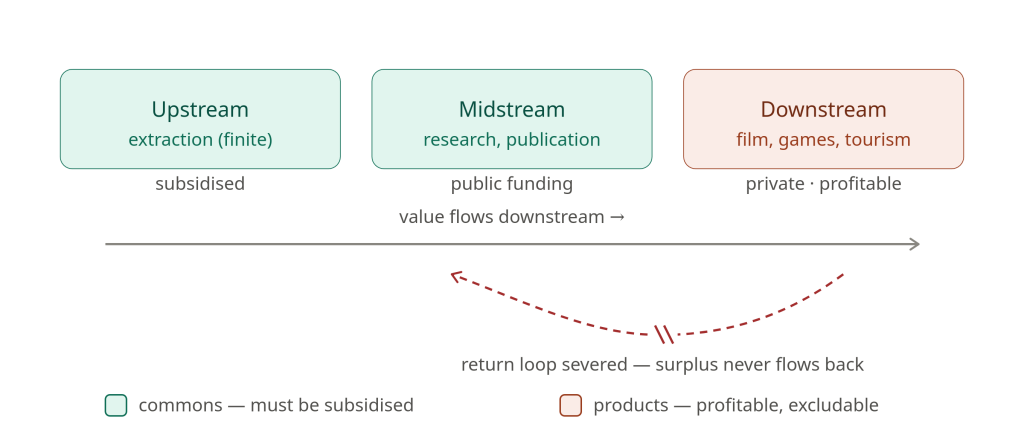
Upstream is the dig: survey, geophysics, remote sensing, excavation — the recovery of information from a finite, irreplaceable, non-renewable resource. Midstream is the refining: post-excavation analysis, scientific dating, conservation, archives, peer-reviewed publication, the museum. Raw stratigraphy is as useless to the public as raw crude until it has been refined into knowledge. Downstream is where the value is realised and where the money is: film and documentary, computer games, narrative books and comics, tourism, heritage, education, even the music and the merchandise.
So far this is just description. Here is the mechanism
Why the money never flows back
The reason the value concentrates downstream — and stays there — is excludability.
Knowledge of the past is a commons. Once it is published, no one can be charged at the gate for knowing it; it cannot be fenced, and what cannot be fenced cannot be sold. The upstream and midstream, by their nature, produce a public good. The romance, on the other hand, is perfectly excludable: a cinema seat, a game licence, a branded heritage experience, an intellectual-property right. Value pools wherever a fence can be built.
The result is a value chain with the return pipe missing. The surplus that the public’s genuine, deep fascination with the past generates is captured downstream, behind fences, and almost none of it routes back to refund the commons that produced the raw material in the first place. The diggers in the ditch generate the substance the whole edifice rests on, and see none of the wealth it creates, because the part they produce is structurally unsellable.
This is where the wrong conclusion gets drawn. Because the upstream “makes no money,” it is funded as an afterthought. But by the logic of every other extractive industry, that is exactly backwards: the colossal downstream value is the justification for increasing the upstream subvention, not the excuse for withholding it. And archaeology has an advantage oil does not — there is no pollution at the wellhead, no externality to clean up. It is a finite resource that, once refined, pays society back in identity, tourism, knowledge and stories, and harms nothing on the way out. The case for public subvention is not weaker than oil’s. It is cleaner.
I do not, for the record, begrudge the downstream its fences. The studio that puts a ticket price on a story about the past is doing nothing wrong; it is putting money into telling the public a tale they want to hear. The fault is not the fence. The fault is that we never built the pipe that sends a fair share back up the chain.
The conflict of interest we should simply abolish
Development-led archaeology — the model that exploded across Ireland and Britain during the building booms — rests on an absurdity. The developer pays for the excavation. The more is found, the more it costs the developer, and the longer they are delayed. So every incentive in the arrangement points in one direction: toward finding and recording less. Consultancies compete for the developer’s contract, and the competition rewards whoever can promise to find less, faster, cheaper. The people doing the recovery are paid by the one party in the whole transaction with a direct interest in minimising what is recovered.
We have built a system in which developers pay archaeologists to destroy archaeology efficiently, and then we wonder why morale, wages and standards are where they are.
The fix is a single cut, moved to the right place: split the cost at the point of encounter.
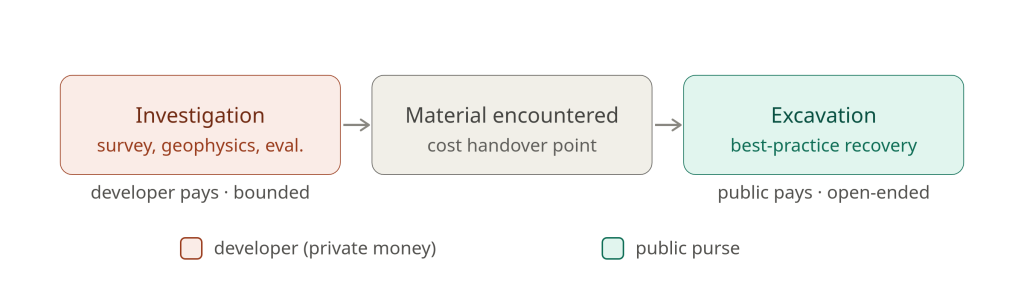
Let the developer pay for the looking part— survey, geophysics, evaluation, monitoring, watching briefs. That cost is bounded and predictable, an almost normal line item any project can price in advance. The search and monitoring phase is certainly the most predictable part of archaeological costs. But the moment significant material is actually encountered, finding — the excavation itself, done properly, to the best standard we can manage — becomes a public charge.
This does two things at once. First, it caps the developer’s open-ended risk. The terror of the bottomless archaeological bill is precisely what drives the panic, the corner-cutting, and the quiet midnight destruction. Remove the unbounded cost and you remove that panic. Second, and more importantly, it severs the corrupting coupling. The excavator stops answering to the party who profits from finding less, and starts answering to the public, whose interest is in finding the most.
And here is the part that turns this from a subsidy into a transfer of power. Control follows payment. Under the current model the developer pays, so the developer effectively owns the decision; the archaeology serves their timeline and their convenience. Move the payment to the public, and the ownership moves too. Because the developer is no longer paying for the important site, they no longer hold a veto over it. The site can be ordered preserved in place, incorporated into the new structure, opened to public access, the plan modified — and in the rare extreme, the development altered or abandoned — precisely because the public, not the developer, is now carrying it. What developers lose is not money. It is the purchased leverage to destroy or ignore.
“But then they’ll just build anywhere”
The obvious objection is that if developers no longer pay for what they find, they lose the incentive to avoid sensitive ground in the first place.
In practice this is far smaller than it sounds, because it is the wrong tool for the job anyway. Avoidance does not belong in the excavation bill; it belongs in planning. We already know where the high-risk, high-value ground is — the cores of ancient towns, monastic enclosures, known archaeological landscapes. The right place to handle a Viking waterfront or an early church is at the planning stage: by refusing unsuitable developments before they start, and by attaching conditions in advance — preserve in situ, design around it, incorporate it, provide access. Developers in such zones should know going in that an important discovery may mean modifying their plan, and in extreme cases losing it.
So the sequence is: known risks are controlled by planning; everything is done to avoid and mitigate what we can predict; and it is only when, despite all that, an unexpected site emerges that the public authority steps in to pay for its proper recovery. Developers still have every reason to avoid trouble — the cost of investigation, the delay, the planning friction — they simply no longer pay to suppress archaeology. One can even imagine a graduated arrangement: a developer contribution that steps down as a find’s significance and value step up, so that the more important the site, the more fully the public carries it, and the less say the developer has over its fate.
The emphasis falls on planning that controls development with appropriate clauses, rather than on a perverse market that pays people to find as little as possible.
The missing pipe
Both halves of this point to the same reconnection. The reform needs a funding source, and the funding source is sitting in plain sight at the downstream end. A modest, ring-fenced levy on the profitable, excludable products that already monetise the public’s appetite for the past — the very industries this argument began with — is nothing more than the return pipe the chain has been missing. The arrow runs back from the fenced downstream to refund the open commons upstream.
The outcome is one almost everyone should accept. The public pays to recover and preserve the sites that genuinely matter. Developers are no longer bankrupted excavating a field of muddy, undatable postholes that nobody needed dug at a cost of a million euro. Resources are marshalled toward significance rather than wasted on incident. And the people in the ditch, who produce the raw material the whole shining downstream is built on, are finally paid out of the wealth their work makes possible.
We already extract the past. We refine it, and we sell it, and we make fortunes at the far end. We simply built the chain with the return pipe left off. Reconnect it.
- Place
- Ireland
- Field
- Archaeology
- Form
- Essay