Contents58 min read
- The Road from Streedagh
- A port facing the sea
- A parliament that could not govern
- Every prohibition is a confession
- One purpose, many operators
- A city gate without walls
- The white cow
- The Irish position, stated in 1517
- The road not taken
- The road not taken: the Dáil Courts
- The civil service crosses over
- Local democracy dismantled
- The man who saw it
- Section Five: Who Really Pays
- The headline number
- Spending is not a gift
- The boomerang
- Where decisions live
- The export of the young
- Money was never the issue
- When capacity becomes the excuse
- Section Six: The Mechanism of Disempowerment
- The manager and the councillor
- Powerlessness produces clientelism
- Concede the service, keep the control
- The hierarchy of places
- The business case that writes itself
- Section Seven: Remedies for Every Region
- Give the councils executive power
- Fiscal devolution, with equalisation
- Move the decisions, not just the desks
- Build the capacity
- A government for Dublin too
- Cities and provinces
- Conclusion: The Measurement and the Naming
- Sources and editorial notes
The Road from Streedagh
Obedientia Civium Urbis Felicitas The Obedience of the Citizens Produces a Happy City. — Motto of the City of Dublin
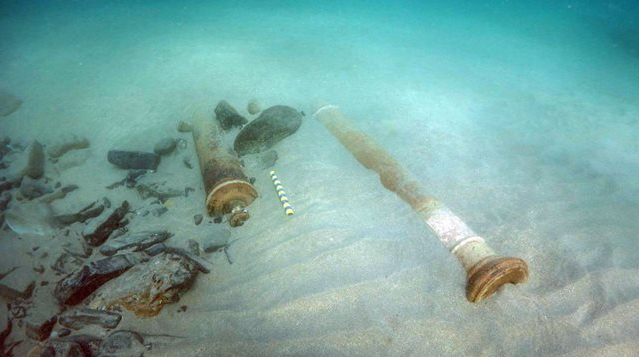
In July 2015, some two hundred people stood on the harbour at Mullaghmore in north Sligo and watched four bronze cannon brought ashore. They came from La Juliana, one of three Armada ships, armed merchantmen, wrecked on Streedagh Strand in September 1588, and uncovered on the seabed by the winter storms. The guns were taken to Dublin for conservation. They have not come back.
In the winter of 1588 one of the few survivors of those wrecks, Captain Francisco de Cuéllar, recorded that the Queen’s Lord Deputy, William Fitzwilliam, “who was in the city of Duplin”, marched west with seventeen hundred soldiers. He hanged the Spaniards he caught and imprisoned the Irish who had sheltered them. Then, after a fruitless campaign and with the winter closing in, he marched back to Dublin, “where he had his residence and garrisons”.
Four centuries apart, the same road, and the same direction.
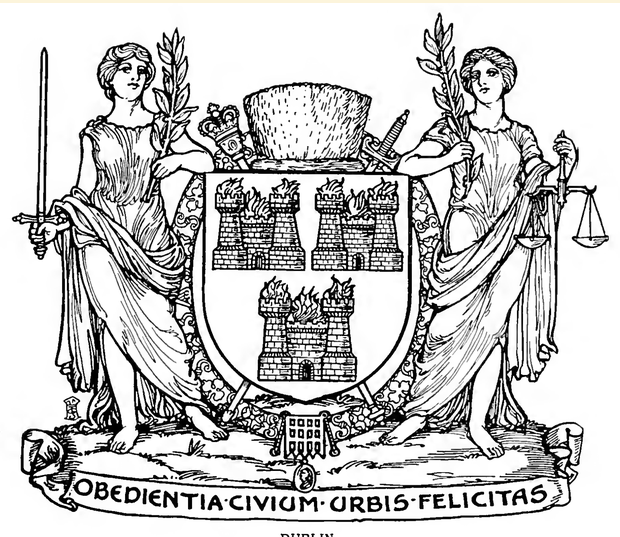
Obedientia Civium Urbis Felicitas. The obedience of the citizens produces a happy city. — Motto of the City of Dublin
Let us ask what kind of city chooses obedience as its founding value. Not justice, not wisdom, not even prosperity. Obedience: the virtue of a place whose purpose was to carry out instructions issued somewhere else.
Two stories are told about Ireland’s regions. The first is that the west is poor because it is backward: remote, rural, short of enterprise, a place of emigration and grievance that never quite caught up. The second is that the east is rich because it is productive, and that Dublin’s taxes pay for the hospitals, schools and roads the rest of the country could not afford on its own. Together they make a complete account. The west is a burden, the east carries it, and any demand from the west for more power or investment is a request for charity from people who have not earned it.
This essay examines the ground these claims stand on: where Dublin’s authority came from, what happened to it in 1922, and where the State’s money and decisions actually go today. Most of the evidence comes from the State’s own records, its own statistics and the words of its own officials. History can cut the Gordian knot of received beliefs and so-called common sense by revealing the origins of the things we are told are “just the way it is”. The reader can judge what it adds up to.
The road from Streedagh is a good place to start, because it has been travelled in the same direction for a very long time.
✦ ✦ ✦
Section Two: How the Machine Was Built
Dublin’s claim to be the capital of Ireland rests on a history so limited, and so dependent on external authority, that it barely survives examination. A capital is more than the place where government sits. It is the city that holds the whole country in view: that knows its regions, draws them together and speaks for them. Dublin has had neither the outlook nor the institutions to do that, because for most of its history it was built to do something else. It was a service town for external power: a harbour, a treasury, a garrison and a counting-house, keeping order and moving resources on behalf of lords who lived across the sea. Facing outward to its masters, and inward to itself, it never had to face the rest of the island. That is the irony at the centre of this essay. The city that presents itself as the most cosmopolitan in Ireland is, in its relationship to the country, the most parochial.
A port facing the sea
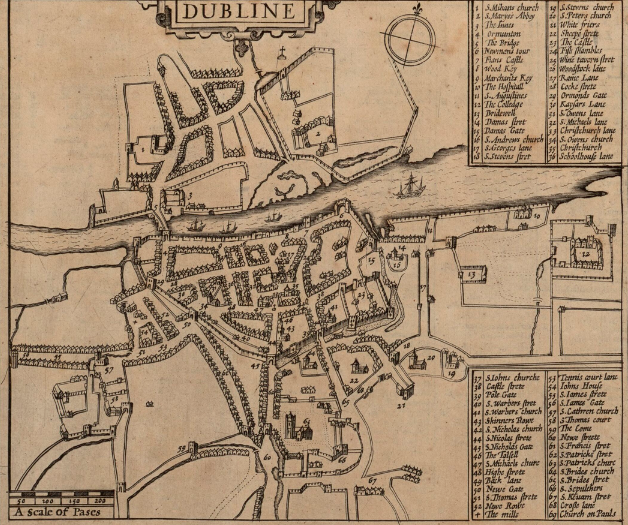
Dublin began as a Norse trading port in the ninth century, and for three centuries its business was the sea. Among its most profitable trades was in people: for much of the Viking age, Dublin ran one of the largest slave markets in western Europe, exporting captives taken in raids on the Irish interior. That is the first fact about the city’s relationship with the rest of the island. Its face was turned to the next shipment, and its back to the country it was raiding.
The Norman conquest from 1169 changed the operators but not the orientation. Henry II’s first charter to the city gave it to his men of Bristol to inhabit. Under the Angevin kings, Dublin was where the lordship’s revenues were gathered and sent to England, and where order was kept for the merchants who traded through it. It became the seat of an English lordship, and from 1297 of a parliament, but its effective authority reached only as far as English military power could be maintained. By the fifteenth century that was not far. The Pale, which emerged within the four “obedient” shires of Dublin, Meath, Louth and Kildare, was the outer limit of meaningful English jurisdiction, and the inner Pale, the Maghery, covered little more than the modern county of Dublin. The Gaelic world loomed over the city throughout this history: the frontier with the clans of the Wicklow mountains lay just to its south. The other loyal walled towns, Cork, Waterford, Limerick, Kilkenny and Galway, stood as isolated outposts, separated from each other and from Dublin by territory that the English state governed in name only, if at all.
A parliament that could not govern
Even inside that small territory, Dublin did not govern itself. Poynings’ Law of 1494 required every Act of the Irish parliament to be approved in advance by the Irish and English Privy Councils. The Declaratory Act of 1720 asserted Westminster’s right to legislate for Ireland directly. Under these arrangements the Irish parliament was not a sovereign governing body. It was a relay station, receiving instructions from London and passing them downward. Dublin was the address where power was administered, not the place where it originated. After the Act of Union in 1801 abolished even that parliament, the city functioned purely as the seat of the Viceroy: the administrative node of a system of security and intelligence operating over a largely hostile population.
The tension behind all of this was older than the colony. In the eleventh and twelfth centuries, reformers aligned with Rome, which had never ruled Ireland in the days of the Empire, began to complain loudly of Irish barbarism. Bernard of Clairvaux, in his Life of Malachy, described the Irish as Christians in name and pagans in fact. By barbarism the reformers meant, above all, a church organised around monasteries rather than dioceses, and a society that did not live in towns or run on the coined money and centralised revenues that sustained the papacy and the feudal lords of Europe. That Irish monks had founded many of the great monasteries of the continent centuries earlier did not soften the charge.
The ideological foundation for the conquest that followed was a single document. Laudabiliter, the papal letter attributed to Adrian IV, the only English pope, granted Ireland to the English crown as a mission of reform. No original survives, and its authenticity has been doubted for centuries. Its value lay precisely in its necessity. Without it, the English presence in Ireland had no legitimating framework beyond military occupation. In 1331 the Justiciar and Council of Ireland still cited the grant “in the time of Pope Adrian” when writing to Pope John XXII. Repeated across centuries, the formula did essential work. It turned conquest into providence, and a trading port into a seat of government. So it may come as a surprise that the community most closely identified with the Roman hierarchy in Ireland was the Pale. The Old English saw themselves as the civilising front of that reform, carrying Rome’s order into lands that had never known it.
Every prohibition is a confession
By the fourteenth century the colony was shrinking, and everyone inside it knew. The Gaelic lordships had absorbed the shock of the Norman incursion and were winning back ground, through military pressure and through a cultural pull the colonists themselves could not resist. The ordinary people of the Pale were speaking Irish, marrying Irish, fostering their children into Irish families, and settling their disputes under Brehon law.
The Statutes of Kilkenny in 1366 are the colony’s anxiety at its most unguarded. They forbade the colonists to speak Irish, to marry Irish, to foster Irish children, to use Irish law, or to entertain Irish poets and musicians. Read carefully, they are a list of everything the people of the Pale were actually doing. You do not legislate against what no one is doing. Every prohibition is a confession.
Out of this anxiety came an identity. The Pale’s ruling class understood itself as the heir of Rome: the outpost of a civilisation of coined money, written law and urban administration, set against a Gaelic world that Rome had never reached and that could therefore be classed as outside civilisation altogether. The distinction it drew between the “civil” Irish of the towns and the “wild” Irish of the interior was the instrument through which that anxiety was managed. The louder the assertion of superiority, the more anxious the reality beneath it.
One purpose, many operators
What emerged from these centuries of siege was more than a culture. It was a mechanism, a self-perpetuating administrative and ideological apparatus whose first enemy was the civilisation it had been placed among. Its logic was consistent across five centuries: identify the Gaelic order as the threat, frame its destruction as civilisation, win metropolitan support for the next phase, absorb the gains, and repeat.
The Reformation tested that logic and confirmed it. Catholic Old English and Protestant New English disagreed profoundly about theology. They did not disagree about the Gaelic order. Many of the Old English served the Elizabethan conquest because a resurgent Gaelic Ireland threatened their position more than a Protestant administration in Dublin Castle did. They might argue over who held the bishoprics. They did not argue over whether the Gaelic order should survive.
The Gaelic side saw this with complete clarity. In November 1599, at the height of the Nine Years War, Christopher Nugent, Lord of Delvin, a Catholic Palesman whose Westmeath lands lay on the front line, sent two men to Hugh O’Neill. They were to tell him that the Palesmen were Catholics too, and had been “when he was not thought to be one”, and that no Catholic authority allowed subjects to take up arms against their prince. Delvin’s own envoys recorded the answer. O’Neill told them “that the English Palesmen were a kind of Catholics”, and that Delvin “would not hazard the loss of a foot of land, or forego his good meat, drink, and lodging to advance the Catholic Religion”. As the historian Hiram Morgan observes, the exchange marks a gap O’Neill’s appeals could not bridge: the Palesmen distrusted the Gaelic lords more than they disliked the Protestant newcomers. It shows that in 1599 the old division between the money-driven culture of the Pale and the decentralised Gaelic economy of cattle and credit was still seen as irreconcilable.
Their loyalty bought them little. Within three years Delvin was a prisoner in Dublin Castle on unproven charges of conspiracy. As he lay dying there in 1602, the Secretary of the Irish Council, Geoffrey Fenton, wrote to Robert Cecil regretting that Delvin would die before his treasons could be proved and his lands confiscated.
The plantation forts built in the midlands from 1548, Fort Protector at Maryborough and Fort Governor at Philipstown, were geometrically planned statements of a civilising programme: the Roman fort on the barbarian frontier. Their logic, that land held under laws the newcomers did not recognise was land available for taking, was carried across the Atlantic by the men who refined it here. Humphrey Gilbert, Walter Raleigh and Ralph Lane served in Ireland before they turned to Virginia. Ireland was not an afterthought to the English empire. It was its laboratory.
The Nine Years War, ending in 1603, finally broke the Gaelic order. The machine had won, and it did not stop. It received new operators, Cromwellian, then Ascendancy, and under each it continued to do what it had been built to do: face east toward the metropolitan power, face away from the interior, and treat the native civilisation as the threat to be managed. The operators changed. The machine’s logic did not.
That is the inheritance. Before following it to 1922, it is worth looking at what the machine was built against, because the myth of the primitive west depends on never asking that question.
✦ ✦ ✦
Section Three: What the Machine Was Built to Destroy
The myth of the primitive west is old enough to have been argued out in writing, and both sides of the argument survive. In November 1599 Hugh O’Neill issued a proclamation from Dungannon to the Catholic lords of the Pale. Among his charges was that the kingdom had been governed by “wicked and detestable policies”, “norished in obscuritie and ignorance, mayntained in barbarity and incivility”. The backwardness of Ireland, in other words, was not its nature. It was the product of how it had been governed.
The Queen’s ministers drafted a reply. It was written in the voice of the Catholic lords of the Pale, but it was corrected in the hands of Robert Cecil and Lord Buckhurst. It called O’Neill an “upstart kern” and, in words it falsely attributed to the Earl of Desmond, described his country as “nothing but bogs and woods, void of all pleasure or order”. It doubted that “the mere Irish” could “become on a sudden so greedy of better education”. And it gave the decisive reason why the country could not be left to itself: if it were, its people “should be quickly lapped into greater miseries and more barbarous estate than any other wild and savage nation”. The government decided not to publish the draft. It did not need to. The argument has been repeated, in gentler language, ever since.
The man who wrote that proclamation knew the Armada wrecks at first hand. In 1588 O’Neill was still ostensibly the Crown’s loyal earl, and the record of that autumn is mixed: forces under his foster-brothers massacred survivors in Inishowen, while O’Neill himself took others in. Among them was a seaman from La Juliana, one of the three ships lost at Streedagh, named Pedro Blanco. Blanco stayed in O’Neill’s service for the rest of his life, fought at the Yellow Ford and Kinsale, and followed him into exile in 1607. The State’s own draft reply of 1599 dated O’Neill’s “treason” to those wrecks.
The western lords went further. Brian O’Rourke of Breifne sheltered Cuéllar and other survivors in the winter of 1588. Three years later, handed over by the King of Scots, he was hanged at Tyburn, with the harbouring of Spaniards among the charges against him.
The myth of the primitive west needs the Gaelic world to have been empty: a place without institutions, ideas or self-understanding, waiting to be civilised. The record shows something else. Four episodes, spread across five centuries, show a civilisation that built its own institutions, defended them with intelligence, stated its principles to outsiders with complete clarity, and was refused even when it reached out.
A city gate without walls
Thirty miles south of Dublin, in a glacial valley in the Wicklow mountains, the monastery of Glendalough had been growing since the sixth century. By the late eleventh century, under the patronage of Muirchertach Ua Briain, it was being developed into something more: an ecclesiastical city that could anchor a Gaelic institutional order as a rival to the Norse port on the Liffey.
The two cities faced in opposite directions. Dublin faced the sea, and its logic was mercantile and extractive. Glendalough faced inward. A steep valley, commercially useless and reached only through mountain country, was not an accident of history but a statement of purpose. The sacred city is not reached by the trader’s road. As at the great pilgrimage centres of the ancient world, the difficulty of the approach is part of what the centre means.
What Glendalough built at its threshold is revealing. It raised a gatehouse, the only monastic gatehouse known in Ireland, modelled, as the archaeologist Christiaan Corlett notes, on the gates of contemporary walled towns such as Dublin. Anyone arriving through the mountains would have read the architecture at once: this is a city gate. But the walls that should have followed it were never built. There was no defensive circuit and no military assertion of jurisdiction. The gate said that a threshold was being crossed. The absence of walls said that the threshold was sacred, not military. That difference, the gate as consecrated entrance against the gate as defended boundary, is the difference between the two civilisations. The Lives of Kevin called Glendalough a second Rome, a claim of equivalence with, and independence from, the Roman hierarchy that was then reaching into the Irish church.
The contest between the two cities was fought through church structure. The Synod of Ráth Breasail in 1111 left Dublin, then attached to Canterbury, out of the Irish diocesan scheme, with its territory falling within Glendalough’s. The Synod of Kells–Mellifont in 1152 reversed the polarity: Dublin became an archbishopric and Glendalough its suffragan. In 1162 Lorcán Ua Tuathail, abbot of Glendalough, became Archbishop of Dublin, Gaelic Ireland’s most sophisticated attempt to resolve the contest on its own terms by placing the holy city’s man at the head of the commercial city’s church. He held the see for seven years before the Normans landed, and died in Normandy in 1180, negotiating with a king whose soldiers had already made the negotiation irrelevant. By 1216 Glendalough had been absorbed into Dublin altogether.
The white cow
In 1172 Henry II convened the Synod of Cashel to bring the Irish church into line with Roman observance and with Norman authority. The bishops and abbots of Ireland were summoned to ratify the new order. The Archbishop of Armagh, Primate of All Ireland, did not attend.
Gilla Meic Liac, who had taken the name Gelasius as a mark of his commitment to church reform, had led the Irish church for thirty-five years. He had succeeded St Malachy, and a martyrology compiled in his lifetime called him cenn Banba, the head of Ireland. He was no reactionary defending abuses. He was one of the most capable church politicians Ireland had produced, and he understood exactly what attendance at Cashel would mean.
Gerald of Wales put his absence down to age and infirmity. Yet the same Gerald records that Gelasius later came to Dublin to give his assent, in his eighties, travelling with a white cow whose milk was his only food, and that he was popularly believed to be a saint. The Norman writer could neither explain this nor leave it out. In Irish tradition white animals are creatures of the threshold, marks of sacred favour, and the image would have been legible to every Irish observer. What the Norman clerics saw was an old man with a cow. What the Irish saw was the visible authority of a tradition the newcomers had no instruments to perceive. Gelasius died in 1174. He had accepted enough of the new order to protect Armagh’s primacy and refused enough to show that the Irish church’s understanding of itself remained intact. In the century after him, ten of the twelve primates of Armagh were native Irishmen.
The Irish position, stated in 1517
That the Gaelic Irish understood precisely what the conflict was about, and could explain it to any educated outsider, is confirmed by an unlikely witness. In 1517 Francesco Chiericati, papal nuncio to the court of Henry VIII and a friend of Erasmus, travelled through Ireland to St Patrick’s Purgatory at Lough Derg. He described what he found in a letter to Isabella d’Este, Marchesa of Mantua.
Chiericati had no stake in the colonial project, though his guides and interpreters were very likely drawn from the Pale, with every reason to present the Gaelic world as barbarous. That the Irish position still comes through his account so clearly suggests it was held with consistency and confidence. He noted that the Irish did not regard taking another’s surplus as a crime, and recorded their answer when challenged:
They say that we are brutal because we make private property of the gifts of fortune, and that they live in accordance with nature, because all things ought to be in common. — Francesco Chiericati, letter to Isabella d’Este, 1517
This is not the voice of confused primitives. It is a precise statement of the difference between two economic orders, made in the same year as Luther’s theses, by people who had watched the monetary property economy arrive at their borders, compared it with their own, and judged it brutal. The Gaelic economy was not a primitive stage awaiting development. It was a deliberately non-monetary system of clientship, tribute, hospitality and reciprocal obligation, in which wealth moved through relationships rather than markets. The Gaelic Ireland of 1517 knew what it was defending and what the machine represented. It chose, on principle, not to become it.
The road not taken
The last episode shows the refusal running the other way. William Bedell, a learned Suffolk clergyman, became Provost of Trinity College Dublin in 1627 and Bishop of Kilmore in 1629. He held, unusually, that the Irish should be ministered to in their own language, and he acted on it. He learned Irish, required his clergy to learn it, and sought out survivors of the hereditary learned families who had carried the manuscript tradition through the wars. With their help, above all that of Muircheartach Ó Cionga, he translated the Old Testament into Irish, completing the Bible that William Ó Domhnaill’s New Testament had begun.
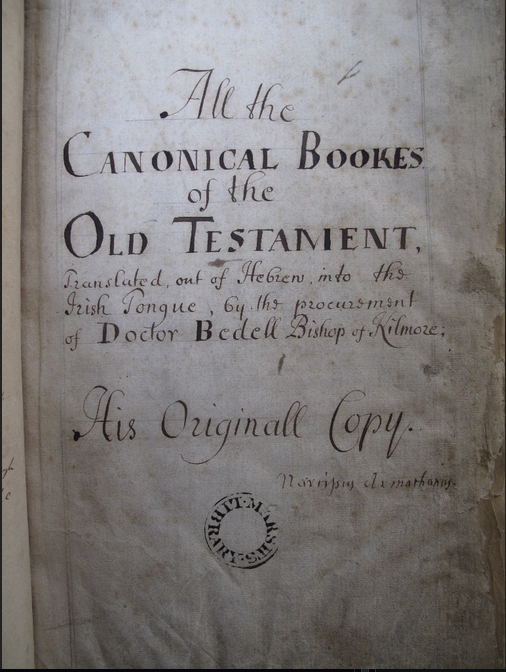
The resistance came from his own establishment, which regarded an Irish-language ministry as a dangerous blurring of the boundary the colonial order depended on, and which at one stage saw his Gaelic collaborators imprisoned. Nor could he look for help to the Catholic side, whose clergy had no interest in a Protestant Bible in any language, least of all in Irish. When the rising of 1641 broke out, Bedell refused to flee. The Confederate Irish imprisoned him, then released him after Gaelic neighbours vouched for him. He died in February 1642, and the Confederate soldiers gave him a guard of honour at his burial: they recognised in him a man their own tradition understood. His Irish Old Testament was not printed until 1685, and then only because Robert Boyle paid for it privately. The machine in Dublin had no use for it. It had never had any use for anything that treated the Gaelic world as something other than an enemy.
These are the traditions the machine was built against: the sacred city without walls, the primate who would not legitimise conquest, the people who named the property economy for what it was, and the scholars who would have met the newcomers halfway. None of them was primitive. All of them were defeated, or ignored. In 1922 the keys of Dublin Castle passed not to any of these traditions, but to the institutions that had spent seven and a half centuries suppressing them.
✦ ✦ ✦
Section Four: The Machine Changes Hands — 1922
On 16 January 1922, the British administration handed Dublin Castle to the Provisional Government. A story, almost certainly apocryphal, has Michael Collins arriving late and being told that, after seven hundred years, the Irish could have spared seven minutes. It is the kind of exchange that makes good history. It is also, in the sense that matters here, wrong. For the men who had fought for independence, the wait was over. For the institution inside those walls, very little had changed at all.
The road not taken: the Dáil Courts
Before the machine reasserted itself, there was a brief moment when something different had begun to grow. As British authority collapsed across rural Ireland during the War of Independence, the revolutionary Dáil set up its own courts. Between 1920 and 1922 they handled land disputes, debts and petty crime across much of the country, and they were busiest in the west. Justice came from neighbours rather than strangers, and the courts drew a legitimacy from local consent that the Crown courts had never had.
It was not the Treaty that ended this experiment. It was the new Irish government. In the summer of 1922 the Provisional Government suspended the republican courts, and in 1923 the Free State passed legislation to wind them up. The courts of the old regime, with their judges, procedures and common-law inheritance, were restored intact. The one institution of the revolution that had grown from the ground up was the first the new State dismantled.
The civil service crosses over
The Free State inherited the Castle administration with a completeness that went largely unexamined in the euphoria of independence. Article 10 of the Treaty, given force of law by the 1922 Constitution, guaranteed the pay, tenure and pensions of every civil servant who transferred. Some 21,000 accepted the option to become employees of the new State. The civil service did not merely survive the revolution. It retreated behind Article 10 as a constitutional guarantee of its pre-Treaty status and defended it in the courts against the government it now served.
The Department of Finance was modelled on the British Treasury, and its outlook, cautious, centralising and suspicious of local spending, became the outlook of the State. The structures, procedures and habits of mind transferred most completely of all, because habits do not appear on any inventory and cannot be handed back with the keys. The historian John M. Regan has called what followed the Treaty an Irish counter-revolution: a settlement in which the most radical possibilities of the revolution were closed down by men committed above all to order and continuity.
An inventory of what crossed is short and revealing. The law: the 1922 Constitution carried every law then in force into the new State until it was repealed. The courts and their common-law inheritance. The buildings: Dublin Castle, the Four Courts, and the Royal College of Science on Merrion Street, part of which the new government took over in 1922 and which is now Government Buildings. The civil service, its Treasury model and its parliamentary procedure. What did not cross was the Dáil’s own courts.
The founders did not pretend otherwise. In a Dáil debate in 1923, answering a Labour deputy for Galway who had protested at the army seizing and selling cattle in his constituency, the Minister for Home Affairs, Kevin O’Higgins, put it in a single sentence: “I think we were probably the most conservative-minded revolutionaries that ever put through a successful revolution.”
Local democracy dismantled
The clearest evidence that the machine had changed hands without changing direction lies in what the new State did to local government. The British had created elected county councils under the Local Government (Ireland) Act of 1898. Within months of independence, the Free State set about curtailing them.
The Local Government (Temporary Provisions) Act of 1923 gave the Minister power to dissolve any local authority after an inquiry into its performance. The first to go was Kerry County Council, then under republican control, dissolved on 9 May 1923 and handed to an appointed commissioner. Leitrim and Offaly followed. Dublin Corporation was dissolved in May 1924 and run by government-appointed commissioners until 1930. Cork Corporation followed that October. Around twenty local bodies were dissolved in the State’s first three years. The Local Government Act of 1925 then abolished the rural district councils altogether, removing the tier of elected government closest to rural communities.
The County Management Act of 1940, in force from 1942, completed the work. It divided council business into reserved functions, held by the elected members, and executive functions, held by an appointed manager. The councillors kept the budget, the development plan and the bye-laws. Almost everything else, including what actually gets built, when, and where, passed to the manager. The manager is now called a chief executive, but the division remains.
In local government, independent Ireland centralised more than British rule had. That is not a claim about famine, plantation or penal law. It is a statement about local democracy: the elected local government the British created in 1898 was suspended, stripped and subordinated by the State that replaced them, within twenty years of its arrival. The councils that were dissolved first were those in republican hands, and the instinct to treat dissent in the State’s own regions as a security problem, rather than as politics, would recur for the rest of the century.
The man who saw it
Bulmer Hobson saw all of this with the clarity of someone present at the revolution’s beginning and excluded from its end. As Marnie Hay has documented, he had been one of the leading organisers of advanced nationalism before 1916, with a political vision far more radical than the administrative inheritance the Free State accepted. He helped rebuild the Irish Republican Brotherhood with Tom Clarke, swore Patrick Pearse into it, and was central to the founding of the Irish Volunteers. He was held by his own comrades on the eve of the Rising, which he believed was militarily futile. Unusually, that made him one of the few senior figures of the pre-Rising movement to survive it, precisely because he had been prevented from taking part, and so one of the few left who knew from the inside what its founders had meant to build. After independence he became a civil servant in the Revenue Commissioners, overseeing the printing of stamps in the same Castle that had housed British rule.
From that position of intimate obscurity he watched successive governments fail to do what he had argued for all his political life. In pamphlets such as The New Querist and National Economic Recovery, and in his minority report to the Banking Commission of 1938, he argued for State credit creation to fund reforestation, land drainage, home industry and the economic reconstruction of the Gaeltacht. He drew on the social credit tradition and on Proudhon’s idea of mutual banking, and he anticipated arguments Keynes would later make famous. At heart his case was the one this essay makes in Section Five: that money is a public instrument, that the limit on what a State can do lies in its real resources rather than in its bank balance, and that a State without monetary sovereignty cannot develop its own regions.
Nobody in power listened. The Free State kept the Irish pound tied one-for-one to sterling, and the link held until 1979, long after any economic case for it had gone. Its monetary policy was set, in effect, in London. When Hobson spoke publicly about housing policy in 1938, the Minister for Finance demanded an explanation and an apology. The dissenting civil servant was silenced, and the machine continued.
By the time Hobson retired, the pattern he had described was set: decisions in Dublin, money directed from the centre, and a west that was told it was poor and treated as though that were its own fault. The next section measures what that pattern produces today.
✦ ✦ ✦
Section Five: Who Really Pays
The second myth is the one repeated with most confidence: the east pays for everything. It is said in the pub, on talk radio, in the Dáil, and beneath every news report on the Western Rail Corridor. It rests on two figures that appear to settle the matter. The east produces most of the State’s output, and the west receives more from the State than it sends back.
The figures are real, but neither means what the myth says it means. Read through the State’s own statistics, and read through a different understanding of what public money is, they describe something close to the opposite: a region whose income arrives as decisions made elsewhere, whose taxes return to the centre before they can become local capacity, and whose young are exported at the moment they become productive.
The headline number
Ireland’s GDP in 2025 was €602 billion. Modified gross national income (GNI*), the Central Statistics Office’s own measure of the income that actually stays in the country, was €334 billion. The gap of €268 billion, 45% of GDP, is mostly multinational profit booked in Ireland and sent abroad, plus depreciation on intellectual property and leased aircraft. The gap opened in 2015, when large multinationals moved intellectual property onto Irish books. By 2021, GDP was nearly twice GNI*.
Those profits are recorded where the companies keep their Irish headquarters, overwhelmingly in Dublin and Cork. When output is tabulated by region, they appear as Eastern and Southern production. Foreign-owned firms produce 71% of Ireland’s business value added with 27% of the jobs. They pay out only 26% of that value added as wages, against 59% for foreign-owned firms in Germany, 67% in Denmark and 70% in France. Elsewhere in Europe, foreign firms look like ordinary businesses. Here they look like profit-booking vehicles with real but limited employment attached. Much of what is counted as the east’s wealth is accounting passing through it.
The function is an old one. Under the Angevin kings, Dublin was where the lordship’s revenues were collected and shipped across the Irish Sea, and where order was kept for merchants from Bristol and Chester. Today it is where the profits of American multinationals are booked and sent on. The lords have changed. The service has not.
Strip that sector out and the picture changes again. Compared with domestically owned firms in the same five sectors across twelve EU countries, adjusted for price levels, Irish-owned firms produce about €43,000 of value added per worker: the second-lowest figure, below Spain and Italy, in each of 2021, 2022 and 2023. The weakness is not western. It is indigenous, and it is national. An economy in which foreign firms book the value while domestic firms lag behind is the familiar shape of a post-colonial economy. It is the shape of the whole State, Dublin included.
The first half of the myth, that the east generates the wealth, is therefore largely a story about where foreign profits are recorded.
Spending is not a gift
The second half of the myth, that the west lives on transfers, depends on how public spending is read. In the 2022 Census, 34% of Sligo residents at work were in public administration, education, or health and social care, against 26% nationally and 25% in Dublin. The State pays about €595 million a year in public and State-funded wages to Sligo residents, and about €389 million in welfare and State pensions. All private-sector wages in the county come to about €743 million. Read conventionally, this is dependency.
That reading assumes public wages are a gift from Dublin taxpayers to the west. They are not. A nurse in Sligo University Hospital and a teacher in a Ballymote school provide services the State exists to provide: the region’s share of the basic infrastructure of civilised life. Nobody describes St James’s Hospital as a subsidy to Dublin, or Trinity College as a transfer to Dublin 2. The salaries paid inside those institutions are counted, correctly, as the cost of public services. When the same salaries are paid in Sligo, they are recounted as charity. The category changes when the money crosses the Shannon.
This essay reads public money in the chartalist tradition associated with Modern Monetary Theory. The State spends first, injecting money into the economy as income, and taxation follows, withdrawing it. The real limits on public provision are physical: workers, materials, building capacity. The question is therefore not whether the west “pays its way”, but what happens to State money once it arrives, and who decides what it becomes.
Within the eurozone, the power to create money is shared through the Eurosystem rather than held in Dublin alone. This changes nothing for the argument here. Whatever fiscal capacity the Irish State possesses, Sligo has none of it.
The boomerang
Follow the money that arrives. Income tax, USC and PRSI on all employees resident in Sligo come to about €460 million a year, and all of it goes to the Exchequer. Of the €595 million in public wages, about €217 million returns directly, or €152 million if employer PRSI, the State paying itself, is left out. The stimulus is real but brief. It passes through local shops, rents and services, and a large share is lifted back to the centre before it can accumulate into anything the county controls.
What does the county control? Sligo County Council’s own income, from Local Property Tax and commercial rates, is about €28 million. Even the property tax is not truly local: it is collected by Revenue and classed by Eurostat as a central-government tax. Because it tracks house prices, it carries the regional pattern inside it. It raises €85 per resident in Sligo and €65 in Leitrim, against €147 in Dublin City and €231 in Dún Laoghaire–Rathdown.
Under Denmark’s municipal income tax rules, the same Sligo wages would leave about €230 million a year under the council’s control. That is not money “taken” from Sligo. Danish municipalities raise it because they also pay primary teachers, childcare staff and elder-care workers. It is a measure of scale: the fiscal responsibility a Sligo council would hold if it governed the services its people actually use. Across Connacht, the equivalent is about €2 billion a year.
By Eurostat’s own figures, Irish local government accounts for 10.5% of all government spending and collects 1.9% of all taxes, the lowest of the twelve European countries compared on both. The EU averages are 22.5% and 9.5%. Danish municipalities account for 66% of government spending. Irish councils carry out 31% of public investment, against 43% across the EU and 48 to 61% in the other unitary states compared. Much of even that 31% is paid for by central grants for specific projects.
This is the boomerang: money thrown out from the centre returns to the hand that threw it. The west is paid, but it is not empowered. It is then classed as lagging. The Northern and Western region produces 47% of the State’s output per person but, through these flows, holds 90% of its income per person, and that share has been falling since 2014. Part of the output gap is real. Before 2015 the region stood in the 60s, and its fall into the 40s owes much to multinational intellectual property landing on the books of the other two regions. Either way, the region is described as dependent by a system that designed its dependence.
Where decisions live
The money flows out to the region. The decisions do not. According to the State’s own administrative database, 247 of the 304 national public bodies with a recorded location, or 81%, are headquartered in Dublin, which has 28% of the population. Every government department is there. Sligo, Leitrim, Donegal, Cavan, Monaghan, Longford and Louth host none.
Sligo has a higher share of public servants than Dublin. Dublin has the headquarters. The west receives service-delivery employment; the east holds the posts where policy is made, budgets are set and priorities are ranked. The Pale is no longer a line on a map. It is an organisation chart.
The export of the young
The deepest transfer runs the other way, and it is never counted. The Greater Dublin Area held 23% of the State’s population in 1926 and 40.5% in 2022. Connacht fell from 18.6% to 11.5% over the same period. Sligo regained its 1926 population only in 2022; Leitrim is still 37% below it.
Following each age group from the 2016 Census to 2022 shows when the drift happens. Dublin ends up with about 30% more 20-to-22-year-olds than the national pattern would give it. Mayo, Leitrim, Roscommon and Donegal end up with 25 to 34% fewer. Sligo holds its school-leavers but loses 15 to 19% of its 24-to-30-year-olds: its graduates. From the early thirties the flow partly reverses, and the western counties win some people back.
The west bears the cost of raising and schooling a generation, through family income, local schools, and the very public wages that are then counted against it as transfers. Dublin’s labour market and tax base receive that generation in its first and most mobile working decade. If any region is subsidising another, this is the subsidy, and it runs east.
A careful reader may object that the regions were catching up for most of the twentieth century. By one measure, they were. The first long series of regional output for the independent State, built by the economic historians Alan de Bromhead and Seán Kenny, shows the regions converging on the national average from 1926 to 1991, and diverging again from the 1990s. But output per head can rise for two reasons: the economy grows, or the people leave. For most of that period, the west did the second. And the divergence began at exactly the moment the State finally had real wealth to allocate, in the foreign investment boom, and allocated it from the centre.
Money was never the issue
The last defence of the myth is that the State simply cannot afford to do otherwise. The record says it can, when it chooses to. When the banking system failed after 2008, the Central Bank of Ireland created euro on a vast scale through Emergency Liquidity Assistance to Anglo Irish Bank, later converted into the promissory-note arrangement of roughly €30 billion. That capacity operated under external supervision. In November 2010, the President of the European Central Bank wrote to the Minister for Finance making continued liquidity conditional on Ireland seeking a bailout, and the State complied.
Money was found, on Frankfurt’s terms, to protect Dublin’s banking system and its creditors. The austerity that followed fell hardest on the regions with the least margin. A decade later, the ECB’s pandemic purchase programme ran to €1.85 trillion, and euro states deficit-spent heavily without market panic. The State’s monetary capacity is real but externally supervised, and when it has been used at scale it has served the centre. Dublin still faces east; only the metropolitan power has changed.
Against those sums, the Western Rail Corridor, “unaffordable” for fifty years, is a rounding error. The constraint on the west was never the availability of money. The real constraints are physical, and political: whose priorities count. When the State has judged a cause essential, it has found the money. It has never judged the west essential.
When capacity becomes the excuse
The road from Streedagh, with which this essay opened, leads back here. The three Armada ships wrecked there in 1588, La Juliana, La Lavia and the Santa María de Visón, are among the best-preserved Armada wrecks known. Over a thousand men died on that shore, and the survivors who reached the Gaelic lordships of the northwest were hunted by an army that marched out from Dublin and back again.
Four centuries later, the wrecks began to break open. Since storms exposed La Juliana in 2015, cannon, a rudder, gun-carriage wheels and other material have been lifted by the State’s Underwater Archaeology Unit and sent to the National Museum in Dublin. The emergency recovery was right, and the archaeologists who carried it out did the State’s duty well. The question is what happened next.
The reason given for the material leaving Sligo is capacity: the county has no conservation laboratory and no museum fit to hold it. That absence has its own history. Sligo County Museum opened in 1954 in a small former manse beside the county library, meant as the first step toward a proper museum. Seventy-two years later, it is still the only one. Sligo contains more of the country’s recorded megalithic tombs than any other county, yet has no modern museum and no national museum presence.
It has already paid for that absence. When Nora Niland began building a Yeats collection for the county in the 1950s, the poet’s son, Senator Michael Yeats, placed his father’s Nobel medal with Sligo on indefinite loan, in recognition of his father’s close ties to the place. For some sixty years it was the centrepiece of the county museum’s Yeats room. In 2016 the family, entirely reasonably, gave the medal to the nation under Section 1003 of the Taxes Consolidation Act, which allows a tax credit for heritage items donated to approved bodies. The approved bodies are the national collections. No institution in Sligo is among them. So the medal left Sligo for the National Library in Dublin, where it joined the Yeats papers the family had given over decades, and Sligo County Museum now displays a replica. Nobody had to decide against Sligo. The law had decided in advance.
Capacity, not money, is the constraint that matters. But a physical constraint is not a fact of nature. It is the product of past decisions about where to build. A conservation laboratory is a building, equipment and trained staff. It exists in Dublin because the State put it there.
To cite its absence in Sligo as the reason Sligo’s heritage must go to Dublin is the Western Rail Corridor argument again: the machine produces the conditions that justify its own priorities. Each object that leaves strengthens the case that Dublin is where such material belongs, and weakens the case for building anything in the northwest. It is a self-reinforcing extraction loop.
The excuse does not even survive its own test. Asked directly on a podcast whether the cannon would return to Sligo if proper facilities were built, a National Museum official said it was unlikely, because they were now an intrinsic part of the museum’s display. Capacity, it turns out, was never the reason. It was the excuse. The reason is possession.
The precedent shows the alternative. When La Trinidad Valencera was found off Donegal in 1971, the Irish museum authorities of the day showed little interest and had no conservation facilities to offer. The material went north, and today the Tower Museum in Derry and the Ulster Museum in Belfast hold Armada collections known around the world. Capacity was built where the material was, and the material built the institutions. In 2015 the Minister responsible said the National Museum would not stand in the way of a local Armada museum. A decade on, the question is not whether the northwest has the capacity. It is why a State that finds money for causes it judges essential has never chosen to build it there.
The administration that hanged the Armada’s survivors, and punished the Irish who sheltered them, governed from Dublin. The institutions that now hold what the sea has given back govern from Dublin too. No one is hanged over a cannon now. But the material still moves east, the decision is still made in the capital, and the region whose people paid the price in 1588 is still told it lacks the capacity to keep its own history. The surviving material is displayed not where the story happened, among the people who sheltered the survivors, but in the city from which the men who hunted them were sent.
That is the answer to who pays. The west is not a burden carried by the east. It is a region whose income arrives as decisions made elsewhere, whose taxes return to the centre before they can become local capacity, whose young are exported as they become productive, and whose resulting poverty is then cited as the reason it cannot be trusted with power. The next section examines the machinery that keeps it so.
✦ ✦ ✦
Section Six: The Mechanism of Disempowerment
Section Five showed where the money goes. This section shows the machinery that keeps it going there. None of it requires anyone to intend the outcome. Each part is ordinary, defensible on its own terms, and administered in good faith. Together they form a system that reliably keeps decisions at the centre and the regions dependent on it.
The manager and the councillor
The division created by the County Management Act of 1940 still defines Irish local government. Elected councillors hold the reserved functions: adopting the annual budget and the county development plan, making bye-laws, and a short list of other formal powers. Everything else is an executive function of the chief executive, who is recruited through the national Public Appointments Service. That includes deciding which roads are repaired, which housing schemes proceed, how staff are deployed and how the money is actually spent.
The chief executive is not, strictly, appointed from Dublin. But the post is filled through a national process, the money it administers arrives overwhelmingly as central grants with conditions attached, and the policies it implements are set by central departments. The councillors, meanwhile, can adopt a budget made almost entirely of money they did not raise and cannot redirect. Their power is real but narrow: they can refuse, delay and object, but they rarely decide.
Powerlessness produces clientelism
The brokerage politics of modern Ireland has old roots. After Kinsale and the destruction of the Gaelic order, the native population was left leaderless and landless on its own land, and the figure who mattered became the intermediary: the man who could get something out of the administration in Dublin. Such middlemen held power by playing both sides, useful to a government that wanted the interior kept quiet, and indispensable to a population that had no other way in. The Free State did not dismantle this politics. It inherited it, and its centralisation gave it new life.
When local government cannot decide anything, people stop asking it to. They go instead to the one figure who can intercede with the centre: the TD. Political scientists have documented this for half a century. Paul Sacks’s study of Donegal politics, The Donegal Mafia (1976), showed how party machines in the northwest were built on brokerage: favours obtained from central departments in return for votes. Lee Komito’s work on Irish clientelism, and Michael D. Higgins’s essay on its limits, traced the same pattern: the TD as intermediary between citizen and State, and the citizen dependent on the intermediary for things that, in a functioning local democracy, would be ordinary entitlements.
The electoral system rewards this, and critics often blame proportional representation alone. But brokerage needs something to broker. It flourishes because the decisions that matter to a community, a grant, a housing allocation, a road, a school extension, are made in Dublin, and the only route to Dublin runs through a national politician. Centralisation reinforces clientelism, and clientelism in turn protects centralisation, because the politicians whose careers depend on brokerage have little interest in a reform that would let communities decide for themselves. The parties that have governed the State since 1922 have been built on exactly this relationship. Appointments to State boards, long a reward for party loyalty, are the same logic at the top.
Concede the service, keep the control
When the regions have organised and demanded more, the State’s reflex has been to grant the service while keeping the control. In 1969 young teachers, journalists and community activists in Connemara founded Gluaiseacht Chearta Sibhialta na Gaeltachta, the Gaeltacht Civil Rights Movement. Among its demands was a radio service in Irish. When the State delayed, they built one themselves: at Easter 1970 Saor Raidió Chonamara began broadcasting from a caravan in Ros Muc. The response was Raidió na Gaeltachta, which went on air in 1972. It was a real victory, and the station has served the Gaeltacht well. But many of the campaigners had wanted it under community control, and it was placed instead within RTÉ. The demand was met. The decision stayed in Dublin.
The same reflex, in harder form, runs through the State’s history. The first councils dissolved in 1923 were those in republican hands. For two decades from 1971, Section 31 of the Broadcasting Act kept a whole strand of political opinion off the national airwaves. The instinct to treat organised dissent in the State’s own regions as a security problem, rather than as politics, is the machine’s oldest habit, and it predates the State by centuries.
The hierarchy of places
The State recognises five cities: Dublin, Cork, Limerick, Waterford and Galway. All five were walled towns of the medieval English colony, and the urban hierarchy of the modern State still follows the charters of that period far more closely than the actual distribution of people and functions. The hierarchy has moved only once, when Galway became a county borough in 1986, and that change confirmed the pattern rather than broke it.
The Local Government Reform Act of 2014 then abolished the town councils altogether, removing the only tier of local government with an institutional presence in smaller towns. Sligo, the largest urban centre in the northwest and designated by the State’s own planning framework as a regional growth centre, lost its borough council in that reform. It is now administered as a municipal district of the county council. The State asks Sligo to grow as a regional centre while denying it any government of its own.
The business case that writes itself
The Western Rail Corridor, the line linking Limerick, Galway, Mayo and Sligo along the western seaboard, was closed in stages from the 1970s. It has been the subject of feasibility studies, commitments, withdrawals and renewed campaigns ever since. The Northern and Western Regional Assembly identifies the lack of rail as the region’s greatest competitive disadvantage, in a region that performs strongly on higher education, broadband access and employment in science and technology.
The most revealing moment came in 2011. Documents later released under freedom of information showed that the Western Rail Corridor and the upgrading of Galway and Sligo airports were removed from an EU-wide transport programme at the request of Leo Varadkar, then Minister for Transport. The maps were redrawn in October 2011 to prioritise links between Dublin, Cork, Limerick and Belfast, leaving out the western half of the State north of Limerick. A party colleague warned that the change could shut the projects out of EU funding. It went ahead.
The usual defence is that this was simply a business case: a minister ranking projects by their returns. But inclusion in the European network made projects eligible for EU co-funding, so the State was not even being asked to bear the whole cost. And infrastructure is not a business in its own right. A railway, a road or a sewerage scheme rarely pays for itself; it pays by making other business possible. Judged by its own returns, almost no public infrastructure anywhere would ever be built. Whatever the intention, the network that survived the redrawing runs between the old towns of the colony, Dublin, Cork and Limerick, and on to Belfast, and leaves out the Gaelic heartlands of Connacht and west Ulster almost exactly.
The business case itself was the product of a century in which investment, population and economic activity had been drawn east, making eastern projects look viable and western ones marginal. The machine produces the conditions that justify its own priorities: the same circular argument that, in Section Five, sends Sligo’s Armada material to Dublin because Sligo has nowhere to keep it.
The partial reversal now planned, the Athenry to Claremorris section, is welcome, and it shows that the decision can be reversed when the will exists. The section north from Claremorris to Collooney, linking Mayo to Sligo, is still unfunded.
Put together, the mechanism looks like this. Councils have no tax powers and little executive power. Decisions therefore rest with central departments. Citizens reach those departments through TDs, whose careers depend on that brokerage. Business cases rank regions by the results of past investment. When regions organise and demand more, the State concedes the service and keeps the control. And the outcome, a region with weak institutions and little investment, is then cited as the reason it cannot be trusted with more. That is what disempowerment looks like. It is not how a capital would act.
✦ ✦ ✦
Section Seven: Remedies for Every Region
If the problem is structural, the remedies have to be structural too. Another national development plan, another set of planning guidelines, another relocation of a few hundred desks, will not touch a pattern whose roots run back centuries. What is needed is a change in where power sits: who raises money, who decides how it is spent, and who answers for the result.
None of what follows is utopian. Most of it is settled practice in comparable European democracies. Some of it has already begun in Ireland. And none of it is only for the west. The machine governs Dublin’s own citizens as surely as it governs Sligo’s, and the remedies are for every region of the State, the capital included.
Give the councils executive power
The first remedy has already been tested. In 2019 the people of Limerick voted in a plebiscite for a directly elected mayor with executive powers. The office was created by legislation in 2024, and the first mayor, elected that June, took over most of the executive functions previously held by the chief executive: strategic planning, housing strategy, transport and the environment, and the drafting of the council’s budget. For the first time since 1940, an elected person runs an Irish local authority.
Limerick proves that the machine can be reversed when the will exists. It also shows the limits of reversing it halfway. The legislation was criticised from the start for relying on soft powers, and the new office still depends on money raised and allocated centrally. Executive power without fiscal power is a better title for the same dependence. The Limerick model should be extended to every county and city that wants it, but it must come with the money to make it real.
Fiscal devolution, with equalisation
The second remedy is the money. Irish local government accounts for about a tenth of public spending and collects under 2% of taxes. The EU averages are about 22% and 9.5%. The target should be to reach the EU average within a decade and to go further over time, on the Danish principle: councils that are responsible for schools, care and local services should raise much of the money for them, through a local share of income tax.
The obvious objection is that a local income tax would leave poorer regions worse off. The Danish system answers it. Denmark equalises revenue between municipalities, so that a council’s services do not depend only on its local tax base. Devolution and solidarity are not opposites. The difference is that, under equalisation, the transfer between regions is visible, rules-based and argued over in public, rather than buried inside a central budget and then misrepresented as charity.
The three regional assemblies already exist, with planning and strategic functions. They should be directly elected and given real budgets. The Northern and Western region, reclassified by the EU as a transition region for the 2021–2027 period because its output per head has fallen below the EU average, is the clearest case for a regional government with the power to change its own trajectory.
Move the decisions, not just the desks
The State has tried decentralisation before. The programme announced in 2003 promised to move more than ten thousand civil servants out of Dublin, and was largely abandoned within a decade. It failed partly because it moved jobs without moving power: offices in the regions still answered to departments in Dublin. The lesson is not that relocation fails. It is that what has to move is the decision. Bodies whose remit is regional, rural or heritage-based should be headquartered in the regions they serve, with the authority to decide there.
Build the capacity
The answer to missing capacity is to build it. That principle runs through every remedy, and Streedagh shows it most clearly. A conservation laboratory and a modern museum in the northwest, able to hold the Armada material and the region’s wider archaeological inheritance, would cost a small fraction of what the State has spent on far less essential causes. The Trinidad Valencera precedent shows what follows: institutions grow around the material, and the material draws people, scholarship and investment to the place.
The same is true of transport. The Western Rail Corridor should be completed from Limerick to Sligo, with the unfunded Claremorris–Collooney section as the immediate priority, and planned northward as part of an all-island network. Individual segments look weak on a business case precisely because the network does not exist. Networks create their own demand. The first task is to build them.
None of this is limited by money. As Section Five showed, the State has found tens of billions when it judged a cause essential. Hobson’s argument, that public credit should be used to develop the country’s own regions, is as sound now as it was in 1938, and the real constraints on it are workers, materials and building capacity, all of which can be planned for.
A government for Dublin too
Dublin needs devolution as much as Sligo does. The city has four local authorities, no metropolitan government, and a housing and transport crisis managed largely from central departments. A Citizens’ Assembly has already recommended a directly elected mayor for Dublin with real powers. Dubliners are governed by the same machine as everyone else, and a Dublin that governed itself would have less reason to govern everyone else.
Cities and provinces
City status and city government should follow function, not medieval charters. Sligo, Drogheda and Dundalk, the regional centres of the northwest and the northeast, should have city governments with the powers and resources their regional role demands.
Beyond that lies the federal question. A federal Ireland, with provincial governments holding real fiscal and administrative authority, and a centre that coordinates rather than controls, would be the institutional form most consistent with the argument of this essay. It would also offer the only plausible framework for a united island, because it would not ask the north to join a centralised southern State whose institutional history gives it good reason for suspicion.
None of this is new. In the winter of 1599 O’Neill’s confederates drew up twenty-two articles for a settlement. Among them were that the officers of State in Dublin be Irishmen; that the provinces, “as Connaught, Munster, &c.”, be governed by Irish noblemen; that a university be founded on the Crown rents; and that Irishmen be free to trade, travel and build ships for “the profit of their Republic”. Robert Cecil wrote a single word on his copy: “Ewtopia”. Geoffrey Fenton, Secretary of the Irish Council, saw the same programme as the worst treason of all. O’Neill, he warned Cecil, “aspireth to cantonize the kingdom … wherein I never read that a rebel went so far”. Four centuries later, provinces that govern themselves are still described as utopian. The word has been in use in Dublin for a long time.
There is an older precedent for this. In the Gaelic political order, Meath was the neutral centre: the place where the provinces met on equal terms, whose authority rested on hosting the whole rather than ruling it. A capital worthy of Ireland would take that as its model. Its authority would come not from the control it holds over the regions but from the quality of the space it holds for all of them.
✦ ✦ ✦
Conclusion: The Measurement and the Naming
The two myths this essay began with are not simply mistaken. They are load-bearing. The story of a backward west explains its poverty without asking who made it poor. The story of an east that pays for everything turns the drain of money, people and decisions toward Dublin into an act of generosity by Dublin. Together they make the structure invisible, and an invisible structure cannot be challenged. That is why they had to be taken apart before anything else could be said.
With the myths removed, the shape underneath is plain. A port that faced the sea became the seat of a colony that faced London. Its administration was built against a Gaelic civilisation that was not primitive but different, and it treated that civilisation as the enemy for seven centuries. In 1922 the machine received new operators and kept its purpose. Its first acts included closing the courts the revolution had built and dissolving the councils that dissented. Today it pays the west in wages and welfare, takes the money back before it can become local power, keeps eight in every ten national bodies in Dublin, and then ranks the west as lagging by the results.
None of this is an argument for romantic nationalism, or for restoring an order that cannot be restored. Brehon law will not be reinstated by statute. Gelasius is not coming back with his white cow. The argument is narrower and more urgent: a State that does not understand its own institutional history cannot govern justly, and the history Dublin least understands is its own.
There is a simple test of whether that can change, and it lies on the shore at Streedagh. The cannon of La Juliana went to Dublin because Sligo had nowhere to keep them, and a museum official has said they are unlikely to come back even if it had. If the State builds the capacity in the northwest and returns the material, the machine will have shown it can be turned. If it does not, the reason will no longer be capacity, and everyone will be able to see what the reason is.
The guns that came ashore at Mullaghmore belonged to Pedro Blanco’s ship. In January 1616, months before his own death in Rome, O’Neill wrote to the King of Spain asking that Blanco, who had followed him through the war and into exile, be given work and returned to his wife and children. It was among the last things he did. If the guns of Blanco’s ship come home to a museum the northwest has built for itself, it will be a small thing. But it would be the first time in four centuries that a decision about the west was made the way the articles of 1599 asked: in the west, by the west. The war O’Neill fought was, at bottom, about who decides. It can be finished now by other means: not with muskets, but with evidence, argument and votes.
Dublin chose obedience as its motto, the virtue of a city built to carry out instructions issued elsewhere. A real capital would rest on something different: on consent, on the self-government of its regions, on authority earned by holding space for the whole island rather than control exercised over it. A capital needs the outlook to see the whole country as its concern, and the institutions to serve it. Dublin was built for neither. Whether it can become that city is still an open question. It has never yet been tried.
Bulmer Hobson spent his last years in Roundstone, in Connemara, looking out over the Atlantic. He was born in Belfast, gave his young adulthood to the cause of independence, was held by his own comrades to keep him from stopping a Rising he believed would fail, and then watched the State he had helped create spend half a century proving his economic analysis right while ignoring everything he proposed. He ended in the west: the part of Ireland furthest from Dublin, closest to the Atlantic, and most continuous with the Gaelic tradition he had tried to build a worthy State around. He died there in 1969.
Whether he found there what he was looking for, we cannot know. What we know is that he looked west, and the State looked east, and the distance between those two directions has never been properly measured or honestly named. This essay has attempted a beginning of that measurement. The naming will take longer.
Sources and editorial notes
Figures in this section come from the companion analysis The Boomerang Economy, which draws on the following:
CSO table NA001 (GDP and GNI*); CSO PIA21 and PIA22 (productivity by ownership).
Eurostat fats_activ and prc_ppp_ind (domestically and foreign-controlled firms, price-adjusted).
Census 2022, table FY060 (residents at work by sector); CSO DEA08 (2024 mean earnings by sector).
Department of Social Protection, Annual Statistics 2024 (welfare and State pensions by county).
Sligo County Council, Adopted Budget 2025; Revenue Property Tax Statistics, July 2026.
Eurostat gov_10a_main and gov_10a_taxag, 2023 (local government spending, tax and investment shares).
CSO tables RAA02, RAA04 and RAA07 (county incomes and regional output).
Irish State Administration Database, isad.ie (headquarters of national public bodies).
CSO FP002 and Census 2016/2022 population by single year of age (population share and cohort migration).
Still to source directly:
☐ ECB President Trichet’s letter to Minister Lenihan, 19 November 2010 (published by the ECB in 2014).
☐ ELA and promissory-note total for Anglo Irish Bank / IBRC (Central Bank of Ireland, 2013 liquidation).
☐ ECB Pandemic Emergency Purchase Programme envelope, €1.85 trillion.
☐ Pre-2015 Northern and Western output share: confirm the “60s” figure against CSO RAA07.
Caveats to keep in a note when published:
County wage bills multiply Census headcounts by mean earnings, so they run somewhat high.
The Danish figures are a counterfactual of scale, not money removed: Danish councils raise that tax because they also fund those services.
Local government’s spending share is given here as 10.5% (Eurostat, 2023). The earlier draft’s 8% should be replaced throughout.
Streedagh passage, to source:
☐ 2015 recoveries and transfer to the National Museum, and the Minister’s statement on a local museum (Irish Times, July 2015).
☐ Trinidad Valencera: Irish museum authorities’ lack of interest and facilities in the 1970s (review of Artherton, La Trinidad Valencera); confirm against a primary account.
☐ Sligo’s share of recorded megalithic tombs (about 15.7%, first of 26 counties) from the author’s own SMR analysis; define “national museum presence” precisely, since Sligo County Museum exists.
☐ Current position on where Streedagh material is held and any decision on its return.
☐ Cuéllar’s narrative: cite the translation used (Allingham’s 1897 edition, in the project files) with page numbers for the Governor’s march from Dublin, the hangings, the 17-day siege and the return to Dublin.
☐ Podcast statement on the cannon not returning: programme, date, speaker’s name and role, timestamp, and exact words. This is the strongest exhibit in the passage and must be quoted verbatim.
☐ Sligo County Museum: 1954 opening, the manse building, and the original intention to found a full museum.
☐ Yeats Nobel medal: indefinite loan to Sligo by Michael Yeats in the 1950s and the 2016 council row over its move (Sligo Weekender, 19 May 2016); loan in recognition of Yeats’s ties to Sligo (Irish Times); 2016 donation under Section 1003, valued at €1.5 million (RTÉ, 28 April 2016); replica now displayed in Sligo (Sligo Library). Confirm the current list of approved bodies under Section 1003 (gov.ie). Museum opening date: sources give 1955, the draft says 1954; confirm.
Sections Two and Three, to source or check:
☐ Dublin slave trade: Holm, Poul, “The Slave Trade of Dublin, Ninth to Twelfth Centuries”, Peritia 5 (1986).
☐ First Irish parliament: confirm 1297 (the old draft had 1296).
☐ Ráth Breasail 1111 and Dublin’s place in the scheme; Kells–Mellifont 1152; the 1216 union of Glendalough with Dublin.
☐ Glendalough gatehouse and the “second Rome” claim: Corlett, A Monumental Guide to Glendalough (2019), pp. 5–7, 14, 20.
☐ Gelasius: Gerald of Wales, Expugnatio Hibernica; Martyrology of Gorman; Dictionary of Irish Biography. Confirm the “ten of twelve primates” figure and its date range.
☐ Chiericati: CELT edition T100081; Purcell, Seanchas Ardmhacha 12:2 (1987). Check whose translation the quotation follows.
☐ Bedell: Shuckburgh (ed.), Two Biographies of William Bedell (1902); O’Sullivan, “Bedell’s Irish Bible”, Long Room 1 (1970).
Section Four, to source or check:
☐ Dáil Courts: Kotsonouris, Retreat from Revolution: The Dáil Courts 1920–24 (1994). Confirm the date of suspension (summer 1922) and the 1923 winding-up legislation.
☐ Article 10 and the transfer of about 21,000 civil servants: Eurydice, historical development; Century Ireland, 16 January 1922. A scholarly source would be stronger (e.g. Fanning, The Irish Department of Finance 1922–58).
☐ Regan, John M., The Irish Counter-Revolution, 1921–1936 (1999).
☐ Dissolution of councils under the 1923 Act: Quinlivan on Cork Corporation (UCC working paper); Vindicating Dublin (Four Courts Press, 2020); Department of Local Government annual reports for the count of about twenty bodies.
☐ County Management Act 1940 and its commencement in 1942; current reserved and executive functions under the Local Government Act 2001.
☐ Hobson: Hay (2009, 2015); Worgan, Saothar 44 (2019); titles and dates of The New Querist, National Economic Recovery and the 1938 minority report.
☐ Irish pound and sterling parity, broken March 1979 on joining the European Monetary System.
Parked from the old Section Five: the “cargo cult” argument on compulsory Irish and the Gaeltacht, and Ellis’s “double suppression”. Both fit better in the outside-categories essay.
Section Six, to source or check:
☐ Reserved and executive functions under the Local Government Act 2001 (as amended); chief executive recruitment through the Public Appointments Service.
☐ Sacks, Paul M., The Donegal Mafia: An Irish Political Machine (Yale, 1976); Komito, Lee, “Irish Clientelism: A Reappraisal”, Economic and Social Review 15:3 (1984); Higgins, Michael D., “The Limits of Clientelism”, in Clapham (ed.), Private Patronage and Public Power (1982).
☐ Gaeltacht Civil Rights Movement and Saor Raidió Chonamara: Irish Times, RnaG at 50; Irish Pirate Radio Archive; Ó Glaisne, Raidió na Gaeltachta (1982).
☐ Section 31 of the Broadcasting Authority Act: dates of the orders, 1971–1994.
☐ Galway county borough status, 1985 Act effective 1986; Sligo Borough Council abolished under the Local Government Reform Act 2014; Sligo as a regional growth centre in the National Planning Framework (2018) and the Northern and Western RSES.
☐ Varadkar and the TEN-T maps: Irish Times, 5 April 2018.
☐ Northern and Western Regional Assembly on rail as the region’s greatest disadvantage: find the Assembly’s own publication rather than the Mayo News report.
☐ Athenry–Claremorris: current planning and construction timetable.
Section Seven, to source or check:
☐ Limerick directly elected mayor: Limerick City and County Council; Local Government (Mayor of Limerick) and Miscellaneous Provisions Act 2024; Irish Examiner on the mayor’s powers.
☐ Danish municipal equalisation scheme: a short official or OECD description.
☐ Northern and Western region as an EU transition region, 2021–2027, and its GDP per head relative to the EU average. Note: transition regions are those between 75% and 100% of the EU average, not below 75% as the old draft stated.
☐ 2003 decentralisation programme: scale (about 10,300 posts) and the 2011 decision to end it.
☐ Citizens’ Assembly on a Directly Elected Mayor for Dublin: report and date.
☐ All-Island Strategic Rail Review recommendations on the western corridor.
Revision pass, to source or check:
☐ Mullaghmore, July 2015: about 200 people and four bronze cannon (Irish Times).
☐ O’Higgins quotation: Dáil Debates, 1923, exact date and column (Century Ireland account). Note that Knirck (Éire-Ireland 38, 2003) argues the “conservative revolutionary” label has been overused; acknowledge in a note.
☐ Article 73 of the 1922 Constitution (continuation of existing law).
☐ Royal College of Science and Government Buildings: date the government first occupied part of the building.
☐ De Bromhead, Alan and Kenny, Seán: the regional GDP series (UCD Centre for Economic Research working paper WP2024/11, and the companion Lund paper); confirm the convergence and divergence dates and the authors’ first names.
O’Neill material (resolves the O’Neill–Kildare placeholder; the exchange was with Delvin, not Kildare):
☐ Morgan, Hiram, “Faith and Fatherland or Queen and Country? An Unpublished Exchange between O’Neill and the State at the Height of the Nine Years War”, Dúiche Néill 9 (1994).
☐ Delvin’s instructions and the envoys’ report, 25–26 November 1599: Cal. S.P. Ire., 1599–1600, pp. 292–4. Fenton on Delvin’s lands: Fenton to Cecil, 29 July 1602, Cal. S.P. Ire., 1601–2, pp. 457–8.
☐ O’Neill’s proclamation, Dungannon, 15 November 1599: T.C.D. MS 578, f. 31; B.L. Add. MS 38,139.
☐ Government draft answer with Cecil’s and Buckhurst’s corrections: Cal. S.P. Ire., 1600–1601, pp. 127–36.
☐ The twenty-two articles, endorsed “Ewtopia” by Cecil: Cal. S.P. Ire., 1599–1600, pp. 279–80. Fenton’s “cantonize” letter: Fenton to Cecil, 7 December 1599, ibid., pp. 307–8.
Pedro Blanco and O’Rourke, to source:
☐ Blanco as a survivor of La Juliana (gov.ie press release on the Cuéllar publication); his service at the Yellow Ford and Kinsale and in the Flight (McGurk, History Ireland 15:4, 2007).
☐ O’Neill’s certificate for Blanco, Rome, 7 January 1616, received by Philip III 17 February 1616 (Micheline Kerney Walsh; Spanish archives). Confirm the Spanish reference.
☐ Inishowen massacre under the Hovendens and O’Neill’s aid to other survivors, 1588: Morgan, Tyrone’s Rebellion (1993), p. 106.
☐ Brian O’Rourke: sheltering of Armada survivors; handed over by James VI; executed at Tyburn, 3 November 1591; the charges at his trial.
☐ “Fifteen Years War” as an Irish name for the conflict: find a source before using.
- Status
- In development
- Place
- Dublin, Ireland
- Field
- History, Politics & Society
- Form
- Study
Leave a Reply