Contents23 min read
- Sligo’s last untranslated native name, and the failure of Sligos heritage protection.
- A name that was never rendered into gibberish
- The manufacture of a name
- Why it survived, and why it was vulnerable
- Where the Danger Comes From
- The third thing: the landscape itself
- How the harm is done
- What cannot be carried off is changed instead
- The name is a key, but the brandname is just noise
- What the name holds, and what losing it destroys
- The Failure of Sligos “Heritage” Sector
- Epilogue
- Against the current
A disguised kingdom: Ó hEoghusa’s Odyssey, and what it says about being unrecognised.
Understanding Sligo Series -1
First published in 2017 and since updated.
Sligo’s last untranslated native name, and the failure of Sligos heritage protection.
The Waterfall
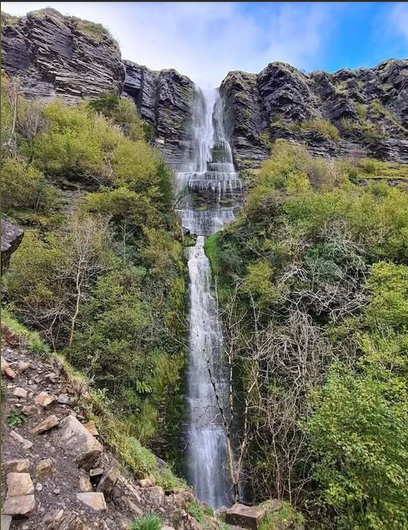
There is a waterfall on the Sligo–Leitrim border that most people who photograph it have never actually seen. What I mean by that should become plain shortly. It cascades nearly five hundred feet off the limestone edge of Kings Mountain — the Benbulben massif — down into the Glencar valley. Perhaps the highest waterfall drop in Ireland. On a still day it is a thin white thread. But when the wind comes up the glen from the south-west and strikes the scarp, it catches the falling water and drives it back up over the lip, so that the stream appears to climb the cliff it is falling from. The water runs the wrong way.
That is not a trick of the light. It is the thing the place is named for.
Its name — its only real name, and until very recently its only name of any kind — is Sruth in Aghaidh an Aird. Literally, the stream against the height. But, the phrase in aghaidh an aird is an old idiom for something running upstream, backwards, against the current. The Electronic Dictionary of the Irish Language records the phrase plainly: anaghaidh aird, “uphill”; and glosses a line about the river Jordan turning in its course — a n-aghaidh áird — as “flowed backwards, up-stream.” So the name resolves, without much strain, to the stream that flows backwards. It is a precise folk-observation of an anomaly, fixed in speech. You have to earn the sight of it — wait for the right wind, in the right season, and look. Most people miss it. The name is the reading that a patient eye, over a long time, arrived at and passed on.
You can now find this waterfall on signposts, on the county’s tourist pages, on a thousand phone screens, under the name the Devil’s Chimney.
That name is not old. That name is not a translation. That name did not exist before December 2016.
A name that was never rendered into gibberish
To see what has actually happened here, it helps to distinguish three quite different operations that the last four centuries performed on Irish placenames. They are not the same.
The first is translation — Irish into English, meaning carried across. It is rare, and it is comparatively benign: the content survives the crossing even when the sound does not.
The second is anglicisation — the Irish rendered into English phonetic gibberish, the meaning destroyed, but a trace of the sound left behind. Sligeach becomes Sligo. Cúil Irra becomes Coolera. The word is disfigured, but a thread remains: you can work back along the sound to the body of the original. This is the operation that fell on very nearly every name in the county in the nineteenth century, most systematically through the Ordnance Survey. It is a partial glamour — a disfigurement but recognisable.
The third is fabrication — the Irish name discarded whole, a new English name invented in its place, and false content installed where the reading used to be. No sound survives. No thread. And, characteristically, a phantom meaning is fitted over the gap so that the absence does not show.
Sruth in Aghaidh an Aird had survived the second operation entirely. It was never anglicised, never mapped into gibberish, never flattened. It kept both its Irish form and its meaning, intact, into the twenty-first century — one of the very last prominent features in the county of which that could be said. (This is the sense in which it is “the last”: not that no other Irish name survives in speech, but that this was among the last major, visible landmarks whose name had never been mapped, translated, or mangled — it remained live, meaningful Irish.)
And then, having escaped anglicisation for four hundred years, it was subjected to the most total of the three operations — fabrication — in living memory. In 2016.
The manufacture of a name
The name the Devil’s Chimney appears to enter the record with a video uploaded to YouTube in December 2016.
From there the sequence is ordinary. A walking-trail listing adopts the new name. The county’s own tourism material carries it. Signage goes up. Each step is individually unremarkable — a trail needs an English signpost, a marketing page needs a title that pays off, a sign follows the path already worn by the ones before it. No single act in the chain looks like an erasure.
And note what the new name does, beyond replacing the old one. “The Devil’s Chimney sounds dramatic, and it is.” It invents a folklore. It implies a local belief — that the people of this valley looked at this cliff and thought of the devil, named it for him, carried some association we might now recover.
Ask what that association was and the answer is: nothing. There was no such belief. The rising spray read as a chimney’s smoke, a devil supplied to furnish the chimney, and a piety back-projected onto people who never held it. The fabrication does not merely empty the slot. It manufactures a false depth to fill it — a heritage-shaped object where the heritage used to be. And the phantom is satisfying: it feels like folklore, so nobody enquires whether it is.
Why it survived, and why it was vulnerable
The obvious question is why this one name, alone, survived the nineteenth century intact —
It survived because it was obscure. It was never on a map. It was a thing of local knowledge, pointed out to visitors sometimes as the place where the water flows backwards — a gnomic puzzle, a wonder you had to be shown and then had to wait to see. Its visibility to officialdom was low precisely because its meaning was conditional: the anomaly only appears in the right wind, and a surveyor passing on a calm day would see nothing to record. Hidden in plain sight, it slipped under the machinery that mangled every name it could actually catch hold of. Obscurity was its shelter.
And obscurity is what it lost, all at once, in December 2016. The video, the trail, the signage made it visible — and visibility is what took it.
The Poem
Eochaidh Ó hEoghusa, writing of the whole territory of Sligo around 1600, built his case on a single counter-intuitive idea: Not that Sligo is poor, but that Sligo’s wealth is the cause of her destruction, that she is taken because she has something to take, that her fertility is her wound.
Mairg dhi nach díthreabh ndocra nó cairge chuas bhfaolchonta
Woe to her that she is not a harsh wilderness, or wolf-haunted hollows of rock.
She would be better off, the poet says, if her banks were rough, her plains covered in heather, her fields worthless. Because then nobody would come for her.
He puts the covetous look and the spear-point under one word — renna — so that to be seen and to be struck are the same act. Sáithid Gaoidhil is Goill … renna a rosg: they drive in the points of their gaze.
Sáithid Gaoidhil is Goill Bhredh renna a rosg, rún a gcroidhe
Gaels and Foreigners of Bréifne drive in the spear-points of their gaze and the desire of their hearts.
The name obeyed that law exactly. The property that made it worth stealing — its vivid, brandable, share-able wonder — is the very property that had kept it safe for four centuries by keeping it off the map. Spared by obscurity; destroyed by exposure. Once seen, it was taken. As it was in the 16th century, so is it now.
Where the Danger Comes From
Quatrain 16: eang as goimhemhla um ghort Bhréifne — the tract that smarts most at Bréifne’s tilled field.
That is a specific, secure claim: the most painful zone is the arable margin adjoining Bréifne, to the east. It is not, on its own, a claim about who is causing the harm — only about where it lands.
The poem opens by placing Sligo tar chrích Bhréifne, “beyond the land of Bréifne” (q. 1) — but this is best read as simple positioning, the kind of landmark-reference common in bardic geography, rather than an accusation. Ó hEoghusa was a Fermanagh poet, writing for a Fermanagh audience; Bréifne is the territory an audience at Maguire’s court would already know, lying between them and Sligo. Naming it locates Sligo. It does not, by itself, indict it.
One further quatrain may name Bréifne as the direction from which a mixed force strikes — Sáithid Gaoidhil is Goill Bhréifne, “Gaels together with Foreigners drive at Bréifne” (q. 8) — but this line’s reading is still unsettled; the word could equally be bréid, a border-strip, describing the object of the attack rather than its origin. Until the manuscript is checked, this cannot be used to build a case.
What can be said with more confidence is that the danger, wherever exactly it originates, is routine:
Quatrain 17: do ghuasacht do ghnáthaimsibh — danger in ordinary seasons.
Not the noise of one campaign. An endemic condition.
And the poem is unambiguous, three times over, that the sea stands outside this danger entirely. The wave (q. 2) endures gan tnúth, without envy. The land (q. 17) is ar nach tóir tonn, a place no wave assails. The territory (q. 42) is tonn-mhaoineach, wave-wealthy. Whatever harms Sligo, it does not come from the water. It comes from the land.
That much is secure: Sligo’s wealth is maritime and safe; her wound is landward and to the east, centred on the Bréifne march.
The principal overland route from Dublin and the midlands into Sligo runs along the southern edge of Bréifne, through the country around Carrick-on-Shannon, before crossing into the Sligo lordship. Anyone campaigning against Sligo from the east or from the centre of English administration — Crown forces most of all — would in practice arrive by way of Bréifne, whatever their actual origin or allegiance. If that is right, “Bréifne” in the poem may function less as an accusation against O’Rourke’s territory and more as a direction — a way of naming the corridor a threat travels through, which lets the poet locate the danger precisely without having to name, or risk naming, whichever power is actually sending it. Bardic poets had good reason to avoid naming the Crown outright in a poem of this kind; naming the road it travels solves the same problem.
That reading is attractive and it would explain why Ó hEoghusa — writing in a period when O’Donnell, the Burkes, and Crown forces under Bingham were all live threats to Sligo — settles on a single place-name rather than an enumeration of enemies. But it is an inference about the poem’s method, not something the text states, and it should be held as such until the addressee is dated and the actual campaigns active against Sligo in that year are checked against it, something ive not quite finalised yet.
The third thing: the landscape itself
Here is where the poem becomes something different from what some modern readers expect a bardic poem to be ( the few that get this far !). Ó hEoghusa is describing a real place, in vocabulary that turns out to be observationally precise.
The hills are limestone. The slopes are aol-chorcra, lime-purple: white stone and heather in the same phrase (q. 6). The cliffs are all gruaidh-fhliuch, “wet-cheeked” — streaming with water down their faces (q. 22). The summits are maoilinn, bald and rounded (q. 10). There are hollow caves in the rock (cuas, qq. 4, 6). Anyone who has stood at the base of Ben Bulben in wet weather knows exactly what he means. This is Dartry limestone, described from life.
The woods are hazel on that limestone. Call (q. 7), craobh (q. 7), fedh (q. 6), fiodhbhaidhe (q. 9), grian-fhiodh — a “sunlit wood” (q. 22) literally “sun-wood”. The ecology is coherent: hazel-dominated scrub with open, lighter stands, growing on thin soil over limestone. It is the same vegetation still recorded in the Sligo lowlands.
The hydrology is karst. The poem gives Sligo an epithet, tirm-shreabh, “dry stream,” and uses it three separate times (qq. 3, 5, 39). At the same time it describes her uplands as braontana, dripping wet (q. 25). Rain-drenched hills, streams that run dry: those two things are only paradoxical to a reader who does not know limestone country. On karst, rainfall is heavy, infiltration is rapid through fissured rock, and surface streams sink and reappear. The poem is describing sinking streams, and it does not know that it is. It is simply reporting what the poet or his informants saw.
Intriguingly, Ó hEoghusa’s poem is not describing Sligo in general. Its landscape vocabulary almost certainly describes this escarpment. He speaks of the all gruaidh-fhliuch — the “wet-cheeked” cliff, the rock-face streaming with water down its front (q. 22). He places the danger on the bearna fuara a himeall, the cold passes on the margin, the very rim of the territory (q. 23). He calls the uplands braontana, dripping (q. 25), and the slopes aol-chorcra, lime-purple, white stone and heather in one word (q. 6). And he locates the tract from which the danger comes um ghort Bhréifne — at Bréifne’s tilled field, the landward eastern edge (q. 16). Wet-faced limestone cliffs; cold passes on the border; dripping karst summits; the wound on the Bréifne march. That is certainly the Dartry scarp above Glencar, and it is the boundary this waterfall marks.
The harbour is articulated in detail, in three tiers. Rian bairc, the ship-lane (q. 22). Ethar-ród, the boat-road — the navigable channel (q. 6). Rian caol-eathair, the small-boat lane (q. 12). These are three distinct water routes for three distinct hull types. A poet does not distinguish three vessel-classes by route unless the depths actually differ. The estuary at Sligo will bring ships of about three metres draft; the outer bays and side channels are shallower. Ó hEoghusa’s vocabulary maps that gradient. And ethar-ród is a personal coinage of his — the only attestations known are in this manuscript, both by him, nine folios apart. The standard dictionary of Old and Middle Irish tentatively gives it as “of swift boats”; on the evidence of the two attestations and their contexts, that is almost certainly wrong. It means boat-road: a channel navigable by working vessels.
The uplands carry flocks. Benn n-eltach, flock-bearing peaks (q. 5); gorm-eltach, green-flocked (q. 24). Summer grazing on the summits. Booleying is not being invented in the eighteenth century; it is in the poem.
And the settlements have towers, walls, ditches, and grain stores. Tuir corra, tapering towers, thrown down (q. 10). Tuir shoillse, bright towers, empty (q. 11). Múr, walls (q. 2). Cladh, an earthen bank (q. 11). And most concretely of all, iothlonna, corn-yards or haggards, set on fire (q. 10). The iothlann is the bulk grain store. To burn it is to convert a raid into a famine, and the poet knows this and lists it in the same breath as the towers.
None of this is stock. Or rather: some of it is drawn from the standard bardic lexicon, but the combination is not, and the accuracy of the combination against the actual landscape is remarkable. This is a poet describing a place he has looked at.
How the harm is done
Do tresgradh a tuir chorra do hadhnadh a hiothlonna do bhán glaise a griamhadh slim do siabhradh maise a maoilinn.
Her tapering towers were thrown down. Her corn-yards were set alight. The green of her sunlit slopes was blanched. *The beauty of her bare summits was bewitched.
The first two lines are what a raiding party literally does. The third line escalates to the wider landscape — pasture, streamlets, ground colour. And the fourth line does something odd: the summits, which cannot be burned or thrown down, are siabhradh — glamoured, enchanted, made spectral, made uncanny.
Siabhradh is a strong word. It is not decay. It is not decline. It is the transformation of a thing’s aspect into something not-itself, something eerie. And the poet uses it here because the hills, being indestructible, could not be attacked in the ordinary way — so what was done to them was done to their appearance.
Note that word, siabhradh, It is going to be useful.
The poem then does something unusual in a bardic poem. Two-thirds of the way through, Ó hEoghusa takes twelve full quatrains — nearly a third of the whole work — and retells the story of Penelope and Odysseus.
Here he lays out his argument by analogy.
Odysseus returns to Ithaca after twenty years, disguised by Athena as a beggar. Nobody in the palace recognises him. Even Penelope, his wife, does not know him. She had reckoned him dead. She was reasonable to have reckoned him dead; twenty years is good evidence. Her error is not stupidity — it is conclusion.
nír aithin é acht go hionmhall fedh a ré re ces cumhadh do mheas gan é d’aontughadh.
She did not know him, and then only slowly. Through her whole life, under grief’s affliction, she had reckoned there would be no reunion.
Meas – a judgement — she had assessed, judged, concluded. And having concluded he would not return, she could not see him standing in front of her. The problem is not that Odysseus has been destroyed. He has not. The problem is that he has been rendered unrecognisable — and the person who most needs to recognise him has already, on good evidence, concluded that he is gone.
The poet describes something subtle but powerful, you cannot see what you do not look for. That your opinion or belief aboiut something often dictates how you see it. One of the most powerful tricks of imperilaism was to alter the names of the territories it invaded. And this act of renaming would both alienate the natives, rendering the familiar unrecognisable. and make the land amenable to exploitation by the incoming system.
But the poet has a solution..
The poem is quite explicit that recognition, when it eventually happens, has three parts, in order. First fiosrú: someone has to ask. Second éisteacht: someone has to listen to the thing itself, not to reports of it. Third aithne, knowing, which comes slowly slowly (go hionmhall): recognition is laborious and gradual, not a flash. And only then does anything follow.
The corresponding failure is stated flatly at q. 35:
nír fhiosruigh, ‘s nír aithin
they did not enquire, and they did not recognise.
The failure to recognise is preceded, in the syntax, by the failure to enquire. Nobody asked. They walked past him because they had already reached their conclusion, and having reached it, they never posed the question that would have overturned it.
What cannot be carried off is changed instead
Taken, though, is not quite the right word for what happens to a waterfall. The renna describes the taking of things that can be taken — cattle, grain, worked and defended land. But a waterfall cannot be carried off. Five hundred feet of falling water on a cliff of Dartry limestone is not portable, not burnable, not destructible by any raid. And this is precisely the case the poem reserves its strongest word for.
In Ó hEoghusa’s catalogue of what was done to Sligo, the summits come last, and they are handled differently from everything else. The towers can be thrown down; the corn-yards can be burned; the pastures can be blanched. But the bare summits — maoilinn, indestructible — cannot be attacked in any of those ways.
So what is done to them is done to their appearance: do siabhradh maise a maoilinn, “the beauty of her bare summits was bewitched” (q. 10). Siabhradh is the poem’s word for the operation performed on what cannot be destroyed. It is not decay and it is not decline. It is the changing of a thing’s aspect into something not-itself — glamoured, made spectral, made uncanny. When the substance is invulnerable, the operation moves to the countenance.
That is exactly the operation on the waterfall. The water cannot be taken, so the name is changed — and the name is the countenance, the aspect under which the thing is known and reached. “Devil’s Chimney” is a siabhradh in the poem’s precise sense: an uncanny, demonic guise laid over a feature that could not otherwise be touched, or in modern terms, could not be commercialised.
Sligo has been made unrecognisable, exactly as Odysseus was made unrecognisable.
.In Ó hEoghusa the siabhradh is an act of malice — a thing done to a territory by its enemies to disfigure what they could not destroy. In 2016 it is an act of commerce. Here the enchantment is not the end of the operation; it is the enabling first move of an appropriation. You cannot sell a five-hundred-foot cliff. But you can change its countenance — enchant the un-sellable landscape feature into a branded product — and the branded product can be sold, indefinitely, to everyone who arrives to photograph the devil. The siabhradh is what converts the immovable into the monetisable. Enchant first; then take.
This is a synthesis of the poem’s two ideas: it welds the renna — the covetous gaze that takes what it covets — to the siabhradh — the changing of what cannot be taken . The poet kept them apart, one for the moveable wealth and one for the indestructible hills. The marketer joins them. What cannot be carried off is first changed in its aspect, and once changed, it can be sold.
That is the poem’s central argument. What Domhnall mac Cathail is being asked to do is not, in the first instance, to fight. He is being asked to recognise. Q. 14, the hinge of the whole poem, says outright that Sligo’s problem is not that she has no champion. Her problem is that she has no fer a hégcaoine d’éisteacht — no man to hear her lament. The requital, when it comes (qq. 37–38), follows recognition automatically: Penelope speaks only after Odysseus is known; Odysseus strikes immediately after Penelope has spoken. The whole crisis is epistemic. Force is downstream of aithne.
That is a sophisticated piece of thinking about how a place is lost. It says: a territory can be so disfigured — physically, politically, semantically — that even those who ought to know it do not; and the recovery of the territory begins not with an army but with someone asking what it is.
The name is a key, but the brandname is just noise
Set the two names side by side as information, and the material core of the case comes clear —
Sruth in Aghaidh an Aird encodes an observation: at this cliff, under certain conditions, water moves against gravity. It is a fact about the behaviour of a specific place, arrived at by attention over time and stored in the name so that the attention need not be repeated from scratch by each generation. It is of a piece with the other precise water-language the same poet uses of the same country: he calls Sligo tirm-shreabh, the place of dry-streams, three separate times, and in the same breath describes her uplands as dripping wet. Rain-soaked hills, streams that run dry — a paradox only to someone who does not know limestone.
On karst, rain sinks fast through fissured rock and surface streams vanish and resurface. The poet reports this accurately; he is simply recording what was seen. In aghaidh an aird is the twin of tirm-shreabh: two folk-readings of anomalous limestone-water, each one true, each one carried in a name.
The Devil’s Chimney, in contrast, encodes nothing. It is a misreading of the same upward spray — the rising mist taken for smoke — stripped of context, stripped of the territory, and refilled with an invented devil. It carries no recoverable observation. It only pretends to. The irony being of course that such a name could not be ancient – because such chimneys simply did not exist in Ireland. And this alone gives it a way as a modern invention, even if the renaming had not been catalogued on the internet.
So the operation is not simply Irish-replaced-by-English. It is a reading replaced by noise dressed as a reading. A name that was an instrument is swapped for a name that is a brand — and the difference is that the instrument required something of you (patience, the right conditions, the earned sight) while the brand requires nothing and delivers its devil on schedule, every visit, in any weather.
That is the deeper reason a marketeer cannot tolerate the true name: a name that only reads sometimes is, to the tourist industry “footfall as god” gaze, a defect to be corrected. The wonder that had to be waited for is re-cut as a product that never disappoints.
What the name holds, and what losing it destroys
It would be easy to file this under trivial vandalism — a signpost, a lost word, no great matter. That underrates what a name of this kind actually is.
Sruth in Aghaidh an Aird is not a label stuck onto a boundary. It is the boundary’s retrieval-key. The waterfall marks the Sligo–Leitrim county line — but the county line is only the latest tenant of a far older division. It follows the ancient border between the tuath of Cairbre Drom Cliabh and that of Dartraighe, the country of the MacFhlannchadha (Clancy), a sept under the O’Rourke of Bréifne. Hanging off the name, reachable through it, is that whole territorial memory: the tuath boundary, the sept, the confederation, and the geographical observation all at once. The name is the index by which every one of those things stays retrievable in ordinary speech.
Ó hEoghusa has a word for the destruction of a store like this. In his catalogue of what a raiding party does to Sligo, alongside the towers thrown down, he lists do hadhnadh a hiothlonna — her corn-yards were set alight. The iothlann is the bulk grain store. To burn it is not to win a battle; it is to convert a raid into a famine, to destroy not the visible object but the means by which life reproduces itself through the coming year. The poet knows this and lists it in the same breath as the towers.
Erasing the name burns the index — the means by which the deeper territorial history reproduced itself in the mouths of the people who used the name daily. The event is small; the famine of memory it produces is not. That is why renaming of this kind should be charted by anyone who takes heritage seriously. It is the modern equivalent of the burning of a grain-store, done quietly, with a signpost.
The Failure of Sligos “Heritage” Sector
There is one institution that has an obligation to prevent precisely this destruction, and it is the heritage function of the County Council. The machine that devours the heritage was set up centuries ago. But the council and its agents have no such escape route.
Its own published best-practice document opens by insisting that “perhaps the most important feature of our heritage is that it is non-renewable and unique,” and lists among its own duties to “provide advice to Sligo’s local authorities and communities on signage and placenames.” Signage and placenames. Non-renewable and unique. The remit could not be more exactly the shape of this case. Sligo County Council not only failed to protect the name, it actively used public money to erase it.
Mistakes are made sometimes, but when confronted with this there is a stony silence. The council, its heritage officer, and its public advisory committees, such as the PPN committee on placenames, have not shown any interest in enforcing their own stated objectives, and have instead, through silence, become the agents of destruction of irreplaceable heritage. And in a manner far more complete than the remapping in the 19th century.
Silence is also the default position of most of Sligos archaeological authorities, whether individuals or institutional who have left it up to the public alone to take up the issue.
Against that remit, two facts. The county’s signage now carries the fabricated name. And through years of petitions, radio phone-ins, social-media argument and direct complaint, the council has issued no statement whatsoever on the matter. This is a very serious failure of the council, its heritage function and archaeology in Sligo.
I report that silence as a fact, because it is one. The silence is the evidence. The evidence is unanswerable: nír fhiosruigh, ‘s nír aithin — the poet’s five-word diagnosis of how a thing is lost.
They did not enquire, and so they did not recognise.
Here it is nearly literal. The name that went onto the signs was not asked-after; it was sourced, at one remove, from a video and the mistaken belief that the waterfall had no name. Nobody posed the question that would have overturned it. And having not asked, they could not recognise what was already there.
In the poets diagnoses, They cannot see the land.
Epilogue
Against the current
There is a last thing..
This poem that gives us the tools to read this erasure is built, at its centre, on the return of Odysseus — the man who comes home unrecognised and must be slowly, laboriously known again before anything can be put right.
The word Ó hEoghusa uses for that homecoming is frithing (q. 30): a word meaning the counter-motion, the going-back, the retracing of a path home. The whole nostos (longing for home)of the Odyssey is a frithing. And the concept echoes the name being erased — in aghaidh an aird,, the going-back-against made visible in falling water.
The poet asks for a counter-motion that restores what was lost
So let this essay be what the poem asks for and what nobody yet supplied. The fiosrú: someone, asking what the place is called. The éisteacht: listening to the thing itself and what it tells us — the record, the water — rather than to the report of it on a signpost. And the aithne will come as it always comes, go hionmhall, slowly, against the current.
The name was never destroyed. It cannot be. It was only made unrecognisable by the councils imposition of its siabhradh, and that is a condition with a cure.
The stream still flows backwards.
This is a working document, not a finished one. Corrections, and especially the pinning-down of the first-appearance date and the scope of the “last untranslated name” claim, are welcomed — the piece will be better for them. The full documentary timeline, with the search-and-fail record and the council correspondence, is set out separately.
- Place
- Sligo
- Field
- History
- Form
- Essay
- Series
- Understanding Sligo